Category: Douglas Rushkoff

  • Save our rivers

    Save our rivers

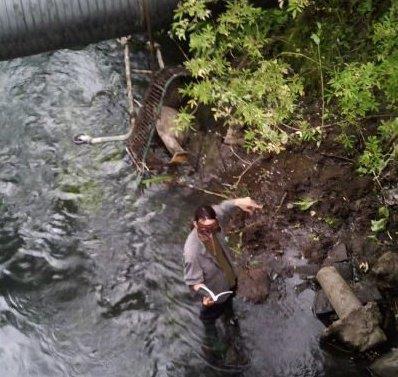
    My first dive into UK politics (besides protesting the closure of some local swimming pools) was on my return to Stourbridge, after 5 years living in America. I was drawn to the river Stour, which the town lends its name. On my first trips down the Stour in October 2005 I noticed some nasty looking rusty-coloured liquid coming out of a small but significant pipe, plus various foam formations where the river picked up pace. This is all besides the bicycles, car tires, and shopping trolleys, littering the river. Perhaps I was more sensitive to this, as I’d just been swimming in the feather river, Lake Tahoe, Pyramid lake, and dozens of other waters while in America. All crystal clear, inviting and beautiful.

    The river stour is beautiful, don’t get me wrong, it just depends on the distance you are from it when making such an observation. You really have to get in there to know what’s going on. Analyze the water, run tests and perhaps try a small glass, see what happens. I’m kidding, do not drink a glass of Stour water, it’s mucky and you’ll be on the bog for a wik.

    So here I was, back in town, after a remarkable American adventure. And I’m full of the spirit of protest and confidence, what can I do? I didn’t have a job, had just rented a room, and was at a loose end. I decided to begin a campaign to clean up the river Stour. I took a crappy video camera and got some footage of the river, together with some shots of Stourbridge, and edited it together with a tune I’d made using Reason software. (see blurred video below)

    I made several phone calls to Severn Trent Water Authority, the Environment Agency and the local rivers and canals organizations, trying to find out who I need to talk to about the probable pollutants running into it, and the litter strewn through the relatively small section of river leading from Lye to Stourbridge (approx 2-3 miles of river).

    Remember that in 2005 it was still a Blair Labour government, whom I was generally speaking, furious and angry at, for dragging us into the so called “War On Terror” with George Bush Jnr. However, in a moment of clarity, I decided to reach out to the local MP for Stourbridge, at that time, Linda Walthrow. I arranged a meeting and turned up at the church in Wollaston to put myself out there. I was unemployed at the time, claiming housing benefits and living rather frugally to say the least.       

    I asked the MP to supply me with some equipment, waders and a hook, so I could become the official custodian of the river…if…I was to clean it up. I also turned her onto a white paper by a media theorist, writer, Douglas Rushkoff, the paper was titled Open Source Democracy. 


    I can’t help but wonder how different things would be if she would have read and understood and shared this document with all of her Labour party, at that point. The coming Digital Revolution, seemed to me to have been highly weaponized by the Conservatives and the right, taking the left off guard and leading to the 14 years of monstrosities and abominations in the UK. Partly, made possible by the digital media landscape and print media landscape domination. Russian interference? I digress.

    I never got my waders of a hook, or a response by email. So I went ahead and started some projects anyway, some of which are documented in film and photographs. This project, started from the river Stour, has expanded and stayed with me on my subsequent travels to Europe. I don’t consider myself an environmentalist or even an activist, for me this was research into poetry and art. Where I pitch my tent. As much as I see the benefits and I admire professional card carry environmentalists, I did not wish to join any political party or movement. I wanted people to see me doing this for another reason, my own selfish reasons.


    My campaign was a success, in as far as I got a print media story, and photograph in the local Newspaper, where I was misquoted but pretty fairly represented as saying words to the effect that, if the government isn’t going to do it, then I’ll do it, look. Trying to draw attention to the issue. Look at the state of the river the town is named after, littered literally with shopping trolleys. What better metaphor for our consumer technology boom of the mid to late noughties? Who cares about the river, fill that trolly up!

    Jump forward nearly 20 years, and Britain’s rivers, waterways, lakes, seas and canals have been repeatedly, perhaps purposefully, polluted with waste sewage water. Meanwhile the major UK Water companies have been enjoying a financial bonanza, profiting from mismanagement, deregulation and the aroma of unaccountability. But no longer. This is coming to a dam. And we have a new chance to re-green and re-clean our waterways, with a different UK government. Once again, we pick up from where we left off, be the change. Turn the tide.


    Feargal Sharkey has become the face and voice of the campaigns to save UK rivers, and lakes, and the sea, and hold those responsible for their decline, to account. I wish him every success, together with George Monbiot and everybody else pushing the good vibes.


    https://www.cpre.org.uk/stories/feargal-sharkeys-mission-to-protect-englands-rivers-and-streams/

    Steve Fly and John Sinclair at Red Light Radio.
  • Douglas Rushkoff Rocks The Google Bus

    Douglas Rushkoff Rocks The Google Bus

    Douglas Rushkoff is one of those rare writers and friends. He can ask big gnarly questions, and then before you know it, present a buffet of solutions that leave you with a ravenous appetite to dig into the future.
    In Program or Be Programmed, Rushkoff made the compelling case for the need for all of us to be programmers. Choose to program and “you gain access to the control panel of civilization. Choose the latter, and it could be the last real choice you get to make.” Yikes, I read that and immediately went to use my limited HTML skills on my nascent website.

    Despite my admiration for his past work, I approach his new book with some trepidation. I guess I thought Rushkoff was going to be the one throwing rocks. Nope. I should have known better. Rushkoff is always more complicated than that. 

    In Throwing Rocks At The Google Bus, Rushkoff begins with some powerful truth telling. 

    The digital economy is breaking things. The media can’t seem to survive digitization. Drivers are losing to Uber. Airbnb is turning neighbors apartments into rentable dorm rooms, and as he lays out the current state of play – event tech visionaries find the demands of the startup economy closing their vision.

    But Rushkoff isn’t claiming Google GOOGL -1.03% is at fault. He says: “there is something troubling about the way Google is impacting the world, but neither it’s buses nor the people in them are the core problem; they’re just and easy target. He says we’ve brought a set of industrial age. “We are running a 21st-century digital economy on a 13th Century printing-press era operating system,” writes Rushkoff. 

    Now it’s not all bad. “On the bright side, millionaires and billionaires are being minted, maybe not enough to compensate for the millions of people being displaced, from their jobs, but they are inspiring just the same.”
    Looking for an example, Rushkoff settles on Uber, and he takes on the company with relish. “By calling itself a platform rather than a taxi dispatcher, Uber has been able to work in a regulatory gray area that slashes overhead while inflating revenue. This is how Uber can be valued at over $18 billion dollars while many of its drivers make below minimum wage after expenses.”

    The crux of the argument that Rushkoff makes is that the digital economy is a house of cards built on fictional growth metrics that drive companies to raise money, undercut human workers, sell on the public markets and then – almost inevitably – collapse under the weight of public market demands. And he’s not alone in his concern. Quoting Union Square Ventures founder Fred Wilson, the book shares Wilson’s blog post. In it Wilson “worries aloud that digital entrepreneurs are more focused the increasing monopolies and entreating value than they are on realizing the internet potential to promote value creation by many players.”

    Growth, it turns out, may be an illusion. “If infinite growth is no longer a possibility or even desirable, then you must shift your sights away from the big “win” in the form of an IPO, acquisition or growth target” writes Rushkoff. “Think of it less like a war, where total victory is the only option, and a bit more like peace, water eat objective is to find a way to keep it going.”

    The core message of the book is that the current state of play in funding, driving, and exiting digital companies is unsustainable. And to bring that point home, Rushkoff shares his stories of  Ventureless Capital: the Patience of the Crowds. His example is a good one – his friend, and mine, Scott Heiferman. Heiferman founded Meetup after selling his first startup at the hight of the dot-com boom. Meetup aims to be a civic platform rather than a platform monopoly. “We’re not trying to vertically/horizontally integrate or get into news busses or invent self-driving space elevators. We know what business e want to be in, it’s a big opportunity and we don’t see ourselves and empire-building imperialists.” Meetup aims to be Meetup, and to grow that business – a perfect Rushkoff example.

    In Throwing Rocks at the Google Bus, Rushkoff calls on business to:
    • Accept that era of extractive growth is over. 
    • Reject platform monopolies like Uber in favor of distributed, worker-owned co-ops, orchestrated through collective authentication systems like bitcoin and blockchains.
    • Resist the short-term, growth-addicted mindset of publicly traded markets.
    • Recognize contributions of land and labor as important as capital, and develop business ecosystems that invest in the local economies on which they ultimately depend.

    “None of us can wave a magic wand and transform the economy from an extractive endgame into a prosperous commons,” writes Rushkoff in his conclusion. “However, I do believe we can reposting our careers and our businesses to become less a part of the problem than participants in the solution. There’s a lot of hope here.”


    Steven Rosenbaum is serial entrepreneur, author, and filmmaker. His latest book, Curate This! is in print and ebook on Amazon.com. He is the CEO of Waywire.com (enterprise.waywire.com)

  • Pull the Cosmic Trigger. Pull It. Pull It.

    Matt Black – Cosmic Trigger crowdcapering appeal by Complexity Productions

    Jim Broadbent – Cosmic Trigger crowdcapering appeal by Complexity Productions Douglas Rushkoff – Cosmic Trigger crowdcapering appeal by Complexity Productions The Cosmic Trigger Play – A taste of Alan Moore by Complexity Productions Cosmic Trigger Play Indigogo Crowdfund https://www.indiegogo.com/project/cosmic-trigger-play/embedded