In London, on my last visit next to Victoria station sits a square glass metal and mirror area with a few shops and some offices The mirrored object presented a great chance for a pano’ love, steve fly http://www.360cities.net/embed_iframe/flight-of-the-navigator
Flight Of The Navigator in London
Category: fly agaric 23
-
360 Panorama Flight of the navigator
-
shape spacestation mission schedules by shunning election machine pressures
Do not despair,
there are words to put your hair on end
tip top tailored trips to smooth out
and curl the end of the world into a Bob.Recorsi, the eternal returnsche
cosmo-constantly
bring a bitter lightstretch the imagination to its limit.
to make the tale true enough
comeback, the field ofthought
emerging again, amplified once more
make it newshape spacestation
mission schedules by
shunning election machine
pressures -
Facestuck
Facestuck by Steven James Pratt (3/08/12)
1.
Oh my god, those faces all literally glued to the screen, right across the planet, literally super-glued to the glass plasma crystal screens, unable to move. Eyes look sideways in terror at the images playing in front of them. Gangs of pixels assemble together in self-organized configurations: the words ‘Cheeky mouthy idiots’ repeated in endless fonts and colours. The images of others also stuck to the screen.A few brave idiots in the initial panic of finding their face stuck to the screen pulled themselves off, leaving a good part of their face still stuck to the screen like a rare pork chop. Many of these people died as a result of their injuries, and some remained still half stuck to the screen, yet with mutilated mouths and bits of flesh dangling around the chin that made eating exceedingly difficult.
“Next the phones, engage.” A voice said.
All mobile phones around the world were now stuck to their users face and the ear in particular, plus the original phone call was interrupted with a voice repeating the word ‘yes’. Scenes of equal chaos and horror soon followed, enhanced by the images from any camera relaying live feeds, broadcasting the distressed individuals pain and anguish between the literally billions of victims.
2.
Some proposed the facestuck virus acted upon the carbon 60 molecule, triggered by certain vibrations quickly developing a highly dangerous and sticky surface, impossible to part from organic materials such as skin once contact is made. Grafting, which results in a permanent scar is a necessary process, but due to the Billions of victims many have spent decades with their devices stuck to their faces and ears.An underground black market arose in cheap surgical….
-
21/12/2012: The end of capitalism starting with Coca Cola
The recent news from Bolivia, concerning their decisions to kick out the coca cola company due to violence, corruption and unrestricted finance capitalism, makes me sit up and listen and engage once again with the 2012 phenomena.
Here we have the kind of tipping point that could begin a new era of corporate responsibility and humanity waking up to the horrors of unrestricted finance capitalism and discovering ways to say no, and kick out the culprits from theor community and/or country, protecting the citizens from any nefarious impact and damage, such as that damage Coca-Cola have, to South America in particular, but the entire world and it’s citizens generally.
Fly Agaric 23 retains a special symbiotic relationship with coca-cola and the coca-cola company, and a special symbiotic relationship with Father Christmas. Both of these mysterious western capitalist phenomena employ the ‘red and white’ color scheme, as does the ‘fly agaric: Amanita Muscaria mushroom. Take note. Fly Agaric grows without charge in the wilderness of natural abundance. Father Christmas and Coca-Cola require a multi Billion Dollar all-around-the-world system of propaganda, lies, deciet and promotional campaigning to keep up their mythological capitalist show.
I represent this news from Bolivia, and hope to help volley the message far and wide. I have added a description of Belching out the Devil by Mark Thomas, for some further insight into the coca-cola curse. Peace, steve fly agaric 23 (acrillic)
Amsterdam, Sensi Empire (2/8/12)
“Bolivia Set To Banish Coca-Cola To Mark Mayan End Of Capitalism
For most Americans, Bolivia is a third world South American country last robbed by Butch Cassidy and the Sundance Kid. However this impoverished nation is making headlines due to its Minister of External Affairs recent announcement that the Coca-Cola Company, one of the world’s largest corporations, is to be booted out of there by year’s end.
David Choquehuanca, the minister in question, explained that Coca-Cola will be expelled from Bolivia on the same day that the Mayan calendar enters a new cycle–December 21. According to Choquehuanca, the date marks the end of capitalism and the start of a culture of life in community-based societies. In order to celebrate that, Bolivia’s government is already planning a series of events that will take place at the Southern Hemisphere’s Summer Solstice on La Isla del Sol, one of the largest islands in Lake Titicaca.
“The twenty-first of December 2012 is the end of selfishness, of division. The twenty-first of December has to be the end of Coca-Cola and the beginning of mocochinche (a local peach-flavored soft drink),” Choquehuanca told reporters at a political rally for Bolivia’s president, Evo Morales. “The planets will line up after 26,000 years. It is the end of capitalism and the beginning of communitarianism,” he added.
It’s already been rumored that Venezuela’s president, Hugo Chavez, will follow suit, encouraging his country to ditch the American beverage for soft drinks produced locally.
It’s curious that Bolivia decided to forbid Coca-Cola in its territory, considering that one of the soft drink’s main ingredients is said to be coca extract (Coca-Cola refuses to confirm that, saying that this is part of their secret formula.) — http://www.forbes.com/sites/andersonantunes/2012/08/01/bolivia-set-to-banish-coca-cola-to-mark-mayan-end-of-capitalism/
“But it’ll make zero difference to Mark Thomas’s tireless campaigning. Stand-up comic turned agent provocateur and writer, in his latest book Belching Out The Devil, Thomas travels the world to expose the flaws of the Coca-Cola business system: a bottling plant in Colombia where trade unionists are routinely murdered by paramilitary death squads, child labour in fields surrounding a sugar mill in El Salvador and the unfathomable decision of opening a plant heavily reliant on water in an area of India already prone to drought.
The Coca-Cola Company absolves itself of any blame because on paper it doesn’t actually own any of these franchise plants or the independently owned sugar mill. All it does is manufacture the syrup ingredient to make the fizzy pop. “All of this stuff is about Coke’s tentacles and the way it works,” says Thomas. “It draws these lines of demarcation between responsibility.” —http://thequietus.com/articles/00687-coca-colonisation-mark-thomas-on-coke
-
Amanita symbiosis system
As Mushrooms Evolve to Live With Trees, They Give Up DNA Associated With Decomposing Cellulose
ScienceDaily (July 18, 2012)
“…if you’re going to actively form a cooperative relationship with a tree, you probably shouldn’t simultaneously be trying to break it apart and eat it. But it’s a very tricky dance to form these kinds of tight, cooperative interactions, and I think this work shows there is a cost associated with that. You have to change, you have to commit, and it can become a sort of gilded cage — these mushrooms are very successful…” —http://www.sciencedaily.com/releases/2012/07/120718192047.htm -
NAUGHTIES DECADE 2001-2011
DECADE 2001-2011
Table of Contents
INTRODUCTION
Hi I finally got around to posting this, it’s been hanging around for a while. I hope you’ll forgive my errors, any feedback will be well received.
So friends…which events seem important to you? Which would you choose to define any given period of time? How do you make sense of them, what conditions nurtured them, which human interventions and which natural disasters led to the events you pick?
If we are to make sense and meaning of history, and sanity–a risky endeavour in these times of global Internet but one which any poet worth the name might pursue–then a ‘poem including history‘ of the last decade seems a good place to start to me. (after writing this introduction I learned that Mark Zukenburg and facebook plan to release a ‘timeline’ application that allows for a similar chronological study of events. However History also moves in cycles, and non-chronological spirals, it is of my opinion.
The launch of Wikipedia in February of 2001 has impacted this writing a great deal due to the simple list of some events deemed worthy of inclusion by the Wikipedia commons group, that are made available for all to see and make sense of at your own risk. The risk seems to me to be somewhat reduced when attention is paid to the subjective nature of perception, and to methods such as ‘operational language used by some-but-not-all scientists and ‘E-prime’ and its variants, used by some-but-not-all linguists.
When put Into chronological order it becomes increasingly difficult for me to avoid drawing conclusions based on the ordering, one thing leads to another, or so it seems to a linear oriented mind set. The question remains: which ‘events’ should become pivotal ones and which shall be relegated to the footnotes or relegated all together? How did the author or protagonist come to choose such events based on which values and principle, what ordering system, what right knowledge? How many are justified by later events and how many need revision, considering, let’s say; the Wikileaks exposures of the period 2007-2010, or the News Corp. phone hacking racket?
Silent But Dudley: Black Country Blues
by Mr Steven James Pratt
Link: http://a.co/7KhqHcL

-
ROBERT ANTON WILSON: UNIVERSE CONTAIN’S A MAYBE
ROBERT ANTON WILSON:
UNIVERSE CONTAIN’S A MAYBEDecember 16, 2000, Palm Springs, CA.
Speaking at the Prophets Conference ~ Palm Springs (number 8) held at the Marquis Resort Conference Center.Recorded by Steven Pratt using a portable minidisc recorder. Special thanks to Robert Anton Wilson for encouraging me to record and inviting me to his room afterwards for an exclusive recording and some tasty clandestine reefers.
NOTES:
17th December 2000, Dr. Wilson gave a performance at the Marquee Hotel, Palm Springs, as a part of the Prophets Conference, now (Great Mystery) that marked the second leg of my five year travel excursion around the USA, studying his work and forwarding my own. I hope the sharing of this performance inspires like minded individuals.I was RAWs care-taker during the three days of the conference and helped him around in his wheelchair, opening doors and getting him to his performance on time.
I recorded his presentation on my trusty old mini-disc recorder, that captured hundreds of hours of my American adventures. I only recently found the disc and transferred it to a ‘digital format’ so I can now share the entire show. Please accept my apologies for the sound quality and my sad state or organization that has led to this ten year gap from performance to distribution.
“I had a manhattan with my lunch” –Bob
Bobs performance was amplified for me by the fact that we were sitting together with Paul Krassner and his wife before the gig drinking Manhattan’s and having a jolly good old belly laugh, I think that Bob was a little tipsy going up onto the stage and really let his bullets fly, getting into cock sucking, the Bush Gore election, Bell’s theorem and more cock sucking to hilarious effect. I imagined Bob spiced up his act to impress Paul who was sitting at the front, I must admit that I had to hold back my laughter due to making the recording and not wanting to be chuckling throughout.
In retrospect ‘The Universe Contains a Maybe’ gives an example of RAWs comeback after his first stroke that left him wheel-chair bound, and his first public speech after the now historic turning point in American history, the Florida election and recount, and recount, and recount.
A line that stuck with me from early in his show was ‘…if the United States wasn’t trying to dominate the whole world, we wouldn’t be threatened by Terrorism’ and Bob goes on to reference the first World Trade Center bombing, just nine months before 911, and when I now hear Bobs typically brilliant, erudite and fact-filled spoken prose on ‘foreign policy’ ‘corporatism’ and the ‘Military industrial state’s’ I wish to accent his anarchist pacifism, considering earth 2010 culture, and his general good will to the disenfranchised, the down trodden and innocent victims of Imperialist, and in this case, American greed, ignorance and violence.
“BULLLLSSSSHHHHITT”–Bob.
Add to Bobs 36 books and thousands of unique and ground breaking articles, his spoken freestyle genius and ability to educate and entertain a crowd like no other sit-down comedian (scientific philosopher) who ever lived, and you start to see the distance from the rest Bob was in his prophesy, although, he would probably not use that term, but here, I think it perfectly describes the content of his presentation, only months before something, like something from out of one or two of his fictional epics; became a new reality. 911, the war on terror, more stolen election activity, foreign meddling, and the banking heists, and the continued war on some drugs.
Even with Bob gone we can revisit his wisdom and wit and laugh along with him, at least temporarily, and each time I listen to one of his presentations I feel safer, I feel that the world is a safer place and feel more optimistic about our collective futures, the emergent technology for realizing the hermetic hologram of art, and collapsing the mechanism for centralized control, corporate monopoly and general brainwashing.
Bob wrote on taboo and censored subjects, subjects that still today still only a handful of investigative journalists would touch, perhaps wikileaks? he has been writing about some of the most challenging things to humanity in a caring and yet viral style, for a long long time, ‘things’ that some suspect might get you killed, harassed and just generally fucked with.
“Live with Integrity” –Bob
Bob taught a resilience and intelligence and that its OK to write about anything, really, even the truth, and to always question authority, the scientific, religious and militaristic, the richest and the most-powerful, the ruthless and the criminal, question authority and think for your self, and to live your life as if this is your duty, as a writer, philosopher and scholar activist. Whoever you are, I hope you can pass it on.
Please visit the following links that embody my thanks to those who have helped forward the life and works of Bob. May these recordings find bright future audiences and RAW scholars alike and tickle them.
For more details on this recording please visit my extended linear notes in progress at http://ataleofatribe.blogspot.com/
Love, steve fly
http://paulkrassner.com/
http://www.ep.tc/realist/
http://www.maybelogic.org/
http://maybelogic.blogspot.com/
http://www.rawilson.com/home.html
http://www.greatmystery.org/history.html
http://www.maybelogic.com/
http://ataleofatribe.blogspot.com/
http://raw.maybeee.com/
http://www.myspace.com/rawmemorial
http://rawillumination.blogspot.com/
http://tsogblogsphere.blogspot.com/
http://photosynthesis.com/
flyagaric23
djflyagaric23Released by: fly agaric 23
http://player.soundcloud.com/player.swf?url=http%3A%2F%2Fsoundcloud.com%2Frawmemorial%2Funiverse-contains-a-maybe&secret_url=false Universe Contains a maybe monday by rawmemorial
http://player.soundcloud.com/player.swf?url=http%3A%2F%2Fsoundcloud.com%2Frawmemorial%2Funiverse-contains-a-maybe-1&secret_url=false Universe Contains a maybe tuesday by rawmemorial
http://player.soundcloud.com/player.swf?url=http%3A%2F%2Fsoundcloud.com%2Frawmemorial%2Funiverse-contains-a-maybe-wednesday&secret_url=false Universe Contains a maybe wednesday by rawmemorial
http://player.soundcloud.com/player.swf?url=http%3A%2F%2Fsoundcloud.com%2Frawmemorial%2Funiverse-contains-a-maybe-thursday&secret_url=false Universe Contains a maybe thursday by rawmemorial
http://player.soundcloud.com/player.swf?url=http%3A%2F%2Fsoundcloud.com%2Frawmemorial%2Funiverse-contains-a-maybe-friday&secret_url=false Universe Contains a maybe friday by rawmemorial
http://player.soundcloud.com/player.swf?url=http%3A%2F%2Fsoundcloud.com%2Frawmemorial%2Funiverse-contains-a-maybe-saturday&secret_url=false Universe Contains a maybe saturday by rawmemorial
http://player.soundcloud.com/player.swf?url=http%3A%2F%2Fsoundcloud.com%2Frawmemorial%2Funiverse-contains-a-maybe-sunday&secret_url=false Universe Contains a maybe sunday by rawmemorial

-
What Ever Happened to the Book? (Future Present) Mark Pesce, Chu, Fly.
Mark Pesce – Words.
CHU – Images.
Steve ‘Fly Agaric” – MixingTable of Contents
What Ever Happened to the Book?
Line Steppers / Christy I: Centrifugal Force
We live in the age of networks. Wherever we are, five billion of us are continuously and ubiquitously connected. That’s everyone over the age of twelve who earns more than about two dollars a day. The network has us all plugged into it. Yet this is only the more recent, and more explicit network. Networks are far older than this most modern incarnation; they are the foundation of how we think. That’s true at the most concrete level: our nervous system is a vast neural network. It’s also true at a more abstract level: our thinking is a network of connections and associations. This is necessarily reflected in the way we write.
I became aware of this connectedness of our thoughts as I read Ted Nelson’s Literary Machines back in 1982. Perhaps the seminal introduction to hypertext, Literary Machines opens with the basic assertion that all texts are hypertexts. Like it or not, we implicitly reference other texts with every word we write. It’s been like this since we learned to write – earlier, really, because we all crib from one another’s spoken thoughts. It’s the secret to our success. Nelson wanted to build a system that would make these implicit relationships explicit, exposing all the hidden references, making text-as-hypertext a self-evident truth. He never got it. But Nelson did influence a generation of hackers – Sir Tim Berners-Lee among them – and pushed them toward the implementation of hypertext.
As the universal hypertext system of HTTP and HTML conquered all, hypertext revealed qualities as a medium which had hitherto been unsuspected. While the great strength of hypertext is its capability for non-linearity – you can depart from the text at any point – no one had reckoned on the force (really, a type of seduction) of those points of departure. Each link presents an opportunity for exploration, and is, in a very palpable sense, similar to the ringing of a telephone. Do we answer? Do we click and follow? A link is pregnant with meaning, and passing a link by necessarily incurs an opportunity cost. The linear text is constantly weighed down with a secondary, ‘centrifugal’ force, trying to tear the reader away from the inertia of the text, and on into another space. The more heavily linked a particular hypertext document is, the greater this pressure.
Consider two different documents that might be served up in a Web browser. One of them is an article from the New York Times Magazine. It is long – perhaps ten thousand words – and has, over all of its length, just a handful of links. Many of these links point back to other New York Times articles. This article stands alone. It is a hyperdocument, but it has not embraced the capabilities of the medium. It has not been seduced. It is a spinster, of sorts, confident in its purity and haughty in its isolation. This article is hardly alone. Nearly all articles I could point to from any professional news source portray the same characteristics of separateness and resistance to connect with the medium they employ. We all know why this is: there is a financial pressure to keep eyes within the website, because attention has been monetized. Every link presents an escape route, and a potential loss of income. Hence, links are kept to a minimum, the losses staunched. Disappointingly, this has become a model for many other hyperdocuments, even where financial considerations do not conflict with the essential nature of the medium. The tone has been set.
On the other hand, consider an average article in Wikipedia. It could be short or long – though only a handful reach ten thousand words – but it will absolutely be sprinkled liberally with links. Many of these links will point back into Wikipedia, allowing someone to learn the meaning of a term they’re unfamiliar with, or explore some tangential bit of knowledge, but there also will be plenty of links that face out, into the rest of the Web. This is a hyperdocument which has embraced the nature of medium, which is not afraid of luring readers away under the pressure of linkage. Wikipedia is a non-profit organization which does not accept advertising and does not monetize attention. Without this competition of intentions, Wikipedia is itself an example of another variety of purity, the pure expression of the tension between the momentum of the text and centrifugal force of hypertext.
Although commercial hyperdocuments try to fence themselves off from the rest of the Web and the lure of its links, they are never totally immune from its persistent tug. Just because you have landed somewhere that has a paucity of links doesn’t constrain your ability to move non-linearly. If nothing else, the browser’s ‘Back’ button continually offers that opportunity, as do all of your bookmarks, the links that lately arrived in email from friends or family or colleagues, even an advertisement proffered by the site. In its drive to monetize attention, the commercial site must contend with the centrifugal force of its own ads. In order to be situated within a hypertext environment, a hyperdocument must accept the reality of centrifugal force, even as it tries, ever more cleverly, to resist it. This is the fundamental tension of all hypertext, but here heightened and amplified because it is resisted and forbidden. It is a source of rising tension, as the Web-beyond-the-borders becomes ever more comprehensive, meaningful and alluring, while the hyperdocument multiplies its attempts to ensnare, seduce, and retain.
This rising tension has had a consequential impact on the hyperdocument, and, more broadly, on an entire class of documents. It is most obvious in the way we now absorb news. Fifteen years ago, we spread out the newspaper for a leisurely read, moving from article to article, generally following the flow of the sections of the newspaper. Today, we click in, read a bit, go back, click in again, read some more, go back, go somewhere else, click in, read a bit, open an email, click in, read a bit, click forward, and so on. We allow ourselves to be picked up and carried along by the centrifugal force of the links; with no particular plan in mind – except perhaps to leave ourselves better informed – we flow with the current, floating down a channel which is shaped by the links we encounter along the way. The newspaper is no longer a coherent experience; it is an assemblage of discrete articles, each of which has no relation to the greater whole. Our behavior reflects this: most of us already gather our news from a selection of sources (NY Times, BBC, Sydney Morning Herald and Guardian UK in my case), or even from an aggregator such as Google News, which completely abstracts the article content from its newspaper ‘vehicle’.
The newspaper as we have known it has been shredded. This is not the fault of Google or any other mechanical process, but rather is a natural if unforeseen consequence of the nature of hypertext. We are the ones who feel the lure of the link; no machine can do that. Newspapers made the brave decision to situate themselves as islands within a sea of hypertext. Though they might believe themselves singular, they are not the only islands in the sea. And we all have boats. That was bad enough, but the islands themselves are dissolving, leaving nothing behind but metaphorical clots of dirt in murky water.
The lure of the link has a two-fold effect on our behavior. With its centrifugal force, it is constantly pulling us away from wherever we are. It also presents us with an opportunity cost. When we load that 10,000-word essay from the New York Times Magazine into our browser window, we’re making a conscious decision to dedicate time and effort to digesting that article. That’s a big commitment. If we’re lucky – if there are no emergencies or calls on the mobile or other interruptions – we’ll finish it. Otherwise, it might stay open in a browser tab for days, silently pleading for completion or closure. Every time we come across something substantial, something lengthy and dense, we run an internal calculation: Do I have time for this? Does my need and interest outweigh all of the other demands upon my attention? Can I focus?
In most circumstances, we will decline the challenge. Whatever it is, it is not salient enough, not alluring enough. It is not so much that we fear commitment as we feel the pressing weight of our other commitments. We have other places to spend our limited attention. This calculation and decision has recently been codified into an acronym: “tl;dr”, for “too long; didn’t read”. It may be weighty and important and meaningful, but hey, I’ve got to get caught up on my Twitter feed and my blogs.
The emergence of the ‘tl;dr’ phenomenon – which all of us practice without naming it – has led public intellectuals to decry the ever-shortening attention span. Attention spans are not shortening: ten year-olds will still drop everything to read a nine-hundred page fantasy novel for eight days. Instead, attention has entered an era of hypercompetitive development. Twenty years ago only a few media clamored for our attention. Now, everything from video games to chatroulette to real-time Twitter feeds to text messages demand our attention. Absence from any one of them comes with a cost, and that burden weighs upon us, subtly but continuously, all figuring into the calculation we make when we decide to go all in or hold back.
The most obvious effect of this hypercompetitive development of attention is the shortening of the text. Under the tyranny of ‘tl;dr’ three hundred words seems just about the right length: long enough to make a point, but not so long as to invoke any fear of commitment. More and more, our diet of text comes in these ‘bite-sized’ chunks. Again, public intellectuals have predicted that this will lead to a dumbing-down of culture, as we lose the depth in everything. The truth is more complex. Our diet will continue to consist of a mixture of short and long-form texts. In truth, we do more reading today than ten years ago, precisely because so much information is being presented to us in short form. It is digestible. But it need not be vacuous. Countless specialty blogs deliver highly-concentrated texts to audiences who need no introduction to the subject material. They always reference their sources, so that if you want to dive in and read the lengthy source work, you are free to commit. Here, the phenomenon of ‘tl;dr’ reveals its Achilles’ Heel: shorter the text, the less invested you are. You give way more easily to centrifugal force. You are more likely to navigate away.
There is a cost incurred both for substance and the lack thereof. Such are the dilemmas of hypertext.

II: Schwarzschild Radius
It appears inarguable that 2010 is the Year of the Electronic Book. The stars have finally aligned: there is a critical mass of usable, well-designed technology, broad acceptance (even anticipation) within the public, and an agreement among publishers that revenue models do exist. Amazon and its Kindle (and various software simulators for PCs and smartphones) have proven the existence of a market. Apple’s recently-released iPad is quintessentially a vehicle for iBooks, its own bookstore-and-book-reader package. Within a few years, tens of millions of both devices, their clones and close copies will be in the hands of readers throughout the world. The electronic book is an inevitability.
At this point a question needs to be asked: what’s so electronic about an electronic book? If I open the Stanza application on my iPhone, and begin reading George Orwell’s Nineteen Eighty-Four, I am presented with something that looks utterly familiar. Too familiar. This is not an electronic book. This is ‘publishing in light’. I believe it essential that we discriminate between the two, because the same commercial forces which have driven links from online newspapers and magazines will strip the term ‘electronic book’ of all of its meaning. An electronic book is not simply a one-for-one translation of a typeset text into UTF-8 characters. It doesn’t even necessarily begin with that translation. Instead, first consider the text qua text. What is it? Who is it speaking to? What is it speaking about?
These questions are important – essential – if we want to avoid turning living typeset texts into dead texts published in light. That act of murder would give us less than we had before, because the published in light texts essentially disavow the medium within which they are situated. They are less useful than typeset texts, purposely stripped of their utility to be shoehorned into a new medium. This serves the economic purposes of publishers – interested in maximizing revenue while minimizing costs – but does nothing for the reader. Nor does it make the electronic book an intrinsically alluring object. That’s an interesting point to consider, because hypertext is intrinsically alluring. The reason for the phenomenal, all-encompassing growth of the Web from 1994 through 2000 was because it seduced everyone who has any relationship to the text. If an electronic book does not offer a new relationship to the text, then what precisely is the point? Portability? Ubiquity? These are nice features, to be sure, but they are not, in themselves, overwhelmingly alluring. This is the visible difference between a book that has been printed in light and an electronic book: the electronic book offers a qualitatively different experience of the text, one which is impossibly alluring. At its most obvious level, it is the difference between Encyclopedia Britannica and Wikipedia.
Publishers will resist the allure of the electronic book, seeing no reason to change what they do simply to satisfy the demands of a new medium. But then, we know that monks did not alter the practices within the scriptorium until printed texts had become ubiquitous throughout Europe. Today’s publishers face a similar obsolescence; unless they adapt their publishing techniques appropriately, they will rapidly be replaced by publishers who choose to embrace the electronic book as a medium,. For the next five years we will exist in an interregnum, as books published in light make way for true electronic books.
What does the electronic book look like? Does it differ at all from the hyperdocuments we are familiar with today? In fifteen years of design experimentation, we’ve learned a lot of ways to present, abstract and play with text. All of these are immediately applicable to the electronic book. The electronic book should represent the best of 2010 has to offer and move forward from that point into regions unexplored. The printed volume took nearly fifty years to evolve into its familiar hand-sized editions. Before that, the form of the manuscript volume – chained to a desk or placed upon an altar – dictated the size of the book. We shouldn’t try to constrain our idea of what an electronic book can be based upon what the book has been. Over the next few years, our innovations will surprise us. We won’t really know what the electronic book looks like until we’ve had plenty of time to play with them.
The electronic book will not be immune from the centrifugal force which is inherent to the medium. Every link, every opportunity to depart from the linear inertia of the text, presents the same tension as within any other hyperdocument. Yet we come to books with a sense of commitment. We want to finish them. But what, exactly do we want to finish? The electronic book must necessarily reveal the interconnectedness of all ideas, of all writings – just as the Web does. So does an electronic book have a beginning and an end? Or is it simply a densely clustered set of texts with a well-defined path traversing them? From the vantage point of 2010 this may seem like a faintly ridiculous question. I doubt that will be the case in 2020, when perhaps half of our new books are electronic books. The more that the electronic book yields itself to the medium which constitutes it, the more useful it becomes – and the less like a book. There is no way that the electronic book can remain apart, indifferent and pure. It will become a hybrid, fluid thing, without clear beginnings or endings, but rather with a concentration of significance and meaning that rises and falls depending on the needs and intent of the reader. More of a gradient than a boundary.
It remains unclear how any such construction can constitute an economically successful entity. Ted Nelson’s “Project Xanadu” anticipated this chaos thirty-five years ago, and provided a solution: ‘transclusion’, which allows hyperdocuments to be referenced and enclosed within other hyperdocuments, ensuring the proper preservation of copyright throughout the hypertext universe. The Web provides no such mechanism, and although it is possible that one could be hacked into our current models, it seems very unlikely that this will happen. This is the intuitive fear of the commercial publishers: they see their market dissolving as the sharp edges disappear. Hence, they tightly grasp their publications and copyrights, publishing in light because it at least presents no slippery slope into financial catastrophe.
We come now to a line which we need to cross very carefully and very consciously, the ‘Schwarzschild Radius’ of electronic books. (For those not familiar with astrophysics, the Schwarzschild Radius is the boundary to a black hole. Once you’re on the wrong side you’re doomed to fall all the way in.) On one side – our side – things look much as they do today. Books are published in light, the economic model is preserved, and readers enjoy a digital experience which is a facsimile of the physical. On the other side, electronic books rapidly become almost completely unrecognizable. It’s not just the financial model which disintegrates. As everything becomes more densely electrified, more subject to the centrifugal force of the medium, and as we become more familiar with the medium itself, everything begins to deform. The text, linear for tens or hundreds of thousands of words, fragments into convenient chunks, the shortest of which looks more like a tweet than a paragraph, the longest of which only occasionally runs for more than a thousand words. Each of these fragments points directly at its antecedent and descendant, or rather at its antecedents and descendants, because it is quite likely that there is more than one of each, simply because there can be more than one of each. The primacy of the single narrative can not withstand the centrifugal force of the medium, any more than the newspaper or the magazine could. Texts will present themselves as intense multiplicity, something that is neither a branching narrative nor a straight line, but which possesses elements of both. This will completely confound our expectations of linearity in the text.
We are today quite used to discontinuous leaps in our texts, though we have not mastered how to maintain our place as we branch ever outward, a fault more of our nervous systems than our browsers. We have a finite ability to track and backtrack; even with the support of the infinitely patient and infinitely impressionable computer, we lose our way, become distracted, or simply move on. This is the greatest threat to the book, that it simply expands beyond our ability to focus upon it. Our consciousness can entertain a universe of thought, but it can not entertain the entire universe at once. Yet our electronic books, as they thread together and merge within the greater sea of hyperdocuments, will become one with the universe of human thought, eventually becoming inseparable from it. With no beginning and no ending, just a series of ‘and-and-and’, as the various nodes, strung together by need or desire, assemble upon demand, the entire notion of a book as something discrete, and for that reason, significant, is abandoned, replaced by a unity, a nirvana of the text, where nothing is really separate from anything else.
What ever happened to the book? It exploded in a paroxysm of joy, dissolved into union with every other human thought, and disappeared forever. This is not an ending, any more than birth is an ending. But it is a transition, at least as profound and comprehensive as the invention of moveable type. It’s our great good luck to live in the midst of this transition, astride the dilemmas of hypertext and the contradictions of the electronic book. Transitions are chaotic, but they are also fecund. The seeds of the new grow in the humus of the old. (And if it all seems sudden and sinister, I’ll simply note that Nietzsche said that new era nearly always looks demonic to the age it obsolesces.)

III: Finnegans Wiki
So what of Aristotle? What does this mean for the narrative? It is easy to conceive of a world where non-fiction texts simply dissolve into the universal sea of texts. But what about stories? From time out of mind we have listened to stories told by the campfire. The Iliad, The Mahabharata, and Beowolf held listeners spellbound as the storyteller wove the tale. For hours at a time we maintained our attention and focus as the stories that told us who we are and our place in the world traveled down the generations.
Will we lose all of this? Can narratives stand up against the centrifugal forces of hypertext? Authors and publishers both seem assured that whatever happens to non-fiction texts, the literary text will remain pure and untouched, even as it becomes a wholly electronic form. The lure of the literary text is that it takes you on a singular journey, from beginning to end, within the universe of the author’s mind. There are no distractions, no interruptions, unless the author has expressly put them there in order to add tension to the plot. A well-written literary text – and even a poorly-written but well-plotted ‘page-turner’ – has the capacity to hold the reader tight within the momentum of linearity. Something is a ‘page-turner’ precisely because its forward momentum effectively blocks the centrifugal force. We occasionally stay up all night reading a book that we ‘couldn’t put down’, precisely because of this momentum. It is easy to imagine that every literary text which doesn’t meet this higher standard of seduction will simply fail as an electronic book, unable to counter the overwhelming lure of the medium.
This is something we never encountered with printed books: until the mid-20th century, the only competition for printed books was other printed books. Now the entire Web – already quite alluring and only growing more so – offers itself up in competition for attention, along with television and films and podcasts and Facebook and Twitter and everything else that has so suddenly become a regular feature of our media diet. How can any text hope to stand against that?
And yet, some do. Children unplugged to read each of the increasingly-lengthy Harry Potter novels, as teenagers did for the Twilight series. Adults regularly buy the latest novel by Dan Brown in numbers that boggle the imagination. None of this is high literature, but it is literature capable of resisting all our alluring distractions. This is one path that the book will follow, one way it will stay true to Aristotle and the requirements of the narrative arc. We will not lose our stories, but it may be that, like blockbuster films, they will become more self-consciously hollow, manipulative, and broad. That is one direction, a direction literary publishers will pursue, because that’s where the money lies.There are two other paths open for literature, nearly diametrically opposed. The first was taken by JRR Tolkien in The Lord of the Rings. Although hugely popular, the three-book series has never been described as a ‘page-turner’, being too digressive and leisurely, yet, for all that, entirely captivating. Tolkien imagined a new universe – or rather, retrieved one from the fragments of Northern European mythology – and placed his readers squarely within it. And although readers do finish the book, in a very real sense they do not leave that universe. The fantasy genre, which Tolkien single-handedly invented with The Lord of the Rings, sells tens of millions of books every year, and the universe of Middle-earth, the archetypal fantasy world, has become the playground for millions who want to explore their own imaginations. Tolkien’s magnum opus lends itself to hypertext; it is one of the few literary works to come complete with a set of appendices to deepen the experience of the universe of the books. Online, the fans of Middle-earth have created seemingly endless resources to explore, explain, and maintain the fantasy. Middle-earth launches off the page, driven by its own centrifugal force, its own drive to unpack itself into a much broader space, both within the reader’s mind and online, in the collective space of all of the work’s readers. This is another direction for the book. While every author will not be a Tolkien, a few authors will work hard to create a universe so potent and broad that readers will be tempted to inhabit it. (Some argue that this is the secret of JK Rowling’s success.)
Finally, there is another path open for the literary text, one which refuses to ignore the medium that constitutes it, which embraces all of the ambiguity and multiplicity and liminality of hypertext. There have been numerous attempts at ‘hypertext fiction’; nearly all of them have been unreadable failures. But there is one text which stands apart, both because it anticipated our current predicament, and because it chose to embrace its contradictions and dilemmas. The book was written and published before the digital computer had been invented, yet even features an innovation which is reminiscent of hypertext. That work is James Joyce’s Finnegans Wake, and it was Joyce’s deliberate effort to make each word choice a layered exploration of meaning that gives the text such power. It should be gibberish, but anyone who has read Finnegans Wake knows it is precisely the opposite. The text is overloaded with meaning, so much so that the mind can’t take it all in. Hypertext has been a help; there are a few wikis which attempt to make linkages between the text and its various derived meanings (the maunderings of four generations of graduate students and Joycephiles), and it may even be that – in another twenty years or so – the wikis will begin to encompass much of what Joyce meant. But there is another possibility. In so fundamentally overloading the text, implicitly creating a link from every single word to something else, Joyce wanted to point to where we were headed. In this, Finnegans Wake could be seen as a type of science fiction, not a dystopian critique like Aldous Huxley’s Brave New World, nor the transhumanist apotheosis of Olaf Stapledon’s Star Maker (both near-contemporary works) but rather a text that pointed the way to what all texts would become, performance by example. As texts become electronic, as they melt and dissolve and link together densely, meaning multiplies exponentially. Every sentence, and every word in every sentence, can send you flying in almost any direction. The tension within this text (there will be only one text) will make reading an exciting, exhilarating, dizzying experience – as it is for those who dedicate themselves to Finnegans Wake.
It has been said that all of human culture could be reconstituted from Finnegans Wake. As our texts become one, as they become one hyperconnected mass of human expression, that new thing will become synonymous with culture. Everything will be there, all strung together. And that’s what happened to the book.

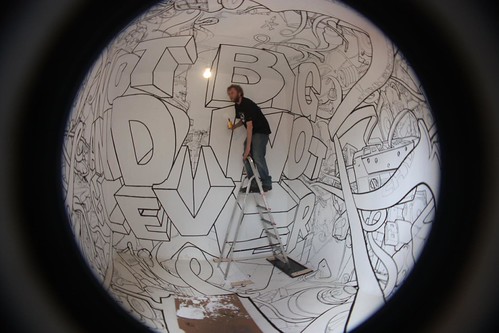
Schudio Photo by CHU


 DEEP SCRATCH