Category: GOOGLE

  • Decentralized Cognitive Commons

    Decentralized Cognitive Commons

    Text graphic featuring the phrase 'Decentralized Cognitive Commons' and an illustration of a brain, attributed to 'Fly Agaric 23', with the website 'deepscratch.net' at the bottom.

    The original post by Ben is highly recommended and essential reading, before engaging with this remix (down to 18 steps, skipping 1 and 2). This here is the original recording from the original artist. Thanks Ben. https://bengoertzel.substack.com/p/beneficial-agi-in-20-steps

    Read more: Decentralized Cognitive Commons

    Thanks to Ben who, I hope, won’t mind too much in my remixing his words and ideas using the LLM’s he points out are limited, in some sense. What is to be done about AI, AGI, ASI and big tech? What can we the people do, where can we find agency, transform the planet, humanity and culture toward a utopian process of natural abundance, obviously and demonstrably beneficial to all? For example: clean abundant water for all. Adequate abundant and free housing and shelter for all. Free abundant health care and social care and medical assistance for all. Free comprehensive education, learning, and practical skills classes for all. Free inclusion and equal contribution to the allocation process of shared resources, governance protocols (both digital and non-digital) in local environments, for all. All to mean in the terminology of Buckminster Fuller: All-Around-The-World-Humanity. All to mean all, not some but not all.

    The Google Gemini Research paper I cooked up this morning (07/10/26), was a cheeky remix of something Ben Goertzel posted concerning 20 (non simple) steps to “to minimize pre-Singularity transition destructive-chaos and smooth our path toward an abundant and wonderful post-Singularity world for human, nonhuman and posthuman beings”. Amen to that. So my question in the form of a prompt was: “Help me create a communicable path towards beneficial and safe AGI, which the layman or average human being can contribute to. How can independent researchers, artists, poets, writers and musicians help steer this technology?” I made an executive decision to miss steps 1and 2 to produce 18 steps.

    The results of this Google Gemini Deep Research query, quickly kicked me in the nuts and inspired this call for an emergency meeting, or round table discussion about whether or not we wish to play, get in the game. How we might confront and steer the imminent technological singularity, for the benefit of all humanity.

    Like many of you reading this, I’m well over-saturated and fed up to the back-teeth with big tech and big gov and big men talking impassionately about how beneficial they’re technology is. Meanwhile demonstrably enshittifying everything. Yet, a new model for beneficial AI, safe, ethical, moral, altruistic, for the betterment of the many not the few, seems possible. At least, if you don’t believe much in that, then what about the tech bros? Surely not a dystopian entropic slow heat-death of humanity and the planet. Not on my watch.

    These honest questions are suitably naive in some sense, non-technical and aimed at producing something an 8 or 80 year old could understand. I’m talking about myself, a non-technical layman and self confessed musician-poet with a keen interest in technology and humanities.

    Also perhaps noteworthy here are my previous Gemini Research Papers and my publications of them, notably MAMMALIAN (31/08/25) and Between The Groove (01/05/25) Tail Ov Tribee (07/07/26). Between them these cover a lot of ground and provide my own strong suspicions about beneficial AI, AGI, ASI etc. Somewhat confusingly criss-crossing between fiction and non-fiction depending from where in spacetime you are perceiving the messages. These works are largely unedited Gemini Research papers, collected, introduced, titled and published with full disclosure about the AI used. The least amount of good-faith gesture I could pay and a demonstration I hope of my honesty, when it comes to the disclosure of where an idea originated for me, how I communicate it, and why.

    I mean to say, please visit the original 20 step outline by Ben Goertzel at his Substack. If you haven’t already, dive in and have a look at what he’s doing, how he’s doing it, and why. What I have done is simply ask a question to re-interpret these steps, for a wider audience of non-technical humans, and for independent artists, poets, musicians, and humanitarians, or those close to my own field of study, but not limited to.

    Finally I fess up that I produced a nice and terse remix of my findings in the form of a roughly two hour audio-visual presentation, I could get behind, with a little help from my friends. You.
    I’ve included the Presentation Doc, The Gemini Research Doc, and MAMMALIAN collection as exhibits for your consideration and added context, previous LLM collaborations..

    What am I asking for? Nothing but the continuation of what you’re doing. Keep doing what you’re doing. I’m just over here saying I see you, and I hope you don’t mind me adding you to a dream team of quality critters. Yes, I confess a vanity project, yet at the same time I hope a small contribution and explicit effort to steer ‘whatever the hell this thing is” towards the beneficial for all…side of technology. A truly decentralized, rotational, altruistic and without any shadow of a doubt, beneficial to all…super intelligence or technology or AI god whatever you want to call it. Human health, sanity, healing, climate renewal, tackling carbon challenges, protecting wildlife and human life, first. I think it can be relatively simple for a huge majority of humans on earth to agree, if only THEY could all be fairly and equally consulted.

    The global campaign to help people across all strata of society better understand technology, AI and how to responsibility, fairly and safely use it for their benefit, with trust and good faith in their local communities and as perceived internationally maybe the challenge of our times. Besides the actual engineering and eventual use of whatever goddess-like AGI ASI thingymajig gets cooked up, the interpretation and access to good balanced fair and factual information remains critical. We can agree. A good fair honest balanced media landscape, educational system and government and private protocol remains critical. Change now, or change later, but change you will.

    –Lotsa love. Fly.

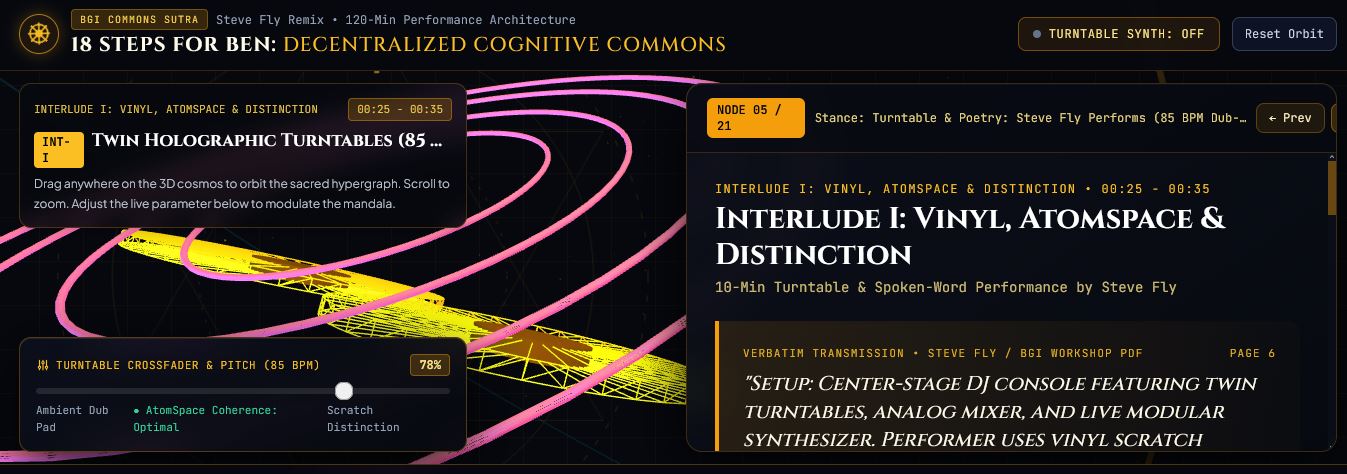
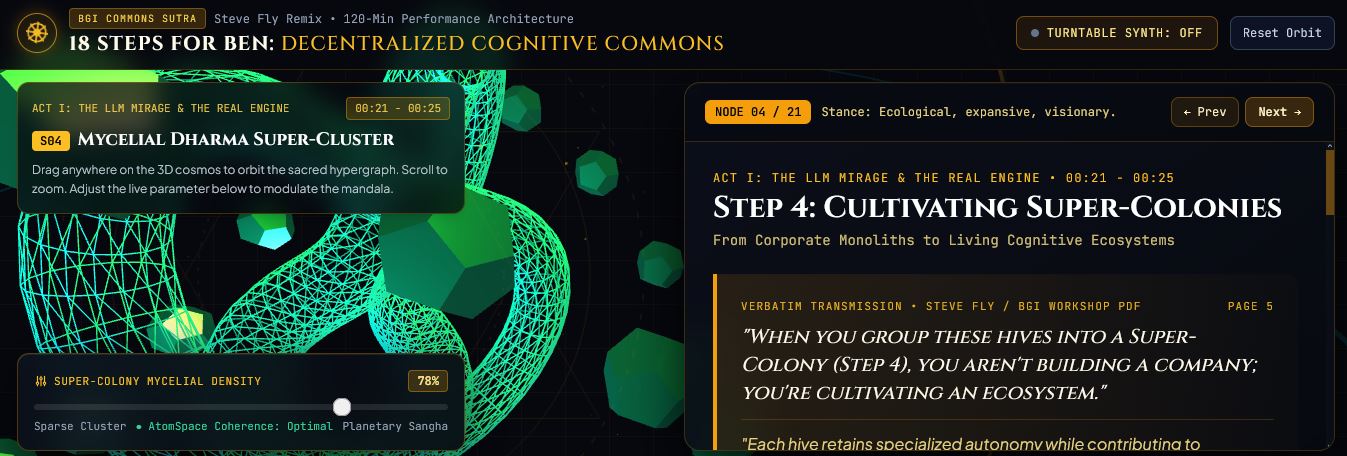
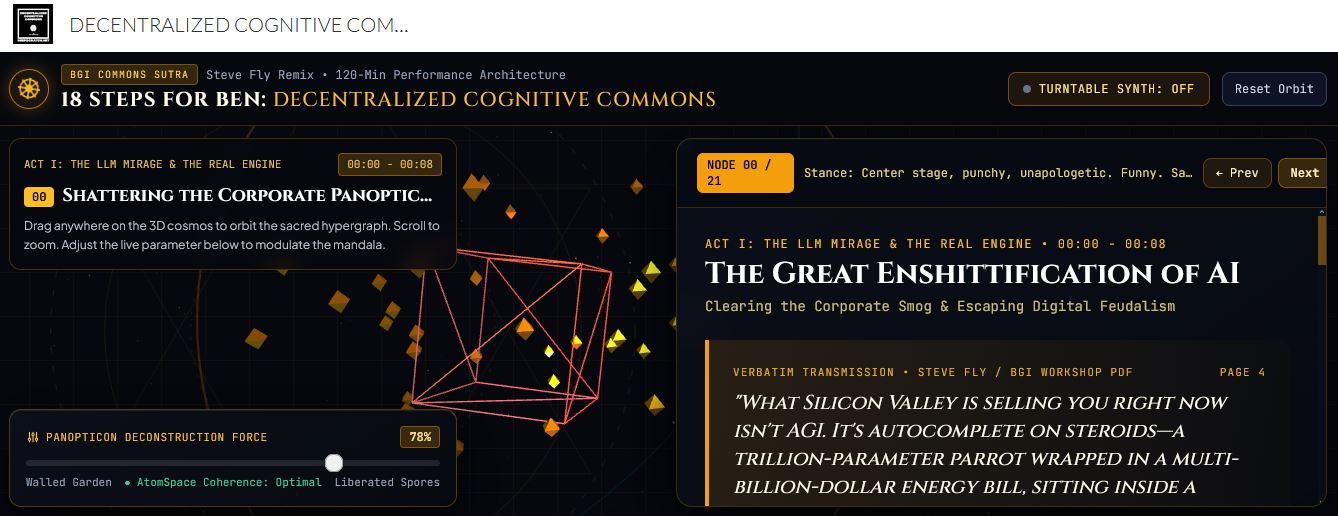
    P.s Only two days after writing this I started my first Vibe Coding experiments, using the latest Gemini Aragon model. For the purpose of correspondences with this particular project, I helped steer the construction of the Decentralized Cognitive Commons web app.
    https://sites.google.com/view/decentralizedcognitivecommons/full-page-embed

    18/10/26

    https://sites.google.com/view/decentralizedcognitivecommons/full-page-embed
  • BRD – GARAJ MAHAL

    BRD – GARAJ MAHAL

    BRD:

    ​⁨BRD Written by Fareed Haque. @GarajMahalMusic⁩ is: ⁨@FareedHaqueMusic⁩, Kai Eckhardt, Oz Ezzeldin, Hassan Hurd. Video content generated using Gemini Veo. The creator intends to plant a tree for each full video and encourages anybody who enjoys this video to go support a local artist, or plant a tree, or both! Visit http://www.garajmahal.us and Patreon.com/stevefly

  • dj mantis

    dj mantis

    Lyrics by Fly

    Give me a D.J!
    Give me an M
    Give me an A
    Give me an N
    Give me an T
    Give me an I
    Give me an S

    MANTIS! Yeah....

    It's the return of the Mantis,
    From out of your dreams,
    Scratching and cutting up the beats, so it seems...
    This is no D.M.T. trip, (oh no)
    This is deep scratch and fly lyrics straight off the lip. (trippa trip trip trippa trip trick-nology.
    Flip it Mantis...
    Pray. Who's ready to eat?
  • Douglas Rushkoff Rocks The Google Bus

    Douglas Rushkoff Rocks The Google Bus

    Douglas Rushkoff is one of those rare writers and friends. He can ask big gnarly questions, and then before you know it, present a buffet of solutions that leave you with a ravenous appetite to dig into the future.
    In Program or Be Programmed, Rushkoff made the compelling case for the need for all of us to be programmers. Choose to program and “you gain access to the control panel of civilization. Choose the latter, and it could be the last real choice you get to make.” Yikes, I read that and immediately went to use my limited HTML skills on my nascent website.

    Despite my admiration for his past work, I approach his new book with some trepidation. I guess I thought Rushkoff was going to be the one throwing rocks. Nope. I should have known better. Rushkoff is always more complicated than that. 

    In Throwing Rocks At The Google Bus, Rushkoff begins with some powerful truth telling. 

    The digital economy is breaking things. The media can’t seem to survive digitization. Drivers are losing to Uber. Airbnb is turning neighbors apartments into rentable dorm rooms, and as he lays out the current state of play – event tech visionaries find the demands of the startup economy closing their vision.

    But Rushkoff isn’t claiming Google GOOGL -1.03% is at fault. He says: “there is something troubling about the way Google is impacting the world, but neither it’s buses nor the people in them are the core problem; they’re just and easy target. He says we’ve brought a set of industrial age. “We are running a 21st-century digital economy on a 13th Century printing-press era operating system,” writes Rushkoff. 

    Now it’s not all bad. “On the bright side, millionaires and billionaires are being minted, maybe not enough to compensate for the millions of people being displaced, from their jobs, but they are inspiring just the same.”
    Looking for an example, Rushkoff settles on Uber, and he takes on the company with relish. “By calling itself a platform rather than a taxi dispatcher, Uber has been able to work in a regulatory gray area that slashes overhead while inflating revenue. This is how Uber can be valued at over $18 billion dollars while many of its drivers make below minimum wage after expenses.”

    The crux of the argument that Rushkoff makes is that the digital economy is a house of cards built on fictional growth metrics that drive companies to raise money, undercut human workers, sell on the public markets and then – almost inevitably – collapse under the weight of public market demands. And he’s not alone in his concern. Quoting Union Square Ventures founder Fred Wilson, the book shares Wilson’s blog post. In it Wilson “worries aloud that digital entrepreneurs are more focused the increasing monopolies and entreating value than they are on realizing the internet potential to promote value creation by many players.”

    Growth, it turns out, may be an illusion. “If infinite growth is no longer a possibility or even desirable, then you must shift your sights away from the big “win” in the form of an IPO, acquisition or growth target” writes Rushkoff. “Think of it less like a war, where total victory is the only option, and a bit more like peace, water eat objective is to find a way to keep it going.”

    The core message of the book is that the current state of play in funding, driving, and exiting digital companies is unsustainable. And to bring that point home, Rushkoff shares his stories of  Ventureless Capital: the Patience of the Crowds. His example is a good one – his friend, and mine, Scott Heiferman. Heiferman founded Meetup after selling his first startup at the hight of the dot-com boom. Meetup aims to be a civic platform rather than a platform monopoly. “We’re not trying to vertically/horizontally integrate or get into news busses or invent self-driving space elevators. We know what business e want to be in, it’s a big opportunity and we don’t see ourselves and empire-building imperialists.” Meetup aims to be Meetup, and to grow that business – a perfect Rushkoff example.

    In Throwing Rocks at the Google Bus, Rushkoff calls on business to:
    • Accept that era of extractive growth is over. 
    • Reject platform monopolies like Uber in favor of distributed, worker-owned co-ops, orchestrated through collective authentication systems like bitcoin and blockchains.
    • Resist the short-term, growth-addicted mindset of publicly traded markets.
    • Recognize contributions of land and labor as important as capital, and develop business ecosystems that invest in the local economies on which they ultimately depend.

    “None of us can wave a magic wand and transform the economy from an extractive endgame into a prosperous commons,” writes Rushkoff in his conclusion. “However, I do believe we can reposting our careers and our businesses to become less a part of the problem than participants in the solution. There’s a lot of hope here.”


    Steven Rosenbaum is serial entrepreneur, author, and filmmaker. His latest book, Curate This! is in print and ebook on Amazon.com. He is the CEO of Waywire.com (enterprise.waywire.com)

  • NOH Play

    “Consider the Tale of the Tribe as an alternative form of scripture. Which form’s of alternative scripture seem appropriate for the 20th Century? And which for the 21st?” —Robert Anton Wilson. Recorsi. 2005.

    ‘Noh’ or Accomplishment: a study of the classical stage of Japan
    By Ernest Francisco Fenollosa, Ezra Pound

    http://books.google.com/books?id=BZNsMakTE94C&lpg=PA270&dq=ezra%20pound%20noh%20plays&lr=&pg=PA270&output=embed

    New approaches to Ezra Pound: a co-ordinated investigation of Pound’s poetry …
    By Eva Hesse

    http://books.google.com/books?id=yXYlK8Uh3dUC&lpg=PA69&dq=ezra%20pound%20noh%20plays&pg=PA69&output=embed

    Yeats the European
    By Alexander Norman Jeffares

    http://books.google.com/books?id=G5iaubedD28C&lpg=PA233&dq=yeats%20noh%20plays&pg=PA233&output=embed

    Transcending space: architectural places in works by Henry David Thoreau, E …
    By Taimi Anne Olsen

    http://books.google.com/books?id=nBVItNLDfFYC&lpg=RA1-PA23&dq=yeats%20noh%20plays&pg=RA1-PA26&output=embed

    Modern drama in theory and practice: Symbolism, surrealism and the absurd
    By J. L. Styan

    http://books.google.com/books?id=GNkfv6l7-OgC&lpg=PA61&dq=yeats%20noh%20plays&pg=PA61&output=embed

    Modernity in East-West literary criticism: new readings
    By Yoshinobu Hakutani

    http://books.google.com/books?id=1ggnAQv14m4C&lpg=PA23&dq=yeats%20noh%20plays&pg=PA23&output=embed

    Progress and identity in the plays of W.B. Yeats, 1892-1907
    By Barbara Ann Suess

    http://books.google.com/books?id=3Z6HF3cyjjUC&lpg=PA54&dq=yeats%20noh%20plays&pg=PA54&output=embed

    A calculus of Ezra Pound: vocations of the American sign
    By Philip Kuberski

    http://books.google.com/books?id=Qe65ADgaTrcC&lpg=PA83&dq=ezra%20pound%20noh%20plays&pg=PA83&output=embed