Category: information theory

  • Decentralized Cognitive Commons

    Decentralized Cognitive Commons

    Text graphic featuring the phrase 'Decentralized Cognitive Commons' and an illustration of a brain, attributed to 'Fly Agaric 23', with the website 'deepscratch.net' at the bottom.

    The original post by Ben is highly recommended and essential reading, before engaging with this remix (down to 18 steps, skipping 1 and 2). This here is the original recording from the original artist. Thanks Ben. https://bengoertzel.substack.com/p/beneficial-agi-in-20-steps

    Read more: Decentralized Cognitive Commons

    Thanks to Ben who, I hope, won’t mind too much in my remixing his words and ideas using the LLM’s he points out are limited, in some sense. What is to be done about AI, AGI, ASI and big tech? What can we the people do, where can we find agency, transform the planet, humanity and culture toward a utopian process of natural abundance, obviously and demonstrably beneficial to all? For example: clean abundant water for all. Adequate abundant and free housing and shelter for all. Free abundant health care and social care and medical assistance for all. Free comprehensive education, learning, and practical skills classes for all. Free inclusion and equal contribution to the allocation process of shared resources, governance protocols (both digital and non-digital) in local environments, for all. All to mean in the terminology of Buckminster Fuller: All-Around-The-World-Humanity. All to mean all, not some but not all.

    The Google Gemini Research paper I cooked up this morning (07/10/26), was a cheeky remix of something Ben Goertzel posted concerning 20 (non simple) steps to “to minimize pre-Singularity transition destructive-chaos and smooth our path toward an abundant and wonderful post-Singularity world for human, nonhuman and posthuman beings”. Amen to that. So my question in the form of a prompt was: “Help me create a communicable path towards beneficial and safe AGI, which the layman or average human being can contribute to. How can independent researchers, artists, poets, writers and musicians help steer this technology?” I made an executive decision to miss steps 1and 2 to produce 18 steps.

    The results of this Google Gemini Deep Research query, quickly kicked me in the nuts and inspired this call for an emergency meeting, or round table discussion about whether or not we wish to play, get in the game. How we might confront and steer the imminent technological singularity, for the benefit of all humanity.

    Like many of you reading this, I’m well over-saturated and fed up to the back-teeth with big tech and big gov and big men talking impassionately about how beneficial they’re technology is. Meanwhile demonstrably enshittifying everything. Yet, a new model for beneficial AI, safe, ethical, moral, altruistic, for the betterment of the many not the few, seems possible. At least, if you don’t believe much in that, then what about the tech bros? Surely not a dystopian entropic slow heat-death of humanity and the planet. Not on my watch.

    These honest questions are suitably naive in some sense, non-technical and aimed at producing something an 8 or 80 year old could understand. I’m talking about myself, a non-technical layman and self confessed musician-poet with a keen interest in technology and humanities.

    Also perhaps noteworthy here are my previous Gemini Research Papers and my publications of them, notably MAMMALIAN (31/08/25) and Between The Groove (01/05/25) Tail Ov Tribee (07/07/26). Between them these cover a lot of ground and provide my own strong suspicions about beneficial AI, AGI, ASI etc. Somewhat confusingly criss-crossing between fiction and non-fiction depending from where in spacetime you are perceiving the messages. These works are largely unedited Gemini Research papers, collected, introduced, titled and published with full disclosure about the AI used. The least amount of good-faith gesture I could pay and a demonstration I hope of my honesty, when it comes to the disclosure of where an idea originated for me, how I communicate it, and why.

    I mean to say, please visit the original 20 step outline by Ben Goertzel at his Substack. If you haven’t already, dive in and have a look at what he’s doing, how he’s doing it, and why. What I have done is simply ask a question to re-interpret these steps, for a wider audience of non-technical humans, and for independent artists, poets, musicians, and humanitarians, or those close to my own field of study, but not limited to.

    Finally I fess up that I produced a nice and terse remix of my findings in the form of a roughly two hour audio-visual presentation, I could get behind, with a little help from my friends. You.
    I’ve included the Presentation Doc, The Gemini Research Doc, and MAMMALIAN collection as exhibits for your consideration and added context, previous LLM collaborations..

    What am I asking for? Nothing but the continuation of what you’re doing. Keep doing what you’re doing. I’m just over here saying I see you, and I hope you don’t mind me adding you to a dream team of quality critters. Yes, I confess a vanity project, yet at the same time I hope a small contribution and explicit effort to steer ‘whatever the hell this thing is” towards the beneficial for all…side of technology. A truly decentralized, rotational, altruistic and without any shadow of a doubt, beneficial to all…super intelligence or technology or AI god whatever you want to call it. Human health, sanity, healing, climate renewal, tackling carbon challenges, protecting wildlife and human life, first. I think it can be relatively simple for a huge majority of humans on earth to agree, if only THEY could all be fairly and equally consulted.

    The global campaign to help people across all strata of society better understand technology, AI and how to responsibility, fairly and safely use it for their benefit, with trust and good faith in their local communities and as perceived internationally maybe the challenge of our times. Besides the actual engineering and eventual use of whatever goddess-like AGI ASI thingymajig gets cooked up, the interpretation and access to good balanced fair and factual information remains critical. We can agree. A good fair honest balanced media landscape, educational system and government and private protocol remains critical. Change now, or change later, but change you will.

    –Lotsa love. Fly.

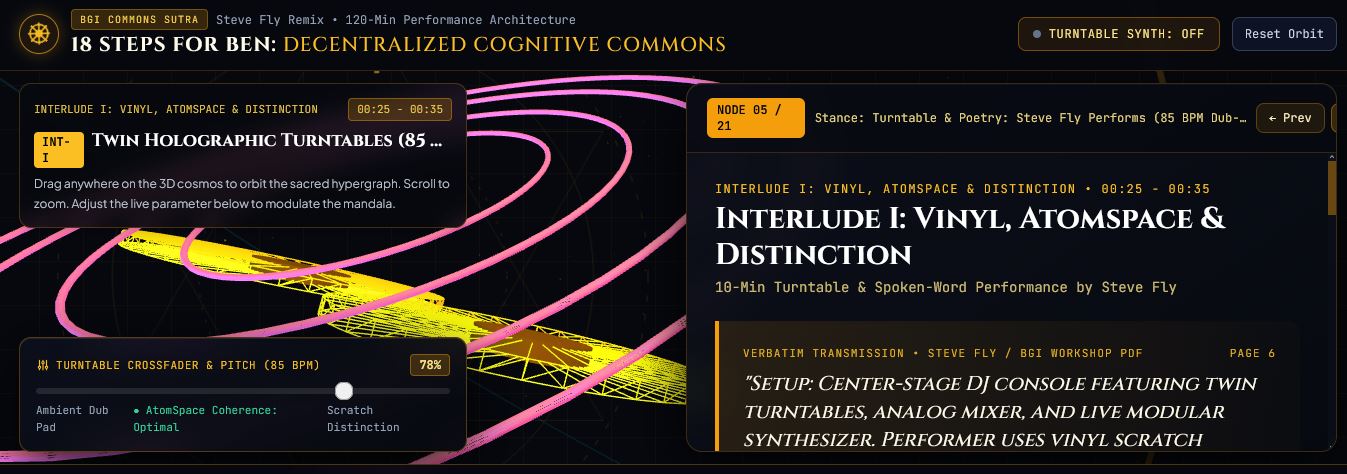
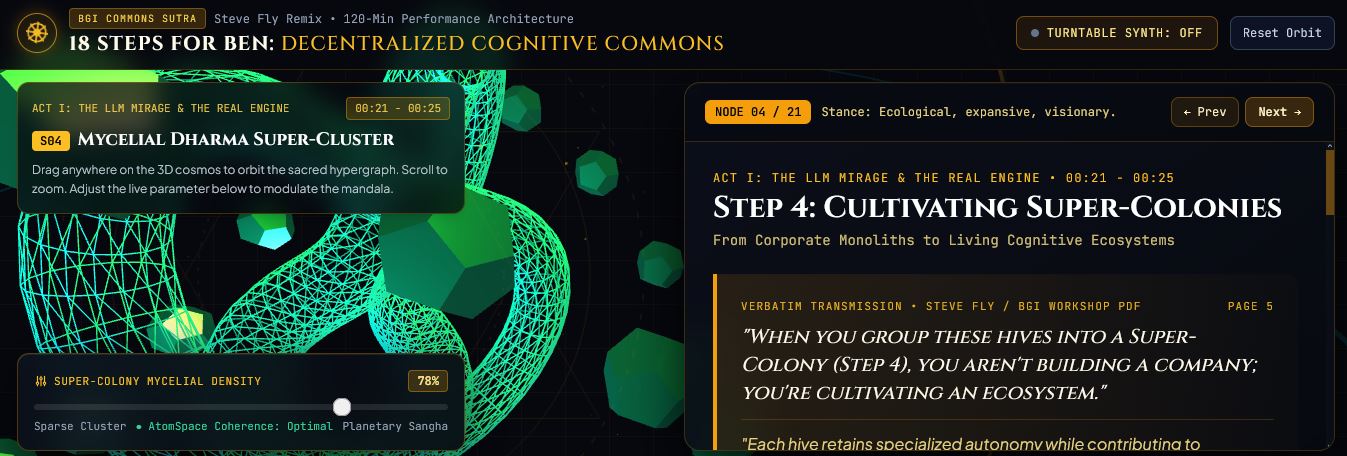
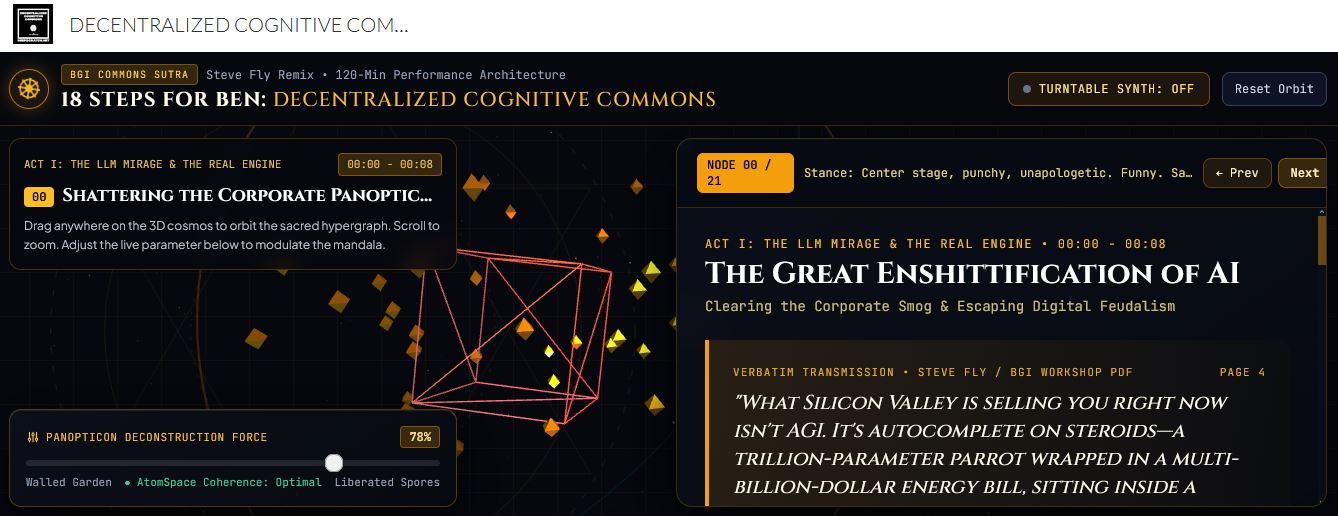
    P.s Only two days after writing this I started my first Vibe Coding experiments, using the latest Gemini Aragon model. For the purpose of correspondences with this particular project, I helped steer the construction of the Decentralized Cognitive Commons web app.
    https://sites.google.com/view/decentralizedcognitivecommons/full-page-embed

    18/10/26

    https://sites.google.com/view/decentralizedcognitivecommons/full-page-embed

  • Bit By Bit, ‘The Information’ Reveals Everything

    http://www.npr.org/player/v2/mediaPlayer.html?action=1&t=1&islist=false&id=134366651&m=134371366

    March 8, 2011

    The Information, written by James Gleick, covers nearly everything — jungle drums, language, Morse code, telegraphy, telephony, quantum mechanics, thermodynamics, genetics and more — as it relates to information, which he describes as the “fundamental core of things.” Information theory can now be seen as the overarching concept for our times, describing how scientists in many disciplines see a common thread to their work.

    Gleick’s book spans centuries and geographic locations, but one person stays throughout the story for almost 400 pages: Claude Shannon, an engineer and mathematician who worked at Bell Labs in the mid-20th century. Shannon created what is now called information theory, Gleick tells Robert Siegel on All Things Considered:

    “He was the first person to use the word ‘bit’ as a scientific unit of measuring this funny abstract thing that until this point in time scientists had not thought of as a measurable scientific quantity.”

    Bits are more commonly recognized as the 1s and 0s that enable computers to store and share information, but can also be thought of in this context as a yes/no, either/or or on/off switch. Gleick describes the bit as “the irreducible quantum of information,” upon which all things are built.

    Just like Isaac Newton took vague words like “force” and “mass” that had fuzzy contemporary meanings and turned them into specific mathematical definitions, “information” now can refer to a specific scientific definition similar to a bit.

    “Binary yes or no choices are at the root of things,” Gleick explains. The physicist John Archibald Wheeler coined an epigram to encapsulate the concept behind information theory: “It from bit.” It described the idea that the smallest particle of every piece of matter is a binary question, a 1 or a 0. From these pieces of information, other things could develop — like DNA, matter and living organisms. The field of information theory, in addition to creating new meanings for words like “information,” also builds upon knowledge from other scientific disciplines such as thermodynamics, even though the result may be a little tough to understand.
    James Gleick also wrote Chaos: Making a New Science, which popularized the idea of the butterfly effect. His books have been finalists for the Pulitzer Prize and the National Book Award.
    Phylis Rose

    James Gleick also wrote Chaos: Making a New Science, which popularized the idea of the butterfly effect. His books have been finalists for the Pulitzer Prize and the National Book Award.

    “When Claude Shannon first wrote his paper and made a connection between information and the thermodynamic concept of entropy, a rumor started around Bell Labs that the great atomic physicist John von Neumann had suggested to Shannon, ‘Just use the word entropy — no one will know what you’re talking about, and everyone will be scared to doubt you.’ “

    Though it may be a difficult subject to conceptualize, entropy does have a deep connection to information science, Gleick says. Entropy is associated with disorder in thermodynamic systems, and analogously so in informational systems. Though it may seem paradoxical to link information to disorder, Gleick explains that each new bit of information is a surprise — if you knew what a particular message contained, there would not be information in it.

    “Information equals disorder, disorder equals entropy and a lot of physicists have been both scratching their heads and making scientific progress ever since,” Gleick says.

    In the everyday — not scientific — sense, an object like the moon only seems to contain information when we perceive it and develop thoughts about it, whether that’s the man in the moon, the moon being made of cheese or the moon driving people to madness. But Gleick says that even without our perceiving it, the moon is more than just matter — it still has its own bits of intrinsic information.

    “It sounds mystical, and I can’t pretend that I fully understand it either, but it’s just one of the many ways in which scientists have discovered a conception of information that helps them solve problems in a whole range of disciplines.”

    We can see now that information is what our world runs on: the blood and the fuel, the vital principle. It pervades the sciences from top to bottom, transforming every branch of knowledge. Information theory began as a bridge from mathematics to electrical engineering and from there to computing. What English speakers call “computer science” Europeans have long since known as informatique, informatica, and Informatik. Now even biology has become an information science, a subject of messages, instructions, and code. Genes encapsulate information and enable procedures for reading it in and writing it out. Life spreads by networking. The body itself is an information processor. Memory is stored not just in brains but in every cell. No wonder genetics bloomed along with information theory. DNA is the quintessential information molecule, the most advanced message processor at the cellular level—an alphabet and a code, 6 billion bits to form a human being. “What lies at the heart of every living thing is not a fire, not warm breath, not a ‘spark of life,’” declares the evolutionary theorist Richard Dawkins. “It is information, words, instructions. . . . If you want to understand life, don’t think about vibrant, throbbing gels and oozes, think about information technology.” The cells of an organism are nodes in a richly interwoven communications network, transmitting and receiving, coding and decoding. Evolution itself embodies an ongoing exchange of information between organism and environment.

    “The information circle becomes the unit of life,” says Werner Loewenstein after thirty years spent studying intercellular communication. He reminds us that information means something deeper now: “It connotes a cosmic principle of organization and order, and it provides an exact measure of that.” The gene has its cultural analog, too: the meme. In cultural evolution, a meme is a replicator and propagator—an idea, a fashion, a chain letter, or a conspiracy theory. On a bad day, a meme is a virus.