
https://www.patreon.com/cw/stevefly/shop
PRESENT AUTHORS INTRODUCTION
So what have we here then Steve? Tinkering with the AI again are we? I told you and warned you a thousand times about it and you just kept going and going and now look wot’ you’ve gone and done. Claiming it’s a bit ov’ a modern verse epic, but know full well it could never truly be the thing, as to our beingness and human struggle through time.Chatting to myself again, as Homo Promptus, in first person reflection space. The following series of essays are AI generated, spoiler alert. And I can already sense that slight frown and disappointment that I wasn’t hand crafting this big shebang, or rag-bag of notes. That’s under construction, in the meantime, this work is my contribution, an example of what I find interesting firstly, and also with luck what you dear reader, enjoy.
The subject matter reflects a purposeful choice, and works on a few different levels, both personal-historical and geographical meaning to me myself and I. For those that know me…the flesh and bone present author…will experience reading these articles in a different way to a total stranger. However I hope the unpredictability of the order and content within rings many bells at once, each effectively acting as an Epyllion (a mini modern epic) but, alas, lacking poetry turns of phrase and typographic experimentation, grammatical loop-da-loops and tricks of human authors with a pen or typewriter, battling digital algorithms and infernal averages. Hot stuff.
There’s something for everyone here, so at the least maybe give it a quick browse. In some sense this is a browsing document, a mini wikipedia world whipped up around this author’s ego, weird esoteric interests, fictional fancies, friends, family, hobbies, and a recurring theme: demonstrating the paradox of the tale of the tribe. Subjective experiences of mine, loves and some struggles, at the same time as containing historical forces (can we say facts without annoying too many people?). Leading, with luck, to distinguished science facts, methods, experiments, peer reviewed studies, when required, generously blended with my own mystical personal queries, carefully crafted and selected for you here. Feels a bit like cheating for an exam, producing all the goods to at least get a pass, but did I and do I really understand these Frankenstein’s Monster mash-ups? Who knows, here’s the results of my experiments. Hope you have a s much fun as I did.
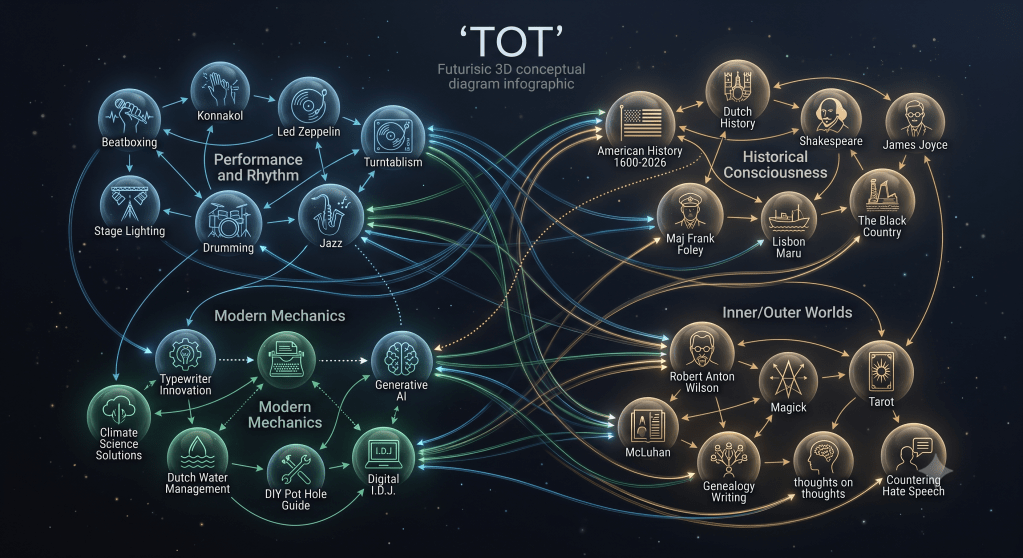
In no particular order the articles feature such people and concepts as Rituals, Sports Mega Events, Economics, Beatboxing, Dutch, English, American History, Turntablism, Shakespeare, James Joyce, Typewriter Innovation, Lisbon Maru, Maj Frank Foley, AI, The Modern Verse Epic, Robert Anton Wilson, Ostriches, Countering Hate Speech, DIY Pot Hole Guide, Konnakol, Led Zeppelin, Swimming, Lightening, Thunder and the Brontic Logos, Magick, Tarot, LBJP, Drumming, Geronimo Pratt, Identity, McLuhan, Climate Science Solutions, The Black Country, Dutch Water Management, Story telling, John Sinclair, Street Art, Jazz, Stage Lighting, Causes Of War, Genealogy Writing, Digital I.D.J, Kim Stanley Robinson, thoughts on thoughts about thoughts.
- We Bad Meaning Good
 https://www.patreon.com/stevefly/posts/we-bad-meaning-165302887 We Bad Meaning Good WBMG I know, this is shady, dark, moody, bad, but this is the beat of the cluba’ dub sub bass, what no authority can imitate. These are bass bin workouts, with a hit hat, a break, what I like to play to make the shake. I dunno, moods I’m feelin’… Read more: We Bad Meaning Good
 - Bumble Fleece (Mix)
 So, by way of introduction, these tunes are a representative of a new interest in an old hobby, an older like for those left-field, abstract jazzy breaks, the wired and funky. Wat a drummer would go for, and that bass. Oh yeah. Now, I gotta’ fess up, back in the day, to take such excursions into abstract experimental breaks could get you booted off the set. As a drummer I leaned into the weirder breakbeat breakbeats.
 - Off The Cuff N’ Ruff
 Poetry, stuff. Thoughts.
 - TOT
 All in all an updated answer to critical questions concerning the limits of AI and what distinguishes human beings with their wet-ware–AI-like interacting human nervous system–from the probability cloud intelligences. Short answer by way of analogy, see the limits and questions and paradox inherent in the tale of the tribe, a poem, a modern verse epic, a poem including history, from an individual in time yet also bringing historical forces to bear, facts from a widely shared globally vindicated source. Like Thunder. It did or it didn’t? Toward a universal agreeability. Negotiations. Understanding. To peace. To digress I digress. Yeah, Ostriches too. Let’s goo. I, still can’t really decide what order to present them in tbh.
 - Ambidexless – A Blend
 The sharp contrast and flip between hot and cold seems like a powerful force across scale, materials and technology. Geology, thermodynamics and data hardware depend upon stable temperature parameters. Like wearing six hoodies and thermal underpants in a sauna, or swimming with no wet suit in the North Sea after eating ten choc’ ice’s, these sharp contrasts are testing human capacity to adequately house and feed everyone. I conclude, burn less fossil fuels, utilise the natural abundance of untapped energy in wind, water, solar and novel natural carbon capture technologies. I’m drifting…
 - Loves Labours Lost Mixtape

 DEEP SCRATCH