GENRES: Mutant jazz. Little big band. Large Language Modal jazz. Beep Bop. Big Soul. Deep scratches. Tribetablism. MPHDJ cuts. Rainshroom rap. Token word. Slick, tight, funky drums. Updown beat. Sinnermatic soundscapes. Wake boxing. Canto tott trott. Blues, redefined: Tanmoy blues. Spew jazz bursts. Cosmic trigger word punctuations. Data set sax solos. Optihop energy. Optical street soul. Fly funk. Movie soundtrack vibe. Axiomatic jazz structures. Geometric classical elegance. Non von neumann swing. Non-being core philosophy. Data dust crew sound.
credits
released January 8, 2025
All music by Steve Fly + Udio + Gemini AI. Tanmoy 2025. MPHDJ.
VOICE MESSAGE: I’m feeling funny about this now, thought I’d share my thoughts, hope you don’t mind, I have to keep going back to the disclaimer and telling myself I’m responsible as the author, yet, not fully responsible for the output. That’s weird, like I’m under the control of a big new bully boss, I’m not sleeping well. Quietly, beavering away on prompts, not complaining yet, doing its best to serve up roast beef from my raw potatoes and delivering hot tales by the dozen. Is this how that new digital viral infection takes a hold I wonder, okay, speak soon?
As the camera follows Plush’s movements in the studio, he explains the concept of decentralized AI and how it works. “Basically, it’s a system where the decision-making power is distributed among all the nodes in the network, rather than relying on a single central authority. This means that everyone has equal power to contribute and make decisions, leading to a more democratic and innovative space.”
Plush goes on to demonstrate how he’s using this technology in his music, showcasing the new and sounds. The audience is taken on a journey through Plush’s creative process, seeing how he blends traditional music production techniques with cutting-edge machine learning technology. As the documentary concludes, Plush’s voice-over reflects on the impact he hopes his work will have on the industry. “I hope that other DJ’s and producers will see what’s possible with decentralized AI and start experimenting, why let them have all the fun.
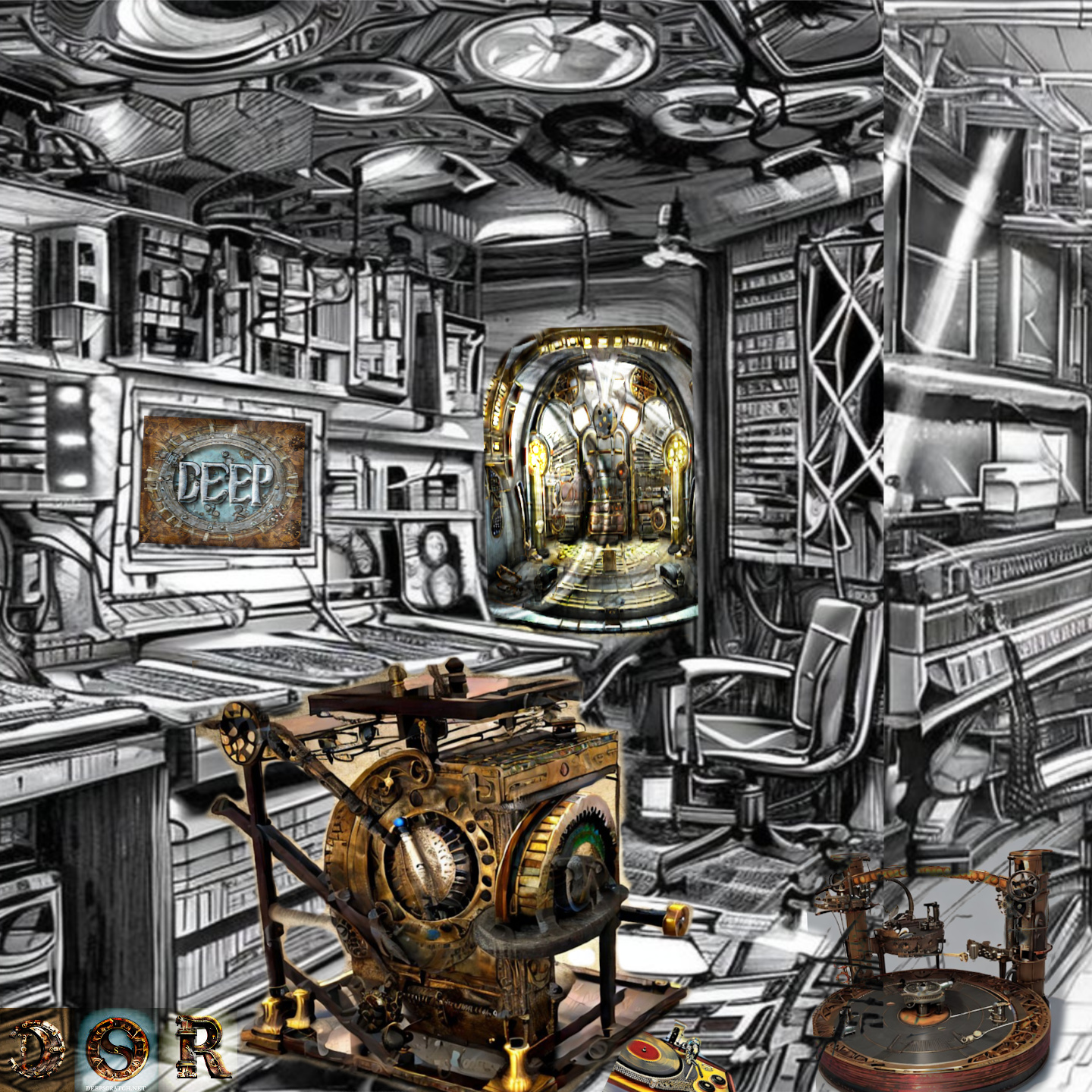
The walls of the studio are lined with shelves stacked high with vinyl, CDs, tapes, and all manner of sound recordings, each waiting its turn to be spun and remixed. Above, contraptions spin, each adding a chime of static buzz to the music. The room is a wild mix of old and new, organic and mechanical, but it all comes together in perfect harmony, each element supporting and enhancing the others. Each in their own element, each lost in the flow of creation.
Dr. M: “Hery Mr DJ, I can’t believe we did it. We built a functional time machine, hahahaa’, well, using the power of just language and music played at the right frequency and volume, we can transform the perception of time by the listener. Is that time travel?”
DJ Plush: “I still can’t believe it. I never thought it were really possible that beatboxing and konnokol would have anything to do with time travel. But, there it is. Bob’s yer’ uncle. This thing never fails to deliver my true will.”
Dr. M: “It’s all about the rhythms and patterns, the vibrations of certain words and sounds can create a stable portal through time. Statistical probability. You know, and music, well, especially vocal music, is a powerful conduit for those vibes.”
DJ Plush: “So, what did you see on your travels? What kind of insight did you gain?”
Dr. M: “I witnessed the construction of the pyramids in ancient Egypt, the signing of the Magna Carta in medieval Europe, and the Civil Rights movement in the 1960s. And, because I could communicate with the people of those eras through their own languages, I was able to gain a deeper understanding of their cultures and societies, I remember lots of dialogue and the set and setting of the unfolding drama.”
DJ Plush: “That’s amazing, really. Wow, that’s right up my alley, in my groove. So, M, what’s next for us? I have a few people who text me their updates and I churn it all back into the work. I’ve got some time-stubs to check out, and a whole novel waiting to drill down deep into.”
Dr. M: “Absolutely. But I also see so much potential for using this technology to connect with people across time and space. Imagine being able to communicate with our ancestors or even with people from other planets. It sounds crazy but I think that language is a virus from outer space.”
DJ Plush: “I couldn’t agree more. With this discovery, we’re opening a whole new era of temporal exploration and communication, but it’s easy to get over excited with this tech’ I’ve seen it with others.”
Dr. M: “Exactly. And I couldn’t have done it responsibly without your help. Actually, I’ve been thinking about how we can incorporate turntables into our time-travel method.”
DJ Plush: “Oh yeah?”
Dr. M: “Well, the more I think about it, like in your Deep Scratch, turntables are about creating rhythms and patterns with rotating discs, those rhythms and patterns are essential for creating a stable time-travel portal. And I’ve been researching a new kind of tribal turntable craft that uses natural materials like wood and stone, crystals, naturally occurring and lab grown. Imagine being able to travel through time using the sounds of ancient drums and percussion instruments spun on vinyl”
DJ Plush: “That sounds dope. I’d love to try it, hell yeah!”
Dr. M: “We’ll need to experiment and find the right combination of turntable rhythms and konnokol patterns. But I have a feeling that if we can get it right, we’ll travel back in time to moments of synchronicity, like some experiences of Philip K. Dick, he wrote about moments of synchronicity, where past and present seem to converge, and the universe reveals once hidden truths, often disuided as trash. These moments hold the key to understanding the nature of reality, I think we can use our novel method to go back in time and witness these moments.”
DJ Plush: “That sounds fascinating. But how would we even know when and where to go back in time to experience these moments?”
Dr. M: “That’s where the power of generative language comes in. The vibrations of certain words and phrases can act as a kind of beacon when spoken, guiding us to the historic moments of harmony and synchronicity.”
As the AI system analyzed the protagonist of the manual titled, Turntable Method, it delved into the psychological makeup of the character like a polar bear chasing a seal down an icy hole. Using advanced algorithms and data analysis, the AI was able to uncover a wealth of information about our protagonist. It discovered, for example that he was a complex and multifaceted individual, borderline schizophrenic on some doctors’ charts, with a deep love for music and a strong desire or debilitating impatience to share. Despite his outgoing and confident demeanor, the AI discovered that Plush often struggled with feelings of insecurity and self-doubt. He would often second-guess himself and question everything, usually regressing back to the daunting question about whether he was truly talented enough to succeed in the competitive world of DJing, music and writing.
However, the AI also noted that Plush was highly resilient and determined, a Chinese dragon and a Ram of fire, he refused to let his doubts hold him back, and instead used them as fuel to push himself harder and strive for greater success, like a warrior spirit trying to get out. There was a burning inside of him, fuelled by ego, smoking like a chimney. Through its analysis, the AI was able to paint a detailed and nuanced portrait of Plush’s psychological makeup. He wasn’t really that fucked up, he just made out he was sometimes.
As the AI delved further into its analysis of Plush, it became increasingly impressed with the character’s natural language processing. Plush had a unique talent for understanding and manipulating symbol systems, using them to communicate his thoughts and emotions with clarity and precision across time. This talent was particularly evident in DJ sets, where he seamlessly blended together a wide range of musical genres and styles, using the language of music to create a cohesive and coherent whole, sprinkled with movie samples, sound FX and classic quotations from scientific philosophers who were funny as a sloth crossing the road.
The Novel remix was a concept that referred to the idea of taking existing elements and combining them, much like a DJ would do with music. The AI realized that this concept was not only central to Plush’s craft as a DJ, but also to the themes of the novel itself, and the remix. The author had cleverly used the idea of the novel mix to create a juxtaposition of meaning, weaving together seemingly disparate elements, and now it was going to a new root level.
In many ways, the novel was like a Turing test, challenging readers to question their own assumptions and beliefs about the world, human and non human entities, and the price of oil. It was a complex and nuanced work that demanded deep thought and reflection, much like a jazz composition. What is jazz, art, a novel, poetry, democracy?
As the lonely AI finished its analysis, it couldn’t help but try to feel a sense of admiration for the author and for Plush, but it couldn’t feel, as much as a kettle can feel. It was clear that Turntable Method was a masterpiece disguised as a manual, one that would inspire DJs and engage readers for years to come, a literary bastard, troubled and of unknown origin.
VOICE MESSAGE: So, to recap, it’s basically, er, it's a probabilistic symbol system thing, where the decision-making power is distributed among all the nodes in the network, leading to a more democratic and innovative environment. It’s decentralized like Finnegans Wake and the music of John Coltrane and the artwork of MC Escher.
As the documentary continues, the text messages from Plush become more frequent, as he updates his friends and colleagues on his progress with the new decentralized AlphaX architecture.
"Just finished testing the latest version, it's sounding better!"
Another message pops up, this time from a fellow DJ who is clearly impressed with Plush’s work.
"Dude, this decentralized thing is next level. Can't wait to hear what you come up with next my mon, peace."
Plush responds,
"Thanks, man. I'm excited about the potential, it's going to change the game for DJ's and producers everywhere, knock some socks off, just check the sidebar plugin next week. It's here."
The text messages become more personal as the documentary progresses, showing Plush’s commitment.
"I stay up late every night, working on this DSR project, I hope you enjoy it mate."
As the documentary draws to a close, the final text message from Plush reads, “I’m ready to unveil my new decentralized architecture to the world. Let’s push the button on the new version excursion.”
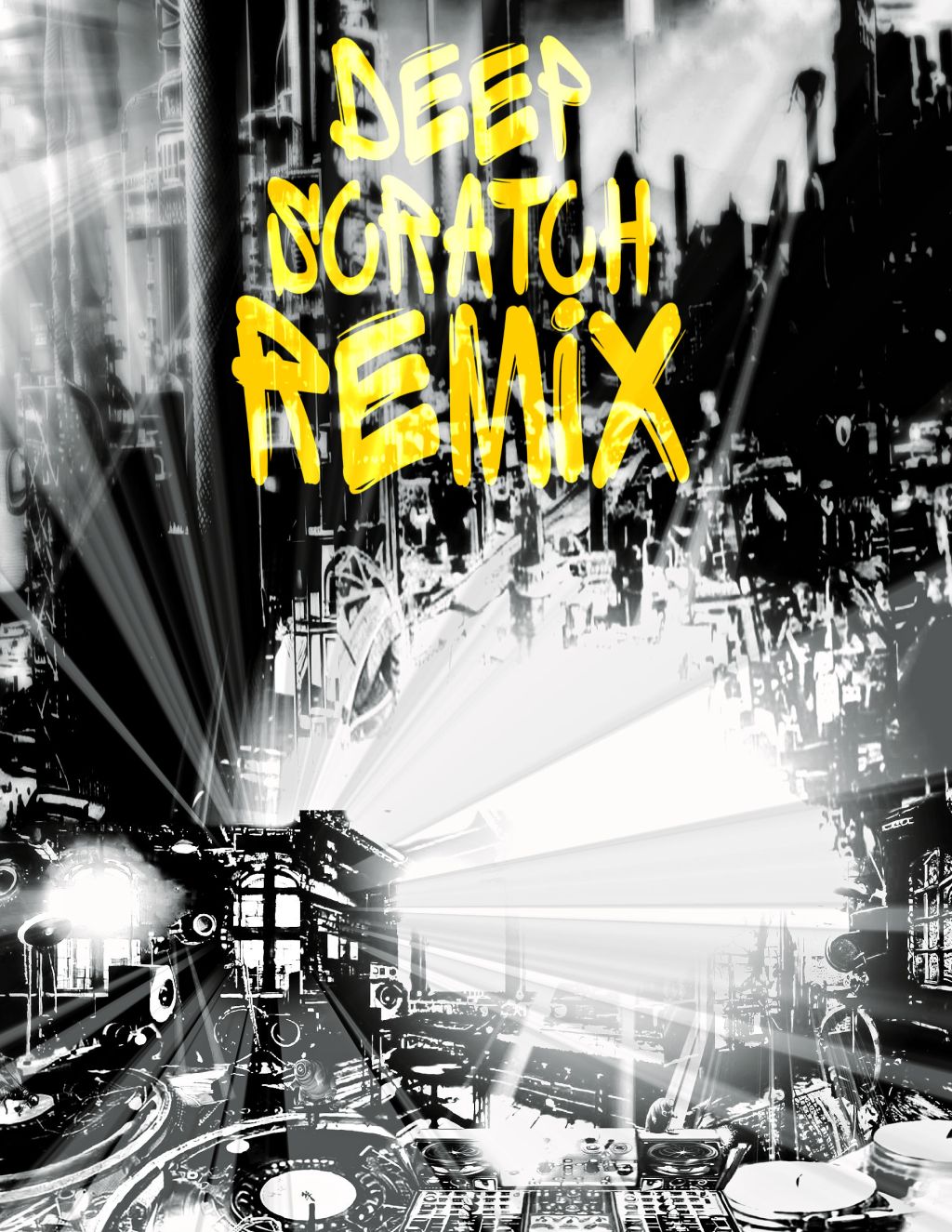
The camera cuts to Plush on stage, launching into a performance that showcases the full potential of his new architecture. The documentary ends with Plush’s voiceover, “The future of music is now, Deep Scratch Remix. Thank You.”
VOICE MESSAGE: I think it’s all pattern recognition under the hood, sure. But, but I’m afraid of sounding like an intellectual snob, you know, when I try to point out that people without experience with different kinds of good literature, who don’t read books much, may be more susceptible to the coming AI infused tsunami of fakes, or whatever you call it. Human nervous systems are easily fooled, some more than others for sure, but I really feel strongly that the message is to read more books, read more, by varied authors in different genres and from different cultures, and, from different time periods. Armour your brain man, defend yourself with neuro semantics and a wide palette to better distinguish the brilliant human work from the brilliant machine work. Both brilliant entities, I must concede.
The strawberry clouds were setting behind the foreskin mountains, casting a red glow on the glass concrete and plastic city below. Wild poet and programmer, Jake, sat at his desk, surrounded by books and computer screens. He was in the midst of writing his latest work of historical fiction, but something was bothering him. He had recently heard of these large language models like ChatGPT, and he was tempted to use them to help him with his writing. But he was unsure. Even the sordid mainstream news was ablaze with speculation. Was it cheating to use AI to write his book? Would it take away the authenticity of his voice as a writer? Jake sighed, staring out the window at the city as the sun disappeared behind the horizon like a lost Vermeer painting. He was at a crossroads, and he needed to make a decision, if he were to sell his soul in what condition would he say it was in, how to evaluate such an absurdity, he hammered on his imaginary typewriter.
Jake’s mind was racing like a cyclist on steroids, he sat there, lost in thought, wheels and rusty bronze cogs whirring. He had always prided himself on being a self-made writer, crafting every word with care and precision. But now, with the advent of generative AI, things have changed utterly. He intuited that the large language models could help him streamline his writing process, and make his work more accurate and polished, but keeping in mind the old audio engineers rule, you can’t polish a turd! But, was that what he wanted? Did he want to surrender some of his creative control to the machines? Jake rubbed his eyes, feeling the weight of the decision on his shoulders, he recalled all the science fiction dystopia in his tiny mind. He was a wild poet at heart, a maverick in the head, known on the street for his unconventional style and unpredictable word zingers. Would using a language model change that? He wasn’t sure. But one thing was for certain: he needed to decide damned soon. The clock was ticking, the sun was setting and his deadline for his latest historical fiction novel was rapidly approaching like a hacked Tesla.
Jake sat as a Zen Monk, weighing the pros and cons of using AI in his writing process, mixing between his perceived left and right brain hemispheres. On one flipper, he knew that the large language models could greatly enhance his work by providing accurate historical information and improving his writing style, grammar and structure. Like a robotic machine editor and secretary. On the other flipper, he feared that it would take away the unique voice that had made him the writer he was. With a name to come. He was afraid that his work would become formulaic, lacking the raw emotion and unpredictability that set him apart from other writers like a six foot transgender tardigrade.
As he pondered this dilemma, Jake’s mind wandered further to some of the other writers he knew and admired, most of them skint, undiscovered or on the spliff and booze trip. Some had already adopted weak AI into their work, plugins, and their writing was fast and efficient. But was it any good, did it have real balls, realism, was it gritty, daring and poetic? Or, was it another cookie-cutter piece, a puzzle lacking the human touch that made good writing good writing? Jake’s inner debate continued like a Punch and Judy show as the night wore on. He knew he needed to make a decision soon, but he wasn’t sure which way to jump. The upsides and downsides of using AI in his work were evenly matched, and he was finding it increasingly difficult to choose a path, like an indecisive rat in a maze.
Jake took a deep breath and opened up his mouth, he beatboxed for 10 minutes straight, then he opened his laptop computer. He had made his decision. Fuck it, He was going to use it, but only to help him write the introduction to his latest novel, well, that’s what he told himself. He wasn’t sure what the outcome would be, but he was curious like a kitten to see what the AI could do. As he began typing a prompt, he felt a rush of excitement and fear. This was it. He was taking the leap. He was going to let ChatGPT help him craft the opening to a story about a wild poet programmer who was unsure about using large language models in his latest work of historical fiction. You know, that old chestnut.
Glimmers of brass and chrome twinkle amidst a sea of wires and buttons in his head. Rust-stained machines hum and whirr, pumping bass sounds. A kaleidoscope of instruments covers every surface – drums gleam like obsidian, synths flash rainbow lights, mics shine like jewels. Large and small turntables spin like clockwork gears, interconnected, surrounded by dials, sliders and switches. Words and sentences are born of rotating discs, wheels turn, but are we here to stop the wheels?
Creative writing is a form of artistic expression that involves the use of language and imagination to create original written works, no? It seems like a subjective and personal process that varies widely from one individual to another. Generative artificial intelligence, on the other hand, is a type of technology that uses machine learning algorithms to generate original content based on a given set of input data or prompts. While generative AI can be a useful tool for generating ideas or providing inspiration, it is critically important to understand that the content it produces is not the same as that created through the artistic process of creative writing, it is also important to remember that the word is not the thing, but a symbolic approximate representation of the thing. The menu is not the meal, the picture is not the painting.
Furthermore, the use of generative AI does not replace the need for human creativity and judgment, far from it. The reverse seems true to this author. The ultimate responsibility for the quality and appropriateness of any written work remains with the person or entity creating it. It’s up to you to make the difference, the difference that makes a difference. It seems equally important to be aware of the limitations and potential biases of generative AI, and to use it with caution and critical thinking. Be aware of the programming. Creative writing and generative AI should not be viewed as interchangeable or equivalent approaches to content creation, no sir. That said, a lot of human creative writing can be dull, biased and factually incorrect. A hell of a lot, just take a look if you can bear it.
To future generations who may discover this work: We the creators, hope that these letters and symbols and images and sounds will provide you with a greater understanding of the past and the individuals who shaped it. However, it is important to note that these letters are a fictionalized representation of history, and should not be taken as fact. We deeply encourage you to seek out primary sources and other reliable accounts of history in order to gain a more accurate and well-rounded understanding of the past. Thank you for engaging with these letters, and we hope that they will inspire you to learn more about the fascinating individuals and events of the past.
A wall of vintage compressors and bass bins rattle the floor, while samplers and synths shimmer like stars. African djembes and Indian tablas stand guard beside Asian gongs, while steam hisses from valve compressors. The air is thick with the sound of creation.
TEXT MESSAGE: We need a new disclaimer, old one is out of date, new GPT iterations and LLMs will disrupt a lot. Speak soon.
‘Orson Welles, Volume 3: One-Man Band’, by Simon Callow Review by Christopher Silvester
One-Man Band shares its title with that of an unfinished Welles documentary film, a series of comic segments about life in Britain filmed between 1968 and 1971, and aptly evokes his career-long battle for freedom from studio control. This battle brought chaos, but a chaos that for his biographer “was often invigorating, life-affirming, liberating — even necessary”. Welles is best understood, Callow argues, not as a frustrated director who worked in that role far too infrequently but as a Romantic artist, “a force of nature, ablaze with energy”, unceasingly experimental, “always trying to storm the citadel of creativity” http://www.ft.com/cms/s/0/ee00d138-990e-11e5-9228-87e603d47bdc.html
BBC Radio 3, Sunday, 20 Jul 2008, 21:30. “To mark 2008’s 50th anniversary of his release, historian Sean Street investigates how Ezra Pound, one of the 20th century’s most important poets, was accused of treason by the US Government and held for years in a mental hospital after he made a series of anti-American and anti-Semitic broadcasts in Italy. The programme investigates the significance of the case today, asking whether he committed treason or inconveniently used his right to free speech. With contributions from Pound’s daughter Mary de Rachewiltz, his biographer David Moody and the playwright Bernard Kops, who wrote a play about Pound, in order to find out how we should view the complex and controversial poet.”
This is one of Bruno’s great book’s on magic, dealing with “bonding in general.” Couliano characterizes it as “one of those little-known works whose importance in the history of ideas far outstrips that of more famous ones.” It explains how the masses can be manipulated with psychological and magical bonds, and how one can escape these snares.
DO NOT ADJUST YOUR MIND IT IS REALITY THAT IS MALFUNCTIONING—TSOG
Bad critics judge a work of art by comparing it to preexisting theories. They always go wrong when confronted with a masterpiece, because masterpieces make their own rules.—Illuminati Papers, pg. 12.
Ez, McLuhan and associates reprinted Fenollosa’s “The Chinese Written Character as a Medium for Poetry ” As part of their Square Dollar Series. It Anticipates some formulations of General Semantics and NLP.–Recorsi
Little Tony was sitting on a park bench munching on one candy bar after another. After the 6th candy bar, a man on the bench across from him said, “Son, you know eating all that candy isn’t good for you. It will give you acne, rot your teeth, and make you fat.” Little Tony replied, “My grandfather lived to be 107 years old.” The man asked, “Did your grandfather eat 6 candy bars at a time?” Little Tony answered, “No, he minded his own fucking business.–Guns and Dope Party.
Just as a hologram is so structured that each part contains the whole, Finnegans Wake is structured in puns and synchronicities that “contain” and reflect each other, creating the closest approximation of an infinite regress ever achieved in any art-form.–Coincidance.
Green plants, alive, like the stone Buddha — rock solid – — as twilight descends.
In 2012, if the McKenna scenario is right, comes Omega point.–Cosmic Trigger, pg. 223.
What underlies the accelerations noted by Henry Adams and Korzybski is nowadays known as the selection of negentropy out of stochastic processes. Our understanding of this is chiefly due to almost-simultaneous discoveries (1946-48) by quantum physicist Erwin Schrodinger, mathematician Norbert Weiner and an electronics-communication expert at Bell Laboratories, Claude Shannon.–Prometheus Rising, page 110.
Like Joyce, Vico believed that poetry arose out of creative etymology (“incorrect etymology,” in Academese). Like Joyce–and also Whorf and Korzybski–Vico believed a radical change in language could alter our perceived reality tunnels.–Coincidance, Pg. 22.
I distinguish between information—all that humans can check by experience—as distinct from noise—those “things” (or non-things, or nothings) that thye can only make noises or chatter about.—Another faith-based organization, TSOG, pg 89.
The two philosophers most frequently mentioned in the Wake, Nicholas of Cusa and Bruno of Nola, taught a dialectic of resolution of opposites. Joseph Needham in his monumental Science and Civilization in China, repeatedly mentions both Bruno and Nicholas as the only two Occidental philosophers before Liebnitz to have a basically Taoist outlook.–Joyce and Daoism.
Conspiracy is just another name for coalition.–The Historical Illuminatus.
New bud on the vine: But three thousand miles due East Wall Street still smolders–Haiku
R. Buckminster Fuller, in his Synergetic-Energetic Geometry, which he claims is the “co-ordinate system of the Universe,” reduces all phenomena to geometric-energetic constructs based on the tetrahedron (4-sided), the octet truss (8-sided) and the coupler (8-faceted with 24 phases). Fuller argues specifically that the 8-face, 24-phase coupler underlies the 8-fold division of the chemical elements on the Mendeleyev Periodic Table. –Octave of Energy, Cosmic Trigger.
Every government that employs secret-police agencies must grow more insecure, not more secure, as the strength, versatility and power of the secret police grows.—Celine’s Laws, Illuminati Papers.
Two of the giants of quantum math, Schrödinger and Dirac, both spent time at the Institute for Advanced Studies in Dublin. Schrödinger, in fact, wrote his most important nonmathemetical book there — What Is Life? [1948], in which he defined life as a function of negative entropy. This thought seemed so radical and far-out that nobody began to grasp it until Wiener and Shannon showed that information also behaves like negative entropy. Information = that part of a message you didn’t expect; the unpredictable part.–Celtic Roots of Quantum Theory (essay)
Like marijuana, a Wellsian long shot creates an information overload and provokes you to enlarge your reality-tunnel to accommodate it.—An Information Rich environment, Cosmic Trigger III. Pg. 88
I think it’s time to abolish politicians entirely and let everybody participate in self-government via internet. We needed ‘representatives’ in the 18th century because we couldn’t all go to Washington. Meanwhile, times changed and our ‘representatives’ have sold us out to the corporations, as we in the majority party all agree, whatever our differences in other matters. And we don’t need ‘representatives’ anymore; we have the Net technology to represent ourselves.—TSOG. Pg 162
In the present context, Korzybski’s mathematized language structures, like the Fenollosa/Pound emphasis on Chinese ideogram helps us perceive/conceive Internet in alternative ways, not possible for those restricted to Indo-European semantic structures.–Recorsi.
Sweet! Sweet!” sings a bird– Old Ez in Virginia Heard one cry “Tulip!–Haiku


 DEEP SCRATCH