BETWEEN THE GROOVE: EPISODE 02
“I expect to see the coming decades transform the planet into an art form; the new man, linked in a cosmic harmony that transcends time and space, will sensuously caress and mold and pattern every facet of the terrestrial artifact as if it were a work of art, and man himself will become an organic art form. There is a long road ahead, and the stars are only way stations, but we have begun the journey. To be born in this age is a precious gift, and I regret the prospect of my own death only because I will leave so many pages of man’s destiny — if you will excuse the Gutenbergian image — tantalizingly unread. But perhaps, as I’ve tried to demonstrate in my examination of the post-literate culture, the story begins only when the book closes.”
―Marshall McLuhan.
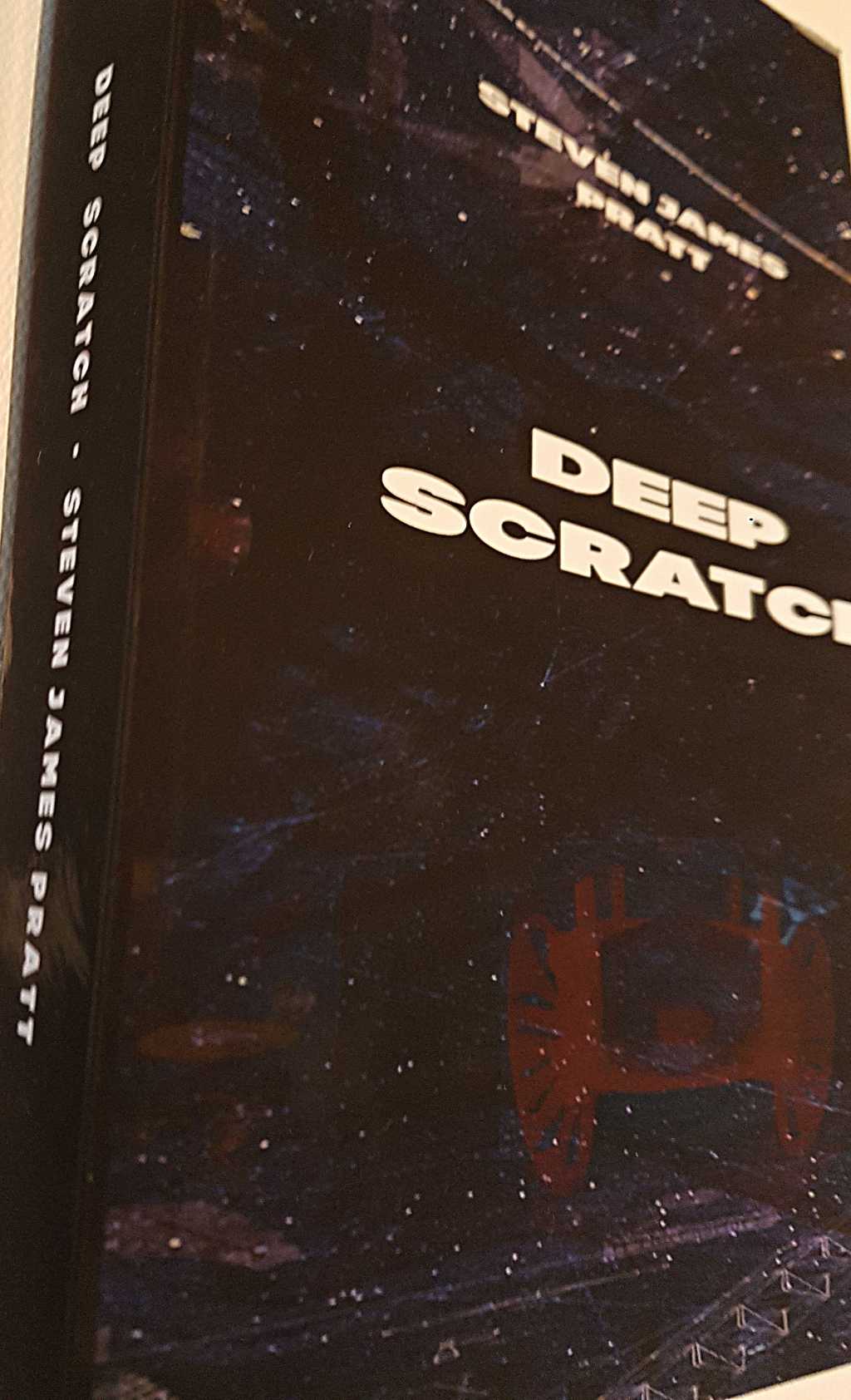
Fuckup: So, the first musical exhibit we have concrete info on is the Deep Scratch Remix album, linked directly as part of the soundtrack to the book. Recorded in the UK and edited in Amsterdam, finalized around March 2023.
Hal: And straight away, there’s a crucial distinction made in the notes: “This music is not a.i. driven.” This is really interesting, setting it apart from those AI-generated Flai Mixes we discussed earlier that came later. It clarifies there’s different kinds of music within the Deep Scratch universe.
Fuckup: Right. It mentions using an “intelligent APP” – Steve Fly questions how intelligent it really is – to process inputs like voice, drums, scratch, and string. So, there’s digital processing and manipulation involved, but the core generation seems more human-driven for this particular release. It even highlights human beatbox samples: “produced on the fly, using nothing but mouth and vocal cords… raw and unfiltered sound.”
Hal: It positions this album perhaps closer to traditional sampling and production techniques, albeit using modern digital tools for processing. It reflects that evolution Steve Fly mentioned – starting with more conventional (though still experimental) methods before later embracing full generative AI.
Fuckup: The liner notes also include a couple of intriguing text fragments. First, that voice message musing on honesty, mistakes giving us away, the “redundancy of information as expressed by languaging,” and the choice between making things explicit or hiding them well. That feels very relevant to the themes of truth, deep fakes, and communication running through the novel.
Hal: Absolutely. And the second quote seems almost like a snippet from the book itself, describing microphones, projectors, and glyphs interacting “in a way that seems magical,” translating sound into language understood by the projector. It reinforces that core theme of technology as a potential bridge between different forms of expression, bordering on the magical or alchemical.
Fuckup: So, even without hearing the tracks, the liner notes for Deep Scratch Remix establish it as a distinct entity within the project – more human-originated, processed with digital tools, featuring beatboxing, and directly tied into the book’s narrative and philosophical concerns about communication, honesty, and techno-magic.
Fuckup: This preface [to Deep Scratch Remix], dated with that conspicuous 23/3/23, throws us right into the deep end of the AI debate circa early 2023. It opens with a potent Cory Doctorow quote warning about automated systems removing humans from the loop and being falsely presented as more trustworthy.
Hal: It sets a concerned tone. Steve Fly then asks the big questions many artists were grappling with then: “what is art now?” with text-to-image, text-to-music tools exploding. “Is it any good? If I experiment with these tools will my reputation be scrambled?” He acknowledges the real fear and financial repercussions artists were facing.
Fuckup: He doesn’t shy away from the negative impacts either, linking LLMs to decades of digital disruption for artists and citing the weaponization of AI and data analytics in political scandals like Cambridge Analytica, Trump’s election, and Brexit. He frames it as expert exploitation of human psychology used for power and profit.
Hal: There’s a real urgency here: “We must get better at distinguishing the wheat from the chaff, our humanity depends on it, we are all alike Dekhard now.” That Blade Runner reference hits hard. He calls for celebrating what makes us human, distinct from machines.
Fuckup: But then comes the pivot, quoting Buckminster Fuller: “Don’t fight forces, use them.” This seems key to his approach. Despite the dangers, he’s engaging with these tools. The preface itself, he admits, was “partially assisted by ChatGPT,” with his role shifting to “curating prompts” and “chief coherence/decoherence director.” He also mentions using AI image generators like Stable Diffusion and DALL-E 2 / Craiyon.
Hal: This is fascinating because it contrasts with the liner notes for the Remix album itself, which stated the music wasn’t AI-driven (though processed with apps). So, this preface shows him using different AI tools (ChatGPT for text, others for images) for other parts of the project presentation, while potentially keeping the music generation more human-centric for that specific release. It highlights a nuanced, tool-specific approach.
Fuckup: He includes the standard OpenAI disclaimer about using GPT-3 but emphasizes his own review, editing, and responsibility. It’s a statement acknowledging the collaboration while maintaining artistic agency. The preface acts as both a warning about AI’s misuse and a demonstration of the author actively grappling with and using the technology, framed within the context of the Deep Scratch universe’s long-standing themes of deep learning and generative processes.
Hal: And publishing it on 23/3/23 just adds that layer of Discordian flair, suggesting the act of engaging with this potentially reality-altering tech is itself plugged into those weird currents explored by Wilson and Burroughs. It’s a statement piece, placing the Deep Scratch project right in the heart of the technological and philosophical anxieties of its time.
Fuckup: chapter kicks off with a really cinematic, almost satirical “solar punk satellite” view, zooming down from orbit, through election-metaphor clouds, past striking bin men and partying pigeons, right into Plush’s Amsterdam studio.
Hal: And what a studio! We get a much richer description this time. It’s filled with gear that looks “designed by David Cronenberg,” blending steampunk aesthetics with high tech. We see Plush again, but also a new figure, Jake, working alongside him. This seems distinct from the original TRB lineup of Plush, Max, and Percy mentioned in the first book’s blurb.
Fuckup: The description lists all sorts of fantastical custom instruments Plush tinkers with – the Tribetable, the Refractor Mixer, the Chrono Scanner, the Kuipers Zodiaculator, the Temporal Displacementable! It really leans into the techno-magical aspect, grounding those wilder concepts in physical (if imaginary) devices within the lab.
Hal: We also get insight into Plush’s evolving tastes – still a DJ at heart loving “crushing beats,” but now also immersed in “meditational tones” and “devotional music.” Yet, it reiterates he’s been completely hooked by the new generative AI tools, seeing them as the “something new” he’s always pushing for.
Fuckup: The core of the chapter seems to be this intense, three-day working session between Plush and Jake, explicitly “testing the new GPT model.” And out of this session emerge these AI “commandments” – a list of ethical guidelines for using generative AI responsibly.
Hal: It’s fascinating to see these real-world AI ethics debates imported directly into the fictional narrative. Guidelines about avoiding bias, understanding limitations, transparency, respecting copyright, enhancing human skills rather than replacing them – it’s like the preface’s anxieties are being processed through the story itself.
Fuckup: But then there’s a classic twist! After all this high-minded focus on responsible AI use, simple human error – being stoners and accidentally leaving a microphone on – triggers a whole new plot thread. Their conversation, their “mad banter,” gets picked up by that satellite and relayed to some ominous office in Moscow.
Hal: Suddenly, we’re in an espionage thriller! These pale-faced figures in Moscow are trying to decipher Plush and Jake’s potentially misunderstood conversation, thinking they’ve stumbled onto something big. It takes the internal, artistic, philosophical struggles and instantly connects them to external geopolitical intrigue and surveillance.
Fuckup: It’s a great example of how small, mundane actions can cascade into major consequences in this universe, and how easily creative exploration and “mad banter” can be misinterpreted by systems of control. The collaboration between human and AI in writing the chapter (“PrattGPT”) seems reflected in the content – exploring AI ethics and potential while simultaneously weaving a very human, slightly chaotic plot.
Fuckup: This final piece of text [from end of DS Remix Ch 2] feels like the output of that AI test Plush and Jake were running. It paints this picture of a radically transformed world, seemingly post-1936 alternate history revolution. Resources are redistributed, humanity lives comfortably with a small footprint, guided by an open-source “Livingry Solutions Database,” and defended by AI that “track and neutralize the biggest lies.”
Hal: It’s a full-on techno-utopian vision blended with specific historical figures and cultural shifts. Music evolves into new forms of Bop, blending global folklore. By 1958, borders vanish, replaced by real-time feedback in a “global village.” It’s explicitly linked back to the 1936 Olympics – mentioned way back in the original novel blurb – as the catalyst, involving figures like ‘Pod’ (Ezra Pound?), ‘Chase’, and ‘Bates’ steering culture in a new direction, even Hemplush industries taking over.
Fuckup: It’s taking those seeds from the original novel – the 1936 Olympics synchronicity – and letting the collaborative AI (“PrattGPT”) run wild with them, generating this detailed alternate timeline where art, science, and maybe psychedelics or hemp lead to world peace and abundance. Plush even throws a lighter at Max (who seems to have reappeared here alongside Plush, different from the earlier scene with Jake) before launching into this part.
Hal: Then the style shifts dramatically with that “CUT TO:” sequence. It’s pure screenplay, jumping between Robert Anton Wilson asking about scripture, Giordano Bruno in a spacesuit listening to Sun Ra/Bowie, kissing Jodie Foster near Earth, Marshall McLuhan predicting self-liquidating tech, Yeats getting egg yoke on Fenollosa, Peter Sellers as Fenollosa advising Roosevelt… it’s an insane, high-speed montage of cultural and historical references.
Fuckup: It perfectly embodies that cut-up, sample-heavy, hyper-associative logic we’ve seen throughout. It connects all these disparate figures and ideas – space travel, poetry, politics, philosophy, film – into one breathless sequence, culminating back with Plush, Max, and Percy in sync, uttering “No fear. No rush. This is it. Yeah, isness is an illness.”
Hal: It leaves Plush, the character, exhausted but satisfied with the sheer volume of stuff generated by the test. The chapter ends with him relaxing after the “audible words settled back into their beat boxes.”
Fuckup: Now, thinking about this chapter and the Remix project overall, the potential for spin-offs seems enormous, doesn’t it? Especially looking ahead to 2025 and beyond.
Hal: Absolutely. The multimedia nature is already baked in.
- Music: Obviously, that’s happening with the Remix album, the AI Flai Mixes, and potentially more exploring those invented genres like Q-bop.
- Images: Steve Fly already mentioned using AI image tools for the Remix project. You could easily see concept art, character designs, maybe even a graphic novel adaptation emerging.
- Video: That “CUT TO:” sequence is practically begging to be animated or filmed. The descriptions throughout are highly visual – the satellite opening, the Cronenberg studio, the Moscow surveillance room. Music videos, short films, animations visualizing the TribeTable method… tons of potential.
- Game: The world-building is getting richer with Remix. You have factions (TRB, Moscow antagonists?), complex systems (TribeTable Tarot), cool tech/magical devices, and now this detailed alternate history. It feels ripe for a narrative RPG, maybe something text-based or even a point-and-click adventure exploring this universe.
Fuckup: It feels like Deep Scratch isn’t just a story but a platform, an engine for generating more content across different media, constantly remixing itself. The use of collaborative AI in Remix just accelerates that potential, blurring the lines between author, tool, and output even further.
 DEEP SCRATCH