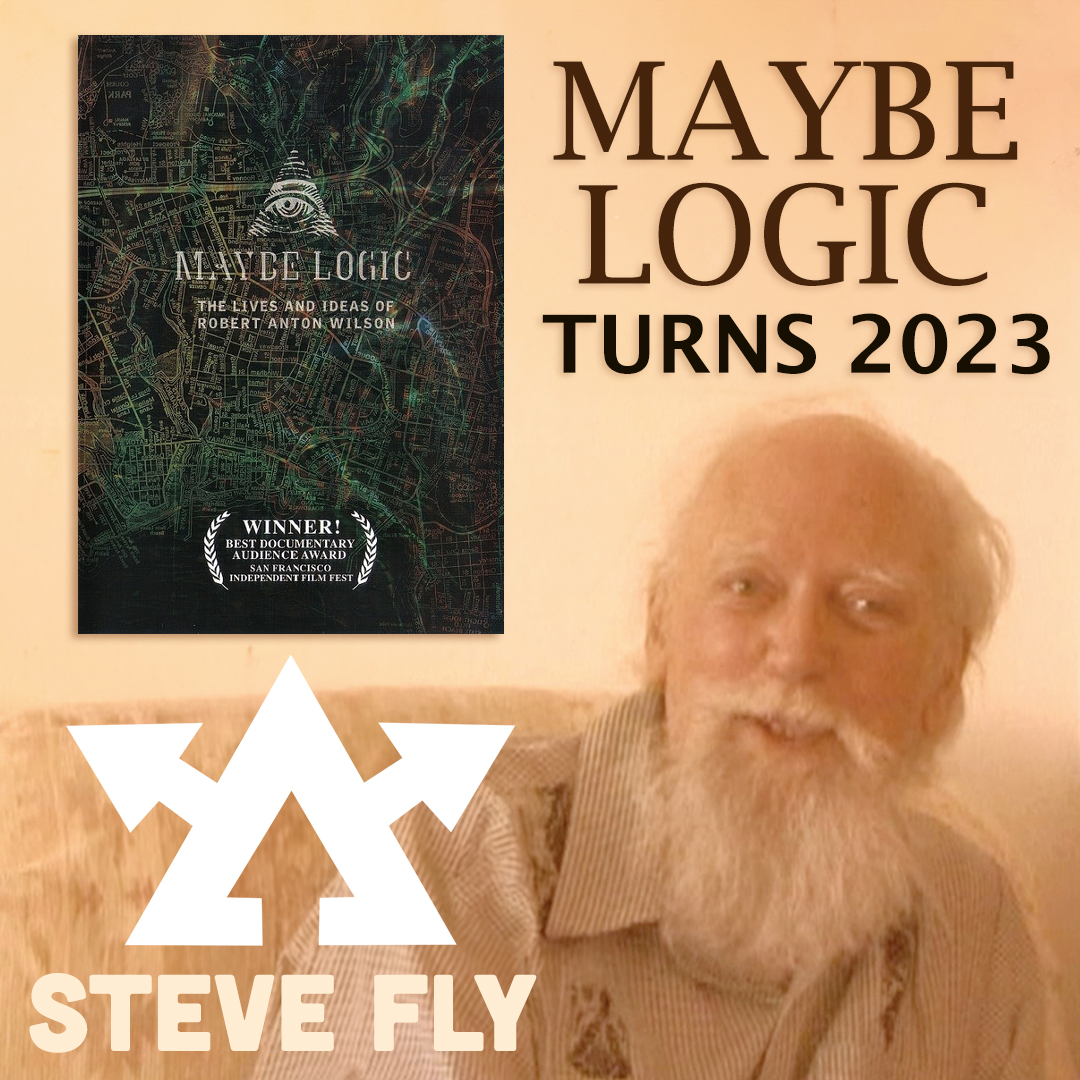
Maybe Logic: The Many Lives And Ideas Of Robert Anton Wilson, was released twenty years ago, July 23rd, 2003. It remains the only full length documentary film about Bob produced and released while he was alive. I suspect more will follow, including TV and Film adaptations of his fictional works, hold tight, we’re only just getting started. Maybe Logic is a good introduction for the initiate, with its straight ahead biographical slant. Twenty years later the film has gathered nineties retro-sensibilities that add to its early noughties appeal. Bob tipped me the wink about the project during a memorable interview at his home in Santa Cruz, September 10th 2002. And prior to that, I assisted in the filming of one of Bob’s lectures at The Learning Annex San Francisco, and some video editing, while working (as a volunteer) with audio archivist SoundPhotoSynthesis.
After my interview in 2002, I reached out to Lance Bauscher who was in the middle of the production process, I met with him and his Deep Leaf Productions associates in Santa Cruz. I felt honored to be generously given associate production credits on the film for assistance with boosting the soundtrack that included The Supplicants, Amon Tobin, The Cinematic Orchestra, Animals On Wheels and Funki Porcini, Boards Of Canada, Matt Elliot, Tarentel, Pullman and Ogen Spiroski (who recently released a beautiful ambient remix of his contribution to the film).
In 2003 I was living in San Francisco, until deciding to stay over in New Orleans after playing Jazz Festival in April. In July I left NOLA on a road trip across the states with my pal Ben Kappel, to arrive at the world premiere of Maybe Logic in Santa Cruz on July 23rd. This turned out to be the last time I saw Bob. Synchronicity was high, Ben and I were pulling on a crafty joint behind the theatre when he walked right out the door in front of us to his car (a black Jaguar). Before leaving, Ben and I showed our appreciation and paid our respects. The experience of seeing and hearing the film for the first time in a large theatre, was mind-enhancing and life changing. In the space of 3 years, I’d gone from sitting in my bedroom reading Bob’s books to interviewing him at his home and being credited on a film about him. This acts as evidence that with a vision and some will power anything is possible. Go out and see for yourself.
I developed a biased opinion that the film was the most important in the world at that moment, capable of bringing about a RAW renaissance in the minds of the people or to paraphrase Tom Robbins, you only need 15% of the population engaged with enlightenment culture to produce a fully enlightened culture, in this case enlightenment to mean engagement with the methods, principles and works of Robert Anton Wilson. The work continues. Eventually the full movie found its way onto youtube, thanks to the RAW Archive. Two years later (2005) I was back in the UK where I organized the UK premiere held at a local pub called The Birch Tree, I spun vinyl records and played the DVD from my laptop while drinking Vimto, so it goes.
Q & A
Q:So. Steve boy. How do you feel when you look back at that film today?
A: As James Brown said, I feel good. Try me! It’s a common thing to do, to romance and big up the past that fits your subjective experiences. This drummer can’t help it, the older he gets the more often his mind drifts to the past, the golden age, for me the turn of the millennium, the period leading up to the film and the groundbreaking on-line learning academy: Maybe Logic Academy (MLA) launched in 2004 with Bob alive and kicking, spurring everybody onward to think who was fortunate to be surfing in his wake. When I look at the film today I’m transported back to that time, the opportunity and the open-windows to remote learning. The internet, for me, was defined by the state of the art, digitally connected MLA. The MLA years (2004-2012) were the best years of my digital life on the web, so far. Acknowledging that will help understand my bias and overly optimistic hopes for the film and the Academy. Both of which, as I write this in Amsterdam, July 14th, 2023, are not functioning in a way that I would have hoped. So it goes. Thankfully we have MaybeDay, plus numerous other independently minded Bob heads, each carrying fragments of the extended story in their own way in new directions. HIlaritas Press are doing a fine job of republishing and keeping his work in print. My message to you, dear reader, is the same as it ever was: read him and read him again.
If you’d like some recommendations on the order of reading I’d say: Cosmic Trigger 1, Schrodinger’s Cat Trilogy, Reality Is What You Can Get Away With, TSOG, Email To The Universe, Prometheus Rising, Quantum Psychology, Masks Of The Illuminati, The Illuminati Papers, Coincidance, Ishtar Rising, The Historical Illuminatus, Sex Drugs And Magic. Illuminatus! Trilogy, Cosmic Trigger II, Cosmic Trigger III.
Q:What’s your favourite part of the film?
A:The part where Bob snaps up some Marijuana brownies from his wheelchair as a part of his support for the Women’s Alliance For Medical Marijuana, in Santa Cruz. This was back when the FED could bust into any premises they deemed to be breaking federal law, regardless of local tolerance and cooperative agreements. We have Bob and other brave poet activists to thank for consistent support for medicinal and recreational cannabis. It’s easy to underestimate the sacrifices made affecting their careers and popularity, hampered by association with illegal cannabis, which even back in 2003 was illegal across the US and most other countries, except most notably, The Netherlands.
Q:If you could edit, or remix the film today, what would you change or add?
A: I’d have added more salty content from his friends and peppered it with hot sprinkles from characters who made up his tale of the tribe, as described in his book TSOG. I would have referenced fields of Fuzzy Logic, Fuzzy Sets, innovated by the Iranian Azerbaijani mathematician, Lofti Zedah. I would add an array of updated footnotes and links, including links to the wide acceptance of quantum computing, multi valued logic, (impact and use of Markov Chains in Generative AI), evidenced foresight of Marshall McLuhan, Claude Shannon and Korzybski on our current Large Language Model global village monopoly. I’d ask for contributions from Adam Gorightly, Jesse Walker, Alan Moore, Matt Black, Bill Drummond, Jim Cauty, Daisy Campbell, Gabriel Kennedy, Bobby Campbell, Zack Leary, Rick Rasa, Christina Pearson, Lon Milo Duquette, Antero Alli, Erik Davis, Adam Curtis, Douglas Rushkoff, R.U. Sirius and Tom Robbins. And then there’s the soundtrack, can you imagine? All that said, the film should remain as it is, a time capsule and artwork from its time.
Q, Bobby Campbell: Did the idea for the phrase “maybe logic” as an encapsulation of RAW’s philosophy pre-exist the documentary? Or was it developed as part of the process of making the film?
A: Thanks for the question Bobby, we’re on the same track here, as you will have read above, a definition of Fuzzy Logic would be a good solid foundation for approaching what can be squeezed into “Maybe Logic” as RAW used the term. As far as I know, before the documentary was made, RAW used the title: “The Universe Contains A Maybe” for more than one of his performances, I think his presentation from The Prophets Conference, Palm Springs, had that title. Together with the decision of Lance to use Maybe Logic as a title for the film, which in itself had added extra accent on Maybe as opposed to Fuzzy, which falls more neatly into the branches of mathematics innovated by Lofti Zedah, that in some sense, continues or adds to, the principles and methodologies RAW found interesting: the Hologrammic Prose of Joyce, Ideogrammic Method of Pound / Fenollosa, Information Theory of Shannon, Non-Aristotelian logic of Korzybski, the dymaxion and tensegrity design-science solutions of Buckminster Fuller. A high six and “yeah man” to all those continuing the work, keeping heads held high and maintaining a kind outlook and inlook.
Q: Why is Maybe Logic important today?
A: As you’re reading this, I hope you see how easy it comes to the present author to write positive reviews about Bob and his books and ideas. I’ve shed hundreds of thousands of words on this question of why? To give you just one reason I’ll say: our survival as a species and your sanity depend on it. To give a few more reasons:
The Maybe Logic Academy (2004 – 2012) was an on-line, decentralized learning Academy, featuring ideas and live feedback of RAW, plus writers and researchers Antero Alli, Erik Davis, Douglas Rushkoff, R.U Sirius, Mark Pesce, Phil Farber, Phil Hine, Luke Reinhardt, Patricia Monaghan, Lon Milo Duquette and others. I can’t shake the urge to imagine what the MLA would be like in 2023, so here’s some communications from MLA faculty. On point and stirring.
EXHIBITS:
https://rushkoff.medium.com/the-media-ecology-of-succession-ccbcf174da72
Douglas Ruskoff: The Media Ecology of ‘Succession’
“As McLuhan used to say, the prior medium becomes the content of the new one. Stage plays were the first content of television. Television is now the first content of the Internet. The medium is reduced to mere content.”
Erik Davis on Antero Ali:
https://www.burningshore.com/p/the-weird-and-the-banal
“Alli also reminds us, however, that weirdness is a feature of objective reality, or at least the picture that physics paints of said reality. In other words, the weird will not be vaporized anytime soon, especially as we dive ever more deeply into the quantum future. But Alli’s most intriguing suggestion is that weirdness may be identified with potential itself: the not-yet, the what-if, the excluded middle, the “nobody” that we really are. The real question, then, is whether AI will further expand the field of potential for anything other than capital. Will it help maintain the openness that characterizes the human (and some of its posthuman possibilities)? Or will it iteratively stitch up that weirdly sacred nebulosity, collapsing the open field into a vanishing point of no return?
https://magazine.mindplex.ai/steal-this-singularity-the-yippies-started-the-digital-revolution/
R.U Sirius: Steal This Singularity (The Yippies Started The Digital Revolution)
“Another Yippie contribution is the use of McLuhanism as a weapon in the countercultural revolution. Hoffman, Jerry Rubin and the other original YIPs took an idealistic youthful new left that was sort of basic and organic, and a mirror of the folk music that they loved, and made it “go electric” (a term used for when Bob Dylan started using rock ’n’ roll to communicate his increasingly surrealistic cultural critique.) That the medium is the message was central to their strategy for an anarchic left-wing sex, drugs & rock ’n’ roll youth revolution. Hoffman’s 1969 book ‘Revolution For the Hell of It’ is saturated with McLuhan references and strategies for how a freak left could take over America, end war and racism. and bring about a post-work celebratory psychedelic utopia. ‘Do It!’ yippie prankster/leader Jerry Rubin’s 1969 book was ‘zapped’ (i.e. designed) by Quentin Fiore, the same force behind ‘The Medium is the Massage’, McLuhan’s most successful incursion into the popular mind. The YIPs had faith that, being native to television and rock ’n’ roll radio, they had an intuitive understanding of the era that outmatched the dinosaurs of the establishment. They could bring the already rebellious rock ’n’ roll media babies into their utopian revolution.
Mark Pesce: It’s time to reveal all recommendation algorithms – by law if necessary.
https://www.theregister.com/2023/04/13/reveal_all_recommendation_algorithms
“The solution to both issues is obvious, technically easy, and yet commercially a nearly impossible proposition: open up all recommendation algorithms. Make them completely transparent, and, for the individual being targeted by the recommendation engine, completely programmable.
I should not only be able to interrogate how I got a horrifying video of a very bad case of pimples, I should be able to get in there and tune things so that the algorithm no longer needs to guess my needs, because I have had the opportunity to make those needs clear.
Every algorithm that recommends things to us – music or movies or podcasts or stories or news reports – should be completely visible. There must be nothing secret behind the scenes, because we know now from countless examples – the biggest and ugliest being Cambridge Analytica – how recommendations can be used to drive us to extremes of belief, emotion – even action. That’s too much power to leave with an algorithm, and too much control to cede to those who tend those algorithms.”
Prop Anon: Chapel Perilous – The Life and Thought Crimes of Robert Anton Wilson
https://mitpress.mit.edu/9781913689568/chapel-perilous/
“Chapel Perilous: The Life and Thought Crimes of Robert Anton Wilson is the first biography of the late countercultural novelist and underground philosopher, Robert Anton Wilson.
Author with Robert Shea of ILLUMINATUS!—one of American literature’s most notorious novels—Wilson’s life and work were infused with magical insight and strange occurrence, apparently fated traumas and puckish tricksterism. His experiences of paranoia, celestial influence, and conspiracy have come to furnish both speculative thought and fiction with a unique repertoire of thought experiments, while his legacy might be recognized in the work of writers as diverse as Alan Moore, Douglas Rushkoff, and Tom Robbins.
In this far-reaching biography, Gabriel Kennedy charts the undergrowth of Wilson’s influence, suggesting that the pulp venues, quack pamphlets, and oddball websites through which his work was usually distributed, allowed him to quietly become one of the most prescient American writers of the 20th century, and one of the 21st’s most salient.
Phil Farber: on Magick, NLP, Crowley & RAW.
https://www.youtube.com/watch?v=Mt0aUNNN2PQ
In this episode, we chat with Meta-Magician Philip Farber on Magick, NLP, Crowley & Robert Anton Wilson. Phil is the author of several books, including “High Magick, a guide to Cannabis in Ritual and Mysticism.” He’s also a regular speaker at the Starwood Festival and other events.
https://www.llewellyn.com/product.php?ean=9780738773513
Lon Milo Duquette: AN ACCIDENTAL CHRIST: The Story of Jesus as Told by His Uncle.
A groundbreaking and irreverent retelling of the Gospel narrative. DuQuette draws on modern scholarship and his depth of esoteric wisdom to offer a plausible case for just how distorted the Jesus myth may have become. Funny, tragic, and remarkably plausible, this novel both inspires and challenges our thinking about Jesus.
https://mitpress.mit.edu/9781907222931/delinquent-elementals/
Phil Hine: Delinquent Elementals: The Very Best of Pagan News. Edited by Phil Hine and Rodney Orpheus
“Delinquent Elementals: The Very Best of Pagan News collects some of the finest articles, news reports, interviews, and humor that appeared in this singular publication, providing a fascinating glimpse into the pagan counterculture. It charts the historical timeline of the Satanic Panic scandal of the late 1980s, documents previously uncollected information, and provides a wide selection of practical knowledge and insight into occult practice. It reveals how occult practitioners interacted with the wider culture—bringing about what is now termed “occulture”: the intersection of esoteric themes with popular culture, political activism, and the struggle for LGBTQ rights and recognition. Wonderfully unpretentious and absurdly funny, this is the definitive guide to the magazine that redefined the nature of late-twentieth century occultism.
Erik Davis: High Weirdness
https://mitpress.mit.edu/9781907222870/high-weirdness/
“A study of the spiritual provocations to be found in the work of Philip K. Dick, Terence McKenna, and Robert Anton Wilson, High Weirdness charts the emergence of a new psychedelic spirituality that arose from the American counterculture of the 1970s. These three authors changed the way millions of readers thought, dreamed, and experienced reality—but how did their writings reflect, as well as shape, the seismic cultural shifts taking place in America?
Next among the cavalcade of AI folk monsters: the “Masked Shoggoth.” The Shoggoth is an alien monster invented by the cosmic horror writer H.P. Lovecraft. The Shoggoth is a huge, boneless slave beast that sprouts eyes and tentacles at random. It’s a creepy beast-of-burden from outer space, and it’s forced to labor, but it’s filled with a silent, burning, unnatural resentment for its subjugation.
https://www.newsweek.com/2023/07/21/ai-scariest-beast-ever-created-says-sci-fi-writer-bruce-sterling-1809439.html
So, the human programmers of today’s new AIs—those text-to-image generators, those Large Language Model GPT chatbots—they adore this alien monster. They deliberately place a little smiley-face Mask on the horrid Shoggoth, so that the public will not realize that they’re trifling with a formless ooze that’s eldritch, vast and uncontrollable.
These AI technicians trade folksy, meme-style cartoons among themselves, where ghastly Shoggoths, sporting funny masks, get wry, catchy captions as they wreak havoc. I collect those images. So far I’ve got two dozen, while the Masked Shoggoth recently guest-starred in The New York Times.–Bruce Sterling, AI Is The Scariest Beast Ever Created.
RAW Semantics: RAW As Media Critic
https://rawsemantics.home.blog/2023/04/06/raw-as-media-critic-1/
“The broader the “takedown” of “The Media Narrative”, the more “ballsy”, uncompromising and indicative of “integrity” it evidently seems to fans of this approach. To my present sensibilities, though, it looks corny, clickbaity and one step from demagogic. (As if the bigger the semantic sweep, the more “boss” the circuit-2 credentials).
Yes, folks – I think Wilson’s “sombunall” applies to “the media”, as to other collective abstractions. Perhaps more so in some ways, since we’re talking about a realm of “communication” rather than anything imaginable as concrete entities or entity. (And: “No two brains are totally alike, just as no two fingerprints are.” – RAW, Everything Is Under Control, intro).
Interacting, processing – the Maybe Logic Academy By Toby Philpott aka Bogus Magus
“What a fascinating group of people turned up! RAW’s writing attracts all kinds of people, of course, not all of whom agree about things, but we stuck to the guideline – “In this area of cyberspace we only have one rule: If you can’t achieve tolerance, at least attempt courtesy”. And RAW would frequently join in conversations, with gnomic interventions.
MORE LINKS FOR YER’ NOGGIN’
Prometheus Rising Audio Book
https://www.hilaritaspress.com/portfolio-item/prometheus-rising-audio-book/
Bobby Campbell: RAW Art
https://www.hilaritaspress.com/portfolio-item/raw-art-by-bobby-campbell/
Daisy Eris Campbell: Cosmic Trigger The Play
https://www.hilaritaspress.com/portfolio-item/cosmic-trigger-the-play/
Robert Anton Wilson: TSOG The Thing That Ate The Constitution
“The master satirist shines light on the recent parapolitical history of the TSOG—the Tsarist Occupation Government—that now masquerades as the U.S. political and cultural leadership. It’s all here with familiar humor and new insight. Like the Id-creature in Forbidden Planet, Wilson’s brilliance reveals the outline of the monster right now chomping on America.” — Kenn Thomas, Steamshovel Press.
https://www.hilaritaspress.com/portfolio-item/tsog-the-thing-that-ate-the-constitution-and-other-everyday-monsters/
“An Afternoon With RAW
“Robert Anton Wilson and Robert Shea. Blog, Internet resources, online reading groups, articles and interviews, Illuminatus! info.”
http://www.rawillumination.net/
“Maybe Logic OST – The Lives and Ideas of Robert Anton Wilson
https://aaamuzika.bandcamp.com/album/maybe-logic-ost-the-lives-and-ideas-of-robert-anton-wilson
“Hilaritas Podcast Series:
https://www.youtube.com/@hilaritaspresspodcasts6111
“From Quakenbush:
https://rawilsonfans.org/
 DEEP SCRATCH