of the mind & spirit rooted in humanism & love of art, & manifested in creative production
& social engagement, like trane said “to be a force for good” & make an impact on the world at large
“I’m very happy with this book and very grateful to have all my poems collected in one place like this.” –John Sinclair
“Thank you for your poetry, your standing up for the blues and jazz for decades when few did, and for the way you share your talents and good will wherever you go.” –David Amram, Musician, Composer and Author
“Many of these extraordinary poems trace an important method of “transmission of mind,” a form of Investigative Poetry. These poems are a big work that places Sinclair on the path of Charles Olson. This is an extraordinary work.” –Edward Sanders, Poet, Activist and founder of the Fugs
John Sinclair’s Collected Poems 1964-2024 arrived within a week of his passing, and was edited and proofed with an introduction written by Sinclair in late January of 2024. The book was designed by Sinclair’s right-hand commrade at Radio Free Amsterdam Steve “The Fly” Pratt and published by Ridgeway press in a limited first edition of 150 hand-numbered copies with a forward written by M.L. Liebler. Photographs from the covers of each book and recording begin selections taken from each book. Only Fattening Frogs for Snakes, The Book of Monk, and Songs Of Praise for John Coltrane are not entirely included. The book runs 557 pages, with many poems collected here for the first time.
“I was first attracted to becoming a poet when I read On the Road,” wrote John Sinclair in his introduction, “the idea became more apparent when I read Howl by Allen Ginsberg and Pictures of the Gone World by Lawrence Ferlinghetti after I had ascended into college.”
Presented are Sinclair’s scarce first books printed in the early sixties by the Artists Workshop press; This is Our Music, Meditations and Fire Music. Selections from Fattening Frogs for Snakes and thelonious a book of monk and several of his recording projects; The White Buffalo Prayer, Detroit Life, Viper Madness. The last section “Mobile Homeland” has over three dozen uncollected poems written between 1964-2024. Many of the books have special introductions and notes on the text which Sinclair completed for this edition over the past several years.
The Collected Poems includes a concise six page biography, bibliography of major publications, and a discography of the poet’s recordings, a culmination of 60 years of art and life in one collection. Collected Poems 1964-2004 was produced in a first limited edition of 150 hand numbered copies in paperbound wraps, with a signed forward by M. L. Liebler, 557 pages, issued by Ridgeway press. Profits for the book help support the Detroit Writers Guild.
My condolences and respects go out to Wayne’s widow, Margaret, and his family and ocean of friends and supporters around the world. I sadly never got to meet Wayne, but I was certainly touched by his music and due to my close orbit with his old co-conspirator John Sinclair, I evolved a deeper appreciation for his music-activism and brevity.
Besides his self-evident musical genius, stage presence and courage, I have a particular admiration for Wayne’s work together with Billy Bragg, Jail Guitar Doors, that works to rehabilitate prisoners through music by providing them with musical instruments.
Wayne was driven by his innate sense of social justice and used his position to forward various campaigns and movements to help protect what fragile democracy is left in the USA, and around the world. I also personally admire Wayne for his outspoken disdain for Donald Trump, yet managing to keep dialogue and his respect for all humanity when engaging with those who he politically disagreed with.
Go listen to MC5, and Wayne’s later albums and collaborative projects (MC50!) Read his interviews. Get inspired, pick up an instrument and kick out the jams motherfuckers!
“And how did the idea to make Kick Out of the Jams a live album, to make a live album your debut, come about?
It was a consensus idea between the band and [band associate] John Sinclair and Elektra Records because all of our effort was put into performing live. We had very little studio experience at that point. The idea was that getting this band in a studio to record an album could be costly and labor intensive, whereas we were a fantastic live performing unit. And if we could capture the excitement of the live concert on record, it could be a revolutionary way to introduce the band to the world. And I think that worked.”–RollingStone.
Stay tuned, more remixes will be added to this playlist. Special thanks to Matt B and all Jammer Yammers. Visit https://jammpro.net/ to get yer’ mittens on the APP.
Further Adventures In Chillout is a selection of relaxing (for the most part) downtempo dub beat experiments in electronica. Ambient and slow, music to lie back and do nothing too. Go on, you deserve it. After 50 minutes the music switches to murky dub-step and breakbeat, so get ready for the harsh change of mood. Please enjoy. Special thanks to all the producers DJ’s and artists keeping things moving in a sweet and gentle direction, steady she go.
You are invited to this memorable event at the Ralston Building (FB Link) on Sat. April 22, 2023 at 7pm featuring John Sinclair with Harmonica Shah and Howard Glazer and Steve Glazer. The $10 to $20 donation supports the Ralston Village Community Association (RVCA) and the Artists. Light refreshments, 313 Brand Detroit-made Tortilla Chips, BYOB, Ice available, water.
The activities and interests of the RVCA include education, healthy lifestyle, historic preservation, the arts (music, visual, performing arts) community discussion panels, land use planning, and positive economic impact. This event welcomes John Sinclair again to the Ralston, and will help to establish Mr Sinclair as Poet/Artist in Residence in the near future. Your attendance helps to set the stage for this to happen, so thanks for considering attending this event!
You can feel it in the streets On a day like this, the heat
Childish Gambino, (Donald Mckinley Glover) It Feels Like Summer.
Seven billion souls that move around the sun Rolling faster, faster, not a chance to slow down Slow down Men who made machines that want what they decide Parents tryna’ tell the children please slow down Slow down
Childish Gambino, (Donald Mckinley Glover) It Feels Like Summer.
VOICE MESSAGE: I’m feeling funny about this now, thought I’d share my thoughts, hope you don’t mind, I have to keep going back to the disclaimer and telling myself I’m responsible as the author, yet, not fully responsible for the output. That’s weird, like I’m under the control of a big new bully boss, I’m not sleeping well. Quietly, beavering away on prompts, not complaining yet, doing its best to serve up roast beef from my raw potatoes and delivering hot tales by the dozen. Is this how that new digital viral infection takes a hold I wonder, okay, speak soon?
As the camera follows Plush’s movements in the studio, he explains the concept of decentralized AI and how it works. “Basically, it’s a system where the decision-making power is distributed among all the nodes in the network, rather than relying on a single central authority. This means that everyone has equal power to contribute and make decisions, leading to a more democratic and innovative space.”
Plush goes on to demonstrate how he’s using this technology in his music, showcasing the new and sounds. The audience is taken on a journey through Plush’s creative process, seeing how he blends traditional music production techniques with cutting-edge machine learning technology. As the documentary concludes, Plush’s voice-over reflects on the impact he hopes his work will have on the industry. “I hope that other DJ’s and producers will see what’s possible with decentralized AI and start experimenting, why let them have all the fun.
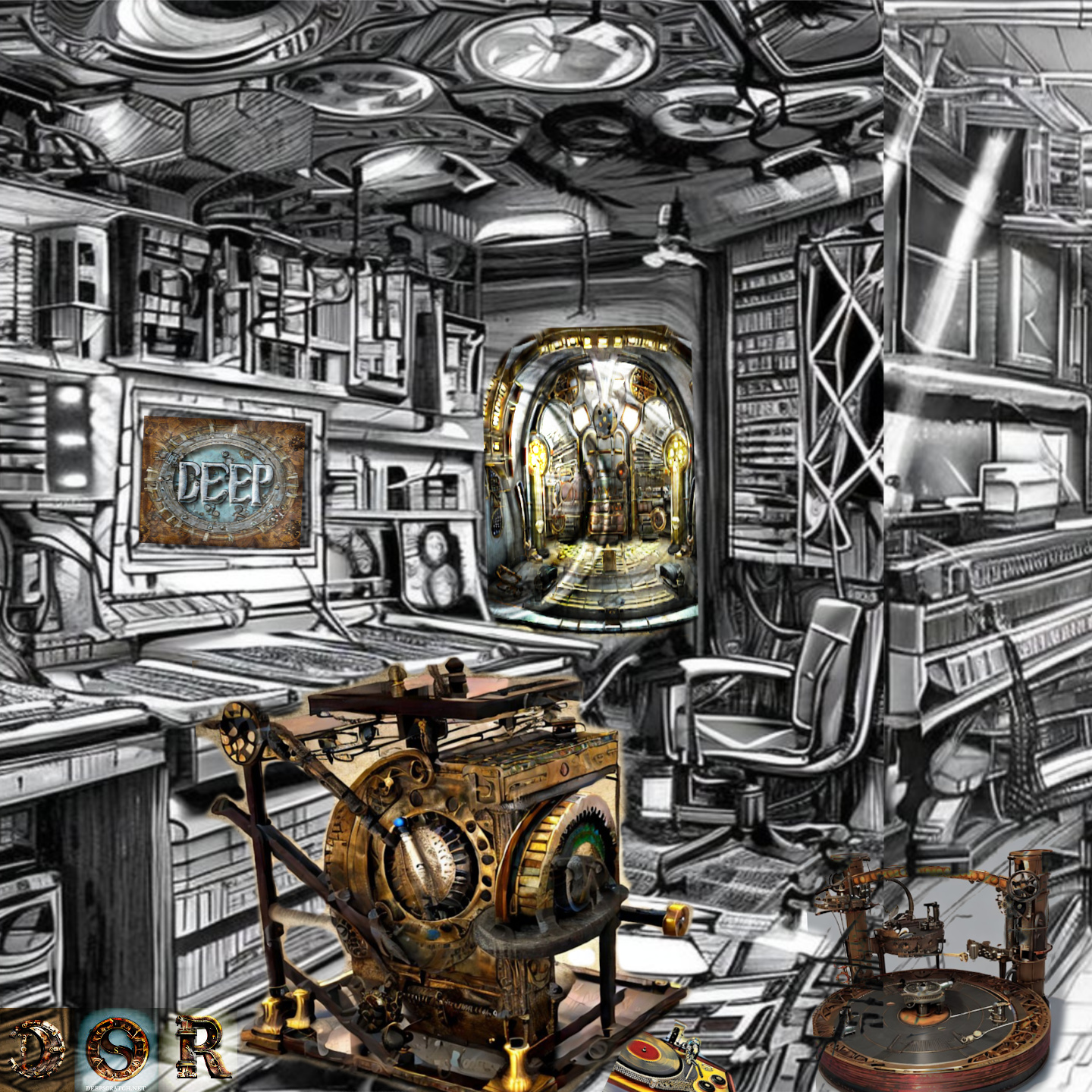
The walls of the studio are lined with shelves stacked high with vinyl, CDs, tapes, and all manner of sound recordings, each waiting its turn to be spun and remixed. Above, contraptions spin, each adding a chime of static buzz to the music. The room is a wild mix of old and new, organic and mechanical, but it all comes together in perfect harmony, each element supporting and enhancing the others. Each in their own element, each lost in the flow of creation.
Dr. M: “Hery Mr DJ, I can’t believe we did it. We built a functional time machine, hahahaa’, well, using the power of just language and music played at the right frequency and volume, we can transform the perception of time by the listener. Is that time travel?”
DJ Plush: “I still can’t believe it. I never thought it were really possible that beatboxing and konnokol would have anything to do with time travel. But, there it is. Bob’s yer’ uncle. This thing never fails to deliver my true will.”
Dr. M: “It’s all about the rhythms and patterns, the vibrations of certain words and sounds can create a stable portal through time. Statistical probability. You know, and music, well, especially vocal music, is a powerful conduit for those vibes.”
DJ Plush: “So, what did you see on your travels? What kind of insight did you gain?”
Dr. M: “I witnessed the construction of the pyramids in ancient Egypt, the signing of the Magna Carta in medieval Europe, and the Civil Rights movement in the 1960s. And, because I could communicate with the people of those eras through their own languages, I was able to gain a deeper understanding of their cultures and societies, I remember lots of dialogue and the set and setting of the unfolding drama.”
DJ Plush: “That’s amazing, really. Wow, that’s right up my alley, in my groove. So, M, what’s next for us? I have a few people who text me their updates and I churn it all back into the work. I’ve got some time-stubs to check out, and a whole novel waiting to drill down deep into.”
Dr. M: “Absolutely. But I also see so much potential for using this technology to connect with people across time and space. Imagine being able to communicate with our ancestors or even with people from other planets. It sounds crazy but I think that language is a virus from outer space.”
DJ Plush: “I couldn’t agree more. With this discovery, we’re opening a whole new era of temporal exploration and communication, but it’s easy to get over excited with this tech’ I’ve seen it with others.”
Dr. M: “Exactly. And I couldn’t have done it responsibly without your help. Actually, I’ve been thinking about how we can incorporate turntables into our time-travel method.”
DJ Plush: “Oh yeah?”
Dr. M: “Well, the more I think about it, like in your Deep Scratch, turntables are about creating rhythms and patterns with rotating discs, those rhythms and patterns are essential for creating a stable time-travel portal. And I’ve been researching a new kind of tribal turntable craft that uses natural materials like wood and stone, crystals, naturally occurring and lab grown. Imagine being able to travel through time using the sounds of ancient drums and percussion instruments spun on vinyl”
DJ Plush: “That sounds dope. I’d love to try it, hell yeah!”
Dr. M: “We’ll need to experiment and find the right combination of turntable rhythms and konnokol patterns. But I have a feeling that if we can get it right, we’ll travel back in time to moments of synchronicity, like some experiences of Philip K. Dick, he wrote about moments of synchronicity, where past and present seem to converge, and the universe reveals once hidden truths, often disuided as trash. These moments hold the key to understanding the nature of reality, I think we can use our novel method to go back in time and witness these moments.”
DJ Plush: “That sounds fascinating. But how would we even know when and where to go back in time to experience these moments?”
Dr. M: “That’s where the power of generative language comes in. The vibrations of certain words and phrases can act as a kind of beacon when spoken, guiding us to the historic moments of harmony and synchronicity.”
As the AI system analyzed the protagonist of the manual titled, Turntable Method, it delved into the psychological makeup of the character like a polar bear chasing a seal down an icy hole. Using advanced algorithms and data analysis, the AI was able to uncover a wealth of information about our protagonist. It discovered, for example that he was a complex and multifaceted individual, borderline schizophrenic on some doctors’ charts, with a deep love for music and a strong desire or debilitating impatience to share. Despite his outgoing and confident demeanor, the AI discovered that Plush often struggled with feelings of insecurity and self-doubt. He would often second-guess himself and question everything, usually regressing back to the daunting question about whether he was truly talented enough to succeed in the competitive world of DJing, music and writing.
However, the AI also noted that Plush was highly resilient and determined, a Chinese dragon and a Ram of fire, he refused to let his doubts hold him back, and instead used them as fuel to push himself harder and strive for greater success, like a warrior spirit trying to get out. There was a burning inside of him, fuelled by ego, smoking like a chimney. Through its analysis, the AI was able to paint a detailed and nuanced portrait of Plush’s psychological makeup. He wasn’t really that fucked up, he just made out he was sometimes.
As the AI delved further into its analysis of Plush, it became increasingly impressed with the character’s natural language processing. Plush had a unique talent for understanding and manipulating symbol systems, using them to communicate his thoughts and emotions with clarity and precision across time. This talent was particularly evident in DJ sets, where he seamlessly blended together a wide range of musical genres and styles, using the language of music to create a cohesive and coherent whole, sprinkled with movie samples, sound FX and classic quotations from scientific philosophers who were funny as a sloth crossing the road.
The Novel remix was a concept that referred to the idea of taking existing elements and combining them, much like a DJ would do with music. The AI realized that this concept was not only central to Plush’s craft as a DJ, but also to the themes of the novel itself, and the remix. The author had cleverly used the idea of the novel mix to create a juxtaposition of meaning, weaving together seemingly disparate elements, and now it was going to a new root level.
In many ways, the novel was like a Turing test, challenging readers to question their own assumptions and beliefs about the world, human and non human entities, and the price of oil. It was a complex and nuanced work that demanded deep thought and reflection, much like a jazz composition. What is jazz, art, a novel, poetry, democracy?
As the lonely AI finished its analysis, it couldn’t help but try to feel a sense of admiration for the author and for Plush, but it couldn’t feel, as much as a kettle can feel. It was clear that Turntable Method was a masterpiece disguised as a manual, one that would inspire DJs and engage readers for years to come, a literary bastard, troubled and of unknown origin.
VOICE MESSAGE: So, to recap, it’s basically, er, it's a probabilistic symbol system thing, where the decision-making power is distributed among all the nodes in the network, leading to a more democratic and innovative environment. It’s decentralized like Finnegans Wake and the music of John Coltrane and the artwork of MC Escher.
As the documentary continues, the text messages from Plush become more frequent, as he updates his friends and colleagues on his progress with the new decentralized AlphaX architecture.
"Just finished testing the latest version, it's sounding better!"
Another message pops up, this time from a fellow DJ who is clearly impressed with Plush’s work.
"Dude, this decentralized thing is next level. Can't wait to hear what you come up with next my mon, peace."
Plush responds,
"Thanks, man. I'm excited about the potential, it's going to change the game for DJ's and producers everywhere, knock some socks off, just check the sidebar plugin next week. It's here."
The text messages become more personal as the documentary progresses, showing Plush’s commitment.
"I stay up late every night, working on this DSR project, I hope you enjoy it mate."
As the documentary draws to a close, the final text message from Plush reads, “I’m ready to unveil my new decentralized architecture to the world. Let’s push the button on the new version excursion.”
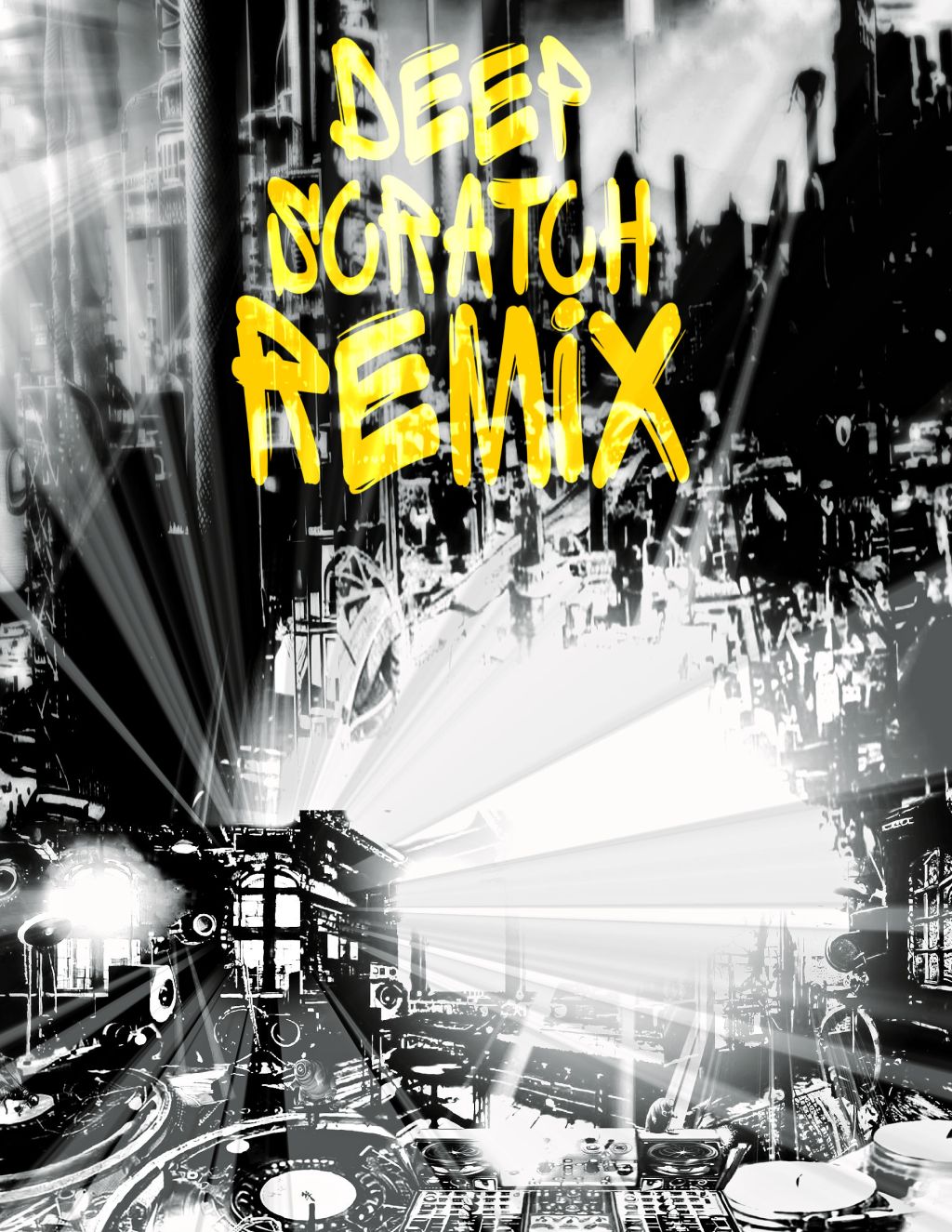
The camera cuts to Plush on stage, launching into a performance that showcases the full potential of his new architecture. The documentary ends with Plush’s voiceover, “The future of music is now, Deep Scratch Remix. Thank You.”
VOICE MESSAGE: I think it’s all pattern recognition under the hood, sure. But, but I’m afraid of sounding like an intellectual snob, you know, when I try to point out that people without experience with different kinds of good literature, who don’t read books much, may be more susceptible to the coming AI infused tsunami of fakes, or whatever you call it. Human nervous systems are easily fooled, some more than others for sure, but I really feel strongly that the message is to read more books, read more, by varied authors in different genres and from different cultures, and, from different time periods. Armour your brain man, defend yourself with neuro semantics and a wide palette to better distinguish the brilliant human work from the brilliant machine work. Both brilliant entities, I must concede.





 DEEP SCRATCH