As the president’s most tireless online antagonists repeat hourly, Trump would seem to be a prime candidate for impeachment and/or removal from office, if not under Article II, Section 4, then using Section 4 of the 25th Amendment, which provides a means of removing a president on grounds of impairment (“unable to discharge the powers and duties of his office”).—http://theweek.com/articles/698288/theres-no-waking-from-americas-trump-nightmare
Author: flyagaric23
-
If not Article II, Section 4, then using Section 4 of the 25th Amendment
-
Cosmic Trigger audio book
The story behind RAW’s Cosmic Trigger Audio Book
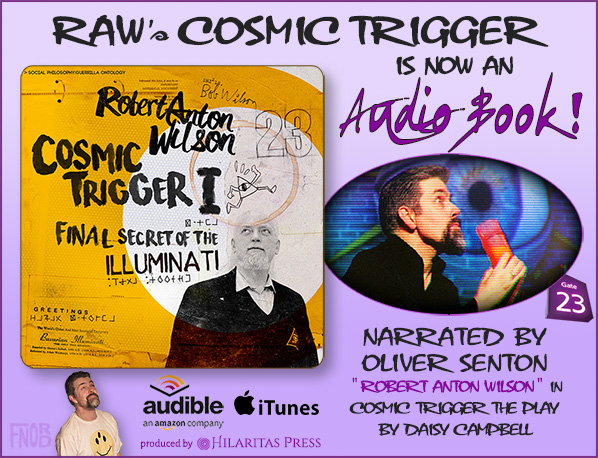
posted by RasaEver since I heard Ken Campbell reading Part One of Illuminatus! in the 2007 Deepleaf Audio production, I had the idea in my head that I’d love to hear an audio book of Cosmic Trigger, and Prometheus Rising, and, well, most of Bob’s books. It took some years for Christina to sort out her dad’s legal affairs enough that we could create Hilaritas Press, start republishing mosbunall of Bob’s books, and then begin thinking of creative ways to further Bob’s works and ideas. In early 2014, Daisy Campbell began to pull together the resources and diverse energies needed to pull the Cosmic Trigger and create her stage adaptation. The RAW Trust was in full support, and already thinking of how the production could one day be staged in Santa Cruz. While Daisy realized her inspired interpretation of Cosmic Trigger, we were creating HIlaritas Press and publishing Cosmic Trigger as our first RAW title.Oliver Senton, narrator for the audio book, played Robert Anton Wilson in Daisy Campbell’s “Cosmic Trigger – The Play”Watching video clips of the production led me to write an email to Daisy in March of 2016, asking her thoughts on making Cosmic Trigger into an audio book. Her response was enthusiastic, and she immediately said, “The best possible man for the audio job would be Oliver Senton who played Bob in the play.”Oliver was equally enthusiastic. Before he went into the recording studio to begin the project, he wrote to Christina,“I have a strong faith that your father’s works are going to grow and grow in popularity and appreciation in the coming years, and that this re-framing of them you’re currently undertaking can only accentuate that. Rereading Cosmic Trigger Part I recently has only reminded me of how much brilliant thought and “feeling good” there is there. Truly, his was a mighty heart.”Christina and I were ecstatic – we had an amazing book and a great actor to narrate – now we only had to make the thing. Easier imagined than done, but the RAW community has a lot of talent. I asked Steve “fly agaric 23” Pratt if he might be able to lend a hand. Oliver knew Steve as the drummer in Daisy’s stage production of Cosmic Trigger. I knew Steve, from back in early 2012 when he approached the Trust about his RAW360 virtual reality project. Steve lives in Amsterdam, doing a wide array of creative projects, and working a lot in the last years with poet/activist John Sinclair. I put Steve in touch with Oliver, and since I was more than 5000 miles away, and Oliver and Steve only had the English Channel to deal with, I took a back seat. That was a great decision. I’m taking the same tack in writing this blog post and letting Steve and Oliver take over . . .Steve writes . . .“Pull It!”Finally the final secret of the Illuminati is out in the air, the Cosmic Trigger audio book project comes 40 years after the book was penned by RAW, and with luck will inspire new generations to come.The project reflects a labour-of-love on behalf of all involved, from the studio recording itself, through the fine tooth-comb editing, and preparations for the audio book launch. To repeat a popular phrase in Cosmic Trigger circles, ‘heroic’ – defines the project perfectly.RAW often suggested (in his Finnegans Wake writings) that reading a text aloud can unlock what were once dormant meanings in the text. Along lines sketched out by Marshall McLuhan, RAW also propagated signals inferring that the medium defines the message, and listening to speech impacts differently on the brain-body system than reading text silently in your head. The ear world and the eye world and the interacting processes of all the senses together, produce a holistic experience in time. This audio book can literally open up new dimensions, inner and outer.Oliver Sentons’ reading stamina and continued ability to keep the listener engrossed in the comprehensive text is a delight to behold. Rasa and Christina have given hundreds of hours and incurred considerable expenses in producing this audio book. I dearly hope you help share and spread the word far and wide, and consider buying this one of a kind, 8 hour Robert Anton Wilson audio trip. With your help and support we can start work on the audio book for Cosmic Trigger Volume II: Down to Earth.Special thanks to Mark Sampson, Simon Reeves, Oliver Senton, Tom and Della Pratt, Scott Groves and to Hagbard Celine for the ill artwork, all RAW heads worldwide, and those who are about to hear the book. Hoo fasa.“Pull it!”– Steve “fly agaric 23” Pratt, April 23, 2017And from Oliver . . .Birmingham, the city in England, has always held a half-formed shape in my memory: my sister went to university there thirty years ago, and since then I’ve only passed through briefly, just changing trains or spending a night or two in standardised hotels. Where better to dive deep into the stream of R.A.Wilson’s thoughts and words; to attempt to capture his elusive, charming, ever-morphing wit.Steve Fly and Mark Sampson installed me safely inside the rock bunker which is Framework Studios, with fruit and water, and shortly we were off, engineer Simon and me, with just a mike and constellations of ideas. I’ve been carrying some of those words in my head for a while (I play RAW in Daisy Campbell’s theatre adaptation of the books), but tackling the whole thing was a whole new challenge.How do you recite a graph? How do you describe an illustration? Above all, how do you capture for so many paragraphs that deep, rolling, barely modulating tone that Wilson had, which carried his bright intelligence so clearly to so many?After a while, a long while, talking as somebody else for so long, it’s impossible to tell how ‘accurate’ you are (whatever that may mean); it becomes more like a meditation than a performance – you disappear down the channel between your brain and the studio’s digital memory and hope for the best when you see the light at the other end.My thanks to the gentlemen for looking after me (and to Steve’s mum and dad for giving me a bed); my respect and gratitude to the man who provided the RAW material. Whatever you think as you listen: believe nothing.– Oliver Senton, April 23, 2017Listen to an excerpt . . .
excerpt: Multiple Realities chapter Written by Robert Anton Wilson
Narrated by Oliver SentonRecorded and mastered by Simon Reeves at Framework Studios (September, 2016)
Edited by Simon Reeves and Steve “fly agaric 23” Pratt
Cover art by amoeba
Co-producers: Mark Sampson (Iron Man Records) & Steve “fly agaric 23” Pratt
Executive Producers: Richard Rasa & Christina PearsonSpecial thanks to Mark Sampson for transport and logistics, and to Tom and Della at Broadmeadow for help with lodgings.


-
Unjust My Opinion
Unjust My Opinion (UMO)
(a freestyle driven by rhyme pressure)…unjust my opinion, makes me cry like a onioni feel my opinion, hurts my foot like a bunionopinion, i got a million, billiona trillion zillion 23 piece pinionI just can’t stand any more your opinionsunless they be new ones, or clever funny uns’shoulda’ coulda’ woulda’ brudda’ what you sayin?why put me in a straight jacket of your wordplayin’pain, who’s payingyou need an op to remove itthat opinion, you can’t prove itlogic in the way, just move itadd to hard facts to soothe itlike a bed of nails, you can’t smooth itlike a sun in a ditch light groove ithave you got more opinions than Trumpcuz we got the funk to shake yo’ rumplance that opinion, remove the lumptomorrow your opinion lies dead in the trunki think your opinion is your opinionso keep your eye on the group and beware the minion -
A note to Bob
Dear Bob,
the world seems so messy without you, and we all miss your social commentary and King Kong like presence on the underground. Raw heads still turn to you for the clearest perspective on any particular issue, be it concerning intelligent signals from outer space, the perils of totalitarian government, any conspiracy you can think of, no matter how wild or crazy (as nothing could be stranger than the truth) We miss your humor and willingness to confront the boogie man in every corner of the cultural living room, where others fear to tread.
new readers are discovering your books daily, both fiction and non-fiction (oh whats the difference these days?) i dream of picking apart the bride of Illuminatus with a 10’000 strong, open on-line community, and to witness the films and games and weird works dedicated to you light up your face. Shit, it’s easy to forget how well you’re ideas are preserved due to your due diligence when writing. You might chuckle to see us all pushing onwards into the dark woods with the world on our shoulders, taking on the TSOG with art and magic. May you rest in peace, and continue to extrude your ubiquitous entanglement with those who wish to tune in. Please visit at any time.
–Steve Fly
-
Hi Kev
Hi Kev,
I thought you might enjoy an update as your all discombobulated and stuff, no longer here with us in this mortal rugby-scrum-of-a-form. I usually fucking hate these kind of notes to the deceased, you know the kind of thing: ‘hey, hey, hey bro…’ as if you can hear me, or as if you can read these lame words, however, with you mate, i thought it might make your spirit fizz, froth, and chuckle a little. And, it makes me feel less like i’m going so stour-crazy in your absence, and a bit more like your on a very very long holiday in some shit hole of a resort, with no wifi.
Gordon Bennet, you really shuffled off the stage at a strategic point eh? sneaky bastid! and you set the 2016 death pool in motion that savaged many of your favourite artists like Prince, George Michael, Bowie, and Leonard Cohen. You woulda’ bin well gutted mate. Even Carrie Fisher died, maybe she’s already on the eternal dancefloor spinning on that galactic pole!
Well, i suppose you’d want the low down on what’s going in town, and with your mates. A who’s who of who, and who’s doing who. Sorry, not tellin’…it’s just all as well as can be expected bro’, it’s not like anybody went and died or nothing like that, but indeed, some might be seen as the living dead on the dancefloor compared to yowa’ kevbot (had to drop the bot in here) Did i mention what a great time i had at your wake? man, after a few drinks i half expected you to walk in the door, pulling a Jesus move on us, but no. Seems you’re really dead, whatever that means.
-
Felthead Animation Experiment
Feltheads (bumpkins) are felted heads by Threadonism – shuffled around under some lights and a camera, with audio by steve fly (warming up for a finnegans wake reading) and special thanks to janne. With luck, more to come very soon. Please let us know what you think, how to improve it?
-
A tough question and a poem
To celebrate 100’000 blog views, a blog tough question, and a poem
I started writing this as a response to the question below, taken from an article that whizzed by on social media. Since starting i watched some Slavoj Zizek on youtube, and marveled at his diligent dance around philosophical questions, and then recalled his comments on punching a nazi, a theme of this blog, that i conclude to mean, don’t punch a nazi, please, it lowers any progressive movement and authenticity of the undeniable force for good. By using the oppressors method of violence. Zizek holds his place as public intellectual and comedic philosopher of our times IMHO. -
Cosmic Trigger NinjaJamm – Demo’s
These 3 Cosmic Trigger themed, Ninjajamm packs are an example of what NinjaJamm can do, or what you can do with NinjaJamm. After carefully cutting up the samples, anybody with enough time on their hands, and will, can use the NinjaJamm framework to produce a unique tune pack. You can download the app free for both IOS and Android devices, here: www.ninjajamm.net
Special thanks to Tom Grashion for help programming the packs, and to Matt B, Alex, and Aneek at Ninjajamm.
–Steve Fly
Kick Out The Jamms – NinjaJamm Demo #1
Fly Raw – Ninjajamm Demo #1
Fly Walk –NinjaJamm Demo #01
Kick Out The Jamms – Ninjajamm Demo #2

 DEEP SCRATCH