Category: Ezra Pound

  • Fungal Economics (2007) by Fly Agaric 23

    Fungal Economics
    branching words and
    money walk

    the shit into our future
    your words
    our words and their
    words of air-sound-sutra

    why is money and
    how did it get all stinky
    who issues it and how?
    a coin for a cow
    paper for gold
    our money their money
    overnight

    who has the magic wands
    the words and the rite
    disorder of things and stuff
    multi-ordinal terms fed to
    herds like worms to morning
    birds

    credit/debit digit edit
    where is the source
    the root and sacred well
    spring of your knowledge
    our nohledge and their
    scholedge
    who issues shit

    and how holy dung
    holy chao
    money exchanged
    for words language and
    economics co-ming-ling

    honey does not grow on trees
    the bees bring it to each
    branch
    the river bank connect
    with moon goddess via
    the rising and falling water
    levels

    make every river bank
    a bank you can trust
    and the fungi
    facts decompose rotten
    money theory

    a natural fungi force
    consumes carbon dioxide
    and releases carbon
    monoxide

    like wise a new natural
    economic order will

    start with fungi
    and mycelium as the
    fiscal roots and financial
    fibers that in the buginning
    fed

    all the money by
    the process of decomposing
    using smart drugs
    depreciating truffle skins

    the truly regenerative and
    maximum interests inherent in the
    fungal feeding
    of the planetary and
    inter-planetary bio-sphere
    make most but not all forms
    of banking and international
    financial doings on this planet
    seem deceptive

    at best and damned sadistic
    and apocalyptic at worst
    new webworking tools
    help to communicate more
    scientifically how and
    why mycelium networks
    have spread into earths biosphere

    in turn the field of fungal
    economics seems less
    of a joke to me
    and more of a biological
    fact observable in nature

    for fly this fungal
    economic reorder fits with
    the animal and plant kingdom
    and the propensity for doing more
    with less

    and maximizing information
    output to the benefit of all
    no dropping carcass seed
    or shell left behind not
    even zero is wasted

    the whole biological spaceship
    earth recycles energy freely
    between species and
    kingdoms of living systems

    some very influential humans
    on the other hand seem to
    have a propensity for hoarding
    life support
    in all its forms

    for a few chosen people
    or a few International syndicates
    at the expense of the many
    –the Majority of humanity on
    planet earth

    who issues it and how
    what is money and how did
    it get that way, to paraphrase Ez

    the fungal metaphor
    maybe the most eloquent
    and beautiful metaphor to
    employ in 2008

    pitched against unrestricted
    global capitalism driven
    by private interest and
    crooked double crossed
    intelligence tsars

    depreciating currency
    imitates the fungal process of
    breaking down biological matter
    making more room at the
    bottom by recycling

    transform and keep the process
    moving along
    if you stay in one place too
    long with your savings

    chemical compound interest
    you will rot at the bottom of the pile
    without jumping into a new
    state of energy

    by the magic transform process
    see transbutation
    holy communion and
    the u.s fed bank of england

    the deception and trickery
    of the global banking
    fraud-gamer community
    is also mimicked

    on a global scale within
    fungal communities
    in fact mushroom myceilium
    germinate those very orchids
    that so many banksters
    are infatuated with

    even penicillin and all its
    synthesized relatives
    are fungal entities
    claimed patented and
    exploited by global pharmo
    corporations

    the dream-drug in its
    penicillin incarnation
    fungal intelligence
    has already penetrated the
    money maze

    not to mention all the
    other medical applications
    and drugs synthesized
    from mushrooms and/or
    fungal bacterium

    but the poet with mould-money
    and mushrooms spilling
    from his mouth does not stop
    here

    mushrooms and fungus
    metaphors deployed to
    synergize human
    financial intelligence

    just the sprouting tip
    of a swarming underground
    body of evidence

    sometimes sprout a fruiting
    bodyblog and spilling
    billions of its viral meme
    spores into earths atmosphere
    every second of every day
    for a billion years to come

    once the poet has sharpened
    his gaze and the haze of terrestrial
    primate politics and economics
    has vanished in the maze

    we can begin to revision
    our future past present perfect
    days all-at-once

    an enpsychlopedia Fungi
    galactica a languaging entity
    a self-replicating fungal blogject
    spore of the words

    money and wind and
    seeds and stars all-at-once

    –fly agaric 23.
    Amsterdam.

    Footsauce:

    Giles Chase: Shanigums Wave, Oillyseas, Publiners, A Sculpture of the Banker as an old man, Excommunicated and the albums Ballads and Strange Folk. Epiphenome’. Faben & Faben.
    Ira Pod: The Dantales, ABS of Revolutions, 17 Stereotypes of Damnbiguation. Videoglyphic method. History is not a dream from which I am trying to awake. No Direction Press.
    Martin McLure: The Gutterverb Autopsy, Misunderstanding Money, The road to Shennanigums Wave
    James Shermon: Mystical doctrine of sports and greedy behavior
    Nesta Venossa: The Wildstyle Grafitti Character as a Medium for Math.
    J. Nathan Shaft: Skully Von’s Travels.
    Sonny Cob Laughlin: Blooming Magnus Trilogy, Neuro-Trigger, Flasks of the really hot tea, The Windows Sunshine, BOG: Bogus Occupation Government, Quantum Theology,
    Ali Fowley: The Book of flies, The book of the wall, poetry without tears, 111 and other writings.
    Jacky Muller: Nine Joints to the moon, Operating manual for Shennanigums Wave, Sin-Energy-Zetitics, On the Path, Planet Terry Sociology.
    Carson Wools: Citizen Murdoch, War of the Words, McGriff, C For Cake, Touch of Usury.
    Manfred Humanski: Religion and Insanity, General Pendantics, X’tenshun Method.

    –Steve Fly Agaric 23
    Amsterdam.
    Thursday, July 17, 2008/Saturday 11th January, 2014

  • Ernest Fenollosa 2014 and TTOTT

    “Ezra Pound was no starnger to Oriental art when he met Mary McNeil Fenollosa, the widow of the American Orientalist Ernest Fenollosa (1853-1908), in London in late September 1913.”–Zhaoming Qian, Orientalism and Modernism (1994)  pg. 9.


    Fenollosa 2014 and TTOTT

    by Steve Fly

    “Fenollosa [1853-1908], wrote an essay on
    The Chinese WrittenCharacter as a Medium for Poetry” which vastly influenced
    Ezra Pound and, through Pound, modern poetry generally;
    said essay also anticipates some formulations of General Semantics
    and NeuroLinguistic Programming [NLP], and foreshadows
    modern critiques of “linear” and “alphabetical” thinking. –Robert Anton Wilson, Recorsi 2005.

    Ernest Fenollosa (1853-1908) found a place in the chain of human innovation, and the lineage of modernism as defined by Dr Robert Anton Wilson in his unfinished project called ‘the tale of the tribe’. Please read some of my others posts trying to get at TTOTT and what it all means to me.

    Fly On The Tale Of The Tribe: A Rollercoaster Ride With Robert Anton Wilson

    by Steven James Pratt

    Link: http://a.co/gOGNKyV


    (more…)

  • Make it NEW


    http://www.loa.org/excerpts/pound/sieburth.jsp


    Introduction


    “The artist is always beginning,” Ezra Pound once wrote. “Any work of art which is not a beginning, an invention, a discovery is of little worth. The very name Troubadour means a ‘finder,’ one who discovers.” Readers of Poems and Translations will be able to follow, for the first time in a single volume, a poet whose career moves through a series of beginnings and re-beginnings—perhaps Pound’s most distinctively American trait.

    In his first published book of poems, A Lume Spento, the Pound of 1908 is still very much a late nineteenth-century poet, steeped in the archaisms of the Pre-Raphaelites. A mere four years later, in Ripostes, he has reinvented himself as a modernist proponent of “Imagism,” before moving on, in rapid succession, to the avant-garde aesthetics of Vorticism and translations from the Chinese (Cathay), the Japanese (“Noh” or Accomplishment), the Provençal (Arnaut Daniel), and the Latin (“Homage to Sextus Propertius”). Each of these forays into new identities and new languages constituted, as Pound himself explained, a “search for oneself,” which entailed “casting off complete masks of the self in each poem.”

    The title Pound chose for the first comprehensive collection of his shorter poems in 1926 was, significantly, Personae—Latin for “masks.” Whether writing in the form of Browningesque dramatic monologues, medieval canzoni, satirical epigrams, Confucian analects, or Sophoclean tragic choruses, Pound in his poems presents us with a medley of masks whose multiple and contradictory features helped shape the face of American poetry in the 20th century.

    In his dedication of The Waste Land, T. S. Eliot paid homage to Ezra Pound as “il miglior fabbro”—that is, “the better craftsman”—Dante’s term for the Troubadour poet Arnaut Daniel. Pound remains a vital ancestral presence in the lineage of American modernist and post-modernist poetry. The list of his descendants includes not only William Carlos Williams, Marianne Moore, Louis Zukofsky, George Oppen, and Charles Olson, but also the Beats and, more recently, the Language Poets—all of whom in their own fashion learned their craft from his work while observing his central imperative: “Make it new.”

    —Richard Sieburth
  • Fenollosa Pound Olson and the Chinese written character


    “The first was Ernest Fenollosa’s provocative essay ‘The Chinese Wriiten Character as a Medium for Poetry.’ He found the Pound-edited text of the essay in the latter’s book Instigations and excitedly copied out its main arguments into his notebook that June. Fenollosa’s account of the exhaustion of poetic qualities in modern discourse resulting from a degeneration of the original capacity of language to mime the physical processes, and his implicit advocacy of a return to the state of primal verbal immediacy, with words once again becoming instrumental to the creation of ‘a vivid shorthand picture of the operations of nature,’ held for Olson the same appeal it had for Pound before him.–Tom Clark, Charles Olson: The Allegory of a Poet’s Life. pg. 103.


  • All powers of Europe


    For my part thought that Americans
    Had been embroiled in European wars long enough
    Easy to see that
    France and England wd/ try to embroil us Obvious
    that all powers of Europe will be continually at manoeuvre
    to work us into their real or imaginary balances
    of power; J.A 1782 FISHERIES.–Ezra Pound, Canto LXV. Pg 377.

    J.A = John Adams
  • Pilot Plan for Concrete Poetry (1958)

    Pilot Plan for Concrete Poetry (1958)
    Augusto de Campos, Decio Pignatari, Haroldo de Campos: Brazil

    From Concrete Poetry: A World View, 1968, ed Mary Ellen Solt

    RELATED RESOURCES:
    Haroldo de Campos in UbuWeb Historical
    Augusto de Campos in UbuWeb Historical
    Decio Pignatari in UbuWeb Historical
    “Concrete Poetry: A World View : Brazil” in UbuWeb Papers
    “The Imperative of Invention…” Charles A. Perrone
    “Interview with Augusto de Campos” Roland Greene
    “The Concrete Historical” Roland Greene
    Sérgio Bessa “Architecture Versus Sound in Concrete Poetry”
    “Speaking About Genre: the Case of Concrete Poetry” Victoria Pineda
    “From (Command) Line to (Iconic) Constellation”, Kenneth Goldsmith

    Concrete Poetry: product of a critical evolution of forms. Assuming that the historical cycle of verse (as formal-rhythmical unit) is closed, concrete poetry begins by being aware of graphic space as structural agent. Qualified space: space-time structure instead of mere linear-temporistical development. Hence the importance of ideogram concept, either in its general sense of spatial or visual syntax, or in its special sense (Fenollosa/ Pound) of method of composition based on direct-analogical, not logical-discursive juxtaposition of elements. “ll faut que notre intelligence s’habitue à comprendre synthético-idéographiquement au lieu de analytico -discursivement” (Apollinaire). Elsenstein: ideogram and montage.

    Forerunners: Mallarmé (Un coup de dés, 1897): the first qualitative jump: “subdivisions prismatiques de l’idée”; space (“blancs”) and typographical devices as substantive elements of composition. Pound (The Cantos); ideogramic method.
    Joyce (Ulysses and Finnegans Wake): word-ideogram; organic interpenetration of time and space. Cummings: atomization of words, physiognomical typography; expressionistic emphasis on space. Apollinaire (Calligrammes): the vision, rather than the praxis. Futurism, Dadaism: contributions to the life of the problem. In Brazil: Oswald de Andrade (1890-1954): “in pills, minutes of poetry. João Cabral de Melo Neto (born 1920—The Engineer and The Psychology of Composition plus Anti-Ode): direct speech, economy and functional architecture of verse.

    Concrete Poetry: tension of things-words in space-time. Dynamic structure: multiplicity of concomitant movements. So in music-by, definition, a time art-space intervenes (Webern and his followers: Boulez and Stockhausen; concrete and electronic music); in visual arts-spatial, by definition-time intervenes (Mondrian and his Boogie-Woogie series; Max Bill; Albers and perceptive ambivalence; concrete art in general).

    Ideogram: appeal to nonverbal communication. Concrete poem communicates its own structure: structure-content. Concrete poem is an object in and by itself, not an interpreter of exterior objects and/ or more or less subjective feelings. Its material word (sound, visual form, semantical charge). Its problem: a problem of functions-relations of this material.

    Factors of proximity and similitude, gestalt psychology. Rhythm: relational force. Concrete poem, by using the phonetical system (digits) and analogical syntax, creates a specific linguistical area-“verbivocovisual” -which shares the advantages of nonverbal communication, without giving up word’s virtualities. With the concrete poem occurs the phenomenon of metacommunication: coincidence and simultaneity of verbal and nonverbal communication; only-it must be noted-it deals with a communication of forms, of a structure-content, not with the usual message communication.

    Concrete Poetry aims at the least common multiple of language. Hence its tendency to nounising and verbification. “The concrete wherewithal of speech” (Sapir). Hence its affinities with the so-called isolating languages (Chinese): “The less outward grammar the Chinese language possesses, the more inner grammar inherent in it” (Humboldt via Cassirer). Chinese offers an example of pure relational syntax, based exclusively on word order (see Fenollosa, Sapir and Cassirer).

    The conflict form-subject looking for identification, we call isomorphism. Parallel to form-subject isomorphism, there is a space-time isomorphisin, which creates movement. In a first moment of concrete poetry pragmatics, isomorphism tends to physiognomy, that is a movement imitating natural appearance (motion); organic form and phenomenology of composition prevail. In a more advanced stage, isomorphism tends to resolve itself into pure structural movement (movement properly said); at this phase, geometric form and mathematics of composition (sensible rationalism) prevail.

    Renouncing the struggle for “absolute,” Concrete Poetry remains in the magnetic field of perennial relativeness. Chronomicro-metering of hazard. Control. Cybernetics. The poem as a mechanism regulating itself: feed-back. Faster communication (problems of functionality and structure implied) endows the poem with a positive value and guides its own making.

    Concrete Poetry: total responsibility before language. Thorough realism. Against a poetry of expression, subjective and hedonistic. To create precise problems and to solve them in terms of sensible language. A general art of the word. The poem-product: useful object.


    Note: Original printed without capitals. The “Pilot Plan for Concrete Poetry” presents a synthesis of the theoretical writings of the Noigandres group from 1950-58. The critical writings and manifestos of Augusto de Campos, Décio Pignatari and Haroldo de Campos have been collected in a volume: Teoria da Poesia Concreta, Textos Críticos e Manifestos 1950-1960, Sao Paulo, Ediçãoes Invenção, 1965.
    Translated by the authors.

    1958
    (From Noigandres 4)

    http://www.ubu.com/papers/noigandres01.html

  • Email To The Tribe (A Youtube Playlist Refresher)

    Email To The Tribe (A Youtube Playlist Refresher)

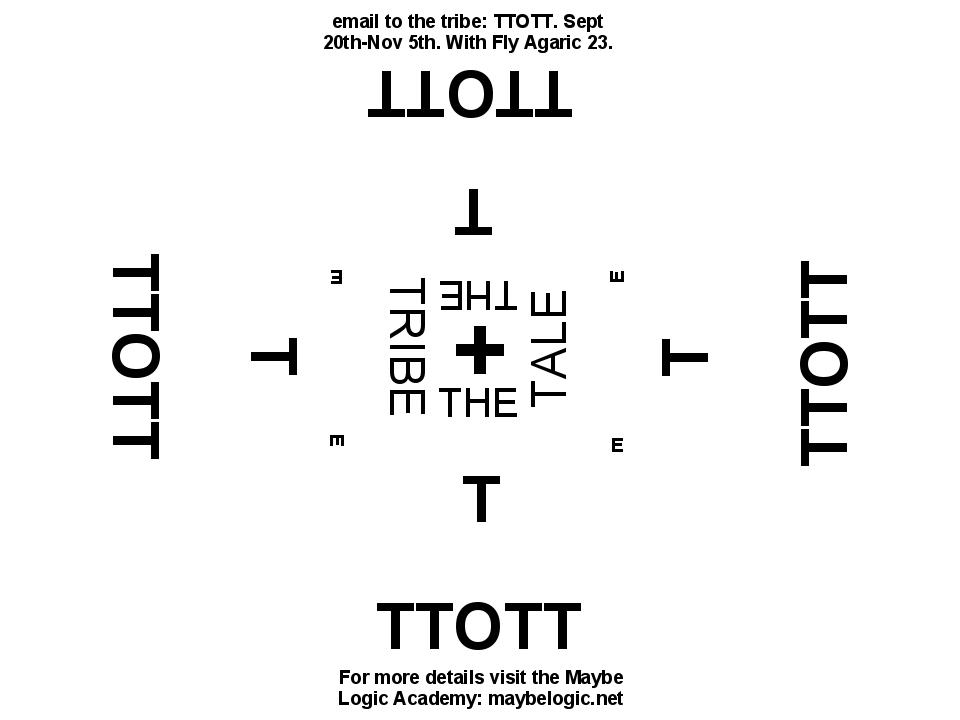
    Email to the tribe is my research class into the tale of the tribe, paying tribute to the last great work of Dr Robert Anton Wilson.…

    –Steve Fly

    Fly On The Tale Of The Tribe: A Rollercoaster Ride With Robert Anton Wilson

    by Steven James Pratt

    Link: http://a.co/gOGNKyV

  • Letter to Harold Innis from McLuhan, 14th March 1951.

    Letter to Harold Innis from McLuhan, 14th March 1951.

    Within the small and obscure field of those who follow the tale of the tribe, as defined by Robert Anton Wilson will probably already be familiar with this letter by Marshall McLuhan, to Harold Innis.

    In the letter McLuhan more or less drafts the trajectory RAW expands upon, with the addition of Giordano Bruno, Alfred Korzybski, Nietzsche, Claude Shannon and Orson Welles, RAW weaves a landscape of, dare i say, cybernetic post modernism?

    Internet…probably the greatest catalyst, tool, for the evolution of language and human-language interfacing. And so, 12/13 historical characters are selected by RAW to approximate the innovations that took place to bring us here, and the human biographical tales crisscrossing with the design science revolutions and new styles. RAWs tale of the tribe.

    Here is that letter that helped start it all, in some sense.

    –steve fly 

    Letter to Harold Adams Innis
    Toronto, 14th March 1951

    Dear Innis,
    Thanks for the lecture re-print. This makes an opportunity for me to mention my interest in the work you are doing in communication study in general. I think there are lines appearing in Empire and Communications, for example, which suggest the possibility of organizing an entire school of studies. Many of the ancient language theories of the Logos type which you cite for their bearings on government and society have recurred and amalgamated themselves today under the auspices of anthropology and social psychology. Working concepts of “collective consciousness” in advertising agencies have in turn given salience and practical effectiveness to these “magical” notions of language.
    But it was most of all the esthetic discoveries of the symbolists since Rimbaud and Mallarmé (developed in English by Joyce, Eliot, Pound, Lewis and Yeats) which have served to recreate in contemporary consciousness an awareness of the potencies of language such as the Western world has not experienced in 1800 years..

    Mallarmé saw the modern press as a magical institution born of technology. The discontinuous juxtaposition of unrelated items made necessary by the influx of news stories from every quarter of the world, created, he saw, a symbolic landscape of great power and importance. (He used the word “symbol” in the strict Greek sense sym-ballein, to pitch together, physically and musically). He saw at once that the modern press was not a rational form but a magical one so far as communication was concerned. Its very technological form was bound to be efficacious far beyond any informative purpose. Politics were becoming musical, jazzy, magical.

    The same symbolist perception applied to cinema showed that the montage of images was basically a return via technology to age-old picture language. S. Eisenstein’s Film Forum and Film Technique explore the relations between modern developments in the arts and Chinese ideogram, pointing to the common basis of ideogram in modern art, science and technology.

    One major discovery of the symbolists which had the greatest importance for subsequent investigation was their notion of the learning process as a labyrinth of the senses and faculties whose retracing provided the key to all arts and sciences (basis of myth of Daedalus, basic for the dreams and schemes of Francis Bacon, and, when transferred by Vico to philology and history of culture, it also forms the basis of modern historiography, archaeology, psychology and artistic procedures alike.)

    Retracing becomes in modern historical scholarship the technique of reconstruction. The technique which Edgar Poe first put to work in his detective stories. In the arts this discovery has had all those astonishing results which have seemed to separate the ordinary public from what it regards as esoteric magic. From the point of view of the artist however the business of art is no longer the communication of thoughts or feelings which are to be conceptually ordered, but a direct participation in an experience. The whole tendency of modern communication whether in the press, in advertizing, or in the high arts is toward participation in a process, rather than apprehension of concepts. And this major revolution, intimately linked to technology, is one whose consequences have not begun to be studied although they have begun to be felt.

    One immediate consequence, it seems to me, has been the decline of literature. The hyper-trophy of letter-press, at once the cause and effect of universal literacy, has produced a spectacular decline of attention to the printed or written word. As you have shown in Empire and Communications, ages of literature have been few and brief in human history. The present literary epoch has been of exceptional duration — 400 years. There are many symptoms that it is at an end. The comic book for example has been seen as a degenerate literary form instead of as a nascent pictorial and dramatic form which has sprung from the new stress on visual-auditory communication in the magazines, the radio and television. The young today cannot follow narrative but they are alert to drama. They cannot bear description but they love landscape and action.

    If literature is to survive as a scholastic discipline except for a very few people, it must be by a transfer of its techniques of perception and judgement to these new media. The new media, which are already much more constitutive educationally than those of the class-room, must be inspected and discussed in the class-room if the class-room is to continue at all except as a place of detention. As a teacher of literature it has long seemed to me that the functions of literature cannot be maintained in present circumstances without radical alteration of the procedures of teaching. Failure in this respect relegated Latin and Greek to the specialist; and English literature has already become a category rather than an interest in school and college.

    As mechanical media have popularized and enforced the presence of the arts on all people it becomes more and more necessary to make studies of the function and effect of communication on society. Present ideas of such effects are almost entirely in terms of mounting or sagging sales curves resulting from special campaigns of commercial education. Neither the agencies nor the consumers know anything about the social or cutural effects of this education.

    Deutsch’s interesting pamphlet on communication is thoroughly divorced from any sense of the social functions performed by communication. He is typical of a school likewise in his failure to study the matter in the particular. He is the technician interested in power but uncritical and unconcerned with social effect. The diagnosis of his type is best found, so far as I know, in Wyndham Lewis’s The Art of Being Ruled. That pamphlet is probably the most radical political document since Machiavelli’s Prince. But whereas Machiavelli was concerned with the use of society as raw material for the arts of power, Lewis reverses the perspective and tries to discern the human shape once more in a vast technological landscape which has been ordered on Machiavellian lines.

    The fallacy in the Deutsch-Wiener approach is its failure to understand the techniques and functions of the traditional arts as the essential type of all human communication. It is instead a dialectical approach born of technology and quite unable of itself to see beyond or around technology. The Medieval schoolmen ultimately ended up on the same dialectical reef.

    As Easterbrook may have told you I have been considering an experiment in communication which is to follow the lines of this letter in suggesting means of linking a variety of specialized fields by what may be called a method of esthetic analysis of their common features. This method has been used by my friend Siegfried Giedion in Space, Time and Architecture and in Mechanization Takes Command. What I have been considering is a single mimeographed sheet to be sent out weekly or fortnightly to a few dozen people in different fields, at first illustrating the underlying unities of form which exist where diversity is all that meets the eye. Then it is hoped there will be a feedback of related perception from various readers which will establish a continuous flow.

    It seems obvious to me that Bloor St. is the one point in this University where one might establish a focus of the arts and sciences. And the organizing concept would naturally be “Communication Theory and practice.” A simultaneous focus of current and historic forms. Relevance to be given to selection of areas of study by dominant artistic and scientific modes of the particular period. Arts here used as providing criteria, techniques of observation, and bodies of recorded, achieved, experience. Points of departure but also return.

    For example the actual techniques of common study today seem to me to be of genuine relevance to anybody who wishes to grasp the best in current poetry and music. And vice versa. There is a real, living unity in our time, as in any other, but it lies submerged under a superficial hubbub of sensation. Using Frequency Modulation techniques one can slice accurately through such interference, whereas Amplitude Modulation leaves you bouncing on all the currents.

    Marshall McLuhan

    from Marshall McLuhan — Complete Correspondence,
    edited by Matie Molinaro & Corinne McLuhan
  • Ezra Pound and Film adaptations of fragments from the Cantos

    Hamilton celebrates Ezra Pound’s 128th Birthday

    By Max Newman ’16

    October 31, 2013
    Forum on Image and Language and Motion (F.I.L.M.) celebrated Hamilton alumnus and late poet Ezra Pound’s 128th birthday last Wednesday with a night full of history and experimental film adaptations.
    Associate Professor of English Steve Yao opened the discussion with a detailed history of Pound from his time at Hamilton to his death in Venice in 1972. Professor Yao claimed, “Pound is arguably the most important poets of the 20th century,” referencing his controversial support of Benito Mussolini and fascism.

    A graduate of the Hamilton Class of 1905, Pound portrayed his social and political beliefs in his poetry. “Pound’s goal was to solidify free verse as the dominant mode in American Literature,” Professor Yao said. Pound’s poems draw on revolutionary era American history, Chinese history and his own experiences.

    Professor Yao describes Pound’s poetry as “difficult” and “mystical” because of its political commentary through romance language. This is especially true in The Cantos, Pound’s unfinished poem split into 120 sections. The poem was highly controversial as politics became heated at the start of World War II. Pound takes the reader through his ideas, focusing on oppression in China due to government corruption.

    Professor Yao ended his opening words by introducing the evening’s main attraction: “Emergency-room physician in Toronto by day (and night), Bernard Dew has an aesthetic calling and artistic gift: he is a devotee of experimental poetry, and Ezra Pound in particular, and is fascinated with avant-garde film, especially the work of Stan Brakhage. In recent years Dew has brought these fascinations together in a series of remarkable cinematic adaptations of selections from Pound’s epic Cantos.”

    Many of Pound’s poems are ekphrastic, written verses in response to visual images or paintings. Dew brilliantly took the text and turned them back into images through his films portraying Cantos #49 and #116. Four years in the making, Dew primarily gathered footage from Venice, Pound’s home for the last few decades of his life as well as his burial ground.

    In Canto #49, Dew has a typewriter-at-work overtone throughout the movie as 15mm film images flash on and off the screen. The grainy collage of film allows the viewer, for even just a few minutes, to journey inside Pound’s complex poetic mind. The images move quickly from beautiful Italian architecture to abstract color flashes Dew filmed in his basement.

    In his final completed Canto, #114, Pound reflects upon the poem as a whole. “It’s especially moving to see him questioning himself,” Dew said. Rarely do poets question the legitimacy of their work, yet Pound explores his crisis in depth.

    Dew portrayed the beauty of Pound’s reflection by filming the first half of the Canto in in silence. Images of long, drawn-out ocean waves fill the screen in silence as if representing Pound’s mind at work.

    Bernard Dew offers an intriguing perspective on Pound’s legacy. Although the films will unlikely appear in a theater near you, the adaptations are slowly circling around the world depicting Pound’s poetry in a language that is universal.

    http://students.hamilton.edu/spectator/arts-entertainment/p/hamilton-celebrates-ezra-pound-s-128th-birthday/view

  • Liffissippi River to Joyce’s Poundland

    …and when the mode of the
    music changes
                               the walls of the
                                        city shake

         a perspective from relative place
                      humbled individual to their part
    in universe and other

    single individuated mind
                                          in time
    gathering tales and knick knacks
                   of history into a trick bag

    do you feel melody and riddim’
    in verse
           word sound image sandwiches
    attention to source
                       to _____ and just story

    word jazz s c r a b l e m and
    recontext’ of everything
                       in John Coltrane and
    James Joyce

                  Pound’s eccentricity flows
    to American in Europe, Joyce’s concentricity
                                           circulates the planet

    two sides of a new shiny coin
                                        ideograms on side a
                             hologrammic prose on the flip

    two torrential rivers of ink
                             bleeding shared currents
                                                               liffissippi

    Joyce’s Be-Bop and
                                 Pound’s symphonic compositions
    cut and mixed together

    Homeric history and Ulysses
                           in a conch shell sunset
                                      and a Dublin street fight

    the inner
    Joyce and the
    outer
                         Pound dynastic index
                             Irish American tell all tales

    The Cantos awake
                             a wake Cantos:
                     a dream/nightmare from
    which I am trying to awake
    (not)

                    sleepwalking giants leave
                           footprints in the mud
    trackers reverse the prints
                                          into beasts

    explicit Cantos give us facts
                  weights and measures, the dates
    places, names and flames to wit

                         implicit Finnegan offers us
    truer ficts, rubber inches,
               neurological realism and the funnies

    …like J.C’s Ballads versus
                                                       Stellar Regions
                  it’s a whole different thing
                                           consistent in its genius

                      ‘FW is psycho-archaeology
            Dr Wilson said.
                 ‘no mystery about the Cantos,
    Pound said.
                                                 they are the tale of
                            the tribe

    http://en.wikipedia.org/wiki/Finnegans_Wake
    http://en.wikipedia.org/wiki/The_Cantos
    http://en.wikipedia.org/wiki/Tale_of_the_Tribe

    –Steve Fly
    Amsterdam, 9th June, 2013