Category: Ezra Pound

  • These fought in any case" by Ezra Pound

    “These Fought in Any Case”
    by Ezra Pound

    These fought in any case,
    and some believing
    pro domo, in any case .....

    Died some, pro patria*,
    walked eye-deep in hell
    believing in old men's lies, then unbelieving
    came home, home to a lie,
    home to many deceits,
    home to old lies and new infamy;
    usury age-old and age-thick
    and liars in public places.

    Daring as never before, wastage as never before.
    Young blood and high blood,
    fair cheeks, and fine bodies;

    fortitude as never before

    frankness as never before,
    disillusions as never told in the old days,
    hysterias, trench confessions,
    laughter out of dead bellies.
     

    *The famous line from one of Horace’s “Odes”:
    Dulce et decorum est pro patria mori (“Sweet and fitting it is to die for one’s country.”)

    http://www.rjgeib.com/thoughts/fight/fight.html

  • Some Joyce/Pound ‘News’ items…


    The Politics of Modernist Poetics: Ezra Pound, Amy Lowell and Imagism:

    Imagism was the poetry of directness and distillation championed by Ezra Pound and Amy Lowell in the first years of the 20th century, reacting against the flowery verse of late Romanticism and urging poets to look to earlier models—like Sappho in ancient Greece and Li Po in 8th century China—to create a poetry of precise and powerful images, without any superfluous words or ornaments.

    http://poetry.about.com/b/2011/10/19/the-politics-of-modernist-poetics-ezra-pound-amy-lowell-and-imagism.htm

    Great literature will live on with or without a prize

    With readability the watchword for the Man Booker prize, it’s unlikely any of the literary greats would even get on to the shortlist
    • The Observer, Sunday 16 October 2011  
    • Would James Joyce have ever made the Man Booker shortlist? Not, you guess, if the current crop of judges had anything to do with it. A Portrait of the Artist as a Young Man might have squeaked on, but Ulysses? Not a chance. “Readability” is the watchword of this year’s panel, apparently, led by the former spy mistress, Dame Stella Rimington. Fellow judge and ex-MP Chris Mullin likes something with a “bit of zip”.
      Given that the Booker is at heart a speed-reading contest for judges – 100-odd novels to read in a couple of months – it is not surprising that those poor unfortunates faced with the task favour books that can be tackled in a few swift hours. Eighty books in and counting, who would want to be confronted with Finnegans Wake?

      http://www.guardian.co.uk/commentisfree/2011/oct/16/observer-editorial-man-booker-prize?newsfeed=true 

      “Poetic possibilities

      Review by MARTIN SPICE

      Poet/editor Ezra Pound’s contribution to what we now know as The Waste Land was profound and is well documented. Many years ago, British publishers Faber & Faber released a facsimile transcript showing his comments and crossings out and he is frequently referred to, rightly or wrongly, as the architect of the poem. Those amendments and alterations are included in the app and can be seen alongside the final version of the poem. There are hours of interest here in examining just what Pound left in and took out.

      http://thestar.com.my/lifestyle/story.asp?file=/2011/7/5/lifebookshelf/9009337&sec=lifebookshelf

      Mad about the girl: Tate Liverpool’s Alice in Wonderland show

      Alice Liddell inspired Lewis Carroll, whose books inspired a thousand art works. But are they any good? Adrian Searle heads down the rabbit hole at Tate Liverpool’s new show
    Alice Pleasance Liddell taken by Charles Dodgson aka Lewis Carroll 
    The real Alice … Alice Pleasance Liddell taken by Charles Dodgson aka Lewis Carroll. Photograph: National Portrait Gallery London
     

    Lewis Carroll, or rather the fictive world of Reverend Charles Lutwidge Dodgson, is firmly embedded in our culture. I am surprised no one has made a religion out of Alice. Perhaps they have.

    She is also very much at large in Tate Liverpool. Here she is, here she isn’t: in James Joyce’s Finnegans Wake and in Jorge Luis Borges; in Jefferson Airplane’s White Rabbit, and in the surrealist works of Max Ernst and Salvador Dalí. Alice captivated Virginia Woolf and Walt Disney, inspired Robert Smithson, Sigmar Polke and a host of better and worse visual artists. Characters from the Alice books, or rather their putative ancestors, can be found, according to Alberto Manguel (writing in a brilliant, short catalogue essay), in Hamlet and Don Quixote, in Kafka, Homer and the Bible. The influence of Carroll’s creation can be found in sci-fi, detective fiction and philosophy, in pre-Raphaelite painting and in hard-arsed conceptualism. You can’t shake Alice off.

    http://www.guardian.co.uk/artanddesign/2011/nov/02/alice-wonderland-tate-liverpool-review?newsfeed=true

  • TTOTT in 12 lines or less

    TTOTT in TWELVE by Steve ‘fly agaric 23’ Pratt.

    Fly On The Tale Of The Tribe: A Rollercoaster Ride With Robert Anton Wilson

    by Steven James Pratt

    Link: http://a.co/gOGNKyV

    (more…)

  • Imagism in the Cantos and Vorticism in the Tate

    “These lines are followed by a sequence of identity shifts involving a seal, the daughter of Lir, and other figures associated with the sea: Eleanor of Aquitaine who, through a pair of Homeric epithets that echo her name, shifts into Helen of Troy, Homer with his ear for the “sea surge”, the old men of Troy who want to send Helen back over the sea, and an extended, Imagistic retelling of the story of the abduction of Dionysus by sailors and his transformation of his abductors into dolphins. Although this last story is found in the Homeric Hymn to Dionysus, also contained in the Divus volume, Pound draws on the version in Ovid‘s poem Metamorphoses, thus introducing the world of ancient Rome into the poem.–http://en.wikipedia.org/wiki/The_Cantos

    “Can you fell the force of the Vorticists?

    by Brian Sewell.

    Wyndam Lewis

    Red: Wyndam Lewis’s Crowd of 1914-15. By early 1917 he had joined the Royal Artillery and was at the Front. He survived, most important male Vorticists did not.
    Wyndam Lewis Wyndam Lewis henri gaudier brzeska Jacob Epstein
    16 Jun 2011

    A vortex, according to the Concise Oxford Dictionary I had at school, is a whirlpool, a whirling mass of fluid, fluid in rotating motion, anything whirling that is capable of swallowing all and everyone drawn into it.

    As this definition goes on to discuss rings, spiral, arcs and curves, it might be reasonable to assume that a group of artists dubbing themselves Vorticists produced art that was certainly curvilinear and possible soft-edged, suggesting fluidity, rotation and other characteristics of the vortex, its depth and singular dedicated force. There was indeed such a group, but arcs and curves, though occasionally present, played surprisingly little part in their work; this, in painting, was for the most part hard-edged and rectilinear, jagged and fragmented as though by internal explosion, centrifugal rather than centripetal, rather than forced into a coherent design suggesting vortical compulsion.

    If there is depth in it, it is the depth of shallow planes superimposed, or of low relief entirely subject to design, or of some architectural or mechanical construction often set, like an object of still life, against a flat ground. In painting, vertiginous rather than vortical forces are implied; in sculpture, either no force of any kind, just enclosed weight and form, as with Gaudier-Brzeska, or a force of entirely different character, that of the machine, as in Epstein‘s Rock Drill.

    In 1914, the American poet Ezra Pound, his associate Thomas Ernest Hulme (always known as T E Hulme), a combative philosopher-cum-theorist-cum-critic, and a very small group of artists working in Britain chose the vortex as their emblem and dubbed themselves Vorticists. The term was far more logically first used in the 17th century of those who followed Descartes’ hypothesis that vortices of matter had determined the structure of the universe, and my hunch is that Pound, who re-coined the term in 1914, must have known Descartes’ considerations of cosmogony when he proclaimed the vortex to be “the point of maximum energy”. Wyndham Lewis slightly modified this view, arguing that “at the heart of the whirlpool is a great silent place where all the energy is concentrated. And there, at the point of concentration, is the Vorticist.” Hulme, who knew nothing of the creative processes of the painter and sculptor and whose head was full of the theories of his immediate contemporary and associate in Germany, Wilhelm Worringer, who had firm grounding as an art historian before he became a philosopher, introduced the notion that “the idea of machinery” would differentiate all that was then contemporary art, and particularly the Vorticists, from the long arm of an exhausted Renaissance. He who reads Worringer’s thesis, Abstraction and Empathy, published in 1908, need never read Hulme’s Speculations, published posthumously in 1924. Both men wished to clear away “the sloppy dregs of the Renaissance”, both offered a blueprint for a modern aesthetic and justification for all modern art movements, and both commended reference to the near abstract art of the far past (Egypt) and the primitivisms of Oceania and Africa, rather than the realism of the Renaissance which, they claimed, had weakened man’s capacity for abstraction. I suspect that Hulme had difficulty with the concept of abstraction – for “abstract” he substituted “geometric” and as the term empathy first entered the English language in 1912, he may not have known it and used “vital” in place of “in feeling”, the meaningless literal translation of “Einfühlung”.

    One may reasonably argue that Hulme was an ass with influence far beyond his knowledge and experience of art. One may argue, with equal reason, that Pound too was an ass, a frivolous intellectual gamester whose knowledge of art reached no further back than Whistler, recently dead, whom he saw as a touchstone of aesthetic excellence, “the great grammarian of the arts” and, absurdly, as some sort of avuncular spirit for his “little gang” of Vorticists. They influenced each other’s thinking, yet for each behind the other’s back lay scorn and derision, Pound complaining of Hulme’s unintelligible lectures and loud-mouthed “crap”, while to kick Pound downstairs was often in Hulme’s mind. They are part of the history of Vorticism only because they were the pseudo-philosophical leaders of the little gang, but to it they contributed nothing but drivel and confusion. The one man who really matters is Wyndham Lewis.

    According to Pound, in December 1913 the gang had been forming for five years. The minor figures drawn into the vortex and very rarely heard of in any post-Vorticist context were Malcolm Arbuthnot, an experimental photographer, Lawrence Atkinson, Jessica Dismorr, Cuthbert Hamilton, Frederick Etchells and Helen Saunders; the major figures, in addition to Lewis, were Henri Gaudier-Brzeska, William Roberts and Edward Wadsworth. David Bomberg and Jacob Epstein were closely associated with the gang, but neither joined it nor signed the manifesto issued in July 1914; nor was Etchells a signatory, but Pound and another poet, Richard Aldington (one of the Imagist group for whom Pound wrote another manifesto), were.
    Christopher Nevinson drew close to Vorticism but was never quite sucked in.

    A month later the First World War began. Gaudier-Brzeska was killed within 10 months; Hulme, an early volunteer to the Royal Marine Artillery, survived until September 1917 and was then killed within sight of Lewis, who had joined the Royal Artillery six months before; in November 1915 Bomberg enlisted as a sapper, and in April 1916 Roberts too became a gunner; Wadsworth joined Naval Intelligence in June 1916 and in the same month Jessica Dismorr went as a volunteer to France. Pound did what he could to hold the rest of the depleted and inactive little gang together and took on Alvin Langdon Coburn, an American and another experimental photographer, assisting him in the development of his futile Vortoscope for taking Vortographs (no, not to be found in Edward Lear’s little dictionary of Wurbl Inwentions) first exhibited in the London Camera Club in February 1917; these were superimposed exposures that rendered image and portraits semi-abstract.

    ….Please read the full article here:
    http://www.thisislondon.co.uk/arts/review-23961140-can-you-fell-the-force-of-the-vorticists.do

  • The Vorticists: Manifesto for a Modern World – review

    “The moon is frequently associated in the poem with creativity, while the sun is more often found in relation to the sphere of political and social activity, although there is frequent overlap between the two. From the Rock Drill sequence on, the poem’s effort is to merge these two aspects of light into a unified whole.–Wikipedia.
    http://en.wikipedia.org/wiki/The_Cantos

    This article from the Guardian gives us some context for Pound’s impact, and gives us some insight into the creative explosion in the arts just before the first world war turned that creativity on its head. Some accents added and some removed–steve fly.

    The Vorticists: Manifesto for a Modern World – review


    The Observer
    , Sunday 19 June 2011.

    Tate Britain
      vorticist

      ‘A pile-driving vision of the future’: The Rock Drill by Jacob Epstein, 1913-1915. Photograph: Jonathan Hordle/ Rex Features
      Rock Drill ought to be his name, not just the title of this long-lost work (this is a reconstruction of the dismantled original). He has terrible force of personality. And he is the most devastating creation in this show by some way, a sculpture from 1913 that seems to summarise all that vorticism stood for with its driving ambition for machine-age dynamism and shattering new forms. The Rock Drill ought to be the ideal host, the perfect symbol for both the movement and the show. Except that Epstein was never a paid-up vorticist.
      In the long march through modernism, vorticism is the quickest of steps. It flares up in 1914, peaks briefly in 1915 and sputters out towards the end of the first world war. There are only two shows. There are only two issues of its in-house journal, Blast. There may be only one full-time vorticist. “Vorticism,” declared Wyndham Lewis in the 1950s, “was what I, personally, did, and said, at a certain period.” The assertion may have infuriated the surviving members of the group, but it is not without its merit when you consider the diversity of their gifts, from the painter David Bomberg to the French sculptor Henri Gaudier-Brzeska, compared to Lewis’s single-mindedness as ringleader, recruiting sergeant, megaphone, exemplar and theorist of England’s only homegrown avant-garde movement. Lewis belongs to the first generation of Europe’s non-representational artists. His drawings are incisive, satirical, on the edge of abstraction. His paintings from this phase – angular, syncopated, explosive – are even better, which is some claim, given that scarcely any survive. In the 1912 illustrations for Timon of Athens, he begins to abandon depth for a flat pageant of forms that jostle like the elements of some unsolved puzzle. By 1915, in his enormous painting The Crowd, he shows quasi-cubist figures haplessly scattered in a system of grids that seems to prefigure the pinball machine. Workshop (1914-15) is a marvellous concatenation of geometric planes, in coruscating pinks and hot mustards, that almost resolve into windows, ladders, stacks and shelves, by day and yet also, as it seems, by night. It turns architecture inside out. And seeing it in Tate Britain‘s survey, surrounded by fading issues of Blast, old catalogues and invitations, typed manifestos and handwritten declarations of solidarity or hatred – period pieces of English art history from 100 years ago – it suddenly looks more modern than ever. With its graphic zip and register, Workshop conjures pop art half a century in advance. There are other masterpieces in this show, but not many. Tate Britain has David Bomberg’s terrific painting The Mud Bath, with its interplay of bent, reclining and zigzagging forms packed into a scarlet tank. It has Gaudier-Brzeska’s Hieratic Head of Ezra Pound, on loan from the National Gallery in Washington, biting its mucklestone lip. From the front, it is Pound to a stylised T (was ever a poet more portrayed?) from his goatee to his bouffant quiff. From the rear, it resembles a circumcised phallus. “Make it virile,” was Pound’s bombastic command; contemporary critics found it merely pornographic. Nobody visiting this show could fail to spot the influence of abroad in almost every work. The Dancers, Les Demoiselles: Wyndham Lewis’s chorus line wends its way directly out of Picasso. Roger Fry had mounted his celebrated exhibition, Manet and the Post-Impressionists, back in 1910, the same year Marinetti delivered his futurist lectures in London. The trick with this show is to try and remain indifferent to the obvious strains of cubism and futurism that appear wherever you look. It is not hard, for instance, to deduce local figurative forms in all this accordion-pleated abstraction – piano keys and nightclubs, people and performers, London alleys and even the back-to-back terraces of northern mining towns. Lewis saw that cubism, for instance, could be more than a highly advanced visual language. It could be made to speak of life itself, with all thronging motion, humanity, incident. One of the strongest works here is his wonderfully acute Architect With Green Tie (1909), which skewers the self-importance of a particular man while sending up the profession’s characteristic fondness for that calculated spot of colour. The work isn’t abstract at all, in fact; it’s one of Lewis’s best caricatures. But it also predates vorticism, exposing an unusual dilemma for the curators of this show, which originated in North Carolina. Vorticism is such a brief movement and so little of the art survives (a huge tranche of it, belonging to the US collector John Quinn, vanished long ago) that it is quite a feat to assemble anything representative. The exhibition attempts to counter the problem by including a good many fellow-travellers, recreating both of the original vorticist shows and displaying the issues of Blast, with its upper-case insults, wonderful woodcuts and wild demagoguery, along with testaments of war, imaginary and real. Here is the row between Lewis and Fry over the Daily Mail‘s Ideal Home Exhibition, of all things, played out in aggressive letters. Here are the missives from the Western Front, including Gaudier-Brzeska’s final postcard before he died in the trenches. He was 23. By the time you get to the end of this vigorous yet melancholy exhibition, vorticism has dwindled into a graphic style. Anyone can imitate it by now and they do. There are still some startling works to come: Edward Wadsworth‘s fantastically concise woodcuts are among the best things here. Look at his Newcastle, as neatly condensed a sonnet to industry, ironwork, bridge span and community as you could find, all stitched together with saw-tooth zips: English printmaking at its sharpest. But even if its members had not lost their lives, the first world war had to kill off this machine-loving movement. Alas, because this show is so strictly vorticist, you do not see how the best of the artists responded, what Lewis made of the trenches in his war paintings, how he mocked his own brutal machismo, his own vicious energy, in the savage self-portrait Mr Wyndham Lewis as a Tyro. But what you do see is what became of Epstein’s The Rock Drill, once again an accidental symbol of the group. Legs gone, drill removed, hands lopped off, Epstein turned the torso into an amputee, vulnerable, disarmed, a victim of wartime violence. http://www.guardian.co.uk/artanddesign/2011/jun/19/vorticists-tate-britain-review
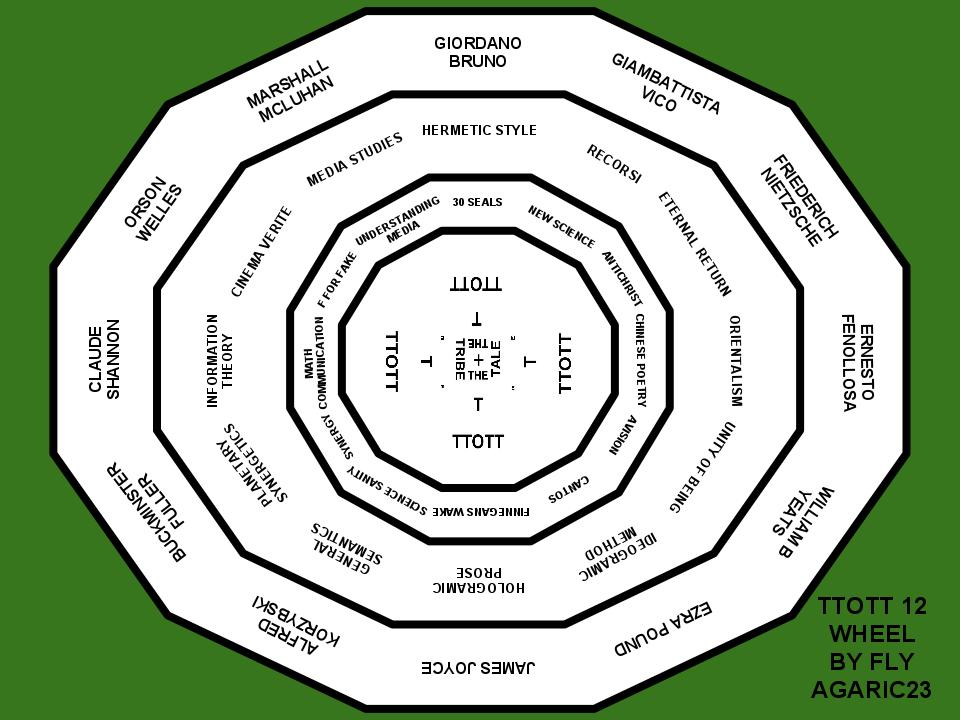
  • TTOTT WHEELS GO AROUNDAROTA

    TTOTT WHEELS GO AROUNDAROTA

    TTOTT WHEELS GO AROUNDAROTA

    BALANCING THE EQUATIONS WITH TRIADS.

    I view a part of my task in setting up a table of ttott correspondences as providing examples of how the tables can be used to create various effects. Both as study guides into historical, biographical work and as imagination guides into the tale of the tribe, and the new translations.

    The triangular structure enables opposing characteristics of mildness and severity a point of resolution and of synthesis, a middle path that may recycle the energies back and around and in so doing balance the opposing forces. The general idea of dividing 30 characters into 10 sets of triangulated groups of three characters, for example, may provide a working model for a rough structure, as would 15 sets of waltzing duo’s of opposing forces or a ‘coincidance of contraries’ as Joyce put it in Finnegans Wake.

    GEODESICS

    I have developed number systems for working out the new maps, due to the possibility of multi-dimensional models at a latter stage of the project, whereby objects containing various symbols and images can be folded and enfolded. I have already experimented with a TTOTT Dodecahedron of 20 sides and 12 vertices, and in principle, the numbers 30, 60, 90,120 and 150 all render symmetrical objects upon which information may be presented, here I pay tribute to Buckminster Fuller, and Giordano Bruno.

    THE TALLY OF THE TRIBE.

    The set of 5 wheels I have designed each have 30 ‘nodes’ on their belt of concentric rings. I made them by choosing 5 major categories: Tailors, Theolo, Texts, Teachings, Totems (Human Beings, Spirits, Texts, Principles, Objects).

    I have chose to recycle ‘T’ words and keep a running TTOTT structure to each heading and category I make. The TTOTT logo features four ‘T’s tilted to create a four way symmetry (+) with a circle placed central. If you pretend to say the word ‘T’ you’ll notice your tongue gets right up on your teeth, and if you make a repeated ‘T’ sound you may notice that you sound a little like a Hi-Hat cymbal, and, that you can repeat the letter ‘T’ faster and with more control than possibly any other letter in the English Alphabet? This will have some correspondence to the spoken word and spoken drum components to the class, but also keep the original TTOTT (the tale of the tribe) intact.

    Giordano Bruno used the number 30 often when constructing his wheels and wheels within wheels. Although unlike Bruno, my belts are so far only attenuated to the TTOTT matter, and simply borrow the use of the number 30 and the idea of putting lists of things on concentric rings, 5 in total, producing 150 nodes, or images in Bruno’s model, that I should add seems incredibly more complex and refined than my wheels. Reading Bruno recently led me to revisit the idea of having 30 things on revolving tables, something I used to anchor some themes in an early edition of my book: World Piss: 30 seals and the spore of the words.

    All the characters that follow Bruno chronologically can appear on the wheels that he inspired, together with Giambattista Vico, (another philosopher of the revolutionary hermetic renaissance tradition), the tribal characters can ride the wheel, the turning tables of correspondences, and so unify in that movement, that ever-changing sensibility and decentralized and rotational wisdom. A revolutionary force.

    CONNECTING CYCLES AND CIRCUITS

    The tale of the tribe must be a connected network, otherwise it is useless. A new team of nodal points, shared swarms that link together. The goal of a hologramic network, a poem, novel, screenplay, album, performing overlapping functions, working together.

    The triple spiral symbolizes the rotational and spiral nature of the connected works of Dr. Robert Anton Wilson, the triad or delta that symbolizes femininity and the triple goddess. Vico and Joyce and Nietzsche feed off the spiraling principles of recorsi. Giordano Bruno and his “Memory Wheels” plus Giambattista Vico and his “Cycles of Ages”, Frederich Nietzsche and the “Eternal Return”, Ernest Fenollosa and the omni-directional radiance of “Chinese Symbolism”, William Butler Yeats and his dynamic “Gyres” and “Unity of Being” and ‘Symbolism’, Ezra Pound and his “Revolutionary Calendar” and ‘Ideogramic method of juxtaposition’, James Joyce and his spiral powered “coincidance of contraries & resolution of opposites”, Buckminster Fuller and the moving “Synergistic” principles. Meanwhile Alfred Korzybski and his “General Semantics”, Marshall McLuhan and his “Global Village Tribes”, Orson Welles and his “Neurological Cinematic Relativity”, Claude Shannon and “Information Theory” and other recurring geniuses and their additional contributions to humanity intersect with connecting threads represented by Dr. Wilson. In my opionion at their most potent when writing on Joyce: the mother-load of compressed hermetic wisdom.

    THE TURNING OF THE TRIBE

    The new maps and seals I present are a work in progress and as far as I know a unique way of processing the information, and potentially a relatively simple and sharable method for others to conduct similar research.

    I would like to present a kind of Top Trumps challenge to create an equally revolutionary belt of innovative thinkers, or simply use any combination of belts on any grouping of things that you may wish, make it new! Bio-seasonal, calendrical, astrological and cosmological belts for example, may add many useful functions, the possibilities are literally endless with this, but I have chose to stack and pack a krewe that I believe represent the tale of the tribe as defined by Dr. Wilson, quite a bunch’, to perhaps provide a new platform for collaborative investigations, and new interpretations. Nodes or units of distilled cultural inheritance.

    Tailors, Theolo, Texts, Teachings, Totems (Human Beings, Spirits, Texts, Principles, Objects). v1.0

    1. “Alighieri, Dante” Agnosticism Arrow Atem-Re Avision
    2. “Bruno, Giordano” Buddhism Binocular Baal Book Of The Law
    3. “Crowley, Aleister” Cinema Verite’ Cup Circe Cantos
    4. “Dick, Philip K.” Deconstructionism Disk Dionysis Divine Comedy
    5. “Escher, M.C” Epistemology Earring Eris Everything is Under Control
    6. “Fuller, Buckminster” Fourth Way Flag Findabair Flying Saucers
    7. “Gurdjieff, G.I” General Semantics Glasses Ganesha Gulliver’s Travels
    8. “Hesse, Herman” Hologrammic Prose Headdress Horus Holographic Universe
    9. “Ibsen, Heinrik” Information Theory Ink Ishtar Illuminatus Trilogy
    10. “Joyce, James” Jungian Psychology Joystick Jove Jitterbug Perfume
    11. “Korzybski, Alfred” Kabbalah Kettle Kallisti Knox Om Pax
    12. “Leary, Timothy” Lullism Lamp Lugh Liber 777
    13. “McLuhan, Marshall” Magick Mitten Ma’at Mass Psychology Of Fascism
    14. “Nietzsche, Friederich” Neuro Linguistic Programming Nail Naga New Science
    15. “Olson, Charles” Ontology Oblisk Osiris Open Society And Its Enemies
    16. “Pound, Ezra” Pataphysics Pincer Prometheus Politics Of Ecstasy
    17. “Quiggly, Carroll” Quantum Psychology Quilt Quetzalcoatl Quantum Psychology
    18. “Reich, Wilhelm” Recorsi Rope Ra Recorsi
    19. “Shannon, Claude” Synergetics Scissor Sarasvati Science and Sanity
    20. “Tesla, Nikola” Tessellation Turntable Thoth Tale of The Tribe
    21. “Unrah, Wes” Unity of Being Umbrella Utu Understanding Media
    22. “Vico, Giambattista” Vorticism Viol Vishnu VALIS
    23. “Welles, Orson” Witchcraft Wand Woden White Goddess
    24. “X, Malcolm” Xenolinguistics Xylophone Xi Wang Mu Xo-psychology
    25. “Yeats, W. Butler” Yin Yang Yurt Yu Huang Yajur Veda
    26. “Zenji, Dogen” Zetetics Zip Zarathustra Zen
    27. “Neumann, John Von” Modernism Mirror Aphrodite Book of Shadows
    28. “Fenollosa, Ernesto” Ideogrammic Method Pipe Pan Ulysses
    29. “Bandler, Richard” Eternal Return Breastplate Luna Cosmic Trigger
    30. “Wiener, Norbert” Neuro-Logic Ring Aphrodite Critical Path

    Monday, September 13, 2010

    Fly Agaric 23 announces online RAW course

    Steve “Fly Agaric” 23 has announced a new online course, “email to the tribe,” which will run from Sept. 20 through Nov. 5 and will feature weekly doses of multimedia; participants are asked to donate what they can.

    Agaric explains, “Each week fly will provide a spread of multimedia for you to process, generally keeping in step with the program, encouraging a wide variety of conversation and focused feedback. Feel free to drop in and drop out, as you like.”

  • Twenty Twelve Line Verses v3.0 (Icosoheedrome)

    Twenty Twelve Line Verses to ‘the tale of the tribe‘ (v3.0) by Fly Agaric 23
    To be printed as TWENTY TRIANGLES to build an Icosohedron.
    Thanks to Mark Pesce for kicking this into ‘hyperspace

    W i l l i a m
    Astrology Laureate
    Automatic Visionary
    Silver AppleMoon Golden Applesun
    Oriental Spiritualist Dramatist
    Great
    Nietzsche
    Return Pantheist
    Philologist Pastmoderniche
    Continental JungFreud Superman
    Existential Perspectivist Genius
    Count
    Alfred
    Organism Binding
    Aristopple Intraverse
    Ash
    Magic Memory
    Giordano Nolan
    Hermetical Quintessence
    Decentralized Models Cyberspace
    Shadow Nickusa Gio Mnemonic
    Heretical Transmigration Infinite
    Art
    Ernest
    Francisco
    Writing Japanheart
    Oriental Scholar
    Holowriting dossier
    Ideogram Metaprogram
    Economic Symbolism Structuring
    Processing
    Klassikspace
    Bio Computer
    Automation Thinking Humanist
    Neuro-linguistic Minded Holismgram
    Orson
    Writer Citizen Actor Director
    Shakespearean Academy Screenplayer
    Thunder Rhetoric
    Historicist Ribelle
    Metaphysique Episteam Vichean
    Graff
    Spaceship Architect
    Goes In For Structure Ezra Sez’
    Energetic Synergetix Manual

    Von
    WarGame Zero Sum
    Co-creator Internet
    Etching Digital Density Binary
    Minimaxi Combinatrix Information
    Wilhelm
    Psychoanalyst
    Imposition Orgone
    Energetic Biofeedback
    Omnipresent Dialectic Dynamo
    Bio Interface
    Cetacean Nation
    Acoustical Linguistics
    Interspecies Communication
    Dyadic Cyclone Floatation mindtank
    Taxonomic McLuhan
    Vico Recorsi Timewave Novelty
    Panspermia Cyberculture Psilocybin
    Bohemian Startrek
    Statistical Totality Gravity
  • Death of Yeats end of Irish literary revival, says Pound, Noh enthusiast

    Death of Yeats end of Irish literary revival, says Pound, Noh enthusiast

    By EZRA POUND
    Special to The Japan Times
    June 5, 1939

    The death of William Butler Yeats [who died Jan. 28, 1939] closes the great era of the Irish literary revival. That death will doubtless have been duly recorded in Japan. Someone in Tokyo may also know of Yeats’ Japanese interlude or flirtation. He, at one time, thought he would be called to a Japanese professorship and did, I think, receive some sort of invitation. You have a “link” with Dublin in those plays of Yeats which were directly stimulated by Fenollosa’s reports and translations of Noh. Having worked with Yeats during the three or four years of his intensest interest in the Noh, I know how much it meant to him.

    News photo

    “The form I have been searching for all my life” was one of his comments. (That would have been about 1917.)

    * * * * *

    A determination for a new poetic drama in Europe, not merely a Celtic twilight or a side show, but a poetic drama that will enter the main stream of our life is manifested both by Jean Cocteau (recent play “Parents Terribles”) and by T. S. Eliot (“Family Reunion”).

    The present chronicler is Confucian and totalitarian. To him both plays seem to be ends of a movement. So far as I am concerned they belong to the age of [Henrik] Ibsen wherein people’s inner wobblings and fusses were important. I believe in, and I believe there exists, a growing consciousness of the individual in the state. “The divine science of politics” (thought as to how people can live together in an organized or organic social system), interests me more than all the Freuds that ever existed.

    At any rate I think the great novelists and dramatists must henceforth sort out the problems dependent on economic pressure from those which remain after this pressure is removed.

    A few years ago P. Bottome [British novelist, Phyllis Bottome] wrote a novel about an insane asylum. On analysis one found a common denominator, nowhere stated by the authoress and not I think present in her consciousness. All the patients were there because of economic pressure. All the doctors and nurses were moved by monetary pressures.

    Of the poets included in my “Active Anthology” [a 1933 anthology of poetry from the first 25 years of the 20th century] the best are all aware of monetary pressure, as something more clear and incisive than the vague “social” urges to be found in last century’s literature. This is not to say that Trollope and, in his last years, Henry James hadn’t come to such perception. They were above and beyond their time. The keenest minds today can be grouped. They can be grouped along this axis. The best writers are aware of problems that have lain unobserved in Dante and Shakespeare, problems of usury, of the just price, of the nature of money and its mode of issue.

    It may interest you to know that the clarity of some paragraphs in The Japan Times on these subjects is, outside Italy, rather restricted to weekly papers and papers of special movements in England and America and in the rest of the Occident.

    Lucid and incisive remarks of Hitler, Schacht [Hjalmar Schacht, German minister of economics 1934-1937] and Funk [Walther Funk, then president of the Reichsbank] do not get the wide and immediate publicity they deserve. They are however understood by writers of such divergent temperament as Wyndham Lewis and [British Army] General J. F. C. Fuller.

    * * * * *

    As job lot items and notes on books worth reading: A current [issue of] Picture Post acknowledges Wyndham Lewis to be the greatest portraitist of our time (even quotes [German-born English Impressionist painter Walter] Sickert as saying, “and of any time” — which is the generous exaggeration of an older painter for a younger one who has been too long denied his just place).

    The best news from America is the edition of E. E. Cummings’ collected poems, plus the publication of W. C. [William Carlos] Williams’ “Life Along the Passaic River” (prose sketches).

    Both the Criterion [British literary magazine, 1922-1939] and Broletto have ceased publication, leaving my personal interest in current periodicals narrowed to The British Union Quarterly, for discussions of state organization, and to Townsman for very brief notices of books and the arts. The Examiner, published in Bethlehem, Connecticut, U.S.A., contains some very well written and carefully thought articles.

    There are valuable notes in several dozens of sectarian or group weeklies and quarterlies in which publications, however, the dross and one-sidedness often out-weighs the sound matter, at least to such a degree that one cannot recommend them to Orientals wanting a clear view of the west.

    Excerpts, edited for space but retaining the language of the time, from four of the articles Ezra Pound contributed to The Japan Times between May 1939 and September 1940 are used with permission from New Directions Publishing Corporation. © 1991 The Trustees of the Ezra Pound Literary Property Trus.

    Related links

    Our man, Mr. Pound

    By EDAN CORKILL

    Letter from Rapallo

    By EZRA POUND

    http://search.japantimes.co.jp/cgi-bin/fl20100328x3.html

  • POUND FOR POUND "Omar Shakespear Pound"

    POUND FOR POUND

    by Charlie Finch


    Today’s New York Times includes a small paid obituary, which reads, in its entirety, as follows: “Omar Shakespear Pound, Died peacefully at Princeton, NJ on 2 March 2010, aged 83, after long illness. Survived by his wife Elizabeth, daughters Katharine and Oriana, grandsons Ben and Joshua.”

    Shall we parse/deconstruct this fine and succinct piece of literary history? Omar Pound bore the name of his putative father, the poet Ezra Pound. A gifted poet and translator in his own right, Omar Pound was the son of the artist Dorothy Shakespear, a close associate of Wyndham Lewis, founder of the Vorticist movement. Dorothy was the daughter of a celebrated lover of the greatest of poets, William Butler Yeats.

    Dorothy’s art work appeared in seminal issues of the Vorticist Bible, BLAST magazine, and Dorothy, of course, was the wife of Ezra Pound. By the time Pound had taken up with his lifelong lover, the violinist Olga Rudge, Dorothy Shakespear had fled to Italy and given birth to Omar Shakespear Pound, whom many suspected was not the biological son of Ezra Pound.

    No matter, for Omar was a loyal son to Pound, seeing him through his grotesque alliance with Mussolini, the anti-Semitism and traitorous radio broadcasts that led to Pound’s detention by the U.S. Army, his incarceration at St. Elizabeth’s and his exile in Rapallo. We might pause to consider the penance contained in Omar’s paid obit: grandsons named Ben and Joshua, leaders of the Old Testament tribes of Israel.

    I have a lifelong friend, the critic and curator Alan Jones, author of the seminal book The Art Dealers, curator of the only show of Jeff Koons‘ works done exclusively by that artist’s own hand (student work from Chicago), and a man so enthralled by the legacy of Joyce, Pound, Yeats and their circle that he long ago married royalty and gave up the New York art world that had nurtured him, forever.

    Alan makes me think that to drown in the cultural past might be a better fate than a world of navel-gazing panels at dull art fairs. The sins and seductions Alan fell for had consequences, at least. And the death notices of that world, like the one for Omar Pound today, are modest and invite the sweet, subtle probe of collective memory.

    CHARLIE FINCH is co-author of Most Art Sucks: Five Years of Coagula (Smart Art Press).

  • NOH Play

    “Consider the Tale of the Tribe as an alternative form of scripture. Which form’s of alternative scripture seem appropriate for the 20th Century? And which for the 21st?” —Robert Anton Wilson. Recorsi. 2005.

    ‘Noh’ or Accomplishment: a study of the classical stage of Japan
    By Ernest Francisco Fenollosa, Ezra Pound

    http://books.google.com/books?id=BZNsMakTE94C&lpg=PA270&dq=ezra%20pound%20noh%20plays&lr=&pg=PA270&output=embed

    New approaches to Ezra Pound: a co-ordinated investigation of Pound’s poetry …
    By Eva Hesse

    http://books.google.com/books?id=yXYlK8Uh3dUC&lpg=PA69&dq=ezra%20pound%20noh%20plays&pg=PA69&output=embed

    Yeats the European
    By Alexander Norman Jeffares

    http://books.google.com/books?id=G5iaubedD28C&lpg=PA233&dq=yeats%20noh%20plays&pg=PA233&output=embed

    Transcending space: architectural places in works by Henry David Thoreau, E …
    By Taimi Anne Olsen

    http://books.google.com/books?id=nBVItNLDfFYC&lpg=RA1-PA23&dq=yeats%20noh%20plays&pg=RA1-PA26&output=embed

    Modern drama in theory and practice: Symbolism, surrealism and the absurd
    By J. L. Styan

    http://books.google.com/books?id=GNkfv6l7-OgC&lpg=PA61&dq=yeats%20noh%20plays&pg=PA61&output=embed

    Modernity in East-West literary criticism: new readings
    By Yoshinobu Hakutani

    http://books.google.com/books?id=1ggnAQv14m4C&lpg=PA23&dq=yeats%20noh%20plays&pg=PA23&output=embed

    Progress and identity in the plays of W.B. Yeats, 1892-1907
    By Barbara Ann Suess

    http://books.google.com/books?id=3Z6HF3cyjjUC&lpg=PA54&dq=yeats%20noh%20plays&pg=PA54&output=embed

    A calculus of Ezra Pound: vocations of the American sign
    By Philip Kuberski

    http://books.google.com/books?id=Qe65ADgaTrcC&lpg=PA83&dq=ezra%20pound%20noh%20plays&pg=PA83&output=embed