Category: James Joyce

  • Pound to Joyce: ‘Wall, Mr Joice, I recon you’re a damn fine writer, that’s what I recon’

    ON THIS DAY…19 DECEMBER

    December 19, 2013

    ON 19 DECEMBER 1917 POUND WROTE TO JOYCE PRAISING ‘TELEMACHUS.’

    Pound, who had already been responsible for getting A Portrait of the Artist as a Young Man into print, was impressed by the first episode of Joyce’s new novel, Ulysses. For the next three years, Pound was editor, critic, and even censor of Ulysses.
    Shortly after A Portrait of the Artist as a Young Man started to appear in serial form in the Egoist in February 1914, Joyce started work on Ulysses, a novel he may well have been thinking about since his time in Rome in 1906-7. However, he put off work on Ulysses in favour of his play Exiles, and it was not until June 1915 that the first episode of Ulysses was written.
    However, even in April 1917 Joyce still maintained that the only part of it that might be ready for publication was the ‘Hamlet’ chapter, and he was reluctant to see that cut to fit the space available in the Egoistmagazine. He told Pound in June that he had finished the ‘Hades’ episode and was working on ‘Aeolus,’ and by August he was telling Margaret Anderson that he hoped to send some of Ulysses to Pound for the Little Review.
    A severe attack of lumbago and glaucoma meant that Joyce had to undergo an eye operation at the end of August, and in mid-October he moved to Locarno to recuperate. The first three episodes of Ulysses were finished there, and sent to Claud Sykes in Zurich for typing. The first episode was then sent on to Pound who hoped to publish it in the Little Review and the Egoist.
    In his letter of 19 December 1917, Pound declares that the opening chapter is ‘echt Joice’ and though there was a passage on the third page that made him question it for a moment, he reread it, and could find nothing wrong. There were some words that he wondered about, for instance ‘merry’ in the phrase ‘merrying over the sea,’ but again these were not a matter for concern.
    The one thing that seemed to occur prophetically to Pound was that the novel was sure to be suppressed but, he declared, ‘it is damn wellworth it.’ Unwittingly, Pound had a dig at Anthony Comstock, the founder of the New York Society for the Suppression of Vice, and promoter of a bill that made it illegal to deliver obscene, lewd or lascivious material. It was Comstock’s law and his Society for the Suppression of Vice that got Ulysses suppressed in 1920.
    Pound concluded his letter in a voice imitative of an American drawl: ‘Wall, Mr Joice, I recon you’re a damn fine writer, that’s what I recon’… You can take it from me, an’ I’m a jedge.’
    Sources & Further Reading:
    Joyce, James: Letters of James Joyce, vol. II edited by Richard Ellmann, London: Faber & Faber, 1966.
    Pound, Ezra: Pound/Joyce – The Letters of Ezra Pound to James Joyce with Pound’s Essays on Joyce, edited and with Commentary by Forrest Reid, London: Faber & Faber, 1968.
  • Multi-Fractal Structure Of Finnegans Wake

    probably one of the best descriptions
    of Hologrammic Prose i have read
    in yonks. Quoted from the Guardian Newspaper
    by Alison Flood. Noyse wairk.

    –Fly

    “The absolute record in terms of multifractality turned out to be Finnegans Wake by James Joyce. The results of our analysis of this text are virtually indistinguishable from ideal, purely mathematical multifractals,” said Professor Stanisław Drożdż, another author of the paper, which has just been published in the computer science journal Information Sciences.
    Joyce himself, reported to have said he wrote Finnegans Wake “to keep the critics busy for 300 years”, might have predicted this. In a letter about the novel, Work in Progess as he then knew it, he told Harriet Weaver: “I am really one of the greatest engineers, if not the greatest, in the world besides being a musicmaker, philosophist and heaps of other things. All the engines I know are wrong. Simplicity. I am making an engine with only one wheel. No spokes of course. The wheel is a perfect square. You see what I’m driving at, don’t you? I am awfully solemn about it, mind you, so you must not think it is a silly story about the mouse and the grapes. No, it’s a wheel, I tell the world. And it’s all square.”
    The academics write in their paper that: “Studying characteristics of the sentence-length variability in a large corpus of world famous literary texts shows that an appealing and aesthetic optimum … involves self-similar, cascade-like alternations of various lengths of sentences.”
    “An overwhelming majority of the studied texts simply obey such fractal attributes but especially spectacular in this respect are hypertext-like, ‘stream-of-consciousness’ novels. In addition, they appear to develop structures characteristic of irreducibly interwoven sets of fractals called multifractals.”

    http://www.theguardian.com/books/2016/jan/27/scientists-reveal-multifractal-structure-of-finnegans-wake-james-joyce 

  • ALL sides defeated. WWI and TTOTT.

    The Great War (not so great in my humble opinion) has been an ongoing part of my study into the tale of the tribe, pivoting on the poetry and prose of Ezra Pound and James Joyce, who both lived through WW1, and who both lost friends.

    I understand, and respect why we have a period of silence in memory of those fallen, but i fail to understand why so few of the silent care to engage in the search for the main causes of war, or pay much attention to those who are brave enough to go there, into the complexity of the deep politics of war. To exhibit constructive criticism of authority, the industrial political economic war machine, those who make the guns and bombs and bullets, and sell them. And the apathy of the public, the sleeping masses who seem hoodwinked into supporting this monstrous killing machine in the name of patriotism. Or at least, not yet motivated to stand proud and say I AM AGAINST WAR, ALL WAR. And in saying that, imply a favour for life over death, compassion and sympathy, not hate and retribution.

    I favour an interconnected global network of co-operative humanity, not annexed and isolated sovereign states fighting over material wealth, atoms, oil and arms. Like weasels fighting in a hole, as Willy Yeats described war.

    Maybe…lets remember all our ancestors, ALL of them, and their struggles in a life lived against all the odds to bring us here. Stop the wars for our futures present sake. Stop the arms dealers. Or perhaps sign a petition, or star speaking out against the trident nuclear submarine plans? “Its a pity that ALL nations couldn’t be defeated”–Ezra Pound, letter to James Joyce concerning the slaughter of WW1

    A memorable line lifted from the Roman poet Horace, and used by the British Poet Winifred Owen: Dulce et decorum est Pro patria mori. “It is sweet and fitting to die for one’s country.” sounds to me, today, like the mantra of a maniac suicide bomber. What do you think? “1,2,3,4 what are we fighting for?”–Country Joe. As Ez wrote: the youth of WW1 have died “For an old bitch gone in the teeth, / For a botched civilization, / … / For two gross of broken statues, / For a few thousand battered books.” Peace means peace. Man! Look into the causes of war to oppose escalations of war. And yes, make room to honor the dead, all of them on all sides, love all the people. There is a time for silence and a time to speak. I suspect we could do with some more strong anti-war voices, poets, artists and perhaps a politician or two? with a basis in humanitarian principles, no fear, and a whole lot of luck. Fear leads to hate, as Yoda said. Yes mate. Steve Fly

  • Zhanmusi Qiaoyisi BIG in CHINA

    By what miracles of linguistic mastery and literary imagination could Chinese characters be made to capture Joyce’s mind-bending manipulations of the alphabet? By what subtleties of cross-cultural understanding could the specificities of Ireland and its mythologies be translated for a Chinese audience? — http://www.theguardian.com/books/2015/jun/13/james-joyce-china-bloomsday-chinese-reputation

    …the alphabet vs. the equation….?

  • Waywords and Meansigns: Recreating Finnegans Wake [in its whole wholume]

    https://archive.org/embed/waywordsandmeansigns

    Recreating Finnegans Wake [in its whole wholume]


    Published May 4, 1939
    Track listing:
    Finnegans Wake is organized into four books. Roman numerals indicate the book, Indo-Arabic numerals indicate the chapter within that book. Chapter names are italicized, followed by the names of musicians. Finnegans Wake is circular, so you can start listening wherever. Mariana Lanari and Sjoerd Leijten suggest beginning with Book IV. To locate a particular passages of the text, use http://www.trentu.ca/faculty/jjoyce/ and http://fweet.org/


    I.1 – Fall, pp. 3-29 – Mariana Lanari & Sjoerd Leijten, with Erik Bindervoet

    I.2 – The Humphriad I: His Agnomen and Reputation, pp. 30-47 – Robert Amos; Chelidon Frame; Alan Ó Raghallaigh

    I.3 – The Humphriad II: His Trial and Incarceration, pp 48-74 – Greg Nahabedian

    I.4 – The Humphriad III – His Demise and Resurrection, pp. 75-103 – Un monton, torero; with Charlie Driker-Ohren & Walker Storz 

    I.5 – The Mamafesta, pp. 104-25 – Tim Carbone 

    I.6 – Riddles: The Personages of the Manifesto, pp. 126-68 – Kevin Spenst

    I.7 – Shem the Penman, pp. 169-216 – Belorusia

    I.8 – Anna Livia, pp. 196-59 – Dérive


    II.1 – The Children’s Hour, pp. 216-59 – Street Kids Named Desire; with Derek Pyle, Parker McQueeney, Zach Leavitt & Samuel Nordli

    II.2 – The Studies, pp. 260-308 – Liz Longo & Izzy Longo, with Leo Traversa

    II.3 – The Stories: Tavernry in Feast, pp. 309-82 – Hayden Chisholm

    II.4 – Mamalujo, pp. 383-99 – Ryan Mihaly


    III.1 – Shaun before the People, pp. 403-28 – Gareth Flowers

    III.2 – Jaun before St. Bride’s, pp. 428-73 – Steve Fly, with William Sutton

    III.3 – Yawn under Inquest, pp. 474-554 – Peter Quadrino, Jake Reading & Evan James

    III.4 – Humphrey Chimpden Earwicker and Anna Livia Plurabelle: Their Bed of Trial, pp. 555-590 – Graziano Galati


    IV.1 – Dawn: Return to the Beginning, pp. 593-628 – Mariana Lanari & Sjoerd Leijten; with Eloísa Ejarque, Grace Kyne-Lilley, & Erik Bindervoet.


    Additional track credits:
    Track 1: Produced and performed by Mariana Lanari and Sjoerd Leijten, with special thanks to guests reader Erik Bindervoet (pp.13-18, pp. 21-24).
    Track 2: Robert Amos recorded by Robert Martin.
    Track 3: Keyboards, Voice, Guitar, Bass, and Drums by Greg Nahabedian. Recorded and mixed by Greg Nahabedian and Paul Schmelz. 
    Track 5: Tim Carbone (fiddle, guitar, drone, tan, keyboards, samples), Andy Goessling (zither), Phil Ferlino (piano). Recorded by Tim Carbone and mixed by Don Sternaker and Tim Carbone. 
    Track 6: Background arrangement by Josh Pitre, featuring a Stravinsky circus polka and two ragtime pieces
    Track 8: Dérive is Greg Nahabedian (keyboard, voice), Paul Schmelz (guitar, voice, keyboard), Noah Jacques (bass, voice), Paul DeGrandpre (drums, voice). Recorded by Paul Schmelz. Mixed by Dérive and Paul Schmelz.
    Track 9: Recorded by Derek Pyle and Zach Leavitt. Sound collage by Derek Pyle, featuring many of the musical allusions found in Joyce’s text. With Derek Pyle (bass, voice), Parker McQueeney (piano, voice), Samuel Nordli (mandolin, violin, and viola) and Zach Leavitt (guitar, bass, voice).
    Track 10: Leo Traversa on bass. Recording by Taylor Roig. 
    Track 11: Recorded by Robert Nacken at Nucamusic Studios in Cologne and by Hayden Chisholm in the Moers Residence house, and at Sant Vicenc beach in Mallorca
    Track 14: William Sutton reads pp. 429-42 469-73; Steven ‘Fly’ Pratt reads pp. 443-68. Drums, turntables, guitar, arrangement, production, recording in Amsterdam by Steve Fly. Mastered by Tim Egmond at Ei-Complex Studios, Amsterdam.
    Track 15: Produced by Jake Reading & Peter Quadrino. Executive producer: Evan James. Recorded and mixed by Jake Reading at Casa de Feelgood. Additional vocals by Evan James and Melba Martinez. 
    Track 17: Produced and performed by Mariana Lanari and Sjoerd Leijten, with special thanks to guests readers Eloísa Ejarque (pp. 610-612), Grace Kyne-Lilley (pp. 613-615), and Erik Bindervoet (pp. 13-18, pp. 21-24).


    Derek’s acknowledgments: 
    Waywords and Meansigns would not be possible without the support of many people. Like the Joycean maxim says: Here Comes Everybody. Thanks to the fwread listserv, especially Peter Quadrino, Peter Chrisp, Roman Tsivkin, as well as Adam Harvey and Mariana Lanari; your collective knowledge of Joyce is astounding. Marie Broadway, Jake Tozer, Sam Nordli, and Emma Pampanin co-hosted the Finnegans Wake parties that inspired this project. Zach Leavitt and Chelsea Westra co-hosted the parties of the future. Elaine Thomas, Dylan Muhlberg, the Amherst Irish Association, Jacqui Wise, Krzysztof Bartnicki, Mike Moran, Mike Medeiros, Jason Gross, Rebecca Hanssens-Reed, Billy Mills, and the James Joyce Gazette played pivotal roles spreading the word about this project, through press coverage and otherwise. Thanks to Mackenzie Libbey, and Michael Robbins, for their support throughout. Thanks to L. Brown Kennedy and Annie G. Rogers for first introducing me to Joyce. Special thanks to Mark Traynor and the James Joyce Centre in Dublin, and to Robert Berry. 

    Infinite thanks to the project contributors, and all who channel the spirit of James Joyce.


    Run time 31 hours, 8 minutes, 11 seconds
    Language und

  • Introducing Islam in Finnegans Wake

    A Fragment from “Introducing Islam in Finnegans Wake” By Aida Yared

    While writing Finnegans Wake, Joyce jotted down abbreviated entries in some fifty notebooks1 that he took great care to preserve. The entries are mainly fragments of sentences from books or newspapers that Joyce was reading – or that were being read to him, scraps of conversations, and personal thoughts or commentaries. Their study is essential to our understanding of Joyce’s last published work.

    When a given Notebook entry was incorporated into his Work in Progress, the Irish writer was in the habit of crossing it out with a colored crayon. Pages 103-110 of VI.B.45, that deal with Islam, are among the Notebooks pages most heavily marked in this fashion: they can be deciphered only when viewed through an orange-red filter, the color of the crayon used by Joyce in deleting the entries. Their source can be traced back to The Story of Mohammed, a biography of the Islamic Prophet by Edith Holland.2VI.B.45 was compiled, according to Danis Rose, in Jan-Feb 1938.3 By that time, Joyce was very familiar with Mohammed and the Mohammedan religion. His reading on the topic, as evidenced by his note-taking, spanned the period during which he was working on Finnegans Wake.

    He owned a copy of the Koran in a French translation by J.-C. Mardrus,4 and took notes from its first few pages in 1926 (VI.B.12.137).5 Other works he had closely read include the Encyclopædia Britannica (article Mecca, VI.B.24.209-216) in 1929-31; The Speeches and Table-Talk of the Prophet Mohammad by Stanley Lane-Poole (VI.B.31.45-69)6 in April-November 1931; and Sir Richard Burton’s The Book of the Thousand Nights and a Night,7 which has extensive marginalia on “the manners and customs of Moslem men,” and to which Joyce intermittently turned from 1922 to 1939 (Notebooks VI.A, VI.B.28, VI.B.32 and VI.B33). Additional notes on Islam are scattered throughout the Notebooks, and include a sizeable cluster on Islamic rituals (VI.B.31.180-182), taken from a source that is still untraced.

    Joyce inserted numerous details of Mohammad’s life and creed – including the origin and structure of the Koran, into Finnegans Wake, where they appear as important components of the framework and collective unconscious of the book.8 The notes from The Story of Mohammed were the closest in time to the publication of Finnegans Wake (1939). Joyce probably took them in the first half of January 1938, as they were used in the revisions of II.3§4-5 for transition (January 18, 1938; JJA 54.253), the second set of Book I galleys (received by Harriet Shaw Weaver on May 16, 1938; JJA 49.287-288), and II.1-II.3§1 galleys.
    http://www.antwerpjamesjoycecenter.com/Holland99.htm

  • Terence McKenna – Surfing Finnegan’s Wake

    In late April 2000, San Francisco
    possibly at 1015 Folsom
    I joined Terence Mckenna’s
    wake

    today i miss Terence
    and his wise
    playful wordwhirl
    languaging

    late 20th century
    modern teller of
    the tale of the tribe:
    Joyce and McLhuan
    and Vico
    here comes everybody…

    R.I.P Terence. (November 16, 1946 – April 3, 2000)

    Terence McKenna – Surfing Finnegan’s Wake

  • Robert Anton Wilson reads Finnegans Wake: Shem the Penman (2014)

    Hey kids! RAW lets loose with a bit of James Joyce in this rough collage by Andre Perkowski… For this was a stinksome inkenstink, quite puzzonal to the wrottel. Smatterafact, Angles aftanon browsing there thought not Edam reeked more rare. My wud! Music by Oz Beckers and Andre Perkowski.

  • …on music and poetry and poetry and music on…

    …on music and poetry and poetry and music on…

    by Steve Fly

    “Omniverse / Is / The totality / Of / All the universes / And you / Are welcome / To / Be citizens / Of / The Omniverse–Sun Ra, Omniverse.


    “Rhythm…is the first formal esthetic relation of any part to part in any esthetic whole or of an esthetic whole to its part or parts or of any part to the esthetic whole of which it is a part.–James Joyce, A Portrait of the Artist as a Young Man (1916)

    To this drummer/blogger, music and poetry share common parenting in the human universe. For example the 8 fingers and 2 thumbs, 2 arms, 2 legs, 2 eyes, 2 ears, 1 mouth and lungs of the majority of humans on earth create a basis and foundation for the human arts. The infinite potential of human hardware, the body, linked up with the infinite potential of the human software, mind, exhibited together in the spacetime flux of sound and symbol can heal the human condition and help the individual get a taste for freedom, and a little regiment.

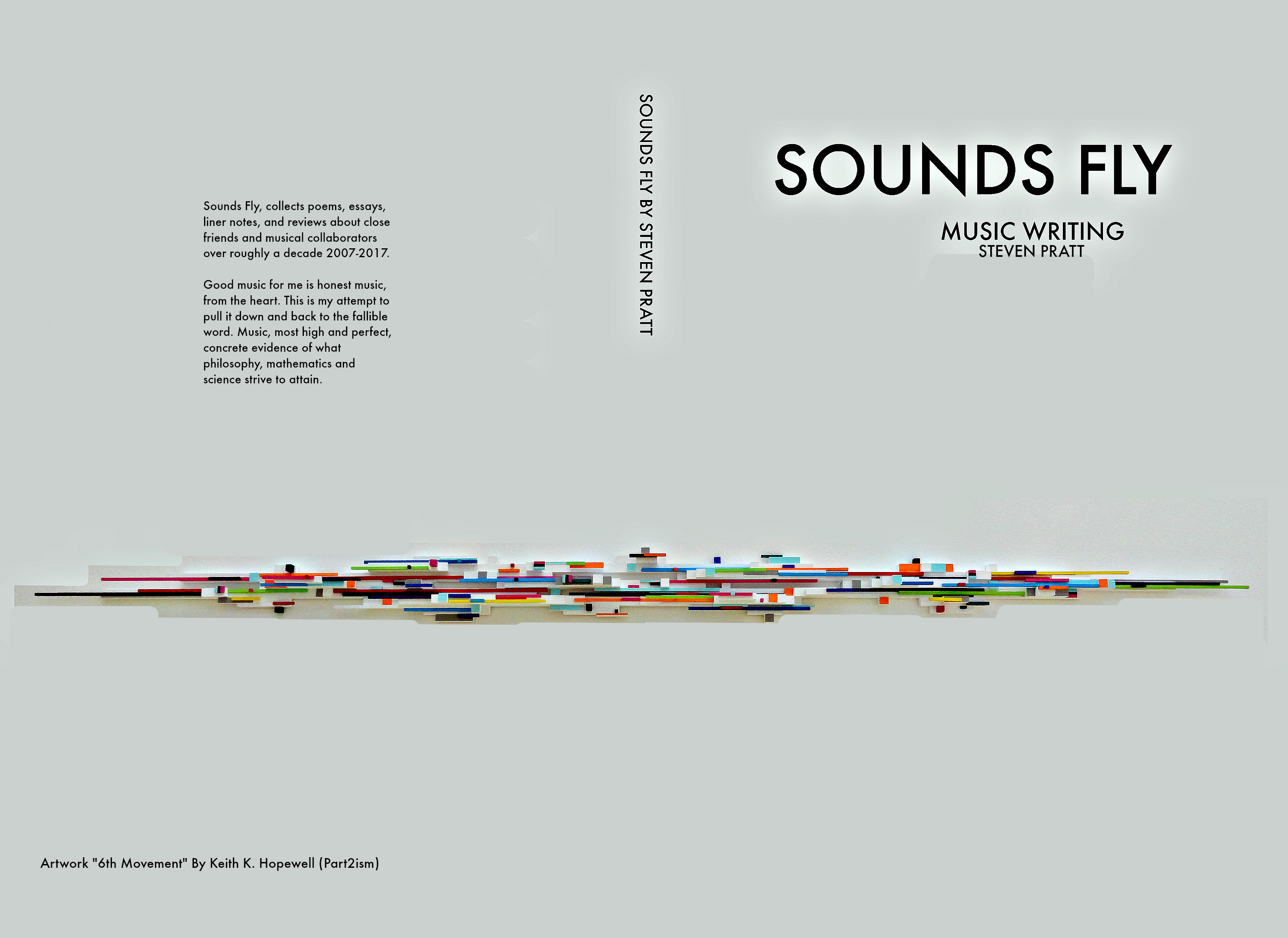
    Sounds Fly: Music Writing

    by Steven James Pratt et al.

    Link: http://a.co/9OHmjhJ

    (more…)