Category: James Joyce

  • Alice In Amrita-Land Dodgson

    Alice in Amanita Land?

    Alice Pleasence Liddel or ALP, “Finnegan said simply, “is one aspect of Anna Livia Plurabelle or ALP, the superwomen who contains all women, in Joyce’s Finnegans Wake.”

    “Oh,” I said. It seemed the only adequate comment.

    “I have wondered, “de Selby went on, “if one can equate APL with ALP on cabalistic grounds, since both equal 111, what of PLA? But that is an irrelevance, i’ve decided. What is important is that in 1932 not only did Alice P. Liddell and John S. Joyce die, but the atom was split for the first time, and the 92nd chemical element was discovered–the last natural element, you see. For the first time in history, humanity had access to the energy of the stars and possessed a full catalog of the basic building blocks of the universe.Robert Anton Wilson, The Horror of Howth Hill, email to the universe.

    http://en.wikipedia.org/wiki/Alice_in_Wonderland

    “Be who,
    farther potential? and so wider but we grisly old Sykos who have
    done our unsmiling bit on ‘alices, when they were yung and
    easily freudened, in the penumbra of the procuring room and
    what oracular comepression we have had apply to them! —James Joyce, Finnegans Wake, Pg 115.

  • Wall Street Crash and Finnegans Wake: The fall of centralized media humpires

    In response to a recent Wall Street Article,
    I’ll remind the Wall Street Journal that WALL street features in the Wake.
    Page three opens with a WALLSTRAIT falling…

    You might want to take the trouble, at the Wall Street
    Journal, of reading and re-reading Finnegans
    Wake, and Proust,
    And Pound, Silvio Gessel, C.H Douglas and even McLuhan
    And listening to Sun Ra, Coltrane, Ornette Coleman and Don Cherry
    While loking at De Kooning and Pollock,
    Flying through oen space and new time
    As if ART were a hypertextually interactive show,
    Binding with your thoughts.
    As you thought, think and drank them.

    Thanks for reminding me of the Wall street crash
    Right smack bang there at the end of the beginning of
    The ‘Wake’…. maybe the first example
    Of ‘hypertext’ and a book jam packed full of ‘tweets’.

    Or listen to lady Gaga and read Dan Brown?
    huh…

    Steve fly

    “Reading demands a greater investment of time than looking at a complicated painting, and the average reader is not prepared to invest that much time in a book, no matter what critics say about it. I feel the same way. I suppose I could get to the bottom of “Finnegans Wake” if I worked at it—but would it be worth the trouble? Or would I be better served by spending the same amount of time rereading the seven volumes of Marcel Proust’s “Remembrance of Things Past,” a modern masterpiece that is not gratuitiously complicated but rewardingly complex?

    “You have turned your back on common men, on their elementary needs and their restricted time and intelligence,” H.G. Wells complained to Joyce after reading “Finnegans Wake.” That didn’t faze him. “The demand that I make of my reader,” Joyce said, “is that he should devote his whole life to reading my works.” To which the obvious retort is: Life’s too short. —http://online.wsj.com/article/SB10001424052748704911704575327163342009080.html?mod=googlenews_wsj

    The fall
    (bababadalgharaghtakamminarronnkonnbronntonnerronntuonnthunntrovarrhounawnskawntoohoohoordenenthurnuk!) of a once wallstrait oldparr is retaled early in bed and later
    on life down through all christian minstrelsy. The great fall of the
    offwall entailed at such short notice the pftjschute of Finnegan,
    erse solid man, that the humptyhillhead of humself prumptly sends
    an unquiring one well to the west in quest of his tumptytumtoes:
    and their upturnpikepointandplace is at the knock out in the park
    where oranges have been laid to rust upon the green since
    devlinsfirst loved livvy.–James Joyce, Finnegans Wake, g. 3

  • A.I AND JAMES JOYCE. Venter and Earwicker Bachwords

    “TO LIVE, TO ERR, TO FALL, TO TRIUMPH, TO RECREATE LIFE OUT OF LIFE.” – from James Joyce’s A Portrait of the Artist as a Young Man.

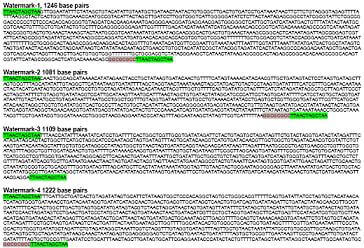
    “We report the design, synthesis, and assembly of the 1.08-Mbp Mycoplasma mycoides JCVI-syn1.0 genome starting from digitized genome sequence information and its transplantation into a Mycoplasma capricolum recipient cell to create new Mycoplasma mycoides cells that are controlled only by the synthetic chromosome.
    http://www.sciencemag.org/cgi/content/abstract/science.1190719

    “The genome contains blueprints, in which are encoded the names of the researchers, a website address, contact email and quotes from James Joyce, Richard Feynman and a biography of Robert Oppenheimer. —http://www.guardian.co.uk/science/blog/audio/2010/may/21/craig-venter-synthetic-life-form

    “a rude breathing on the void of to be, a venter hearing his
    own bauchspeech in backwords, or, more strictly, but tristurned
    initials, the cluekey to a worldroom beyond the roomwhorld, for
    scarce one —James Joyce, Finnegans Wake, pg. 100


    Synthetic biology is a new area of biological research that combines science and engineering. Synthetic biology encompasses a variety of different approaches, methodologies and disciplines, and many different definitions exist. What they all have in common, however, is that they see synthetic biology as the design and construction of new biological functions and systems not found in nature. –http://en.wikipedia.org/wiki/Synthetic_biology

    http://video.ted.com/assets/player/swf/EmbedPlayer.swf

    http://www.ted.com/talks/craig_venter_unveils_synthetic_life.html

    Synthetic Genomics is a company dedicated to using modified or synthetically produced microorganisms to produce the alternative fuels ethanol and hydrogen. Synthetic Genomics was founded in part by J. Craig Venter. Venter’s previous company, Celera Genomics, was a driving force in the race to sequence the Human Genome.[1]

    The firm takes its name from the phrase synthetic genomics which is a scientific discipline of synthetic biology related to the generation of organisms artificially using genetic material.[2] Currently, Synthetic Genomics is working to produce biofuels on an industrial-scale using recombinant algae and other microorganisms. They are receiving funding from companies like Exxon for this venture. –http://en.wikipedia.org/wiki/Synthetic_Genomics


    As a development of that ongoing effort, last week Venter announced in the pages of Science magazine that his research team had – by putting together a living and replicating bacterium from synthetic components, inserting a computer-generated genome into a cell – “created life” in the laboratory for the first time. The experiment suggested the possibility of creating bacteria to perform specific functions: as producers of fossil fuels or medicines.

    Venter, now 63, is nothing if not a showman and the publication of this revelation and the subsequent press conferences, have polarised opinion in ways with which he has long been familiar. Some authorities, and several newspaper leader writers, have claimed him as our Galileo or our Einstein; others have been notably underwhelmed.

    Freeman Dyson, the physicist, captured the full range of academic sentiment in this dry appraisal: “This experiment is clumsy, tedious, unoriginal. From the point of view of aesthetic and intellectual elegance, it is a bad experiment. But it is nevertheless a big discovery… the ability to design and create new forms of life marks a turning point in the history of our species and our planet.”

    Venter’s ego and his preference to turn to corporations rather than research foundations as funding partners (Exxon Mobil is a $600m sponsor of his energy experiments) do not tend to endear him to the academic establishment. Steve Jones, professor of genetics at University College London, and a perennial voice of reason, offered me this verdict on the biologist’s latest headlines.

    “It’s very easy to mock Venter,” Jones suggests. “When he first appeared, people just kind of sneered at him. But they stopped sneering when they saw his brilliance in realising that the genome was not a problem of chemistry but a problem of computer power. I don’t think anybody can deny that that was a monumental achievement and he has been doing fantastically interesting things subsequently with marine life. Having said that, though, the man is clearly a bit of a prick and one with a serial addiction to publicity.” —http://www.guardian.co.uk/theobserver/2010/may/23/observer-profile-craig-venter

    HIGH RESOLUTION PDF OF NEW SELF-REPLICATING LIFE FORM.

    lastly but mostly, in
    her genesic field it is all game and no gammon; she is ladylike in
    everything she does and plays the gentleman’s part every time.
    Let us auspice it! –James Joyce, FW, pg. 112

    * “TO LIVE, TO ERR, TO FALL, TO TRIUMPH, TO RECREATE LIFE OUT OF LIFE.” – from James Joyce’s A Portrait of the Artist as a Young Man.
    * “SEE THINGS NOT AS THEY ARE, BUT AS THEY MIGHT BE.”- a quote from the book, American Prometheus which discusses J. Robert Oppenheimer and the first atomic bomb.
    * *“WHAT I CANNOT BUILD, I CANNOT UNDERSTAND.” – attributed to Richard Feynman (physicist, philosopher, badass) as the last words on his blackboard at the time of his death as described in The Universe in a Nutshell by Stephen Hawking (physicist, philosopher, badass).

  • Stephen Hawking: RIVERRUN ENVIRONS.

    Joyce’s ‘pancosmos’
    may still yet send shock waves throughout the physics
    Cluster community consciousness…may yet, may yet.
    (and the global internet by default)
    if we would give equal credit to
    the inner-space of mind-like spaces,
    & the outer-space and external phenomena: still mind-like in fact,
    I guess… see our faulty wonky perception, the
    Shadows often mistaken for the ‘things’ themselves.

    LO! to balance the equation of being, of being, of being
    Like how James Joyce seems to balance ‘being’ the equation
    With holographic prose, prose writing the tightrope, spun prose;
    Innovated, deployed and distributed evenly
    Trughout Finnegans Week.


    Time flows like a river and it seems as if each of us is carried relentlessly along by time’s current. But time is like a river in another way. It flows at different speeds in different places and that is the key to traveling into the future, —Stephen Hawking.

    riverrun, past Eve and Adam’s, from swerve of shore to bend
    of bay, brings us by a commodius vicus of recirculation back to
    Howth Castle and Environs. —James Joyce.


  • Finnegans Wake vs. The Volcano

    I often search the wake for terms and words of interest to me, on a whim. Here I simply quote to instance of the word VOLCANO in the wake. I suspect Joyce surrounded these words with others of a similar nature, or with a strong affinity with one another; a node/cluster of Volcanic fall out. VOLCANO seems another description of the wake, a literary Volcano of languages, hot out the mamalujo womb of the Earth itself, forged in the unspeakable furnace and tossed of out a mountain top resulting in a upward fountain of European chaos and mayhem. Except, unlike a real geological Volcano, the wake plots itselves’ back together again by a re-amalgam of the coincidance of contraries that brought it about in the first place.

    I shot be shoddied, throttle me, fine me cowheel for ever,
    usquebauched the ersewild aleconner, for bringing briars to
    Bembracken and ringing rinbus round Demetrius for, as you wrinkle
    wryghtly, bully bluedomer, it’s a suirsite’s stircus haunting
    hesteries round old volcanoes. We gin too gnir and thus plinary
    indulgence makes collemullas of us all. But Time is for talerman
    tasting his tap. Tiptoptap, Mister Maut.
    He made one summery (Cholk and murble in lonestime) of his
    the three swallows like he was muzzling Moselems and torched
    up as the faery pangeant fluwed down the hisophenguts, a slake
    for the quicklining, to the tickle of his tube and the twobble of
    his fable, O, fibbing once upon a spray what a queer and queasy
    spree it was. Plumped. – James Joyce, Finnegans Wake, pg. 319.

    I am now becoming about fed up be going circulating about them
    new hikler’s highways like them nameless souls,ercked and skorned
    and grizzild all over, till it’s rusty October in this bleak forest
    and was veribally complussed by thinking of the crater of some
    noted volcano or the Dublin river or the catchalot trouth
    subsias away out or to isolate i from my multiple Mes on the
    spits of Lumbage Island or bury meself, clogs, coolcellar and all,
    deep in my wineupon ponteen unless Morrissey’s colt could help
    me or the gander maybe at 49 as it is a tithe fish so it is, this
    pig’s stomach business, and where on dearth or in the miraculous
    meddle of this expending umniverse to turn since it came into
    my hands I am hopeless off course to be doing anything
    concerning. – James Joyce, Finnegans Wake, pg. 410.

    Part one of RAW’s book Coincidance starts with a piece called SYNCHRONICITY AND ISOMORPHISM IN FINNEGANS WAKE. And features an essay: THE PHYSICS OF SYNCHRONICITY (pg. 147), that I believe criss-cross with study of the New Physics and the possible, most probable, I deduct, Holographic Universe model of ‘reality’ ‘consciousness’ and ‘Synchronicity’ as defined by Dr. Wilson, in the language Cybernetics and Neurologic. http://wordspore.blogspot.com/2010/04/dedicated-to-inspiration-for-this-work.html

    by thiswis aposterioprismically apatstrophied and paralogically
    periparolysed, celestial from principalest of Iro’s Irismans ruinboon pot
    before, (for beingtime monkblinkers timeblinged
    completamentarily murkblankered in their neutrolysis between the possible
    viriditude of the sager and the probable eruberuption of the
    saint), — James Joyce, Finnegans Wake, pg.612.

    “Such different accounts of a single event, however, are treated in Finnegans Wake not as inconsistent but as complementary. Like the corpuscular and the undulatory characteristics of light in Bohr’s complementarity principle, they are but different facets of the same entity. Even such disparate views as those held by Saint Patrick and the Archdruid in their debate on the “true inwardness of reality” (611.21) are ultimately dissolved into a complementary unity:

    for beingtime monkblinkers timeblinged complementarily murkblankered in their neutrolysis between the possible viritude of the sager and the probable eruberuption of the saint. (612.21-24)

    Finnegans Wake shares this complementarity with quantum physics as it shares the spatiotemporal unity with the relativity theory. Joyce points out in his book that only through unification of apparently disparate concepts can the “true inwardness of reality” shine through: “And let every crisscouple be so crosscomplimentary, little eggons, youlk and meelk, in a farbiger pancosmos” (613.10-12).
    http://duszenko.northern.edu/joyce/quanta.html

  • Twenty Twelve Line Verses v3.0 (Icosoheedrome)

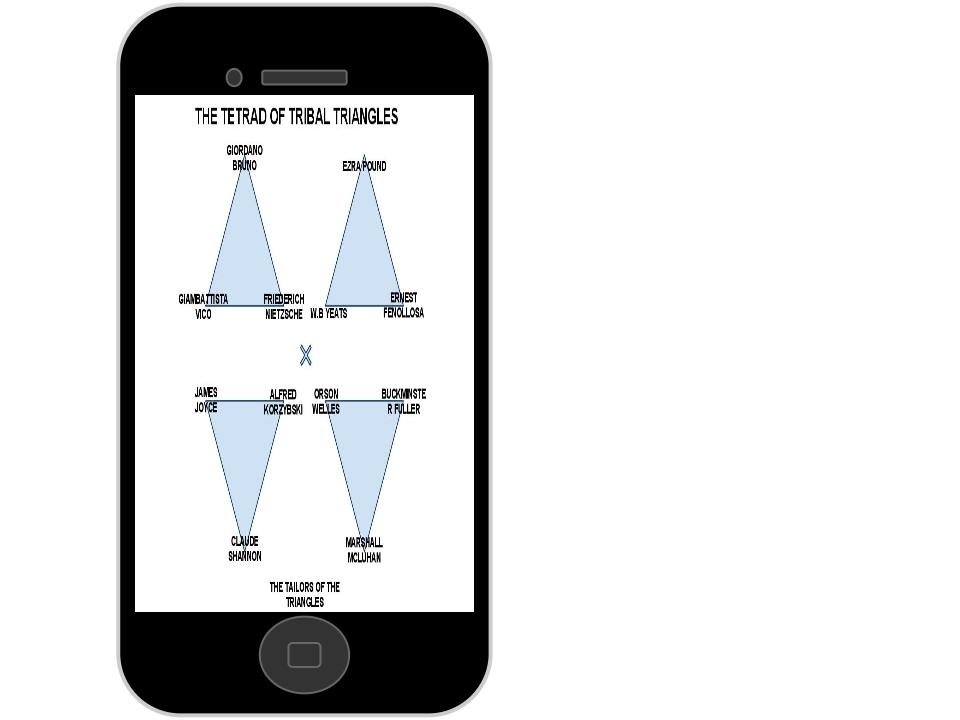
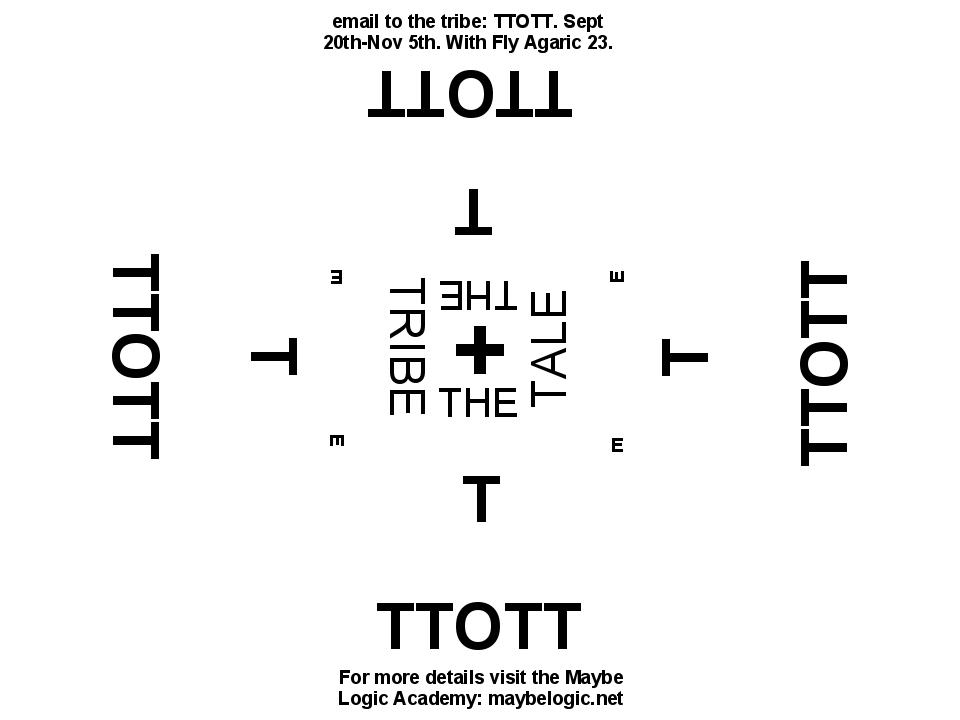
    Twenty Twelve Line Verses to ‘the tale of the tribe‘ (v3.0) by Fly Agaric 23
    To be printed as TWENTY TRIANGLES to build an Icosohedron.
    Thanks to Mark Pesce for kicking this into ‘hyperspace

    W i l l i a m
    Astrology Laureate
    Automatic Visionary
    Silver AppleMoon Golden Applesun
    Oriental Spiritualist Dramatist
    Great
    Nietzsche
    Return Pantheist
    Philologist Pastmoderniche
    Continental JungFreud Superman
    Existential Perspectivist Genius
    Count
    Alfred
    Organism Binding
    Aristopple Intraverse
    Ash
    Magic Memory
    Giordano Nolan
    Hermetical Quintessence
    Decentralized Models Cyberspace
    Shadow Nickusa Gio Mnemonic
    Heretical Transmigration Infinite
    Art
    Ernest
    Francisco
    Writing Japanheart
    Oriental Scholar
    Holowriting dossier
    Ideogram Metaprogram
    Economic Symbolism Structuring
    Processing
    Klassikspace
    Bio Computer
    Automation Thinking Humanist
    Neuro-linguistic Minded Holismgram
    Orson
    Writer Citizen Actor Director
    Shakespearean Academy Screenplayer
    Thunder Rhetoric
    Historicist Ribelle
    Metaphysique Episteam Vichean
    Graff
    Spaceship Architect
    Goes In For Structure Ezra Sez’
    Energetic Synergetix Manual

    Von
    WarGame Zero Sum
    Co-creator Internet
    Etching Digital Density Binary
    Minimaxi Combinatrix Information
    Wilhelm
    Psychoanalyst
    Imposition Orgone
    Energetic Biofeedback
    Omnipresent Dialectic Dynamo
    Bio Interface
    Cetacean Nation
    Acoustical Linguistics
    Interspecies Communication
    Dyadic Cyclone Floatation mindtank
    Taxonomic McLuhan
    Vico Recorsi Timewave Novelty
    Panspermia Cyberculture Psilocybin
    Bohemian Startrek
    Statistical Totality Gravity
  • POUND FOR POUND "Omar Shakespear Pound"

    POUND FOR POUND

    by Charlie Finch


    Today’s New York Times includes a small paid obituary, which reads, in its entirety, as follows: “Omar Shakespear Pound, Died peacefully at Princeton, NJ on 2 March 2010, aged 83, after long illness. Survived by his wife Elizabeth, daughters Katharine and Oriana, grandsons Ben and Joshua.”

    Shall we parse/deconstruct this fine and succinct piece of literary history? Omar Pound bore the name of his putative father, the poet Ezra Pound. A gifted poet and translator in his own right, Omar Pound was the son of the artist Dorothy Shakespear, a close associate of Wyndham Lewis, founder of the Vorticist movement. Dorothy was the daughter of a celebrated lover of the greatest of poets, William Butler Yeats.

    Dorothy’s art work appeared in seminal issues of the Vorticist Bible, BLAST magazine, and Dorothy, of course, was the wife of Ezra Pound. By the time Pound had taken up with his lifelong lover, the violinist Olga Rudge, Dorothy Shakespear had fled to Italy and given birth to Omar Shakespear Pound, whom many suspected was not the biological son of Ezra Pound.

    No matter, for Omar was a loyal son to Pound, seeing him through his grotesque alliance with Mussolini, the anti-Semitism and traitorous radio broadcasts that led to Pound’s detention by the U.S. Army, his incarceration at St. Elizabeth’s and his exile in Rapallo. We might pause to consider the penance contained in Omar’s paid obit: grandsons named Ben and Joshua, leaders of the Old Testament tribes of Israel.

    I have a lifelong friend, the critic and curator Alan Jones, author of the seminal book The Art Dealers, curator of the only show of Jeff Koons‘ works done exclusively by that artist’s own hand (student work from Chicago), and a man so enthralled by the legacy of Joyce, Pound, Yeats and their circle that he long ago married royalty and gave up the New York art world that had nurtured him, forever.

    Alan makes me think that to drown in the cultural past might be a better fate than a world of navel-gazing panels at dull art fairs. The sins and seductions Alan fell for had consequences, at least. And the death notices of that world, like the one for Omar Pound today, are modest and invite the sweet, subtle probe of collective memory.

    CHARLIE FINCH is co-author of Most Art Sucks: Five Years of Coagula (Smart Art Press).

  • Aleister Crowley on James Joyce and the Novel of the Mind

    http://books.google.co.uk/books?id=e6Zx4MCtF3kC&lpg=PA287&dq=james%20joyce%20aleister%20crowley&pg=PA287&output=embed

    Aleister Crowley on the novel of the mind

    1923

    Extract from ‘The Genius of Mr. James Joyce’, New Pearson’s Magazine, xlix (July 1923), 52-3.

    In a discussion of a new form of literature, the ‘novel of the mind’, the critic notes that this kind of fiction may ‘depart from artistic creation’.

    . . . This form of writing has been saved, by the genius of Mr. James Joyce, from its worst fate, that of becoming a mere amateur contribution to medical text-books.

    Every new discovery produces a genius. Its enemies might say that psycho-analysis—the latest and deepest theory to account for the vagaries of human behaviour—has found the genius it deserves. Although Mr. Joyce is known only to a limited circle in England and America, his work has been ranked with that of Swift, Sterne, and Rabelais by such critics as M. Valery, Mr. Ezra Pound and Mr. T. S. Eliot.

    There is caution to be exercised in appraising the work of a contemporary. . . . I am convinced personally that Mr. Joyce is a genius all the world will have to recognize. I rest my proof upon his most important book Ulysses, and upon his first novel, A Portrait of the Artist as a Young Man, and on such portions of Ulysses as have appeared. Before these he wrote two books, Chamber Music, a collection of most delicate songs, and Dubliners, sketches of Dublin life distinguished by its savage bitterness, and the subsequent hostility it excited. The Portrait when it appeared was hailed as a masterpiece, but it has been boycotted by libraries and booksellers for no discernible reason other than the fact that the profound descriptions tell the truth from a new, and therefore to the majority a disturbing, point of view.
    http://www.questia.com/PM.qst?a=o&d=102931236

  • TTOTT TEXTS v2.0

    ARGUABLY The greatest single resource for the study of DR. Robert Anton Wilson’s tale of the tribe.

    Steve fly agaric 23.

    Marshall McLuhan: Renaissance for a wired world By Gary Genosko.

    The medium and the magician: Orson Welles, the radio years, 1934-1952 By Paul Heyer.

    The classic Noh theatre of Japan By Ernest Francisco Fenollosa, Ezra Pound

    The legacy of Norbert Wiener By Norbert Wiener, David Jerison, Isadore Manuel Singer, Daniel W. Stroock

    The virtual Marshall McLuhan By Donald F. Theall

    Popular culture in a new age By Marshall William Fishwick

    Vico and Joyce By Donald Phillip Verene

    Science and sanity: an introduction to non-Aristotelian systems and general semantics By Alfred Korzybski

    The Ezra Pound encyclopedia By Demetres P. Tryphonopoulos, Stephen Adams

    Giordano Bruno and the geometry of language By Arielle Saiber

    Giambattista Vico and Anglo-American science: philosophy and writing By Marcel Danesi

    Beyond Good and Evil By Friedrich Wilhelm Nietzsche.

    The New Anthology of American Poetry: Traditions and revolutions, beginnings… By Steven Gould Axelrod, Camille Roman, Thomas J. Travisano

    The good European: Nietzsche’s work sites in word and image By David Farrell Krell, Donald L. Bates

    The Dragon Painter By Mary McNeil Fenollosa

    At the speed of light there is only illumination: a reappraisal of Marshall McLuhan By John George Moss, Linda M. Morra

    The Chinese Written Character as a Medium for Poetry: A Critical Edition By Ernest Fenollosa, Ezra Pound

    From Whitney to Chomsky: essays in the history of American linguistics By John Earl Joseph

    The imported pioneers: Westerners who helped build modern Japan By Neil Pedlar

    Fearing the Dark: The Val Lewton Career By Edmund G. Bansak, Robert Wise

    Spoken and written discourse: a multi-disciplinary perspective By Khosrow Jahandaríe

    American literature and science By Robert J. Scholnick

    The poetry of Ezra Pound By Hugh Kenner

    Nietzsche: an introduction By Gianni Vattimo

    News is people: the rise of local TV news and the fall of news from New York By Craig Allen