Category: Marshall McLuhan

  • Massive Online Open Courses: From McLuhan to MOOC.

    Note to Maybe Logic Academy!
    http://www.maybelogic.org/

    Massive Online Open Courses: From McLuhan to MOOC.

    “In this summer of 2012 the buzz in the world of higher education is about massive online open courses, or “MOOC.” It seems that cyber-prophet Marshall McLuhan saw this coming.

    As a classroom teacher for over 35 years who is about to set a virtual foot onto the campus of MOOC U (my neuroethics course will be offered by Coursera in January, the other major entrant into MOOC being EdX), I wonder what I’m getting into. I have a feeling I’m not alone among my dozens of colleagues in this regard. Surely they also wonder if the transmission of knowledge to which they’ve given much of their lives is about to undergo an unpredictable transformation in which they will play a part. University of Virginia professor Mark Edmundson is dubious that the classroom artistry of the truly fine teacher can be captured in the online experience.

    Edmundson has a point. I know exactly what he means when he compares those precious moments of didactic flow in a physical classroom to jazz improvisation.

    Yet the precise contours of the MOOC experience and its implications for higher education remain a mystery to everyone, including the investors, institutions and instructors. All we really know is that (1) the sheer number of potential online students is mind-boggling and hard to resist; and (2) the “production values” need to be far better than those for the university-produced online lectures I’ve watched in the past few years.

    The MOOCs need to hit that sweet spot between two hours of a static lecturer-focused camera and the flash-and-dash of TED Talks. But at this stage that still doesn’t tell us much about what to expect.

    In search of an oracle, I stumbled upon a piece co-authored by Marshall McLuhan in 1967 in, of all places, Look magazine (many teachers worry that online students will look but not think). The article forecast the learning experience of “The Class of 1989”; the same issue included a long essay by a Look senior editor on “The Generation Gap.” Just as young people were demanding more “relevance” in schools, McLuhan recites the longstanding progressive critique of standardized education as “bodies of knowledge” and lectures, the latter seen “one of the least effective [mode of education] ever devised by man,” soon to go the way of all other “mechanized production line[s].”

    Instead, McLuhan wrote, “the new modes of instantaneous, long-distance human communication — radio, telephone, television — are linking the world’s people in a vast net of electric circuitry that creates a new depth and breadth of personal involvement and events and breaks down the old, traditional boundaries that made specialization possible.” McLuhan thus foresaw the end of the mass-produced student. “When computers are properly used, in fact, they are almost certain to increase individual diversity. A worldwide network of computers will make all of mankind’s factual knowledge available to all students everywhere in a matter of minutes or seconds.”

    Not bad for 1967, just as the Pentagon’s packet switching technology was indeed laying the groundwork for “a worldwide network of computers.”

    http://www.huffingtonpost.com/jonathan-d-moreno/massive-online-open-cours_b_1695128.html

  • ‘Marshall McLuhan strikes back’ and ‘the medium is the message’


    More Than Ever, the Medium Is the Message: How You Can Celebrate Marshall McLuhan’s 100th 

    “This is the 100th anniversary of McLuhan’s birth, and there’s been a year-long global celebration of the man — and his messages. All of this merry-making culminates in a conference and concert in Toronto November 7 – 10th.”

    http://www.huffingtonpost.com/julia-moulden/marshall-mcluhan_b_1065015.html

    Marshall McLuhan strikes back

    Published On Thu Oct 20 2011
    Philip Marchand, author of Marshall McLuhan: the medium and the messenger

    Image

    By Greg Quill Entertainment Reporter
    ENTERTAINMENT COLUMNIST
     

    Of the myriad arcane factoids, theories, impressions and interpretations likely to be disclosed during the course of the International Festival of Authors’ three major McLuhan 100 readings and dissertations over the next week, one is of exceptional interest: the Toronto-based communications guru, who was able to see a bigger picture than other contemporaries in his field, had a physiological advantage over most other mammals — a unique vascular pattern in his left cerebral cortex seen only in cats.

    “Actually, he used to say it was unique to tigers,” says McLuhan biographer and former Star books columnist, Philip Marchand, whose Marshall McLuhan: the medium and the messenger (1998), is considered one of the most compelling portraits of the complex and often incomprehensible academic and theorist, who is said to have pre-imagined the Internet, and laid out such forward thinking notions as “the medium is the message” and “the global village.”
    “It was the result of brain surgery in 1967 to remove a benign tumor,” says Marchand, who began his biography after being appointed to the task of cataloguing McLuhan’s papers for the national archive. McLuhan died in 1980 from the effects of a stroke.

    “He feared a blockage of blood vessels would necessitate another operation, but rather miraculously, new vascular systems developed that were apparently uncharacteristic in human anatomy.”

    What effect this anomaly had on McLuhan’s legacy is anyone’s guess, though some of his peers subsequently noted that the operation that saved his life cost him his genius, and that his work in later years never matched the promise in The Gutenberg Galaxy: The Making of Typographic Man and Understanding Media: The Extensions of Man, in the early 1960s.

    McLuhan might have fallen out of favour at the time of his death — “he was seen as a bit of a charlatan, because he preferred talking to writing and publishing, and used language and phrases that other academics considered dense and impenetrable,” Marchand says — but he’s back with a vengeance now, as one by one, his media prophesies become not just the new reality of communications-driven world, but a way of life.

    The International Festival of Author’s McLuhan 100 events, which gets underway Friday night at the Fleck Dance Theatre with an appearance by New York University professor and renowned social and technological networks consultant Clay Shirky, aren’t just manifestations of Toronto’s official year-long focus on the centenary of one of the city’s favourite sons, an international star, says festival director Geoffrey Taylor.

    “We were approached a year ago by the city to find a way of including McLuhan in the festival, which is, for the most part, a celebration of the written word and of new works of fiction.
    “But it’s also a festival about ideas and communication, so it was an easy fit, particularly since McLuhan is being embraced by a new generation of writers.”

    On Friday night Shirky will read from his latest book, Cognitive Surplus, and answer questions from Toronto broadcaster and graduate of the U of T’s McLuhan Program, Jesse Hirsh.
    Saturday afternoon, at Studio Theatre, Brooke Gladstone, co-host and managing editor of U.S. National Public Radio’s news magazine On the Media, will present The Influencing Machine, a graphic novel on the complexities of the modern media, with illustrations by Josh Neufeld.

    And Wednesday at Studio Theatre, Canadian novelist, essayist and filmmaker Douglas Coupland discusses his latest book, Marshall McLuhan, part of Penguin Group’s Extraordinary Canadians series.

    The Generation X author will be interviewed by Nora Young, host and creator of CBC Radio’s Spark, which examines technology and culture.

    McLuhan, says Taylor, is better appreciated in other parts of the world than in his homeland, “and generally underrated everywhere.

    “But writers are having to deal with communications in so many different ways now … and McLuhan seems more relevant than ever.”

    In a recent essay in the U.K. Guardian, Coupland, currently on tour in a remote region of China and outside the range of the Internet and email, outlined the origins of his fascination with McLuhan’s work, and the subject of his new book:

    “To be fair, McLuhan was about more than ‘the medium is the message’, but that remains a fabulous reduction. McLuhan was an information canary, warning us that there were new media coming down the line, and it was the effects of these new media on the mind that he wondered about so extravagantly — the message seemed to be very dark, indeed.

    “In his poetic and elliptical ways, McLuhan foresaw a fluid melting world of texting, email, YouTube, Google, smart phones and reality TV,” Coupland writes.

    “Most of the content of any of these media is pure crap. But what’s spooking us all is the inevitable message of these new media: what will be the psychic fallout of these technologies on our inner lives?

    “As with TV in the 1950s, don’t be fooled by the content of texts or blogging or online shopping. Look at what these media are doing to our souls. That’s what McLuhan did.”

    Marchand isn’t so sure either that McLuhan would have liked living in the wired world he foresaw as the inevitable confluence of broadcasting technology and the demands of the age of information.

    “For one thing, he loved books, and worked in a book-lined office. He devoured non-fiction by reading every second page, and never missed a thing. I don’t think he’d have enjoyed reading e-books.

    “He died before personal computers were a reality, but I think he’d have loved the Internet’s immediacy, and would have had no difficulty understanding its surrounding effect, or that it seems more real than the natural world,” Marchand adds.

    “But keyboards and texting, the reliance on literate skills in this new environment — I’m not sure what he’d have made of that.”

    BOOKS BY MARSHALL MCLUHAN:

    The Mechanical Bride: Folklore of Industrial Man 1951
    The Gutenberg Galaxy: The Making of Typographic Man 1962
    Understanding Media: The Extensions of Man 1964
    Verbi-Voco-Visual Explorations 1967
    Medium is the Massage: An Inventory of Effects 1967
    War and Peace in the Global Village with Quentin Fiore 1968
    Through the Vanishing Point: Space in Poetry and in Painting with Harley Parker 1968
    Counterblast with Harley Parker 1969
    From Cliche to Archetype with Wilfred Watson 1970
    Culture is Our Business 1970
    Take Today: The Executive as Drop-out 1972
    City as Classroom: Understanding Language and Media with Kathryn Hutchon and Eric McLuhan 1977
    Posthumous books:
    Laws of Media: The New Science with Eric McLuhan 1988
    The Global Village: Transformations in World Life and Media in the 21st Century with Bruce R. Powers 1989

  • Transformations in World Life and Media in the 21st Century

    Transformations in World Life and Media in the 21st Century
    ISBN13: 9780195079104ISBN10: 0195079108 Paperback, 240 pages

    Price:

    $19.99

    Description

    Extending the visionary early work of the late Marshall McLuhan, The Global Village , one of his last collaborative efforts, applies that vision to today’s worldwide, integrated electronic network.

    When McLuhan’s groundbreaking Understanding Media was published in 1964, the media as we know it today did not exist. But McLuhan’s argument, that the technological extensions of human consciousness were racing ahead of our ability to understand their consequences, has never been more compelling. And if the medium is the message, as McLuhan maintained, then the message is becoming almost impossible to decipher.

    In The Global Village , McLuhan and co-author Bruce R. Powers propose a detailed conceptual framework in terms of which the technological advances of the past two decades may be understood. At the heart of their theory is the argument that today’s users of technology are caught between two very different ways of perceiving the world. On the one hand there is what they refer to as Visual Space–the linear, quantitative mode of perception that is characteristic of the Western world; on the other hand there is Acoustic Space–the holistic, qualitative reasoning of the East. The medium of print, the authors argue, fosters and preserves the perception of Visual Space; but, like television, the technologies of the data base, the communications satellite, and the global media network are pushing their users towards the more dynamic, “many-centered” orientation of Acoustic Space.

    The authors warn, however, that this movement towards Acoustic Space may not go smoothly. Indeed, McLuhan and Powers argue that with the advent of the global village–the result of worldwide communications–these two worldviews “are slamming into each other at the speed of light,” asserting that “the key to peace is to understand both these systems simultaneously.”

    Employing McLuhan’s concept of the Tetrad–a device for predicting the changes wrought by new technologies–the authors analyze this collision of viewpoints. Taking no sides, they seek to do today what McLuhan did so successfully twenty-five years ago–to look around the corner of the coming world, and to help us all be prepared for what we will find there. 

     
  • TTOTT WHEELS GO AROUNDAROTA

    TTOTT WHEELS GO AROUNDAROTA

    TTOTT WHEELS GO AROUNDAROTA

    BALANCING THE EQUATIONS WITH TRIADS.

    I view a part of my task in setting up a table of ttott correspondences as providing examples of how the tables can be used to create various effects. Both as study guides into historical, biographical work and as imagination guides into the tale of the tribe, and the new translations.

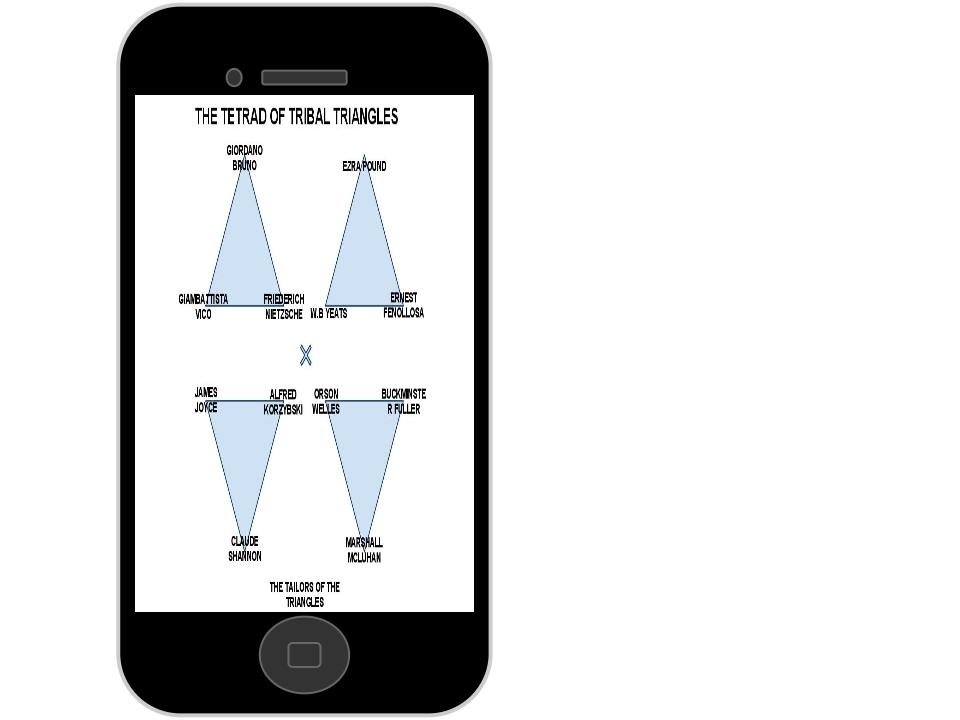
    The triangular structure enables opposing characteristics of mildness and severity a point of resolution and of synthesis, a middle path that may recycle the energies back and around and in so doing balance the opposing forces. The general idea of dividing 30 characters into 10 sets of triangulated groups of three characters, for example, may provide a working model for a rough structure, as would 15 sets of waltzing duo’s of opposing forces or a ‘coincidance of contraries’ as Joyce put it in Finnegans Wake.

    GEODESICS

    I have developed number systems for working out the new maps, due to the possibility of multi-dimensional models at a latter stage of the project, whereby objects containing various symbols and images can be folded and enfolded. I have already experimented with a TTOTT Dodecahedron of 20 sides and 12 vertices, and in principle, the numbers 30, 60, 90,120 and 150 all render symmetrical objects upon which information may be presented, here I pay tribute to Buckminster Fuller, and Giordano Bruno.

    THE TALLY OF THE TRIBE.

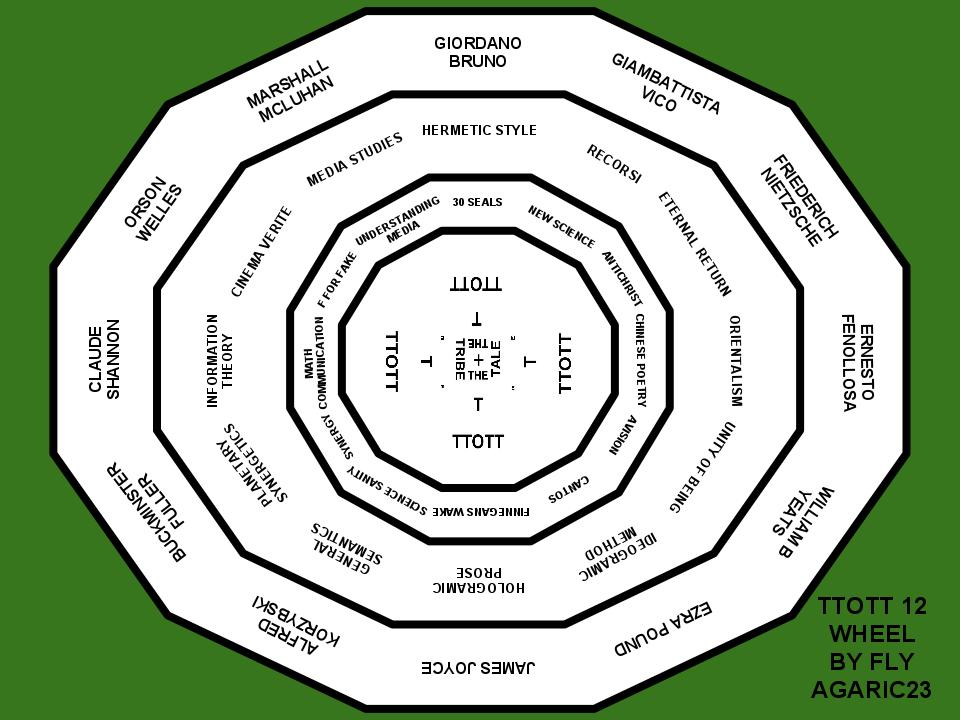
    The set of 5 wheels I have designed each have 30 ‘nodes’ on their belt of concentric rings. I made them by choosing 5 major categories: Tailors, Theolo, Texts, Teachings, Totems (Human Beings, Spirits, Texts, Principles, Objects).

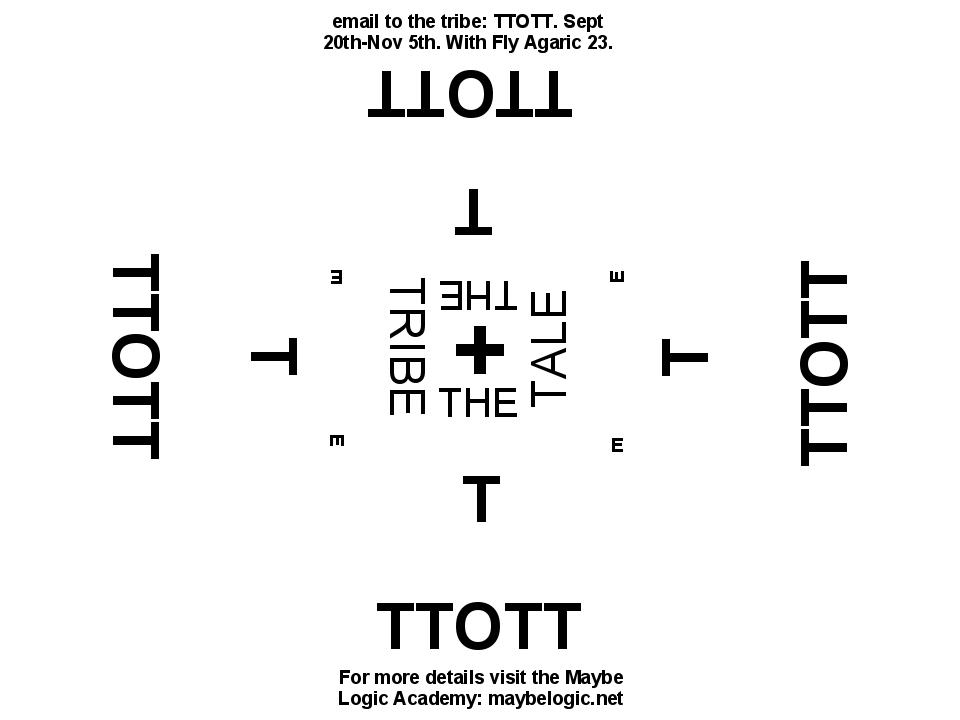
    I have chose to recycle ‘T’ words and keep a running TTOTT structure to each heading and category I make. The TTOTT logo features four ‘T’s tilted to create a four way symmetry (+) with a circle placed central. If you pretend to say the word ‘T’ you’ll notice your tongue gets right up on your teeth, and if you make a repeated ‘T’ sound you may notice that you sound a little like a Hi-Hat cymbal, and, that you can repeat the letter ‘T’ faster and with more control than possibly any other letter in the English Alphabet? This will have some correspondence to the spoken word and spoken drum components to the class, but also keep the original TTOTT (the tale of the tribe) intact.

    Giordano Bruno used the number 30 often when constructing his wheels and wheels within wheels. Although unlike Bruno, my belts are so far only attenuated to the TTOTT matter, and simply borrow the use of the number 30 and the idea of putting lists of things on concentric rings, 5 in total, producing 150 nodes, or images in Bruno’s model, that I should add seems incredibly more complex and refined than my wheels. Reading Bruno recently led me to revisit the idea of having 30 things on revolving tables, something I used to anchor some themes in an early edition of my book: World Piss: 30 seals and the spore of the words.

    All the characters that follow Bruno chronologically can appear on the wheels that he inspired, together with Giambattista Vico, (another philosopher of the revolutionary hermetic renaissance tradition), the tribal characters can ride the wheel, the turning tables of correspondences, and so unify in that movement, that ever-changing sensibility and decentralized and rotational wisdom. A revolutionary force.

    CONNECTING CYCLES AND CIRCUITS

    The tale of the tribe must be a connected network, otherwise it is useless. A new team of nodal points, shared swarms that link together. The goal of a hologramic network, a poem, novel, screenplay, album, performing overlapping functions, working together.

    The triple spiral symbolizes the rotational and spiral nature of the connected works of Dr. Robert Anton Wilson, the triad or delta that symbolizes femininity and the triple goddess. Vico and Joyce and Nietzsche feed off the spiraling principles of recorsi. Giordano Bruno and his “Memory Wheels” plus Giambattista Vico and his “Cycles of Ages”, Frederich Nietzsche and the “Eternal Return”, Ernest Fenollosa and the omni-directional radiance of “Chinese Symbolism”, William Butler Yeats and his dynamic “Gyres” and “Unity of Being” and ‘Symbolism’, Ezra Pound and his “Revolutionary Calendar” and ‘Ideogramic method of juxtaposition’, James Joyce and his spiral powered “coincidance of contraries & resolution of opposites”, Buckminster Fuller and the moving “Synergistic” principles. Meanwhile Alfred Korzybski and his “General Semantics”, Marshall McLuhan and his “Global Village Tribes”, Orson Welles and his “Neurological Cinematic Relativity”, Claude Shannon and “Information Theory” and other recurring geniuses and their additional contributions to humanity intersect with connecting threads represented by Dr. Wilson. In my opionion at their most potent when writing on Joyce: the mother-load of compressed hermetic wisdom.

    THE TURNING OF THE TRIBE

    The new maps and seals I present are a work in progress and as far as I know a unique way of processing the information, and potentially a relatively simple and sharable method for others to conduct similar research.

    I would like to present a kind of Top Trumps challenge to create an equally revolutionary belt of innovative thinkers, or simply use any combination of belts on any grouping of things that you may wish, make it new! Bio-seasonal, calendrical, astrological and cosmological belts for example, may add many useful functions, the possibilities are literally endless with this, but I have chose to stack and pack a krewe that I believe represent the tale of the tribe as defined by Dr. Wilson, quite a bunch’, to perhaps provide a new platform for collaborative investigations, and new interpretations. Nodes or units of distilled cultural inheritance.

    Tailors, Theolo, Texts, Teachings, Totems (Human Beings, Spirits, Texts, Principles, Objects). v1.0

    1. “Alighieri, Dante” Agnosticism Arrow Atem-Re Avision
    2. “Bruno, Giordano” Buddhism Binocular Baal Book Of The Law
    3. “Crowley, Aleister” Cinema Verite’ Cup Circe Cantos
    4. “Dick, Philip K.” Deconstructionism Disk Dionysis Divine Comedy
    5. “Escher, M.C” Epistemology Earring Eris Everything is Under Control
    6. “Fuller, Buckminster” Fourth Way Flag Findabair Flying Saucers
    7. “Gurdjieff, G.I” General Semantics Glasses Ganesha Gulliver’s Travels
    8. “Hesse, Herman” Hologrammic Prose Headdress Horus Holographic Universe
    9. “Ibsen, Heinrik” Information Theory Ink Ishtar Illuminatus Trilogy
    10. “Joyce, James” Jungian Psychology Joystick Jove Jitterbug Perfume
    11. “Korzybski, Alfred” Kabbalah Kettle Kallisti Knox Om Pax
    12. “Leary, Timothy” Lullism Lamp Lugh Liber 777
    13. “McLuhan, Marshall” Magick Mitten Ma’at Mass Psychology Of Fascism
    14. “Nietzsche, Friederich” Neuro Linguistic Programming Nail Naga New Science
    15. “Olson, Charles” Ontology Oblisk Osiris Open Society And Its Enemies
    16. “Pound, Ezra” Pataphysics Pincer Prometheus Politics Of Ecstasy
    17. “Quiggly, Carroll” Quantum Psychology Quilt Quetzalcoatl Quantum Psychology
    18. “Reich, Wilhelm” Recorsi Rope Ra Recorsi
    19. “Shannon, Claude” Synergetics Scissor Sarasvati Science and Sanity
    20. “Tesla, Nikola” Tessellation Turntable Thoth Tale of The Tribe
    21. “Unrah, Wes” Unity of Being Umbrella Utu Understanding Media
    22. “Vico, Giambattista” Vorticism Viol Vishnu VALIS
    23. “Welles, Orson” Witchcraft Wand Woden White Goddess
    24. “X, Malcolm” Xenolinguistics Xylophone Xi Wang Mu Xo-psychology
    25. “Yeats, W. Butler” Yin Yang Yurt Yu Huang Yajur Veda
    26. “Zenji, Dogen” Zetetics Zip Zarathustra Zen
    27. “Neumann, John Von” Modernism Mirror Aphrodite Book of Shadows
    28. “Fenollosa, Ernesto” Ideogrammic Method Pipe Pan Ulysses
    29. “Bandler, Richard” Eternal Return Breastplate Luna Cosmic Trigger
    30. “Wiener, Norbert” Neuro-Logic Ring Aphrodite Critical Path

    Monday, September 13, 2010

    Fly Agaric 23 announces online RAW course

    Steve “Fly Agaric” 23 has announced a new online course, “email to the tribe,” which will run from Sept. 20 through Nov. 5 and will feature weekly doses of multimedia; participants are asked to donate what they can.

    Agaric explains, “Each week fly will provide a spread of multimedia for you to process, generally keeping in step with the program, encouraging a wide variety of conversation and focused feedback. Feel free to drop in and drop out, as you like.”

  • email to the tribe: a Maybe Logic Class by Fly Agaric 23

    email to the tribe: a Maybe Logic Class by Fly Agaric 23


    Fly Agaric 23

    September 20 – November 5
    email to the tribe
    Homogrammic Prose


    The tale of the tribe approximates a tale of humanity, or ‘tales’, a new global epic that must capture illuminating details from humanity and juxtapose them in a special way using special language (Hologrammic prose, the Hermetic style, Ideogrammic method, Joyce’s ‘epiphany’ etc.) Dr.Robert Anton Wilson crafted his tale of the tribe to suit, among other definitions; the architects of post-modem’ cyber-culture, reaching back to the renaissance and pulling up-tense to our decentralized–hyper connected–future present. 
     
    During a six week period, I-fly will share his open interpretations of the tale of the tribe, performing an on-line multimedia vortex of signals, dialed into James Joyce, Ezra Pound, Giordano Bruno, Marshall Mcluhan, ‘Bucky’Fuller, and RAW himself.
     
    email to the tribe will reprocess communications from across time, and produce new maps, new metaphors, and mold new memes that help forward the tale of the tribe and the RAW wisdom oozing out from all quarters.
     
    Each week fly will provide a spread of multimedia for you to process, generally keeping in step with the program, encouraging a wide variety of conversation and focused feedback. Feel free to drop in and drop out, as you like.
     
    EMAIL TO THE TRIBE: WEEKLY PRESCRIPTION.
    WEEK ONE – WHEELS AND CYCLES (Sep 20-26)
    The wheels of the tribe go around and around.
    WEEKLY DOSE: Decentralized and Rotational Map Warfare.
     
    WEEK TWO – GENERAL EPIPHANY (Sep 27-3rd October)
    Hologrammic Prose and meaningful common speech
    WEEKLY DOSE: RAW-FLY interviews. (Oct 4-10)
     
    WEEK THREE – IDEOGRAMMIC FULLERENE (Oct 11-17)
    The synergy of history
    WEEKLY DOSE: Vicosahedron and Canto LXVI. Open Source History.
     
    WEEK FOUR – GLOBAL FEEDBACK (Oct 18-24
    If its not connected its useless
    WEEKLY DOSE: Shannanigums Wave & Future Present.
     
    WEEK FIVE – CINEMA OF UNITY (Oct 25-31)
    Moving pictures to TV/Internet
    WEEKLY DOSE: Maybe Logic & RAW Multimedia.
     
    WEEK SIX – THE TALE OF THE CYBERNET (Nov 1-5)
    My-wiki-face-twitter
    WEEKLY DOSE: Work of the tribe. email to the tribe.
     
    COURSE TEXTS: Recorsi by Robert Anton Wilson.
     

    • $Pay-What-You-Can$ – Enroll Now •
    [$50 recommended minimum price] 

    http://www.maybelogic.org/courses.htm 

  • Twenty Twelve Line Verses v3.0 (Icosoheedrome)

    Twenty Twelve Line Verses to ‘the tale of the tribe‘ (v3.0) by Fly Agaric 23
    To be printed as TWENTY TRIANGLES to build an Icosohedron.
    Thanks to Mark Pesce for kicking this into ‘hyperspace

    W i l l i a m
    Astrology Laureate
    Automatic Visionary
    Silver AppleMoon Golden Applesun
    Oriental Spiritualist Dramatist
    Great
    Nietzsche
    Return Pantheist
    Philologist Pastmoderniche
    Continental JungFreud Superman
    Existential Perspectivist Genius
    Count
    Alfred
    Organism Binding
    Aristopple Intraverse
    Ash
    Magic Memory
    Giordano Nolan
    Hermetical Quintessence
    Decentralized Models Cyberspace
    Shadow Nickusa Gio Mnemonic
    Heretical Transmigration Infinite
    Art
    Ernest
    Francisco
    Writing Japanheart
    Oriental Scholar
    Holowriting dossier
    Ideogram Metaprogram
    Economic Symbolism Structuring
    Processing
    Klassikspace
    Bio Computer
    Automation Thinking Humanist
    Neuro-linguistic Minded Holismgram
    Orson
    Writer Citizen Actor Director
    Shakespearean Academy Screenplayer
    Thunder Rhetoric
    Historicist Ribelle
    Metaphysique Episteam Vichean
    Graff
    Spaceship Architect
    Goes In For Structure Ezra Sez’
    Energetic Synergetix Manual

    Von
    WarGame Zero Sum
    Co-creator Internet
    Etching Digital Density Binary
    Minimaxi Combinatrix Information
    Wilhelm
    Psychoanalyst
    Imposition Orgone
    Energetic Biofeedback
    Omnipresent Dialectic Dynamo
    Bio Interface
    Cetacean Nation
    Acoustical Linguistics
    Interspecies Communication
    Dyadic Cyclone Floatation mindtank
    Taxonomic McLuhan
    Vico Recorsi Timewave Novelty
    Panspermia Cyberculture Psilocybin
    Bohemian Startrek
    Statistical Totality Gravity
  • TTOTT TEXTS v2.0

    ARGUABLY The greatest single resource for the study of DR. Robert Anton Wilson’s tale of the tribe.

    Steve fly agaric 23.

    Marshall McLuhan: Renaissance for a wired world By Gary Genosko.

    The medium and the magician: Orson Welles, the radio years, 1934-1952 By Paul Heyer.

    The classic Noh theatre of Japan By Ernest Francisco Fenollosa, Ezra Pound

    The legacy of Norbert Wiener By Norbert Wiener, David Jerison, Isadore Manuel Singer, Daniel W. Stroock

    The virtual Marshall McLuhan By Donald F. Theall

    Popular culture in a new age By Marshall William Fishwick

    Vico and Joyce By Donald Phillip Verene

    Science and sanity: an introduction to non-Aristotelian systems and general semantics By Alfred Korzybski

    The Ezra Pound encyclopedia By Demetres P. Tryphonopoulos, Stephen Adams

    Giordano Bruno and the geometry of language By Arielle Saiber

    Giambattista Vico and Anglo-American science: philosophy and writing By Marcel Danesi

    Beyond Good and Evil By Friedrich Wilhelm Nietzsche.

    The New Anthology of American Poetry: Traditions and revolutions, beginnings… By Steven Gould Axelrod, Camille Roman, Thomas J. Travisano

    The good European: Nietzsche’s work sites in word and image By David Farrell Krell, Donald L. Bates

    The Dragon Painter By Mary McNeil Fenollosa

    At the speed of light there is only illumination: a reappraisal of Marshall McLuhan By John George Moss, Linda M. Morra

    The Chinese Written Character as a Medium for Poetry: A Critical Edition By Ernest Fenollosa, Ezra Pound

    From Whitney to Chomsky: essays in the history of American linguistics By John Earl Joseph

    The imported pioneers: Westerners who helped build modern Japan By Neil Pedlar

    Fearing the Dark: The Val Lewton Career By Edmund G. Bansak, Robert Wise

    Spoken and written discourse: a multi-disciplinary perspective By Khosrow Jahandaríe

    American literature and science By Robert J. Scholnick

    The poetry of Ezra Pound By Hugh Kenner

    Nietzsche: an introduction By Gianni Vattimo

    News is people: the rise of local TV news and the fall of news from New York By Craig Allen

  • FINNEGANS WAKE: THE MOVIE (1966)

    This movie was shared over at the maybelogic blog, thanks to Bobby. It sparked a flurry of visions. I thought of BOB. He would have loved this movie, I think. I find the TV scenes and treatment of the multi-media mixture of signals, more generally, mind blowing.
    –steve fly

    “”A half-forgotten, half-legendary pioneer in American abstract and animated filmmaking, Mary Ellen Bute, late in her career as an artist, created this adaptation of James Joyce, her only feature. In the transformation from Joyce’s polyglot prose to the necessarily concrete imagery of actors and sets, Passages discovers a truly oneiric film style, a weirdly post-New Wave rediscovery of Surrealism, and in her panoply of allusion – 1950s dance crazes, atomic weaponry, ICBMs, and television all make appearances – she finds a cinematic approximation of the novel’s nearly impenetrable vertically compressed structure.

    With Passages from Finnegans Wake Bute was the first to adapt a work of James Joyce to film and was honored for this project at the Cannes Film Festival in 1965 as best debut.”

    http://www.ubu.com/film/joyce_wake.html

  • F is For Fourier Transfers

    I find it hard to describe what I’ve learnt this week, but I’ll share something I started to learn about just today, after reading Mark’s ‘Hyperpeople’ where he writes “MP3 recording uses a mathematical technique known as Fourier Transforms to break an audio signal into its constituent sound waves. It’s like a chord played on a guitar: you can think of a chord as a set of individual strings being played simultaneously.”

    This quote caused me, among other things, to think of Claude Shannon, and led me, via a quick wiki search to some of his fascinating contributions to the –digital age–to my mind today, I kind of learnt that good poetry has a resonance with the Fourier Transform, like music, by way of the sweet chord-analogy made by Mark Pesce. I’m not sure I have fully processed and learn’t about Fourier transforms, but I have found a new field of interest I feel worthy of deeper investigation and sharing here as an example. I also learnt a little about Giordano Bruno, Nietzsche, Giambattista Vico, James Joyce, McLuhan and Claude Shannon and what they have in common with my own warped interpretation of some parts of ‘Hyperpeople’.

    Furthermore, I feel that, although Internet may have no historical precedent, certain individuals have a strong resonance with the world wide web. Today I learn’t why Nietzsche and Shannon, in particular, are important historical figures, kick-started by thoughts inspired while reading ‘hyperpeople’ if… we were to fiddle with historical events, contrasted with the current refreshing focus on the present 2009 – scenario-universe.
    I shd/ come clean here though, friends, and confess that I’m not an academic, a Phd, or a University student, but I’m probably best classed in the realm of the drop-out I guess.