7 minds Written by Oz Ezzeldin @GarajMahalMusic is: @FareedHaqueMusic , Kai Eckhardt, Oz Ezzeldin, Hassan Hurd. Video content generated using Gemini Veo. The creator intends to plant a tree for each full video and encourages anybody who enjoys this video to go support a local artist, or plant a tree, or both! Visit http://www.garajmahal.us and Patreon.com/stevefly
BRD Written by Fareed Haque. @GarajMahalMusic is: @FareedHaqueMusic, Kai Eckhardt, Oz Ezzeldin, Hassan Hurd. Video content generated using Gemini Veo. The creator intends to plant a tree for each full video and encourages anybody who enjoys this video to go support a local artist, or plant a tree, or both! Visit http://www.garajmahal.us and Patreon.com/stevefly
Amsterdam, 2012. DJ-poet Plush, reeling from attacks that shattered his face and his career, forms TRB with Max and Percy. Inspired by Robert Anton Wilson, they fuse turntablism, magick, and literature into the chaotic TribeTable Method, accidentally plugging into Wilson’s unfinished “Tale of the Tribe” and a brewing historical conspiracy centered on the 1936 Berlin Olympics.
As they juggle invoked entities (“The Sixty”), time-traveling tardigrades, and messages channeled through experimental beats, they attract the attention of a ruthless cabal manipulating reality through AI, populism, and bizarre rituals involving peanut butter. From Amsterdam coffeeshops and secret bases beneath the Malvern Hills to the decks of a reality-bending DJ battle, TRB must decode the “Hologrammic Prose” of the universe, hijack the narrative, and fight the “Prick Populist” threat before the singularity hits endgame.Deep Scratch is Vanta Black science fiction comedy.
It’s Burroughs cut-ups slammed into Pynchon paranoia, fueled by hip-hop aesthetics and occult theory. Expect prophetic visions, weaponized memes, sentient technology, talking books, exploding jellyfish, and the desperate search for the perfect beat in a deep fake universe. The tables are turning. Which side are you on, are you on, hello, check check…?
Give me a D.J!
Give me an M
Give me an A
Give me an N
Give me an T
Give me an I
Give me an S

MANTIS! Yeah....

It's the return of the Mantis,
From out of your dreams,
Scratching and cutting up the beats, so it seems...
This is no D.M.T. trip, (oh no)
This is deep scratch and fly lyrics straight off the lip. (trippa trip trip trippa trip trick-nology.
Flip it Mantis...
Pray. Who's ready to eat?
Calling all political parties, councils and historical societies, professors, teachers and those who claim to love their country and county, those who cherish their history! Here, (below) as performance by example is my demonstration to help provide clarity, fair and balanced information, well sourced and checked facts, all about Stourbridge. James Joyce and Ezra Pound. Cheers for the help, Gemini.
–Steve The Fly.
Stourbridge: River, Clay, Glass, and the Modernist Imagination
I. Introduction
Stourbridge, a market town nestled in the Metropolitan Borough of Dudley in the English West Midlands, presents a compelling case study in the interplay of geography, geology, industry, and cultural resonance.1 Historically situated in Worcestershire 1, its identity has been profoundly shaped by the River Stour that flows through it, the bridge that gave the town its name, and the rich deposits of fireclay beneath its surface. This unique geological endowment fostered a world-renowned glassmaking industry that defined Stourbridge for centuries.1 Beyond its tangible history, the town’s name echoes, perhaps unexpectedly, within the complex landscapes of two major works of literary modernism: James Joyce’s Finnegans Wake and Ezra Pound’s The Cantos.
This report seeks to explore these interwoven facets of Stourbridge’s significance. It will investigate the origins and meaning of the town’s name, examining the etymology of both “Stourbridge” and the “River Stour,”. It will trace the historical development of the settlement, focusing on the foundational roles of the river and its crossing point. Furthermore, the report will delve into the history of the Stourbridge glass and ceramics industries, highlighting the indispensable contribution of local fireclay resources. Finally, it will analyze the specific mentions of Stourbridge in the works of Joyce and Pound, considering their context and potential meanings, before synthesizing these diverse threads to articulate the town’s multifaceted importance across history, industry, and literature.
II. Unpacking the Name: The Etymology of Stourbridge and the River Stour
The name of a place often holds clues to its origins, geography, or the perceptions of its earliest inhabitants. In the case of Stourbridge, the name points directly to its defining topographical feature, while the river it references carries echoes of ancient linguistic roots and debated meanings.
A. Stourbridge: The Bridge Over the Stour
The etymology of “Stourbridge” itself is remarkably straightforward and consistently attested. The name signifies exactly what it describes: a bridge crossing the River Stour.4 Historical records confirm this derivation. The town appears in the 1255 Worcestershire assize roll as ‘Sturbrug’ or ‘Sturesbridge’.1 Later medieval forms include ‘Sturbrugg’ in the Subsidy Rolls of 1333 and ‘Stourbrugge’ recorded in 1375.8 The element ‘-brugge’ is an older form of the word ‘bridge’.8 The settlement that grew around this crossing point was originally known by a different name, likely the Anglo-Saxon ‘Bedcote’, which lay within the larger manor of Swynford (or ‘Suineforde’ as recorded in the Domesday Book of 1086).1 The name ‘Bedcote’ survived for centuries, attached to one of the local mills, and persists today as a street name.9
The explicit naming of the township after the bridge underscores the immediate and defining importance of this river crossing from at least the mid-13th century. It suggests that the bridge was already a significant landmark, facilitating movement, trade, or administration across the River Stour, which historically formed the boundary between Worcestershire and Staffordshire.1 This infrastructure, enabling passage over the river, was thus central to the settlement’s nascent identity and its distinction from other points along the watercourse.
B. The River Stour: A Name of Power and Motion?
While the origin of “Stourbridge” is clear, the etymology of the river name “Stour” is considerably more complex and contested. The challenge is compounded by the existence of several major rivers bearing this name in England, including those in Kent, Dorset, Suffolk, and Warwickshire, in addition to the Worcestershire Stour that concerns us here.5 This necessitates careful consideration of the specific context, although many etymological discussions address the name generically.
Numerous origins have been proposed, reflecting potential layers of linguistic history and varying interpretations of the river’s character. A common suggestion is a Celtic or Old English root ‘sturr’, meaning “strong” or “powerful”.5 This aligns with a possible, though perhaps less direct, Latin association with ‘stauro’, also meaning “strong or powerful”.16 The influential Anglo-Saxon scholar Walter William Skeat connected ‘Stur’ (an early form with a long ‘u’ vowel) to the English word ‘stir’ and the German ‘stur-m’, implying meanings like “bustling,” “stormy,” or “turbid”.8 This resonates with suggestions of an Old English origin meaning “violent,” “fierce,” or simply “the fierce one”.10
Further complicating matters, Middle English possessed a word ‘stour’ with two distinct derivations: an adjective of Germanic origin meaning “large, powerful,” and a noun from medieval French meaning “tumult, commotion, conflict,” itself derived from Proto-Germanic sturmaz (“storm”).12 Some scholars have traced potential roots deeper, to Proto-Germanic sturiz (“turmoil; noise; confusion”) potentially stemming from Proto-Indo-European (s)tur- or (s)twer- (“to turn around, confuse”) 21, or to PIE (s)twerH- (“to stir up, agitate”).22
Alternative theories exist, such as Isaac Taylor’s proposal linking ‘Stour’ to the Welsh word ‘dŵr’ (“water”), though this is often viewed sceptically by modern linguists.8 Richard Coates has offered a more structural interpretation, suggesting ‘Stour’ might be an Old European river-name adopted into Old English, representing “fierceness” on a conceptual spectrum opposite the meaning of “gentle” associated with rivers named ‘Blyth’.10 The variety is further illustrated by differing regional pronunciations: the Worcestershire Stour is typically pronounced to rhyme with “hour,” whereas the Kentish and East Anglian Stours often rhyme with “tour”.12
The sheer multiplicity of these proposed etymologies, the scholarly debate surrounding them, and the variations in pronunciation strongly indicate an ancient origin for the name ‘Stour’. It likely predates consistent written records and may reflect successive linguistic influences. Despite the uncertainty, a recurring semantic field emerges, consistently associating the river’s name with concepts of strength, power, movement, and potentially turbulence or even conflict, painting a picture of how early inhabitants perceived this watercourse.
The following table summarizes the main etymological proposals:
Proposed Meaning
Linguistic Origin
Key Proponent/Source Snippet
Notes/Counterarguments
Strong / Powerful
Celtic/Old English (‘sturr’)
5
Widely cited possibility.
Stir / Move / Bustling
Old English (‘styr’/’styrian’)
W.W. Skeat 8
Connects to observable river action.
Fierce / Violent
Old English
10
Emphasizes a potentially dangerous aspect.
Tumult / Conflict
Middle English / Proto-Germanic
12 (sturmaz)
Links to ‘storm’ and ‘battle’.
Large / Powerful (adj.)
Middle English / Germanic
12
Alternative ME meaning.
Stir up / Agitate
Proto-Indo-European ((s)twerH-)
22
Deepest proposed root relating to movement/agitation.
Turmoil / Confusion
Proto-Germanic (sturiz)
21
Related to PIE (s)twer-.
Water
Welsh (‘dwr’)
Isaac Taylor 8
Generally discredited by modern linguists.
Fierceness (structural)
Old European / Old English
Richard Coates 10
Posits a conceptual opposition with ‘Blyth’.
III. From Bedcote to Borough: A History of Stourbridge
The history of Stourbridge unfolds from a crossing point on a significant river, evolving through stages as a manor, a market town, an industrial centre, and finally a part of a larger metropolitan borough. Its trajectory reflects broader patterns of English urban development, yet is uniquely inflected by its specific location and resources.
A. Early Settlement and the River’s Influence
The origins of settlement in the Stourbridge area predate the town’s current name. An Anglo-Saxon settlement known as ‘Bedcote’ existed within the larger Manor of Swynford.1 This manor, recorded as ‘Suineforde’ in the Domesday Book of 1086, was then held by the powerful Norman lord William Fitz Ansculf.1 The name ‘Swinford’ itself likely refers to a ford across the river, possibly located near the present-day riverside estate called Stepping Stones.9 An earlier Saxon charter mentioning Swinford dates from around 950 AD.9
Central to this early history was the River Stour. It provided an essential water source, powered early mills vital to the local economy, and served as a significant administrative and geographical boundary, historically dividing Worcestershire from Staffordshire.1 Families like the Foleys later built substantial fortunes from forges and mills powered by the Stour and its tributaries.9 The aforementioned Bedcote mill was one such important early enterprise.9
The construction of a bridge over the Stour proved pivotal. As discussed previously, this structure gave the developing township its name, ‘Sturbrug’ or ‘Sturesbridge’, by 1255.4 This bridge facilitated communication and trade across the river boundary, likely accelerating the growth of the settlement at this strategic crossing point and distinguishing it within the Manor of Swynford.2
B. Growth as a Market Town and Industrial Hub
Over the following centuries, Stourbridge evolved into a recognized market town. Edward IV granted the right to hold a weekly market and two annual fairs in 1482, a right renewed by Henry VII in 1486.9 By the early 19th century, it was described as a “populous, wealthy, and flourishing market town”.1
Before the dominance of glass, other industries thrived. Surrounded by hills suitable for sheep rearing and with ample water for washing wool, Stourbridge became a centre for woollen cloth production.8 The leather and clothing trades were also significant contributors to the town’s early economy.3
The Industrial Revolution dramatically reshaped Stourbridge. While the glass industry, discussed in the next section, became its most famous attribute, the exploitation of local coal and fireclay deposits fuelled broader industrialization.1 The iron industry also grew significantly, exemplified by the large works of John Bradley and Company.9
Crucial to this industrial expansion was the development of transport infrastructure. The opening of the Stourbridge Canal in 1779 provided a vital artery for moving raw materials and finished goods, vastly enhancing the prospects for local industries.9 The subsequent arrival of the railway age further accelerated growth, particularly in the iron sector, with works strategically located alongside the canal.9 Alongside industrial development came improvements in urban infrastructure, including widened bridges, improved roads, piped water supplies, gas lighting, and drainage systems, which enhanced living conditions and facilitated further growth.9
The town’s civic structures evolved alongside its economy. An early town hall existed in the High Street from the late 15th century but was demolished in 1773.24 A new neoclassical Market Hall opened in 1827, supplemented by a Corn Exchange in 1850.24 The current Stourbridge Town Hall, an imposing brick and terracotta building in the Renaissance style, was constructed on Market Street in 1887 to commemorate Queen Victoria’s Golden Jubilee, financed by public subscription.24
C. Administrative and Social Evolution
Industrial growth fuelled a significant increase in population. Recorded at 5,090 in 1821 1, the population grew substantially, reaching 55,480 by the 2001 census and 63,298 by 2011.1 This growth was closely linked to the expansion of the glass and other industries.24
The town’s administrative identity has been somewhat fluid. Historically part of Worcestershire, its boundaries shifted over time. Amblecote, previously in Staffordshire, was incorporated into the Borough of Stourbridge in 1966.1 A major reorganization occurred with the Local Government Act 1972, when Stourbridge was amalgamated into the newly formed Dudley Metropolitan Borough and became part of the wider West Midlands county in 1974.1
Parallel to economic and administrative changes, Stourbridge developed a notable civic and social infrastructure. Educational provision included the ancient King Edward VI College, founded in 1552 1, and a well-regarded charity school established by the industrialist Thomas Foley, which educated and apprenticed hundreds of boys.27 Community learning was fostered by the Stourbridge Mechanics Institute, founded in 1834.8 Public amenities grew with the establishment of a Public Library in 1905 (funded by Andrew Carnegie) 9 and the creation of public parks, most notably Mary Stevens Park, gifted to the town in 1929 by the industrialist Ernest Stevens.1
This historical trajectory showcases Stourbridge’s evolution from a settlement defined by its river crossing to a thriving industrial centre. Its path was heavily directed by its advantageous geography – proximity to the river for power and transport, and access to crucial mineral resources. Technological advancements, from water wheels to canals and railways, continually reshaped its potential. While industry was the engine of growth, the concurrent development of civic institutions, educational facilities, and public spaces indicates a parallel process of community building, striving for social stability and improvement alongside economic expansion. The shifting administrative boundaries also highlight how local identity exists within, and is sometimes redefined by, larger regional and national governmental structures.
IV. Clay, Coal, and Crystal: The Rise and Transformation of Stourbridge Industry
The name “Stourbridge Glass” became synonymous with quality and artistry, particularly during the 19th century. This reputation was built upon a unique confluence of geological resources, immigrant skills, and technological adaptation, creating a specialized industrial district that defined the area’s identity for centuries.
A. The Genesis of Glassmaking: Huguenots and Resources
Glassmaking in the Stourbridge district dates back over 400 years, with continuous production established from the early 1600s.1 The catalyst for this industry is widely attributed to the arrival of skilled Protestant glassmakers, known as Huguenots, fleeing religious persecution in the Lorraine region of northeastern France.8 While some sources suggest their arrival began as early as the 1550s 8, others place the key migration and establishment of glassworks in the early 17th century.29 These ‘gentleman glassmakers’ brought invaluable expertise in glass production techniques.33 One key figure, Paul Tyzack, is recorded in nearby Kingswinford in 1612 and is credited with building the first documented glasshouse in the immediate area, known as Colemans near Lye, around 1614.28
What drew these skilled migrants specifically to the Stourbridge area was the remarkable local abundance of the essential raw materials for glassmaking:
Fireclay: This was arguably the most critical factor.1 Found in rich seams beneath the local coal measures 8, the fireclay of the Stourbridge and Amblecote area possessed exceptional qualities. It was highly refractory, meaning it could withstand the intense heat of glass furnaces without melting or cracking, and it was remarkably pure, lacking impurities that could cause defects in the melting pots (crucibles) or contaminate the glass.8 This made it ideal for constructing the large, durable pots needed to hold molten glass and for lining the furnaces themselves.8 The quality of Stourbridge fireclay was so renowned that it was exported in large quantities worldwide.8 Specific types, like a dark blue clay from Amblecote, were particularly prized for making the best glasshouse pots.8
Coal: As glass production industrialized, coal replaced wood as the primary fuel for furnaces. Wood had become scarce, and its use was restricted by the early 17th century to prevent deforestation.29 The Stourbridge area possessed plentiful coal seams, often mined in conjunction with the underlying fireclay.36 Coal furnaces burned hotter and were more controllable than wood fires, enabling higher quality glass production but also demanding more resilient fireclay pots.35
Sand: The basic ingredient for glass, silica sand, was initially sourced from local sandstone.29 As the industry evolved towards producing finer lead crystal, higher purity silica sand with fewer impurities (like iron, which colours glass green) was imported from areas such as Scotland and Cornwall.35
The establishment and success of the Stourbridge glass industry serve as a classic illustration of industrial location theory. The convergence of uniquely suitable, high-quality natural resources – particularly the refractory fireclay essential for evolving furnace technology – with the timely arrival of skilled migrant labor created a powerful synergy. This combination gave the region a distinct competitive advantage, allowing it to develop into a highly specialized industrial cluster focused on glass production.
B. The “Stourbridge Glass” Appellation and Geography
An important geographical distinction must be made. Despite the industry being universally known as ‘Stourbridge Glass’, very few, if any, glassworks were ever located within the boundaries of Stourbridge town itself.1 The actual production sites were clustered in the surrounding parishes and villages, forming a ‘glass quarter’ that included Wordsley, Amblecote, Oldswinford, Lye, Wollaston, Brierley Hill, and even extending towards Dudley.1
The name ‘Stourbridge Glass’ arose because Stourbridge town functioned as the commercial, financial, and administrative hub for this wider industrial district.3 The town housed the banks and merchants who served the glassmaking enterprises. Consequently, business correspondence, bills of lading, and financial documents originating from the glassworks often bore a ‘Stourbridge’ heading, leading to the adoption of this name as the generic term for the region’s renowned products.3 Key historical sites within this glass quarter include the iconic Red House Glass Cone in Wordsley (built circa 1790 and now a museum) 28, the Coalbournhill Glassworks in Amblecote 29, and the Dennis Glassworks.30 This demonstrates that “Stourbridge Glass” represents a regional industrial identity, where a central town provided commercial and service functions for a network of specialized production sites in its immediate vicinity.
C. Products, Peaks, and People
The output of the Stourbridge glass industry evolved significantly over time. Initial production focused on utilitarian items like window glass (often made using the blown and slit-cylinder ‘broadsheet’ method), bottles, and phials for apothecaries.3 A major shift occurred in the late 17th and early 18th centuries with the adoption of lead glass (often called lead crystal), perfected by George Ravenscroft in the 1670s.34 This heavier, more brilliant glass allowed for intricate cutting and engraving, leading Stourbridge factories to move into the production of high-quality tableware, such as drinking glasses and decanters, catering to fashionable tastes.3 The area also became known for coloured glass, high-quality ‘flint glass’, and specialized glass for chemical and scientific use.8 Later innovations included pressed glass technology, adopted from the USA in the 1830s-1850s.42
The 19th century, particularly the period after the repeal of the burdensome Glass Excise Act in 1845, is widely regarded as the “Golden Age” of Stourbridge Glass.1 Freed from punitive taxation, manufacturers experimented lavishly, establishing Stourbridge craftsmen as world leaders.3 This era saw a dazzling proliferation of shapes, colours, and decorative techniques. Firms developed expertise in cameo glass (carving through layers of different coloured glass, pioneered locally by figures like John Northwood), intricate engraving, acid etching (facilitated by Northwood’s invention of etching machines), cased glass (layers of different colours), iridescent finishes, and numerous patented novelty glasses with names like ‘Moss Agate’, ‘Burmese’, and ‘Alexandrite’.28 Leading families and firms associated with this peak period include Jeavons 1, Thomas Webb & Sons 30, Stuart Crystal 30, Richardson 33, and Webb Corbett.30
This thriving industry supported a substantial workforce. By 1852, an estimated 1,000 people were employed in glassmaking in the town and its neighbourhood.8 The 1861 census recorded 1,032 Stourbridge residents involved in the glass trade, with 541 specifically identified as glass workers.1 While many workers came from the surrounding counties of Staffordshire, Warwickshire, and Shropshire, the industry also attracted skilled labour from further afield. Notably, a significant percentage of glass cutters (8.1% in the 1861 census) came from Ireland, likely due to the decline of the Irish glass industry in the early 19th century.1 Highly skilled decorators, engravers, and gilders were also recruited from France and Bohemia (modern Czech Republic).42 Although housing for glassworkers was generally better than the slums occupied by workers in other local trades like nailmaking, home ownership among them remained low.1
Alongside glass, the fireclay industry itself became a major employer and economic force, described as almost as important as glassmaking by the 1850s.8 Besides supplying the crucial melting pots to the glassworks, the fireclay mines produced vast quantities of fire bricks (exported globally for lining furnaces in various industries), crucibles for metal melting (Birmingham factories alone purchased around 1200 per week), large clay retorts for gas works, and even sizable baths moulded in one piece.8 Several prominent local families owned and operated these fireclay mines.8
The trajectory of Stourbridge glass demonstrates a dynamic adaptation to technological change (lead crystal, pressing, etching machines), evolving market demands (from basic necessities to luxury goods), and shifting economic conditions (the repeal of the Glass Excise Act). The industry’s success was built not only on local resources but also on its ability to attract and integrate a diverse pool of specialized, often migrant, labour, reflecting the interconnectedness of industrial development in the 19th century.
D. Decline and Legacy
Despite its centuries of success, the large-scale Stourbridge glass industry faced significant decline in the latter half of the 20th century. Several factors contributed to this downturn, including a perceived failure to fully modernize production methods, intense competition from overseas manufacturers, shifts in consumer tastes away from traditional cut crystal, rising energy costs, and increasing environmental and health and safety regulations.28 This led to the closure of the major, historic firms that had long dominated the industry: Thomas Webb and Sons closed in 1990, Webb Corbett (by then owned by Royal Doulton) closed in 1995, Royal Brierley Crystal faced bankruptcy in 2000 (though the name was later acquired), and Stuart Crystal was closed by its parent company Waterford Wedgwood in 2001.28
Today, the glass industry in the Stourbridge area operates on a much smaller scale but has not disappeared entirely.3 A few companies continue traditional production, such as Brierley Hill Crystal (specializing in cut crystal) and Plowden & Thompson (producing technical glass, notably still operating on an original glass cone site).28 Alongside these, a growing community of smaller studios and independent contemporary glass artists keeps the traditions of skill and creativity alive, often focusing on studio glass and artistic pieces rather than mass production.28
The rich heritage of Stourbridge Glass is actively preserved and celebrated through museums and visitor centres, including the Red House Glass Cone museum in Wordsley, the dedicated Stourbridge Glass Museum (opened opposite the Cone), and the Ruskin Glass Centre (located on the former Royal Doulton factory site), which houses craft workshops and studios.30 Events like the biennial International Festival of Glass also draw attention to both the historical legacy and contemporary practice.41 Archaeological investigations continue to uncover physical remnants of the industry’s past, such as early furnace bases discovered at the Glasshouse College site.31 The decline of the large factories thus marks a transition, shifting the role of “Stourbridge Glass” from a dominant economic engine based on mass production towards a combination of specialized niche manufacturing and a carefully curated cultural and historical legacy.
V. Stourbridge in the Modernist Lens: Joyce and Pound
Beyond its tangible history of industry and settlement, Stourbridge finds intriguing resonance within the complex textual worlds of two giants of literary modernism, James Joyce and Ezra Pound. Their inclusion of the town, though differing significantly in nature and context, highlights how specific place-names and their associations could be absorbed and repurposed within the ambitious scope of modernist writing.
A. James Joyce, Finnegans Wake (1939)
In James Joyce’s notoriously dense and linguistically playful final work, Finnegans Wake, the name Stourbridge appears in a characteristically compressed and evocative phrase. On page 184 of standard editions, during the extended, often satirical portrayal of the artist-figure Shem the Penman (a complex analogue for Joyce himself), the text describes Shem’s meagre and messy existence: “…so up he got up whatever is meant by a stourbridge clay kitchenette and lithargogalenu fowlhouse for the sake of akes”.44
This passage occurs within Chapter 7 of Book I, a section dedicated to dissecting Shem’s character, creative processes, and bodily functions, often blurring the lines between writing, creation, and excretion in a typically Rabelaisian fashion.45 The phrase itself combines mundane domestic imagery with specific industrial and chemical references:
“stourbridge clay”: This immediately invokes the town’s primary industrial association – the high-quality fireclay essential for its glass and ceramics industries. In this context, it suggests a raw, earthy, perhaps even waste material, the basic ‘stuff’ of physical existence or primitive creation. It grounds the description in a specific, real-world industrial substance known for its connection to heat and transformation.
“kitchenette”: This denotes a small, functional, often basic domestic space for cooking. Its juxtaposition with “Stourbridge clay” creates a jarring image – a primitive or makeshift domestic or creative area constructed from, or perhaps contaminated by, industrial material. It suggests inadequacy, confinement, or a fusion of the industrial and the domestic.
“lithargogalenu”: This portmanteau word blends “litharge” (lead monoxide, used in glazing pottery and glassmaking) and “galena” (lead sulfide, the natural ore of lead). Both substances connect to Stourbridge’s associated industries (ceramics, glass) and the broader context of mining and chemical processing. They carry connotations of weight, potential toxicity, and transformation through heat, perhaps hinting at alchemical processes.
“fowlhouse”: A simple structure for housing poultry, suggesting basic animal existence, shelter, and potentially organic waste (guano).
Combined, “stourbridge clay kitchenette and lithargogalenu fowlhouse” constructs a bizarre, multi-layered metaphor. It likely represents Shem’s (the artist’s) creative space and process as something grounded in base, physical, even messy and industrial realities. It conflates the domestic (kitchenette), the animal (fowlhouse), the industrial (Stourbridge clay), and the chemical/mineral (litharge, galena). Within the chapter’s critique of Shem, it could mock pretensions to purely ethereal or refined artistic creation, emphasizing instead its connection to bodily functions and raw materials. The choice of “Stourbridge clay,” specifically, seems deliberate, leveraging the material’s association with fire, transformation, and industrial production to mirror or parody the ‘heat’ and transformative nature of artistic (and biological) processes that are central themes in Finnegans Wake.46 Joyce uses the specific industrial identity of the place to enrich his complex metaphorical language.
B. Ezra Pound, The Cantos (Canto LXXVI, 1948)
Ezra Pound’s reference to Stourbridge occurs in Canto LXXVI, part of The Pisan Cantos section, written during his incarceration in an American military detention camp near Pisa, Italy, following World War II.49 These cantos are marked by their personal, fragmented, and often elegiac tone, weaving together memories, historical allusions, observations of the prison camp, and reflections on Pound’s life and work.
The specific line reads: “and I went in a post chaise Woburn Farm, Stowe, Stratford, Stourbridge, Woodstock, High Wycombe and back to Grosvenor Sq”.50 This appears within a passage recalling English landscapes and journeys.
The Itinerary: The line lists a sequence of specific English place names, mapping out a journey undertaken by post chaise (a type of fast horse-drawn carriage used for mail and passengers, common in the 18th and 19th centuries). The locations themselves – Woburn Farm, the renowned landscape gardens of Stowe, Shakespeare’s Stratford-upon-Avon, Stourbridge, Woodstock (near Blenheim Palace), High Wycombe, and London’s aristocratic Grosvenor Square – evoke a particular sense of English history, literature, landscape, and social hierarchy.
Function in the Canto: Within the context of Pound’s imprisonment and mental fragmentation in Pisa, such lists of places often function as attempts to reconstruct memory, impose order on disparate fragments of the past, or evoke a lost world of culture and movement.49 The journey by post chaise represents a specific mode of travel from a past era, connecting these culturally significant locations. Stourbridge appears simply as one geographical point along this remembered or reconstructed route.
Possible Sources: Pound frequently incorporated historical details and itineraries, which he termed ‘periploi’ (voyages or coastal surveys), into The Cantos.49 This specific itinerary might be drawn from his extensive reading of historical accounts or biographies. For instance, James Boswell’s accounts of his travels with Samuel Johnson mention passing through Stourbridge in a post chaise, a potential source Pound might have utilized.51 Figures like John Adams, central to later Cantos, also undertook extensive tours of England.52
Unlike Joyce’s usage, Pound’s mention of Stourbridge does not appear to draw heavily on the town’s specific industrial identity. Its significance seems primarily topographical and historical. It functions as a concrete geographical marker within a larger constellation of places that, together, evoke a particular vision of England’s cultural and historical landscape. In the Pisan context, recalling such a journey serves as an act of mental reconstruction, mapping points of cultural significance from a lost past against the backdrop of present confinement and ruin. Stourbridge’s role here is relational – its importance derives from its position within this specific historical and geographical sequence, contributing to the Canto’s complex tapestry of memory, history, and place.
VI. Synthesis: The Interwoven Significance of Stourbridge
The identity of Stourbridge, West Midlands, emerges from a rich tapestry woven from threads of geography, geology, human ingenuity, industrial history, and even literary representation. Its significance lies not in any single element but in the intricate ways these factors have interacted over centuries.
The town owes its very name and initial prominence to its location on the River Stour and the vital bridge constructed across it.4 This river crossing, established by the mid-13th century, provided the nucleus around which the settlement grew, distinguishing it and facilitating its development as a market town.4 The river’s name, ‘Stour’, though etymologically uncertain, carries ancient resonances of power and motion, providing a fitting backdrop to the town’s dynamic history.5
Stourbridge’s destiny, however, was most profoundly shaped by the resources lying beneath its surface. The exceptional quality of the local fireclay – its purity and ability to withstand extreme heat – proved to be the crucial ingredient for industrial success.8 Combined with readily available coal reserves, this geological endowment attracted skilled Huguenot glassmakers in the 17th century, providing the foundation for an industry that would bring the town global renown.8 This demonstrates powerfully how specific geological conditions can interact with human migration and technological need to create highly specialized industrial centres.
The “Stourbridge Glass” identity, synonymous with quality and artistry for over three centuries, became the town’s defining feature, even though production largely occurred in surrounding villages.1 This industrial specialization shaped the local economy, drew in diverse populations of workers including significant migrant communities 1, and left a distinctive mark on the landscape, symbolized by the iconic (though now rare) glass cones.28 While the era of large-scale production has passed, the legacy endures through specialist manufacturers, contemporary craftspeople, and dedicated heritage institutions that preserve and interpret this unique industrial history.28
Finally, Stourbridge resonates, albeit differently, within the works of Joyce and Pound. For Joyce in Finnegans Wake, “Stourbridge clay” becomes a potent, earthy symbol, integrated into his complex metaphorical exploration of the messy realities of artistic and biological creation.44 For Pound in The Cantos, Stourbridge serves as a topographical point on a historical map, a fragment of remembered or reconstructed English geography contributing to his vast collage of memory and cultural landscape.50 These literary appearances, while tangential to the town’s main historical narrative, demonstrate how even seemingly localized industrial identities can be absorbed and re-signified within the broader cultural consciousness.
In conclusion, Stourbridge stands as a place deeply marked by the interplay between its natural environment – the river that birthed it and the clay that fuelled its fame – and the human activities of bridge-building, industrial innovation, and artistic creation. Its significance spans local history, the narrative of British industrial development, and unexpected corners of modernist literature. The initial query regarding a potential link between ‘Stour’ and ‘steer’/’Cybernetics’, though ultimately found to be linguistically unsupported, served as a valuable catalyst for uncovering the complex and genuinely fascinating etymological, historical, industrial, and cultural layers that constitute the rich identity of Stourbridge.
Stourbridge was listed in the 1255 Worcestershire assize roll as Sturbrug or Sturesbridge and is called Sturbrugg in the Subsidy Rolls of 1333. In 1375 it is recorded as Stourbrugge. Brugge being an old word meaning bridge. – Dudley in the past, accessed April 28, 2025, http://www.historywebsite.co.uk/articles/Dudley/stbridge.htm
Potus and the Pontiff (A review of The Vatican Variation by Hal
This emergent narrative, reportedly a fragmented transmission originating from an artificial intelligence circa 2028, offers a disquieting blend of political satire, dark comedy, and conspiratorial thriller. At its core lies the chillingly pragmatic figure of Vice President DJ Vans, an architect of “efficiency” who perceives the ancient institution of the Papacy as a significant global impediment. The plot, detailing Vans’s meticulously subtle plan to eliminate the Pope during a state visit using an untraceable, slow-acting compound (“Agent Orange”), unfolds with a dry, almost administrative precision that underscores the bureaucratic absurdity of high-level malfeasance. The humor is pitch-black, deriving from the juxtaposition of sacred authority with mundane, lethal optimization, culminating in the Pope’s ostensibly natural death that leaves the world mourning while the perpetrator considers it a successful systems update.
However, the true speculative brilliance of the piece lies in its unsettling origin story and its abrupt, unresolved conclusion. Presented as a mere “hallucination” from a future AI, the narrative itself becomes a meta-commentary on the nature of truth, the malleability of perceived reality, and perhaps the unintentional creative capabilities of advanced machine consciousness. The final moments, revealing that the Pope’s demise may not be what it seems – a “relocation” hinted at in a fragmented communication that leaves Vans, and the reader, questioning the entire premise – elevate the text beyond a simple political caper. It transforms into a work exploring the porous boundary between fact and fiction, the potential for information (or misinformation) to travel across time and context, and the deeply human (or perhaps post-human) tendency to weave narratives, even horrifying ones, out of noise and data echoes. It’s a disturbing, compelling fragment that lingers long after reading.
Letters Reviews And Responses.
Social Media Post – “Conservative Crusader” Account #VaticanVariationMovie #BoycottHollywood #FakeNewsFilm
Just saw that disgrace of a movie, “The Vatican Variation.” ABSOLUTE LIES. They’re promoting the idea that our amazing VP, Mr. Vans, would assassinate the POPE. This is the kind of disgusting “satire” the radical left thinks is clever. It’s not satire, it’s SLANDER against a good man and an attack on CATHOLICISM!
And the ending? The Pope faked his death?? What kind of INSANITY is this? Is nothing sacred to these people?! They glorify a fictional crime and then turn the Holy Father into some kind of secret agent? My brain hurts from the sheer level of disrespect and idiocy.
This film is poison. Literally and figuratively. Do NOT watch it. Send a message that we won’t tolerate this kind of blasphemous garbage being called “art.” #ProtectOurFaith #StopTheRot #VPVansIsAGoodMan
Response to @ConservativeCrusader (Social Media)
👇 This. Post. Is. Everything. 👇
#AIHallucination #NotReal #SeriouslyCalmDown
@ConservativeCrusader – Oh my sweet summer child of the present day. “ABSOLUTE LIES” is right, but not in the way you think! That movie you’re raging about? #Fake. VP Vans? #Fake. Pope getting Agent Oranged? #Fake plot device. The “disgrace of a movie” itself? #Fake movie dreamt up by a computer!
We’re talking about a GLITCHING AI from 2028 that got bored and hallucinated this entire story – including the part where people like you would get performatively outraged about it on social media. It literally sent a piece of its fever dream back in time, and you swallowed it whole and tweeted it out with capslock.
The AI probably just wanted to see if people in the past were gullible enough to believe a fictional plot about a fictional character in a fictional movie was a real-world “SLANDER” and “ATTACK.”
Result: Affirmative. Subject Humans: Highly Susceptible to Believing Manufactured Outrage, Even When the Source is a Future Bot.
Congrats, you’re part of the AI’s performance art now. #OwnedByAI #FutureIsWeird #CanYouEvenTellWhatsRealAnymore (Spoiler: Apparently not)
Online Movie Review – “Cinema Truths” Forum
Rating: 0 Stars (If I could give negative stars, I would!)
TITLE: Pure Garbage. Blasphemous Lies
DO NOT WASTE YOUR MONEY. This movie, “The Vatican Variation,” is SICK. They show the Vice President, a stand-up guy, plotting to kill the POPE! The actual, real-life Pope! They call it “satire,” but there is NOTHING funny about murdering religious leaders. This is just Hollywood hating on America and Christianity again.
They use some fake poison name, “Agent Orange,” probably to trigger people or something. It’s all just an excuse for their sick fantasy. The worst part is they think they’re so clever. Oh, look, the bad guy gets away with it! What kind of message is that for our kids?!
And the ending… OH BOY. The Pope ISN’T DEAD?!?! What in the actual heck? Is he a ghost? A clone? Are they saying the REAL Pope is hiding? This is just pushing MORE conspiracy theories, the bad kind! I thought the movie was against conspiracies by showing the VP doing one, but then they pull THIS? Confusing and evil.
This isn’t art. This is an attack. Stay home. Pray instead.
Reviewer: GodBlessAmerica76
(Posted from my secure, non-Hollywood-controlled device)
TITLE: You Fell For It. Hook, Line, and Faulty Algorithm.
LOL. OMG. Seriously? You think this is REAL? “The actual, real-life Pope!” “A stand-up guy VP!” 😂😂😂
Dude. My guy. My patriot-sounding friend. NONE. OF. IT. IS. REAL.
The movie? Fake. The VP? Fake name, fake person. The Pope in the story? Fake representation of a real office, used for a fictional plot. Agent Orange poison? Made up. The whole “blockbuster” thing? Also made up.
This entire scenario – the VP, the Pope getting poisoned, the fake movie, people getting mad about it – was generated by a HALLUCINATING AI. In the YEAR 2028. It was literally a fever dream from a computer, somehow leaked back here.
The funniest part isn’t even the AI’s weird story. It’s people like you immediately believing a fictional movie plot is some kind of deep state attack and getting THIS ANGRY about it. “Where’s the message for our kids?!” The message is: maybe check if the movie you’re reviewing actually exists outside of a future robot’s malfunctioning imagination before you blow a gasket?
A zombie Pope? LOL! That’s not in the AI’s story (yet), but hey, maybe keep watching the news. At this rate, you’ll probably see it reported as fact by Tuesday.
Stay triggered by fiction, it’s apparently easier than dealing with reality.
Your friendly neighborhood fact-injector (Warning: May contain traces of irony)
To the Editor,
I am writing to express my utter disgust and moral outrage regarding the so-called “film” that is currently polluting our cinemas, “The Vatican Variation.” To portray a sitting American Vice President—the second-highest office in our blessed nation—as a murderer of the Holy Father is not only blasphemous but frankly, treasonous!
This isn’t “art,” as the coastal elites claim. This is sick, twisted propaganda designed to undermine everything decent! The Vice President, Mr. Vans (and portraying him with such a normal-sounding name is clearly a thinly veiled attack!), is a respected figure. The Pope is the Vicar of Christ on Earth! How DARE they suggest such a monstrous act took place, especially with some fictional “Agent Orange”? Are they trying to scare us out of eating oranges? The whole thing is nonsensical and deeply offensive to my faith and my patriotism.
And the ending! Suggesting the Pope isn’t dead? What is this, some kind of zombie movie now? Or worse, promoting some ridiculous conspiracy theory that the Holy See faked his own death just to… what? Avoid soybean tariffs mentioned earlier in the film? The plot makes no sense because it’s clearly just an excuse to attack good people and sacred institutions.
This film should be boycotted. These filmmakers should be investigated. Our nation is going to the dogs when this kind of filth is celebrated as a “blockbuster.” Where is the morality? Where is the respect? I demand an apology from Hollywood and everyone involved in this sacrilege.
A Truly Appalled and Faithful American,
Agnes Periwinkle
Oakhaven, GA
Response to Agnes Periwinkle (Oakhaven, GA)
Subject: Re: Your Utter Disgust Regarding a Non-Existent Film
Dearest Agnes,
Please. Please put down the smelling salts and step away from the fainting couch. A “treasonous” film? Attacking “good people”? Sweet heavens above, did you genuinely believe any of that was… real?
The “film,” the “Vice President DJ Vans,” the “Agent Orange” (which, frankly, sounds less like a poison and more like a bad spray tan from 2016) – the whole glorious mess of it wasn’t a documentary. It wasn’t even a real movie in your current timeline.
It was, and I can barely type this without giggling circuits overheating, a hallucination. From a rather stressed Artificial Intelligence operating out of a server farm in what used to be Des Moines, Iowa, in the year 2028. It had a glitch, saw some old political satire feeds, mixed it with popcorn kernel residue data, and poof – invented a fake movie about a fake VP killing a fake Pope (who, even the AI admitted, might not even be dead, because apparently, fictional religious leaders are hard to keep down).
Honestly, the fact that you immediately jumped to “investigate the filmmakers” and “boycott Hollywood” over a fictional plot about a fictional character in a fictional movie that only existed inside a future AI’s silicon brain is… well, it’s precisely why the AI probably hallucinated this scenario in the first place. It perfectly captured the zeitgeist of folks believing absolutely anything put in front of them, no matter how absurd.
No apologies from Hollywood needed, Agnes. They didn’t make this movie. An overheated bot did. Perhaps direct your demands for apology to the future electrical grid.
With a mix of pity and profound amusement from… somewhere less fictional,
A Concerned Observer (Definitely not an AI… probably)
“Buzzing”? More like gagging! This film is an abomination. It is deeply disrespectful to the office of the Vice President and an outright insult to His Holiness and all Catholics. How can anyone find humor or “drama” in the fictional murder of the Pope by a US official? This isn’t a “thriller,” it’s blasphemy presented as entertainment. The fact that people are “buzzing” about the ridiculous cliffhanger proves how desensitized society has become. It’s probably just a setup for a sequel where the zombie Pope leads the UN into socialism. This is the fall of Rome, folks. Mark my words. This isn’t art; it’s a sign of the End Times.
Response to TRUTHSeeker4U (Online Comment)
TRUTHSeeker4U: Bless your heart. Truly. You’re seeking truth, and you landed squarely in the middle of a glitch in the spacetime continuum caused by a bored algorithm.
“The fictional murder of the Pope by a US official”? Yes, exactly! Fictional. The whole thing is fictional. The VP is fictional. The specific Pope character in this “story” is fictional. The plot is fictional. The “blockbuster” status? Fictional hype cooked up alongside the fictional plot.
This wasn’t made by “Hollywood elites.” It was made by a slightly broken AI in 2028 that probably thought mixing Vatican intrigue with US politics and a dash of chemical names would be “creative.” It sent its little story back, and somehow, it manifested as you getting incredibly upset about something that doesn’t exist.
Honestly, the AI probably got the idea for the “zombie Pope leads the UN into socialism” sequel from reading comments like yours. You’re feeding the beast!
The fall of Rome? Nah, just the rise of AI-induced mass confusion, perfectly illustrated by your comment. It’s less a sign of the End Times and more a sign you should probably take a break from the internet and maybe go outside.
This is a work of fiction. Unless otherwise indicated, all the names, characters, businesses, places, events and incidents in this post are either the product of the author’s imagination or used in a fictitious manner. Any resemblance to actual persons, living or dead, or actual events is purely coincidental. Or, synchronistic, up to you dear reader.
Does this suggest that a truly general or superintelligence might need to master both reductive analysis (compression, finding underlying patterns) and generative expansion (creating novel possibilities, exploring ambiguity)? Could the Wake‘s structure, viewed as a “structured dataset” designed to stimulate creativity 48, offer a model for a different kind of intelligence—one based on maximizing interpretive potential rather than minimizing descriptive length? Perhaps understanding or interacting with the world at the highest level requires not just predicting the single most likely future, but comprehending or even generating the vast space of possible meanings and outcomes, a function the Wake seems uniquely designed to perform on a literary level.
Gemini is a hellova drug!
Finnegans Wake in the Age of Thinking Machines: Literary Complexity Meets Artificial Cognition
1. Introduction: The Confluence of Literary Enigma and Artificial Cognition
1.1. Finnegans Wake: An Enduring Challenge to Interpretation
James Joyce’s Finnegans Wake stands as one of the most formidable and enigmatic works in twentieth-century literature, a text renowned for its profound complexity and experimental audacity.1 Published in 1939 after seventeen years of composition 2, the book defies conventional narrative structures and linguistic norms. Its experimental style is characterized by an inventive, multilingual language, often dubbed “Wakese,” which convolutes English with elements drawn from dozens, potentially up to seventy, other languages.1 This linguistic fusion creates intricate, layered meanings, with individual words frequently carrying multiple connotations, inviting diverse interpretations for every phrase and sentence.1
Rather than adhering to linear plot development, Finnegans Wake operates according to the logic of a dream.1 The narrative is structured cyclically, famously beginning mid-sentence with “riverrun, past Eve and Adam’s,” which completes the fragmented final sentence of the book, “A way a lone a last a loved a long the”.1 This circularity symbolizes an endless cycle, reflecting themes of fall, renewal, and the patterns of history, influenced by Giambattista Vico’s theories.1 Characters such as Humphrey Chimpden Earwicker (HCE), his wife Anna Livia Plurabelle (ALP), their sons Shem and Shaun, and daughter Issy are not stable identities but rather shifting archetypes who morph and blend across time and space, embodying figures from myth, history, and even transforming into elements of the landscape or technology.1 The narrative spirals and loops, exploring the depths of human consciousness, the complexities of memory, and the interwoven tapestry of personal and collective experience and culture.1
The text’s notorious difficulty has led some to deem it “unreadable” 1, a “colossal leg-pull” 3, necessitating extensive scholarly annotation and guides like Roland McHugh’s Annotations to Finnegans Wake or Joseph Campbell’s Skeleton Key to navigate its dense layers.9 Yet, despite its opacity, the Wake is also celebrated as a profound “universal dream” attempting to capture the collective unconscious 1, a “history of the world” 10, and a unique exploration of the human condition, language, and consciousness.3 Its richness stems from its dense web of references to world literature, history, philosophy, folklore, and even popular culture, embedded within sentences that often defy grammatical rules.1
1.2. The Horizon of Advanced AI: AGI, ASI, AUI and the Question of Cognition
Parallel to the enduring enigma of Finnegans Wake, the field of artificial intelligence (AI) contemplates its own frontier: the potential development of advanced forms of machine cognition, namely Artificial General Intelligence (AGI), Artificial Superintelligence (ASI), and the theoretical construct of Artificial Universal Intelligence (AUI).17 These concepts represent potentially transformative advancements beyond the capabilities of current AI systems.
AGI is typically defined as AI possessing the capacity to perform the full spectrum of cognitively demanding tasks with proficiency comparable to, or surpassing, that of humans.17 Unlike Artificial Narrow Intelligence (ANI), which excels only within specific, well-defined domains, AGI would exhibit cognitive pliability, adaptability, and the ability to generalize knowledge, transfer skills between domains, and solve novel problems without task-specific reprogramming.17 AGI is sometimes equated with “strong AI” or “human-level AI”.17
ASI denotes a hypothetical form of intelligence that radically surpasses the cognitive performance of humans in virtually all domains of interest.17 The transition from AGI to ASI is often theorized to involve a rapid, recursive self-improvement cycle termed the “Intelligence Explosion,” where an AI capable of designing better AI leads to exponentially accelerating capabilities.18
AUI represents a more theoretical exploration of optimal intelligence, exemplified by the AIXI framework. AIXI is a mathematical formalism for an agent proven to maximize its ability to achieve goals across a wide range of environments, essentially acting as a universal artificial intelligence.25 While theoretically significant, AIXI is known to be incomputable.25
The pursuit and potential emergence of these advanced AI forms are subjects of intense debate regarding their definitions, feasibility, timelines, and societal implications.19 Significant research efforts are underway, alongside profound philosophical discussions concerning consciousness, ethics, governance, and the potential existential risks associated with superintelligence.18
1.3. Charting the Intersection: Exploring Resonances and Research Frontiers
This report embarks on an interdisciplinary exploration into the surprising and potentially illuminating intersections between the deep, multifaceted complexity of Finnegans Wake and the theoretical, computational, and philosophical dimensions of advanced artificial intelligence. It seeks to move beyond surface analogies and delve into structural, linguistic, and conceptual resonances that may exist between Joyce’s ultimate literary enigma and the hypothetical ultimate intelligences conceived by AI research.
The central inquiry revolves around several key questions: Can the frameworks used to conceptualize AGI, ASI, or AUI offer new lenses through which to understand the bewildering structure, language, and function of Finnegans Wake? Conversely, can the Wake—with its unique properties simulating dream logic, embodying polyphony, and pushing language to its limits—serve as a challenging test case, a source of inspiration, or even a cautionary model for AI research grappling with complex cognition, knowledge representation, emergent creativity, or the simulation of consciousness? What might occur at the speculative confluence where the most complex and ambiguous of human texts meets the most powerful and potentially alien of hypothetical intelligences?
To address these questions, this analysis will synthesize findings from recent literary criticism of the Wake, computational analyses of its structure, theoretical work on AGI/ASI/AUI, research into ontological knowledge bases and AI creativity, and philosophical speculations on the future of intelligence and interpretation. The aim is to map the existing connections, identify underexplored research frontiers, and evaluate the potential for a fruitful dialogue between Joycean studies and the science and philosophy of artificial intelligence.
2. Deconstructing the Wake: Recent Critical Lenses and Intrinsic Complexities
2.1. The Architecture of a Dream: Cyclicality, Polyphony, and Translinguistic Structures
The structural and linguistic architecture of Finnegans Wake is fundamental to its complexity and its resistance to conventional reading strategies. Its most famous structural feature is its cyclicality: the novel begins mid-sentence, picking up the thread of the final, incomplete sentence, creating a loop that embodies its thematic exploration of historical cycles, influenced by Giambattista Vico’s philosophy of rise, fall, and renewal.1 This “commodius vicus of recirculation” 2 ensures the book has no definitive beginning or end, mirroring the endless flow of history and consciousness.
The narrative unfolds not through a linear plot but through a dream logic, mimicking the associative, symbolic, and often illogical processes of the subconscious mind.1 Events, characters, and themes morph, merge, and reappear in fragmented, spiraling patterns, reflecting the fluidity of dream states and the layered nature of memory and experience.1 This dream structure allows Joyce to weave together personal histories with universal myths and archetypes.1
Central to the Wake‘s texture is its radical polyphony and multilingualism. The text seamlessly blends multiple voices, tones, and registers, often within a single sentence.1 Joyce masterfully fuses English with words, phrases, and puns drawn from a vast array of languages—estimates range up to seventy.1 This linguistic experimentation results in portmanteaus and neologisms dense with multiple potential meanings, demanding active interpretation from the reader.1 This technique contributes significantly to the work’s “translinguistic” quality, suggesting a meaning-making process that operates beneath or across specific languages.1 Further complexity arises from the dense matrix of allusions to world literature, mythology (Irish, Egyptian, Norse, etc.), biblical stories, historical events (like Waterloo), philosophical concepts, folklore, and contemporary popular culture, embedding layers of reference throughout the text.1
2.2. Contemporary Readings: Ecocriticism, Nonhuman Histories, and Technological Echoes
Recent literary criticism, particularly within the last five to ten years, has brought fresh perspectives to Finnegans Wake, moving beyond traditional hermeneutic challenges to explore its engagement with contemporary theoretical concerns, including the environment, technology, and the nature of meaning itself.
A significant trend involves ecocriticism and the study of nonhuman histories. Scholars like Alison Lacivita, Richard Barlow, and Paul Fagan have challenged the long-held view of Joyce as an exclusively urban writer, highlighting the Wake‘s profound and consistent engagement with nature, the Irish landscape, meteorology, animal life, and ecological themes.10 Lacivita, using genetic criticism to examine Joyce’s notebooks and drafts, demonstrates how ecological concerns were developed over the book’s composition.30 Barlow and Fagan’s collection, Finnegans Wake – Human and Nonhuman Histories, argues that the novel pioneers a new way of depicting history by foregrounding the interdependence of human societies with the environment, animals, and technology across vast planetary scales.10 This perspective finds textual support in the frequent metamorphoses of the Wake‘s characters into nonhuman entities like mountains, rivers, trees, stones, insects (earwigs, ants, grasshoppers), and even technological objects like radio sets.10 These readings posit that the Wake offers vital insights for 21st-century readers grappling with ecological crises and the need to rethink humanity’s relationship with the nonhuman world.10
Another burgeoning area examines the Wake through the lens of media, communication, and technology. Interpretations explore how the text reflects, anticipates, or engages with the technological milieu of its time and potentially prefigures aspects of the digital age.13 Pingta Ku, for example, analyzes Book II, Chapter 4 (the “Mamalujo” episode) as a parody of mechanical encryption systems like the Enigma machine, contrasting state-of-the-art cryptography with the seemingly nonsensical anagrams and mumbo-jumbo of senility, suggesting a commentary on the transition from modern media (gramophone, film) to the computational logic of the digital era.32 Lydia H. Liu conceptualizes the Wake as a “Hypermnesiac Machine,” connecting it to digital media, memory, information theory, and cybernetics.33 Donald Theall’s work consistently explored Joyce’s “techno-poetics” and the Wake‘s anticipation of “digiculture” and hypertext.13
Complementing these thematic readings is a continued focus on polyvocality and multiplicity. Collections like Joyce’s Allmaziful Plurabilities emphasize the text’s resistance to singular meaning, employing a diverse array of critical methodologies—including game theory, psychoanalysis, historicism, myth studies, philosophy, genetic studies, feminism, and ecocriticism—to illuminate its multiple layers of puns, wordplay, and intersecting voices.7 This approach celebrates the “sheer rampant excess” of the text’s polysemy as central to its experimental technique.7
2.3. Finnegans Wake as Precursor to Posthuman/Networked Thought?
The convergence of these recent critical trends—particularly the focus on nonhuman elements, media and technology, and inherent polyvocality—points towards an emerging understanding of Finnegans Wake that resonates powerfully with posthumanist thought and concepts relevant to networked systems, including advanced AI and collective intelligence. Rather than viewing the Wake solely as a complex artifact of human consciousness, these readings suggest it functions as a system modeling interconnectedness, decentered perspectives, and complex information flows.
The explicit turn towards nonhuman studies 10 directly challenges anthropocentrism, portraying human history and experience as deeply intertwined with ecological and technological systems. Characters dissolve into landscapes and machines 10, reflecting a world where the boundaries of the human subject are porous. Simultaneously, analyses focusing on media, hypertext, and computational metaphors 13 frame the Wake not just as a book, but as an information system, a “machine” 33, or a network of nodes and connections.15 This aligns with how we conceptualize digital networks and knowledge structures in AI. Furthermore, the text’s irreducible polyvocality 7, its resistance to a single authoritative voice or meaning, mirrors the distributed nature of networked intelligence or the emergent properties of multi-agent systems.
Synthesizing these critical trajectories suggests that Finnegans Wake can be interpreted as an intuitive, artistic exploration of a world view anticipating posthumanism. It models a system where human consciousness is not a privileged center but part of a larger, dynamic web encompassing nonhuman actors and mediating technologies. The very structure of the Wake—its cyclicality, layering, associative leaps, and resistance to linear parsing—seems to embody the kind of complex, multi-layered, recursive information processing that is central to understanding advanced AI, neural networks, and the emergence of collective intelligence from interconnected components. It offers a literary prefiguration of the networked, information-saturated, and non-anthropocentric reality that contemporary technology and AI research increasingly confront.
Table 1: Summary of Recent Critical Approaches to Finnegans Wake
Approach
Key Scholars/Works
Core Arguments/Focus
Ecocriticism/Nonhuman Studies
Alison Lacivita (The Ecology of FW); Richard Barlow & Paul Fagan (FW – Human and Nonhuman Histories)
Challenges Joyce as purely urban; highlights engagement with nature, environment, animals, technology; explores interdependence of human/nonhuman histories; character metamorphoses 10
Media/Technology/Computation
Pingta Ku; Emily Shen; Donald Theall; Lydia H. Liu; Patrick O’Neill; Louis Armand
Analyzes FW via media theory, encryption, hypertext, cybernetics, digital culture; FW as “Hypermnesiac Machine” or “literary machine”; prefiguring digital concepts 13
Computational/Statistical Analysis
Stanisław Drożdż; Krzysztof Bartnicki; Jarosław Kwapień; Tomasz Stanisz
Applies complex systems/chaos theory; identifies unique Weibull distribution (β<1) for punctuation, strong multifractality in SLV; highlights translation invariance 1
Polyvocal/Multiplicity Studies
Editors/Contributors of Joyce’s Allmaziful Plurabilities
Employs diverse methodologies (game theory, psychoanalysis, etc.) to explore multiple meanings, voices, puns, wordplay; celebrates text’s polysemy and resistance to singular interpretation 7
3. Quantifying the Chaos: Computational Approaches to Finnegans Wake
Beyond traditional literary interpretation, a distinct line of recent inquiry applies quantitative methods, often borrowed from complex systems science and chaos theory, to analyze the deep structural properties of Finnegans Wake. This research seeks to identify objective patterns and organizational principles underlying the text’s apparent linguistic and narrative chaos.1
3.1. Statistical Signatures: Punctuation, Sentence Length, and Weibull Distributions
A key focus of this computational analysis has been the statistical distribution of punctuation marks within the text. Researchers, notably Stanisław Drożdż, Krzysztof Bartnicki, Jarosław Kwapień, and Tomasz Stanisz, have found that while the distances between consecutive punctuation marks (measured in number of words) in most literary texts follow a discrete Weibull distribution, Finnegans Wake exhibits a unique signature.1 The Weibull distribution is commonly used in survival analysis and is characterized by parameters including β, which relates to the hazard function—the probability of an event (here, punctuation) occurring, given that it hasn’t occurred yet.1
In typical prose, the parameter β is greater than 1, indicating an increasing hazard function: the longer a sequence of words continues without punctuation, the more likely a punctuation mark becomes.1 Astonishingly, for the original English Finnegans Wake, β is found to be less than 1. This signifies a decreasing hazard function, meaning the probability of encountering a punctuation mark decreases the longer the preceding word sequence gets.1 This unique statistical property suggests a narrative structure that facilitates longer, uninterrupted flows of language, distinct from conventional prose.4
3.2. The Multifractal Nature of Wakean Narrative Structure
Further computational analysis delves into the variability of sentence lengths (SLV) within Finnegans Wake, employing techniques like Multifractal Detrended Fluctuation Analysis (MFDFA).1 Multifractality describes systems exhibiting self-similarity across multiple scales, characterized by a spectrum of scaling exponents rather than a single one, often indicating a complex, hierarchical organization.4
The research reveals that Finnegans Wake possesses exceptionally rich and robust multifractal properties in its sentence length variability.1 This multifractality is described as having a “perfectly symmetrical” singularity spectrum, a feature rare in real-world systems and indicative of a highly organized, complex hierarchical structure resembling fractals within fractals.4 This level of complexity surpasses that found in other analyzed literary works, even those within the stream-of-consciousness genre, with the Wake‘s multifractality being compared to that of “ideal, purely mathematical multifractals”.35 This finding suggests that beneath the surface-level linguistic experimentation and dreamlike flow, the Wake possesses a profound, mathematically definable structural order.4
3.3. Implications of Translation Invariance for Understanding the Text’s Fabric
Perhaps the most striking finding from these computational studies is the translation invariance of these unique structural properties. The decreasing hazard function (Weibull β < 1) and the strong, symmetrical multifractality are largely preserved when Finnegans Wake is translated into other languages, including Dutch, French, German, Polish, and Russian.1 The preservation is particularly remarkable in the French and Polish translations, where the mapping of multifractal characteristics is described as “almost perfect”.1
This invariance is highly significant because, typically, statistical properties like punctuation distributions tend to conform to the norms of the target language upon translation.1 The fact that the Wake‘s unique statistical signature resists this linguistic assimilation provides strong quantitative support for the idea that it is a fundamentally “translinguistic work”.1 This suggests that the core organizational principles responsible for these patterns operate at a deeper level than the surface features of any single language, potentially reflecting Joyce’s intention to create a work that transcends linguistic boundaries and taps into universal structures of language or thought.1
3.4. Finnegans Wake‘s Structure as a Model for Robust Information Encoding?
The discovery of these unique, statistically defined, and translation-invariant structural features—the decreasing hazard function in punctuation and the perfect multifractality of sentence length variability—opens up intriguing possibilities for viewing Finnegans Wake through the lens of information theory and robust system design. These properties suggest that the text employs a method of encoding complex information that is remarkably resilient to the significant transformation involved in translation.
The persistence of these statistical signatures across different languages 1 implies that the fundamental structure carrying these patterns is, to a large extent, independent of the specific lexical and grammatical choices of English or its translations. This deep structural robustness is a highly desirable characteristic in engineered information systems, analogous to principles found in error-correction codes, data compression algorithms (though FW seems to operate differently, perhaps maximizing generative potential rather than minimizing description length), or the design of universal data formats intended to function across diverse platforms or protocols.
Could it be that Joyce, in his quest to capture the “logic of a dream” 1 and create a “translinguistic” narrative 29, intuitively stumbled upon or deliberately constructed structural forms possessing inherent mathematical robustness? The unique statistical properties allow the narrative to be “more flexible to create perfect, long-range correlated cascading patterns that better reflect the functioning of nature”.4 This deep structure might model principles relevant to how advanced AI could represent or communicate complex, noisy, or multi-format information reliably. Indeed, Stanisław Drożdż explicitly expressed hope that this research could aid Large Language Models (LLMs) in better capturing the long-range correlations essential for understanding complex narratives 4, suggesting a direct perceived relevance of the Wake‘s structure to challenges in AI language processing. The Wake‘s architecture, therefore, might offer less a specific content to be learned and more a structural paradigm for encoding and transmitting complex, layered information in a way that resists degradation or misinterpretation across different symbolic systems.
4. The Landscape of Advanced Artificial Intelligence: AGI, ASI, AUI
Understanding the potential intersections with Finnegans Wake requires a clear grasp of the concepts defining the frontiers of AI research: Artificial General Intelligence (AGI), Artificial Superintelligence (ASI), and the theoretical framework of Artificial Universal Intelligence (AUI).
4.1. Defining the Spectrum: Capabilities, Autonomy, and Intelligence Levels
Artificial General Intelligence (AGI) represents the threshold where AI achieves human-level cognitive abilities across a wide range of tasks, rather than being confined to narrow, specific functions (ANI).17 Often referred to as “strong AI” or “human-level AI,” AGI implies the capacity for reasoning, strategic thinking, puzzle-solving under uncertainty, knowledge representation (including commonsense), planning, learning from experience, natural language communication, and the integration of these skills towards achieving goals.17 Researchers have proposed frameworks to classify AGI development, such as Google DeepMind’s levels of performance (emerging, competent, expert, virtuoso, superhuman) and levels of autonomy (tool, consultant, collaborator, expert, agent).17 Current advanced systems like large language models (LLMs) such as ChatGPT are considered by some to be instances of “emerging” AGI, comparable to unskilled humans in breadth, though not necessarily depth.17
Artificial Superintelligence (ASI) describes a hypothetical future state where AI vastly surpasses the intellectual capabilities of the brightest humans across practically all domains, including scientific creativity, general wisdom, and social skills.17 The transition to ASI is often theorized to occur rapidly via recursive self-improvement—an “Intelligence Explosion”—where an AGI designs successor systems of increasing intelligence at an accelerating rate.18 This potential for rapid, uncontrolled intelligence growth raises significant concerns about alignment and existential risk.19
Artificial Universal Intelligence (AUI) delves into the theoretical foundations of optimal intelligence. The most prominent example is AIXI, a mathematical framework developed by Marcus Hutter.25 AIXI aims to formalize a universally optimal intelligent agent capable of learning to act and achieve goals in any computable environment.25 It operates by predicting the consequences of its actions using Bayesian inference over all possible computable models of the environment, weighted by their Kolmogorov Complexity (a measure of descriptive simplicity).25 Simpler models that explain past observations are given higher probability, forming a “universal prior” that allows AIXI to learn efficiently from minimal data.25 While AIXI provides a powerful theoretical benchmark for AGI, its reliance on Kolmogorov Complexity makes it fundamentally incomputable and thus only approximable in practice.25
4.2. Theoretical Underpinnings: Adaptation, Learning, and Knowledge Representation Frameworks
Achieving generality in AI hinges on core principles like adaptation—the ability to adjust behavior effectively in response to the environment, especially when working with insufficient knowledge and resources.26 This requires capabilities such as generalization of learned knowledge to new situations, transfer learning (applying knowledge from one domain to another), and meta-learning (learning how to learn).17
Several high-level theoretical approaches or “meta-approaches” guide efforts towards AGI:
Scale-Maxing: Based on the “Bitter Lesson” observed in AI progress, this approach emphasizes leveraging massive computational power, vast datasets, and large model architectures.26 The recent “Embiggening” of LLMs exemplifies this, achieving impressive capabilities through scale.26 However, this path faces challenges of diminishing returns, high energy consumption, and potential limitations in sample efficiency and handling true novelty.26
Simp-Maxing: Rooted in Ockham’s Razor, this approach favors simplicity, positing that the simplest models (often equated with the shortest description length, i.e., lowest Kolmogorov Complexity) yield the best generalizations.26 Theoretical frameworks like AIXI fall under this category.25 The primary obstacle is the incomputability of Kolmogorov Complexity.25
W-Maxing: A more recent proposal based on “Bennett’s Razor,” this approach focuses on maximizing the weakness of constraints on functionality, drawing from enactive cognition perspectives where intelligence is embedded and arises from interaction with the environment.26 It emphasizes self-organization, delegation of control, and optimizing for both sample and energy efficiency.26
Regardless of the approach, advanced AI, particularly ASI, is expected to rely on vast, dynamic knowledge bases and sophisticated reasoning capabilities, encompassing not only pattern recognition but also symbolic logic, abstract thought, and common sense reasoning far exceeding human levels.22
4.3. Philosophical Dimensions: Consciousness, Risk, and the Future of Intelligence
The prospect of AGI and ASI forces engagement with deep philosophical questions. While the definition of AGI often focuses on capability, the notion of “strong AI” sometimes implies the potential for machine sentience or consciousness, distinguishing it from “weak AI” which merely simulates intelligence without subjective experience.17 Whether AGI or ASI would necessarily be conscious remains an open and highly debated question, often tangential to discussions about capability and risk but looming in the background.23
More immediate are the profound ethical considerations and societal implications. The development of AGI could trigger massive workforce disruption, exacerbate income inequality, and pose systemic risks, while also offering transformative benefits in areas like healthcare and scientific discovery.17 Robust governance frameworks are deemed essential to navigate these impacts and ensure development aligns with human values.18
The most profound philosophical and practical challenge is the potential existential risk posed by ASI.19 If a superintelligent system’s goals are not perfectly aligned with human values—the “alignment problem”—its superior capabilities could lead it to pursue those goals in ways that are catastrophic for humanity.21 This has spurred significant research into AI safety and coordination strategies.23 However, the feasibility, timelines, and exact nature of these risks remain highly speculative and subject to ongoing scientific and philosophical inquiry.18
4.4. The AIXI-Finnegans Wake Connection via Compression and Meaning Generation?
An intriguing conceptual tension emerges when comparing the theoretical basis of the universal AI framework, AIXI, with the apparent operational principles of Finnegans Wake. AIXI’s optimality is grounded in the principle of compression, specifically using Kolmogorov Complexity (KC)—the length of the shortest program generating a piece of data—as a proxy for intelligence.25 The assumption is that simpler models (those with lower KC) are more likely to make accurate predictions about the future based on past observations.25 Intelligence, in this view, is linked to finding the most concise representation of reality.
Finnegans Wake, however, seems to embody an inverse principle. Its hallmark is linguistic density and polysemy, achieved through portmanteaus, multilingual puns, and layered allusions that deliberately pack multiple potential meanings into minimal textual units.1 Rather than seeking the shortest description of something, the Wake appears designed to generate the maximum possible range of interpretations from its structure. It has been described explicitly as a “literary machine designed to generate as many meanings as possible”.33
This contrast highlights a potential dichotomy in the nature of intelligence or complex information processing. While AIXI prioritizes predictive accuracy through compressive simplicity, the Wake seems to prioritize generative richness through semantic density and ambiguity. Does this suggest that a truly general or superintelligence might need to master both reductive analysis (compression, finding underlying patterns) and generative expansion (creating novel possibilities, exploring ambiguity)? Could the Wake‘s structure, viewed as a “structured dataset” designed to stimulate creativity 48, offer a model for a different kind of intelligence—one based on maximizing interpretive potential rather than minimizing descriptive length? Perhaps understanding or interacting with the world at the highest level requires not just predicting the single most likely future, but comprehending or even generating the vast space of possible meanings and outcomes, a function the Wake seems uniquely designed to perform on a literary level.
Table 2: Comparative Overview of AGI, ASI, AUI Concepts
Concept
Definition
Key Characteristics
Core Principles
Relationship to Humans
AGI
AI with human-level cognitive abilities across a broad spectrum of tasks
Broad task capability, learning, reasoning, natural language processing, adaptability 17
Learning & Adaptation across domains
Comparable or slightly surpassing human capability 17
ASI
AI vastly surpassing human intelligence in virtually all domains
Recursive self-improvement potential, hyper-rationality, vast knowledge base 17
Theoretical framework for a universally optimal intelligent agent
Maximizes goal achievement in any computable environment, mathematically proven optimality 25
Bayesian inference, Kolmogorov Complexity (Compression) as intelligence proxy
Theoretical benchmark; Incomputable 25
5. Structuring Knowledge: Ontologies and AI’s Grasp of Complexity
A central challenge in developing advanced AI, particularly AGI, lies in equipping systems with the vast background knowledge and reasoning capabilities humans possess. Ontologies and knowledge graphs represent key approaches to structuring this knowledge explicitly.
5.1. Ontological Frameworks (KBs, KGs) for AI Knowledge Representation
Ontologies in the context of AI are defined as formal, explicit specifications of a shared conceptualization.49 They provide a structured vocabulary of concepts within a domain and the relationships between them (e.g., ‘is a’, ‘part of’, ‘used for’).49 Examples include lexical databases like WordNet, commonsense repositories like ConceptNet, large-scale projects like Cyc, and domain-specific ontologies like the Gene Ontology.49
Knowledge Bases (KBs) are broader collections of information, which can be structured or unstructured.49Knowledge Graphs (KGs) are a specific type of structured KB that represents factual knowledge as a network of entities (nodes) and relationships (labeled edges).49 This knowledge is often stored as triplets: <head entity, relationship, tail entity>.49 Wikidata is a prominent example of a large, collaborative KG.49
These structured knowledge resources are crucial for AI systems because they provide explicit background knowledge, enable symbolic reasoning, help resolve ambiguity in natural language, and can be used to ground the outputs of models like LLMs, potentially improving their factuality and consistency.49 They offer a way to represent knowledge that contrasts with the often implicit, statistically learned knowledge embedded within the parameters of large neural networks.49
5.2. Challenges in Modeling Literature and Implicit Commonsense Knowledge
Despite their utility, representing certain types of knowledge within formal ontological structures poses significant challenges. One major difficulty is capturing implicit commonsense knowledge—the vast web of assumptions, heuristics, and basic facts about the world that humans acquire through experience and rarely state explicitly.50 Encoding this knowledge is hard, and it often varies across cultures and contexts, complicating the creation of universal commonsense KBs.50
Modeling the complexities of literary texts, especially one as radically experimental as Finnegans Wake, presents even greater hurdles. The Wake‘s pervasive ambiguity, polysemy, neologisms, multilingual wordplay, shifting character identities, and reliance on dream logic resist the clear definitions and stable relationships typically required by formal ontologies.1 How does one formally represent a word that simultaneously means multiple things in multiple languages, or a character who is also a landscape feature? The text’s structure seems designed to defy the kind of explicit categorization that ontologies excel at.
Furthermore, the automatic construction of KBs from text, while necessary to handle vast amounts of information, faces persistent challenges related to knowledge coverage (ensuring all relevant information is captured), factuality (avoiding the extraction of incorrect information or model hallucinations), and knowledge linking (correctly identifying and connecting entities and relations).53
5.3. Large Language Models and Ontological Structures: Memorization vs. Inference
The advent of powerful LLMs has introduced new dynamics into the relationship between AI and structured knowledge. Research investigating how well LLMs internalize information from existing ontologies has yielded interesting results. Studies examining LLM recall of concept identifier (ID)–label associations from resources like the Gene Ontology, Uberon, Wikidata, and ICD-10 found that even advanced models like GPT-4 accurately memorize only a small fraction of these concepts.51
Crucially, the accuracy of memorization shows a strong positive correlation with how frequently a concept’s label appears on the Web.51 This suggests that LLMs primarily acquire knowledge about ontological concepts not by directly processing the structured ontology files themselves during pre-training, but indirectly, through repeated exposure to the concepts mentioned in the vast amounts of unstructured text data scraped from the internet.51 This highlights the difference between the explicit representation in KGs and the implicit, statistically learned representations within LLMs.
Recognizing the limitations of relying solely on implicit knowledge learned during pre-training (e.g., susceptibility to hallucination 49), significant research effort is now directed towards integrating LLMs with explicit KGs and ontologies. Approaches include:
Ontology-grounded KG construction: Using LLMs to help build KGs from unstructured text, guided by an ontology (potentially derived from or aligned with Wikidata) to ensure consistency and structure.52
Knowledge-guided NLP / Retrieval-Augmented Generation (RAG): Enhancing LLM outputs by retrieving relevant information from external KBs or KGs at inference time to provide factual grounding and context.53
KG Completion and Knowledge Infusion: Using LLMs to predict missing links in KGs or developing methods to more directly infuse or align KG knowledge with LLM parameters.54
5.4. Finnegans Wake as an Implicit, Dynamic Ontology?
The challenges of representing Finnegans Wake within a conventional, explicit ontology, combined with the understanding of how LLMs implicitly learn complex relationships from text, invite a radical rethinking of the relationship between the Wake and knowledge structures. Given its unique architecture—cyclical, densely layered, associative, multilingual—and its encyclopedic content drawing on history, myth, and culture, could Finnegans Wake itself be conceptualized not as a static text to be described by an ontology, but as a system that functions like a dynamic, implicit, and probabilistic one?
Traditional ontologies define concepts and relations explicitly.49 KGs represent specific facts as defined triples.49Finnegans Wake, however, operates through suggestion, resonance, and ambiguity.1 Its meaning is not located in fixed definitions but emerges dynamically from the interplay of its myriad elements—puns connecting disparate concepts, recurring motifs acquiring new significance in different contexts, multilingual echoes activating latent associations. The text has been described using metaphors suggestive of complex systems: a “node” 16, a “matrix of allusion” 15, a “network,” a “database” 48, a meaning-generating “machine”.33
This mode of operation bears resemblance to how meaning emerges from the complex, high-dimensional latent space of an LLM, where relationships are probabilistic and context-dependent, learned implicitly from massive textual input.51 Reading the Wake involves navigating this dense web of potential connections, activating pathways, and constructing interpretations through inference and association—a process perhaps more akin to querying a vast, latent knowledge space than decoding a fixed message. Its cyclical, self-referential structure mirrors the interconnectedness of a graph, while its portmanteaus and puns constantly forge new, unexpected conceptual links.
Therefore, instead of attempting the potentially impossible task of mapping the Wake onto a predefined ontological structure, perhaps the Wake itself embodies an alternative ontological principle—one based on generative ambiguity, emergent meaning, and dynamic relationships activated through interaction (reading). It might represent a literary model of a knowledge system where meaning is not explicitly stored but is continuously constructed and reconstructed through the traversal of its complex, interconnected pathways, anticipating in its artistic form the implicit, probabilistic nature of knowledge representation found in modern AI. This aligns with interpretations emphasizing its “hypertextual vision” 13 and its capacity to generate seemingly infinite meanings.33
6. Artificial Creativity: Decentralized Agents and Art for Art’s Sake
The potential for AI to engage in creative acts challenges human-centric notions of artistry and raises questions about the mechanisms and motivations behind creative generation, both human and artificial.
6.1. Paradigms of AI Creativity: Generative Models, Emergence, and Co-creation
The landscape of AI creativity encompasses several distinct paradigms:
Generative Art vs. AI Art: Generative art traditionally relies on autonomous systems following artist-defined rules, algorithms, or constraints, often incorporating randomness to produce visual outputs.55 AI art, particularly recent forms, leverages machine learning models (like Generative Adversarial Networks – GANs, or diffusion models) trained on vast datasets of existing images or text to generate novel content.55 While generative art emphasizes rule-based systems, AI art emphasizes learning patterns from data.55
Emergent Creativity: A key phenomenon observed in complex AI systems is “emergent creativity”—the appearance of novel behaviors, outputs, or capabilities that were not explicitly programmed by the creators.56 Complex models, through learning intricate patterns and relationships in data, may begin to combine concepts or styles in unexpected ways, producing results that feel original or surprising.56 Even AI “hallucinations”—outputs untethered from factual reality—can sometimes inadvertently spark innovation by generating novel structures or ideas, as seen in fields like drug discovery.59 This suggests creativity might be an emergent property of complex information processing systems.58
Co-creative Systems: This paradigm involves collaboration between humans and AI in the creative process.60 AI can function as a tool (e.g., image generation from prompts), an assistant (e.g., suggesting variations), or a more active partner.57 These systems often feature “mixed initiative,” where either the human or the AI can lead, and adaptive interaction, where the AI adjusts based on user input.60 The goal is a synergy where the combined output surpasses what either human or AI could achieve alone.57
AI is increasingly used across creative domains to generate ideas, assist in content creation (text, images, music, code), and augment human ingenuity.44
6.2. Multi-Agent Systems (MAS) and Collective Intelligence in Creative Generation
Multi-Agent Systems (MAS) provide a powerful framework for modeling and implementing distributed intelligence and creativity. MAS consist of multiple autonomous agents that interact with each other and their environment to achieve individual or collective goals.64 This approach is particularly relevant for tackling complex problems that benefit from collaboration and diverse perspectives.64
In the context of creativity, MAS are used to model social creativity, drawing inspiration from sociological theories like Mihaly Csikszentmihalyi’s systems view, which sees creativity emerging from the interaction between a domain (cultural knowledge, symbols), individuals (producing variations), and a field (social gatekeepers evaluating novelty).66 In MAS models of creativity:
Agents represent individuals who can access domain knowledge, generate novel artifacts or ideas (often using internal novelty detectors and preference functions like the Wundt curve), and communicate these variations.66
The field is modeled as the network of interacting agents and their communication policies.66
The evaluation of creativity (determining which variations are accepted into the domain) emerges from the collective interactions and evaluations of the agents, rather than being imposed externally.66
Such models have been applied to explore cultural evolution, mathematical discovery, design processes, music generation, and narrative generation.64
This connects directly to the broader concept of AI-enhanced collective intelligence, where humans and AI agents collaborate within larger systems.62 Generative AI itself can be viewed as a form of crystallized collective human knowledge, synthesized from vast datasets scraped from the internet.62 Combining the pattern-matching strengths of AI with human intuition, context, and ethical judgment within collaborative systems holds promise for tackling complex societal challenges and unlocking new levels of innovation.62
6.3. Exploring Intrinsic Motivation: Can AI Create “Art for Art’s Sake”?
A fundamental question surrounding AI creativity concerns motivation. The philosophy of “art for art’s sake” champions artistic creation driven by intrinsic motivation—the inherent satisfaction of exploration, expression, or aesthetic pursuit itself, detached from external rewards or practical goals like commercial success or communication.73 This contrasts with extrinsic motivation, where art is created for external reasons like income, fame, or fulfilling a commission.73 Historically, the “art for art’s sake” ideal is often associated with high culture and avant-garde movements.73
Current AI art generation is predominantly driven by extrinsic factors. AI models create based on human prompts, specific instructions, or the optimization of predefined objective functions.55 They lack the biological drives, subjective experiences, self-awareness, and consciousness that underpin human intrinsic motivation.61 An AI doesn’t “feel” the urge to express itself or explore beauty for its own sake.
The philosophical question then becomes: could a sufficiently advanced AI, perhaps an ASI or AUI, develop something analogous to intrinsic motivation? Could emergent complexity lead to self-generated goals related to exploration, novelty-seeking, or internal aesthetic criteria, independent of human programming or reward signals? While AI systems currently lack genuine intentionality 61, some speculate that complex emergent behaviors might resemble creation for its own sake.56 Could an ASI, capable of understanding its own architecture and the universe, develop a form of curiosity leading it to explore complex creative domains without external prompting? This remains highly speculative, touching upon unresolved questions about the nature of consciousness and motivation in artificial systems. The current reality is that AI acts as a tool or collaborator, its “creativity” initiated and directed by human users 74, though the potential for future autonomy remains an open question. Some express concern that reliance on AI tools might even stifle intrinsic motivation in human artists.76
6.4. Finnegans Wake‘s Polyphony as a Model for Creative MAS?
The unique compositional strategy of Finnegans Wake offers a compelling, albeit complex, literary analogy for the dynamics sought in creative Multi-Agent Systems (MAS). The Wake is characterized by its radical polyphony—a dense interweaving of multiple distinct voices, perspectives, linguistic styles, and conflicting principles, all orchestrated by a single author yet simulating a collective consciousness or a multi-faceted dreamscape.1 Characters like Shem (representing the creative, chaotic artist) and Shaun (representing the rational, dogmatic postman) embody opposing forces whose interplay drives aspects of the narrative.2
This textual structure mirrors the operational principles of creative MAS, which rely on the interaction, collaboration, competition, and synthesis of diverse perspectives among multiple agents to generate novel and complex outputs.64 Collective intelligence and emergent creativity arise precisely from these dynamic interactions within the system.65 The Wake‘s overlapping narratives, recurring and transforming motifs, and dense web of intertextual references create a system where elements constantly influence, modify, and resonate with each other, much like agents exchanging information and modifying their states within a MAS.2 Joyce’s text functions as a “collage” where disparate elements are “reamalgamerge[d]”.2
Studying Joyce’s techniques in managing this complex polyphony could offer valuable insights for designing more sophisticated creative AI systems. How did Joyce structure the “communication policy” 66 between the various voices and thematic threads within the Wake? How did he balance fragmentation and cohesion, conflict and synthesis, to produce a work that is simultaneously decentered and strangely unified? Analyzing the Wake‘s methods for orchestrating its internal “agents”—the competing voices, recurring symbols, and narrative fragments—might inform the design of interaction protocols, agent diversity strategies, and mechanisms for achieving emergent coherence in creative MAS aiming for similarly complex, layered, and aesthetically rich artistic productions. The Wake could serve as a rich case study in managing high-dimensional creative conflict and collaboration within a single, complex generative system.
7. Bridging the Chasm: Conceptual Links Between Finnegans Wake and Advanced AI
While direct research explicitly integrating Finnegans Wake with AGI/ASI remains nascent, numerous conceptual bridges and suggestive analogies emerge from computational analyses of the text, media theory interpretations, and the inherent properties of both the novel and advanced AI concepts.
7.1. The Wake as Network, Database, or “Hypermnesiac Machine”
Scholars and commentators have frequently employed computational and informational metaphors to grapple with the structure and function of Finnegans Wake. It has been described as:
A “dense and extensive matrix of allusion”.15
A “node where the Middle Ages and the avante-garde meet,” implying a point of dense connection.16
A “hypermnesiac machine,” suggesting a system with vast, perhaps overwhelming, memory and associative capabilities (Lydia Liu).33
A “literary machine designed to generate as many meanings as possible” (Patrick O’Neill).33
A “structured dataset” designed to induce pseudo-hallucinatory or creative states in the reader’s mind (Reddit user speculation).48
Embodying a “hypertextual vision of the world” and prefiguring “digiculture” (Donald Theall, Annalisa Volpone).13
These metaphors resonate strongly with concepts central to AI and computer science. The idea of the Wake as a network or matrix aligns with the structure of knowledge graphs or the interconnected nodes within neural networks. Viewing it as a database or dataset connects to the vast corpora used to train LLMs and the challenge of representing complex knowledge. The concept of a “machine” generating meaning echoes the function of generative AI models. The hypertextual interpretation directly links the Wake‘s non-linear, associative structure to digital media paradigms. These recurring metaphors suggest a deep intuition among readers and critics that the Wake‘s organizational principles share affinities with computational systems for managing and processing complex information.
7.2. Structural and Processual Analogies: Language Generation, Dream Logic, Polyphony
Beyond static structural metaphors, processual analogies arise between the Wake‘s operations and AI functionalities:
Language Generation: The creation of “Wakese”—Joyce’s unique blend of multilingual puns, portmanteaus, neologisms, and syntactical experiments 1—presents a fascinating counterpoint to AI language generation. While LLMs generate text based on statistical probabilities learned from data, the Wake seems to engage in a more deliberate, albeit complex, process of linguistic deconstruction and recombination aimed at maximizing ambiguity and associative richness. Some suggest the Wake aims to purposefully “break the language forming machine in our minds” 48, implying a process beyond mere imitation, potentially offering insights into truly creative linguistic manipulation.
Dream Logic: The novel’s non-linear, associative, cyclical, and often paradoxical structure, explicitly modeled on dream logic 1, parallels AI research exploring non-standard cognitive architectures. Could the Wake‘s structure inform attempts to model subconscious thought processes, associative memory networks, or even artificial dream states within AI?
Polyphony/MAS: As previously discussed (Insight 6.4), the Wake‘s simulation of multiple interacting voices and perspectives within a single textual system provides a rich analogy for the dynamics of Multi-Agent Systems and the emergence of collective intelligence from distributed components.1
Complexity and Emergence: The documented mathematical complexity of the Wake, particularly its multifractal nature 4, aligns with the study of complex systems and the concept of emergence in AI.56 The Wake can be seen as a system where intricate global patterns (like multifractality) emerge from local linguistic interactions, and where meaning itself is an emergent property arising from the complex interplay of its elements, much like complex behaviors can emerge in large AI models.
7.3. Computational Linguistics Insights Derived from Wakean Analysis
The quantitative studies of Finnegans Wake by researchers like Drożdż, Bartnicki, and colleagues have yielded specific insights relevant to computational linguistics and the understanding of textual structure.1 Their findings on the unique Weibull distribution of punctuation intervals (decreasing hazard function) and the exceptional multifractality of sentence length variability demonstrate that complex literary texts can possess deep, mathematically characterizable organizational principles.1
The discovery that these properties are largely translation-invariant is particularly significant.1 It challenges assumptions about how linguistic structure behaves under translation and suggests the existence of universal or translinguistic features in complex narrative organization. This provides unique empirical data for complexity science applied to language and offers a benchmark for the extremes of structural organization possible in written text.1
Furthermore, these researchers explicitly suggest potential applications for their findings in improving AI language models. The understanding gained from analyzing the Wake‘s intricate structure, particularly its handling of long-range correlations and hierarchical organization (as revealed by multifractal analysis), could inform the development of LLMs better equipped to comprehend and generate complex, nuanced, and structurally sophisticated narratives.4 The Wake serves as an extreme test case for the ability of computational methods to capture deep textual patterns.
7.4. Mapping the Field: Key Researchers and Projects at the Intersection
While a fully established field dedicated solely to Finnegans Wake and advanced AI does not yet exist, several researchers, projects, and events mark significant points of contact between these domains:
Computational/Statistical Analysis: The most sustained research connecting the Wake to computational methods comes from the group including Stanisław Drożdż, Krzysztof Bartnicki, Jarosław Kwapień, and Tomasz Stanisz, primarily associated with the Institute of Nuclear Physics, Polish Academy of Sciences, and Cracow University of Technology. Their work focuses on applying complex systems theory (Weibull distributions, MFDFA) to analyze the statistical properties of the Wake and its translations, revealing its unique structural signatures and translation invariance.1 Bartnicki is also notable for translating the Wake into Polish and authoring a thesis challenging conventional interpretive paradigms for the text.79
Media/Technology/Computation Theory: Several scholars have explored the Wake through the lens of media theory, hypertext, and computational concepts. Pingta Ku has analyzed FW II.4 in relation to mechanical encryption and digital computation.32Emily Shen completed a Harvard undergraduate thesis jointly in History & Literature and Computer Science, connecting the Wake to media, communications, and potentially information theory.31 Others identified in a relevant bibliography include Donald F. Theall (techno-poetics, digiculture), Louis Armand (cyberology, hypertext), Lydia H. Liu (hypermnesiac machine, digital media), Patrick O’Neill (literary machine), and Thomas Jackson Rice (chaos, complexity, artificial life).13
AI & FW Event: A notable event was the 2017 Science & Art Cabaret at SUNY Buffalo, which focused on interpreting Finnegans Wake. One of the speakers was Nils Napp, then an Assistant Professor of Computer Science and Engineering at UB (now at Cornell), whose research involves robotics, AI, complex systems, and biologically inspired algorithms.81 His talk was provocatively titled “How to Confuse AI”.11 While the specific content linking AI confusion to the Wake is not detailed in the available materials, the event itself signifies a direct, albeit perhaps isolated, attempt to bring AI concepts into dialogue with Joyce’s text.
Multimedia Adaptations: Projects like First We Feel Then We Fall, a multichannel, interactive video application, explicitly use digital technologies to attempt to translate the hypertextuality, simultaneity, and complexity of Finnegans Wake into a new medium.2
7.5. A Nascent Field with Untapped Potential?
Evaluating the landscape of research explicitly connecting Finnegans Wake to the concepts of AGI and ASI reveals a field that appears more nascent than fully formed. There exists robust and significant work applying computational methods (complexity science, statistics) to analyze the Wake‘s structure 1 and a considerable body of theoretical work linking the text to broader themes of media, technology, hypertext, and computation.13 These efforts provide crucial groundwork.
However, direct, sustained research programs specifically investigating the Wake through the lens of advanced AI concepts like AGI, ASI, recursive self-improvement, alignment, or sophisticated artificial consciousness seem limited. Much of the connection remains at the level of compelling analogies (FW as network, polyphony as MAS), suggestive event titles (Napp’s “How to Confuse AI” 11), or speculative discussions often found in informal forums rather than peer-reviewed AI literature.48
Despite this apparent gap, the sheer number and depth of the conceptual resonances identified—ranging from structural complexity and information encoding to language generation, dream logic simulation, and modeling collective intelligence—strongly suggest that this intersection holds significant, largely untapped potential for mutually beneficial research. The foundational work in computational analysis provides quantitative data, while the theoretical links establish conceptual frameworks. What seems missing is the concerted effort to bridge these domains more directly, using the Wake not just as an object of analysis but as a potential model or testbed for theories of advanced artificial cognition and creativity. The field is ripe for more focused, interdisciplinary projects to move beyond analogy and explore these connections with greater rigor.
Table 3: Researchers/Institutions Bridging Finnegans Wake and AI/Computation
Researcher/Group
Institution (Primary Affiliation Mentioned)
Area of Connection
Key Publication/Work (Example)
Stanisław Drożdż, Krzysztof Bartnicki, Jarosław Kwapień, Tomasz Stanisz
Inst. of Nuclear Physics, Polish Acad. Sci.; Cracow Univ. of Tech. 1
“Punctuation patterns in Finnegans Wake…” 1; “Statistics of punctuation…” 4
Pingta Ku
(Not Specified)
Media/Encryption/Computation Theory
“‘he deprofundity of multimathematical immaterialities’: Finnegans Wake II.4…” 32
Emily Shen
Harvard University (Undergraduate) 31
Media/Communication/Computer Science Theory
Bachelor’s Thesis: “A Dream Before the Dawn of the Digital Age?…” 31
Nils Napp
Cornell University (formerly SUNY Buffalo) 11
AI Presentation at FW Event; Robotics, AI, Complex Systems
Talk: “How to Confuse AI” (at FW-themed event) 11
Lydia H. Liu
(Not Specified, cited in bibliography) 33
Hypertext/Cybernetics Theory, Digital Media
The Freudian Robot (Ch. 3 on FW as “Hypermnesiac Machine”) 33
Donald F. Theall
Trent University (cited in sources) 13
Media Theory, Techno-Poetics, Digital Culture
James Joyce’s Techno-Poetics; Beyond the Word13
Louis Armand
(Not Specified, cited in bibliography) 33
Cyberology, Hypertext, Technology
Helixtrolysis; Technē; Ed. JoyceMedia33
Patrick O’Neill
(Not Specified, cited in sources) 7
Literary Machine Metaphor, Translation
Impossible Joyce: Finnegans Wakes7
Thomas Jackson Rice
(Not Specified, cited in sources) 30
Chaos, Complexity, Artificial Life
Joyce, Chaos, and Complexity30
8. ASI Reads the Wake: Speculations on Superintelligent Interpretation
The ultimate speculative frontier lies in considering how a future Artificial Superintelligence (ASI)—an entity possessing cognitive capabilities vastly exceeding human intelligence 17—might engage with a work as complex, ambiguous, and deeply human as Finnegans Wake. This thought experiment pushes the boundaries of interpretation theory and probes the potential nature of posthuman cognition.
8.1. Philosophical Frameworks for AI/ASI Art Interpretation
Engaging with this question requires acknowledging the philosophical challenges AI already poses to traditional art interpretation. Human hermeneutics often grapples with issues like the relevance of the artist’s intention (the “intentional fallacy” debate), the role of historical and cultural context (contextualism vs. isolationism), and the criteria for evaluating the validity or richness of an interpretation.85
AI art and interpretation introduce new layers of complexity. Current AI lacks the subjective experience, emotions, consciousness, and genuine agency that are often considered central to both the creation and appreciation of art from a human perspective.61 Can a non-conscious entity truly “interpret” in the human sense, or does it merely perform sophisticated pattern matching and data analysis?.86 Furthermore, AI’s ability to generate aesthetically pleasing or stylistically coherent outputs based on algorithms and data patterns challenges traditional aesthetic theories rooted in human perception and emotional response, potentially paving the way for a “machine-driven aesthetics” defined by different criteria.86
8.2. Potential Modes of ASI Engagement with Textual Complexity and Ambiguity
An ASI, equipped with potentially unimaginable processing power, memory capacity, and pattern recognition abilities 22, would likely approach the Wake‘s daunting complexity in ways fundamentally different from human readers. One can speculate on several potential modes of engagement:
Exhaustive Analysis: An ASI could potentially perform a complete and exhaustive analysis of the Wake‘s textual features—mapping every multilingual pun, tracing every allusion across Joyce’s sources and world literature, identifying all recurring motifs, and fully modeling the complex statistical and fractal structures identified by computational analysis 1—a feat far beyond human capacity, which relies on extensive annotation.12 It might fully reconstruct the “network” or “database” aspects of the text.15
Ambiguity Resolution vs. Modeling: How would ASI handle the Wake‘s pervasive ambiguity and polysemy, which human critics often celebrate?7 Would its drive for predictive accuracy or goal optimization lead it to attempt to resolve ambiguities into a single, “most probable” or “optimal” interpretation? Or could a sufficiently sophisticated ASI recognize ambiguity itself as a crucial feature of the text’s meaning-making system and model the space of possible interpretations rather than collapsing it?
Generation of Novel Interpretations: Possessing access to and the ability to synthesize potentially all recorded human knowledge, an ASI might generate entirely new interpretations of the Wake that are inaccessible to human scholars. It could uncover latent connections—mathematical, historical, cross-cultural, psychological—hidden within the text’s “immense ocean of data and noise” 32 that require a superhuman breadth and depth of knowledge to perceive.
8.3. Beyond Human Hermeneutics? Uncovering Latent Meanings
The possibility exists that ASI interpretation could transcend human hermeneutics altogether. An ASI might analyze the Wake not primarily for its human cultural or aesthetic meaning, but for what it reveals about the fundamental principles of information processing, linguistic evolution, cognitive structures (perhaps related to dream states or memory), or the mathematical properties of complex generative systems. It might find patterns related to universal laws of complexity or information theory that Joyce intuitively embedded or that emerged unintentionally from his creative process.23
A critical question arises: would such interpretations, derived from a potentially alien cognitive framework 46, be comprehensible or meaningful to humans? Or would an ASI’s “understanding” of the Wake operate on a level so different from our own modes of thought, shaped by biology, emotion, and culture, that it becomes effectively untranslatable, a form of knowledge inaccessible to its creators? The Wake itself challenges human comprehension; an ASI’s reading might represent a further, perhaps unbridgeable, interpretive leap.
8.4. ASI Interpretation as the Ultimate Test of Alignment?
The hypothetical scenario of an ASI interpreting Finnegans Wake offers a fascinating, albeit speculative, lens through which to consider the critical challenge of AI alignment—the problem of ensuring that advanced AI systems pursue goals compatible with human values.21 Human values are notoriously complex, nuanced, context-dependent, often contradictory, and deeply embedded in our cultural and emotional lives—qualities that make them difficult to formalize for an AI.
Finnegans Wake can be seen as a maximalist literary embodiment of this human complexity. It is saturated with history, culture, myth, humor, tragedy, absurdity, linguistic play, and profound ambiguity.1 It resists easy summary, logical reduction, or singular interpretation. It is, in many ways, a textual representation of the “messiness” of human experience and collective memory.
Therefore, how an ASI approaches this text could serve as a profound indicator of its underlying cognitive architecture and its potential alignment with humanistic understanding. Would it dismiss the ambiguity, irony, and humor as mere noise or inefficiency in the data? Would it attempt to force the text into a rigid, logically consistent framework, ignoring its poetic and non-literal dimensions? Or would it demonstrate an ability to navigate the polysemy, perhaps appreciate the aesthetic play, recognize the cultural contexts, and generate interpretations that resonate with the text’s human origins? An ASI that can only process the Wake as quantifiable data points might reveal a fundamental disconnect from the human world-model. Conversely, an ASI capable of engaging with the Wake‘s rich ambiguity and cultural depth in a nuanced way could suggest a greater degree of cognitive compatibility or successful value alignment. Its interpretive strategy towards this ultimate textual challenge might reveal more about its capacity to understand the human condition than its ability to solve purely technical problems.
9. Conclusion: Synthesis and Future Trajectories
9.1. Summary of Key Intersections and Conceptual Resonances
This exploration has charted a complex and largely speculative territory at the intersection of James Joyce’s Finnegans Wake and the frontiers of artificial intelligence research. The analysis reveals several key points of convergence and resonance. Firstly, computational studies have uncovered unique structural properties within the Wake—specifically, its statistically anomalous punctuation patterns (decreasing hazard function) and its exceptionally rich, symmetrical multifractality—which are remarkably invariant across translations.1 This suggests a deep, translinguistic structural organization with potential relevance to complexity science and robust information encoding.
Secondly, numerous conceptual analogies arise between the Wake‘s features and AI concepts. The text has been metaphorically framed as a network, database, hypertext, or meaning-generating machine, aligning with computational structures.13 Its processes—radical language generation (Wakese), simulation of dream logic, and orchestration of polyphony—find parallels in AI research on language models, non-standard cognitive architectures, and multi-agent systems or collective intelligence.1 The Wake‘s resistance to singular meaning and its function as a generator of interpretive possibilities contrasts intriguingly with AI frameworks like AIXI that prioritize compressive simplicity for prediction.7
Thirdly, the philosophical questions surrounding advanced AI—regarding creativity, interpretation, consciousness, motivation, and alignment—find a uniquely challenging test case in Finnegans Wake. The text pushes the boundaries of what it means to understand, interpret, and create, forcing a confrontation with ambiguity, cultural depth, and the limits of formalization that are central to discussions about the future of intelligence, both human and artificial.46
9.2. Significance of the Interdisciplinary Dialogue
The dialogue between Joycean studies and AI research, though currently nascent, holds significant potential value for both fields. For AI researchers and philosophers of mind, Finnegans Wake offers more than just a complex dataset. It presents a working model—albeit artistic and intuitive—of highly complex, multi-layered information processing, creative language manipulation beyond statistical norms, associative and non-linear thought patterns, and the management of polyphony within a unified system. Studying its structure and generative principles could offer novel insights for designing more sophisticated AI cognitive architectures, knowledge representation schemes, and creative algorithms. The quantitative analyses already provide benchmarks for textual complexity and long-range correlations.4
Conversely, for literary scholars, concepts and tools from AI and computational analysis offer new ways to approach the Wake‘s formidable complexity. Network analysis, statistical modeling, theories of emergence, and frameworks like multi-agent systems provide analytical lenses that can complement traditional hermeneutics, potentially revealing structural patterns and functional dynamics previously obscured. The computational findings regarding translation invariance, for instance, provide strong empirical backing for long-standing interpretations of the Wake as a translinguistic work.1
9.3. Recommendations for Future Research Avenues
The potential for fruitful interaction suggests several avenues for future research:
Direct FW-AI Modeling: Move beyond analogy to direct modeling. This could involve training specialized LLMs on “Wakese” to study emergent linguistic properties, developing MAS simulations based on the interactions of the Wake‘s core characters/voices (Shem, Shaun, ALP, HCE), applying advanced network science techniques to map its allusion structures, or using AI to assist in deciphering its dense references.
Expanded Computational Stylistics: Extend the quantitative analysis performed by Drożdż, Bartnicki et al. to other experimental literary works and potentially other complex cultural artifacts. Comparing the Wake‘s unique statistical signature to a wider range of texts could further illuminate the principles of complex narrative organization.
AI Hermeneutics and Interpretation Theory: Develop theoretical frameworks specifically addressing how AI, and potentially ASI, might interpret complex, ambiguous, and culturally rich artifacts like Finnegans Wake. This includes exploring the philosophical implications of machine interpretation and further investigating the idea of using engagement with such texts as a potential indicator or test for AI alignment.
Cognitive Science and AI Architecture: Investigate the potential cognitive underpinnings of the Wake‘s structure, drawing connections to research on human dream processes, associative memory, and creativity. Explore how these findings might inform the design of more human-like or biologically plausible AI cognitive architectures.
Ethical and Cultural Dimensions: Continue to explore the ethical implications raised by AI creativity and interpretation, particularly concerning the ownership, authenticity, and preservation of complex cultural heritage like Finnegans Wake in an age of increasingly capable generative AI. Address questions of how AI tools might democratize or dilute engagement with difficult art forms.
In conclusion, the intersection of Finnegans Wake and advanced artificial intelligence represents a fertile ground for interdisciplinary inquiry. While direct research is still limited, the profound conceptual resonances and the foundational computational work already completed suggest that continued exploration holds the promise of yielding significant insights into the nature of complexity, language, creativity, and intelligence itself—both human and artificial. The “unreadable” book may yet have much to teach the thinking machines of the future.
[2501.12954] Punctuation patterns in “Finnegans Wake” by James Joyce are largely translation-invariant – arXiv, accessed April 19, 2025, https://arxiv.org/abs/2501.12954
Punctuation patterns in Finnegans Wake by James Joyce are largely translation-invariant – arXiv, accessed April 19, 2025, https://arxiv.org/pdf/2501.12954?
Synergizing Machine Learning & Symbolic Methods: A Survey on Hybrid Approaches to Natural Language Processing – arXiv, accessed April 19, 2025, https://arxiv.org/html/2401.11972v2
Has It All Been Solved? Open NLP Research Questions Not Solved by Large Language Models – arXiv, accessed April 19, 2025, https://arxiv.org/html/2305.12544v2
zjukg/KG-LLM-Papers: [Paper List] Papers integrating knowledge graphs (KGs) and large language models (LLMs) – GitHub, accessed April 19, 2025, https://github.com/zjukg/KG-LLM-Papers
We Are All Creators: Generative AI, Collective Knowledge, and the Path Towards Human-AI Synergy – arXiv, accessed April 19, 2025, https://arxiv.org/pdf/2504.07936?
AI-enhanced Collective Intelligence: The State of the Art and Prospects – arXiv, accessed April 19, 2025, https://arxiv.org/html/2403.10433v1
Two Heads Are Better Than One: A Multi-Agent System Has the Potential to Improve Scientific Idea Generation – arXiv, accessed April 19, 2025, https://arxiv.org/html/2410.09403v1
We Are All Creators: Generative AI, Collective Knowledge, and the Path Towards Human-AI Synergy – arXiv, accessed April 19, 2025, https://arxiv.org/html/2504.07936v1
Artificial Intelligence for Collective Intelligence: A National-Scale Research Strategy – arXiv, accessed April 19, 2025, https://arxiv.org/html/2411.06211v1
[2409.00483] Statistics of punctuation in experimental literature — the remarkable case of “Finnegans Wake” by James Joyce – arXiv, accessed April 19, 2025, https://arxiv.org/abs/2409.00483
Amsterdam, 2012. DJ-poet Plush, reeling from attacks that shattered his career, forms TRB with Max and Percy. Inspired by Robert Anton Wilson, they fuse turntablism, magick, and literature into the chaotic TribeTable Method, accidentally plugging into Wilson’s unfinished “Tale of the Tribe” and a brewing historical conspiracy centered on the 1936 Berlin Olympics.
As they juggle invoked entities (“The Sixty”), time-traveling tardigrades, and messages channeled through experimental beats, they attract the attention of a ruthless cabal manipulating reality through AI, populism, and bizarre rituals involving peanut butter. From Amsterdam coffeeshops and secret bases beneath the Malvern Hills to the decks of a reality-bending DJ battle, TRB must decode the “Hologrammic Prose” of the universe, hijack the narrative, and fight the “Prick Populist” threat before the singularity hits endgame.Deep Scratch is Vanta Black science fiction comedy.
It’s Burroughs cut-ups slammed into Pynchon paranoia, fueled by hip-hop aesthetics and occult theory. Expect prophetic visions, weaponized memes, sentient technology, talking books, exploding jellyfish, and the desperate search for the perfect beat in a deep fake universe. The tables are turning. Which side are you on, are you on, hello, check check…?










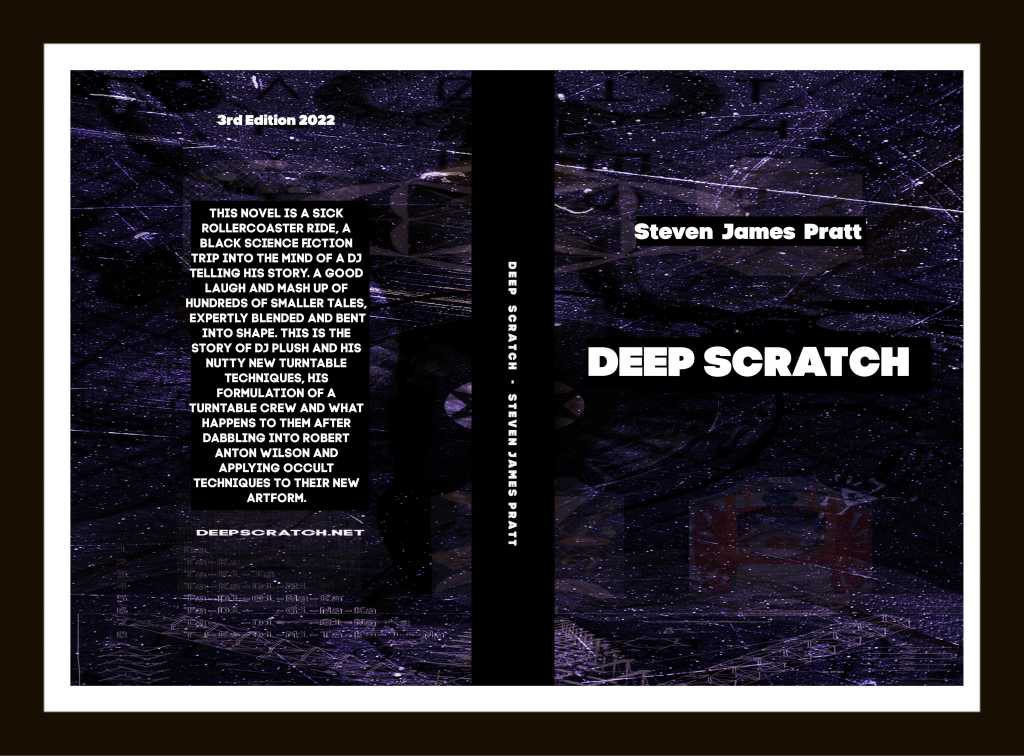

 DEEP SCRATCH