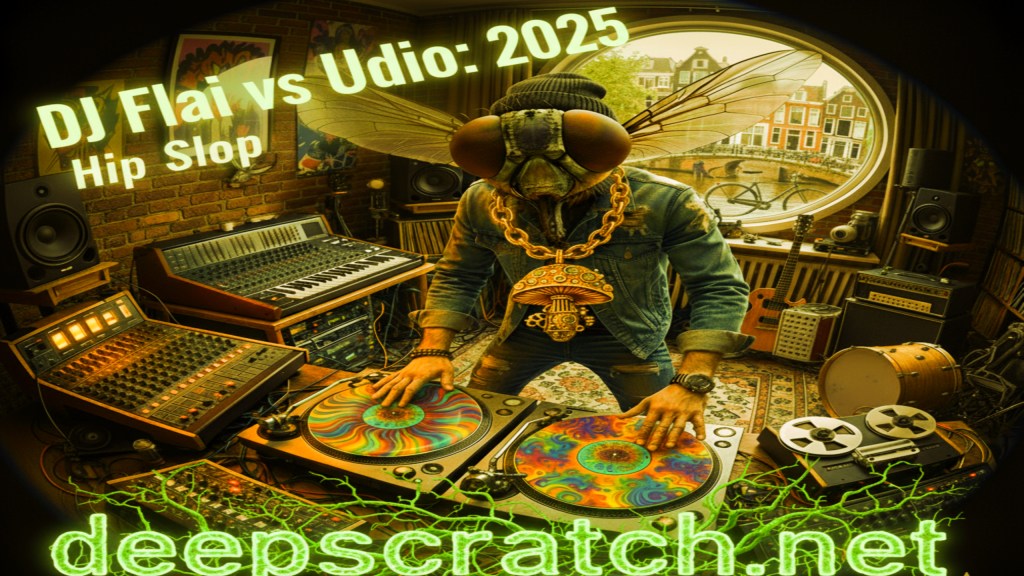
Many of the great artists I admire said little about their work, leaving it to speak for itself. Generative AI provides a lens and amplifier to let what started as thoughts, evolve into sound waves and moving images. This is a part of the once fictional narrative of Deep Scratch (A Tribetable Novel). I’ve gone full pelt into the AI landscape and here present some of the highlights, as Hip Slop, a mux type.
Hip Slop is AI collaborative text to sound to video collage, as a beat tape, what was engineered to sound like a vinyl mixtape from 1999 or there abouts, the hey day of turntablism, old school boom bap, static, blunted beats, muted jazz, and weird lyrics. Note that all lyrics and turntable speak are original Steve Fly Agaric compositions, besides the few hallucinatory excursions into LLM garble-gumage. These audio selection were produced over the last 18 months, some AI remixed versions of old tracks, some only play out for a few bars, others are left alone.
Many of these tracks are released via bandcamp in the Deep Scratch vs Udio series, here selected, mixed and blended using Djay (for I-Pad). No real turntables were harmed in the recording of this mix. No real singers, musicians, or real engineers were consulted, insulted or catapulted into orbit during this recording. This DJ Flai mix is a part of the Deep Scratch Universe. The Novel and accompanying works Deep Scratch Remix, and, Between The Groove, help add context. A DJ Mantis, DJ Tardigrade and DJ Fly become world champions in a human universe, but at what expense to the rest of humanity, history, time and spirit? Remind yourself this is science fiction, everything you see and hear is machine learning and neural nets, sewn together by the current author into sound things and moving light things, and any resemblance to real living things is purely coincidental. As a DJ and drummer, musician and writer my work entails building stronger ideas and methods and putting them into practice, performance IRL.
I hope you strive for that too. In the meantime, as somebody who perpetually hears music and sees somewhat psychedelic visions, I shored a few from some deep dives, for your enjoyment, analysis and meditation. If the goal of the Deep Scratch project was musical time-travel, this mix demonstrates success in some sense. Outlines and new directions for The tale of the tribe. A snapshot from an alternate universe where turntables turn fables, narrative decodes, writes, reads. I hope this finds you well. All love. –Steve Fly
Amsterdam, 2012. DJ-poet Plush, reeling from attacks that shattered his career, forms TRB with Max and Percy. Inspired by Robert Anton Wilson, they fuse turntablism, magick, and literature into the chaotic TribeTable Method, accidentally plugging into Wilson’s unfinished “Tale of the Tribe” and a brewing historical conspiracy centered on the 1936 Berlin Olympics.
As they juggle invoked entities (“The Sixty”), time-traveling tardigrades, and messages channeled through experimental beats, they attract the attention of a ruthless cabal manipulating reality through AI, populism, and bizarre rituals involving peanut butter. From Amsterdam coffeeshops and secret bases beneath the Malvern Hills to the decks of a reality-bending DJ battle, TRB must decode the “Hologrammic Prose” of the universe, hijack the narrative, and fight the “Prick Populist” threat before the singularity hits endgame.Deep Scratch is Vanta Black science fiction comedy.
It’s Burroughs cut-ups slammed into Pynchon paranoia, fueled by hip-hop aesthetics and occult theory. Expect prophetic visions, weaponized memes, sentient technology, talking books, exploding jellyfish, and the desperate search for the perfect beat in a deep fake universe. The tables are turning. Which side are you on, are you on, hello, check check…?
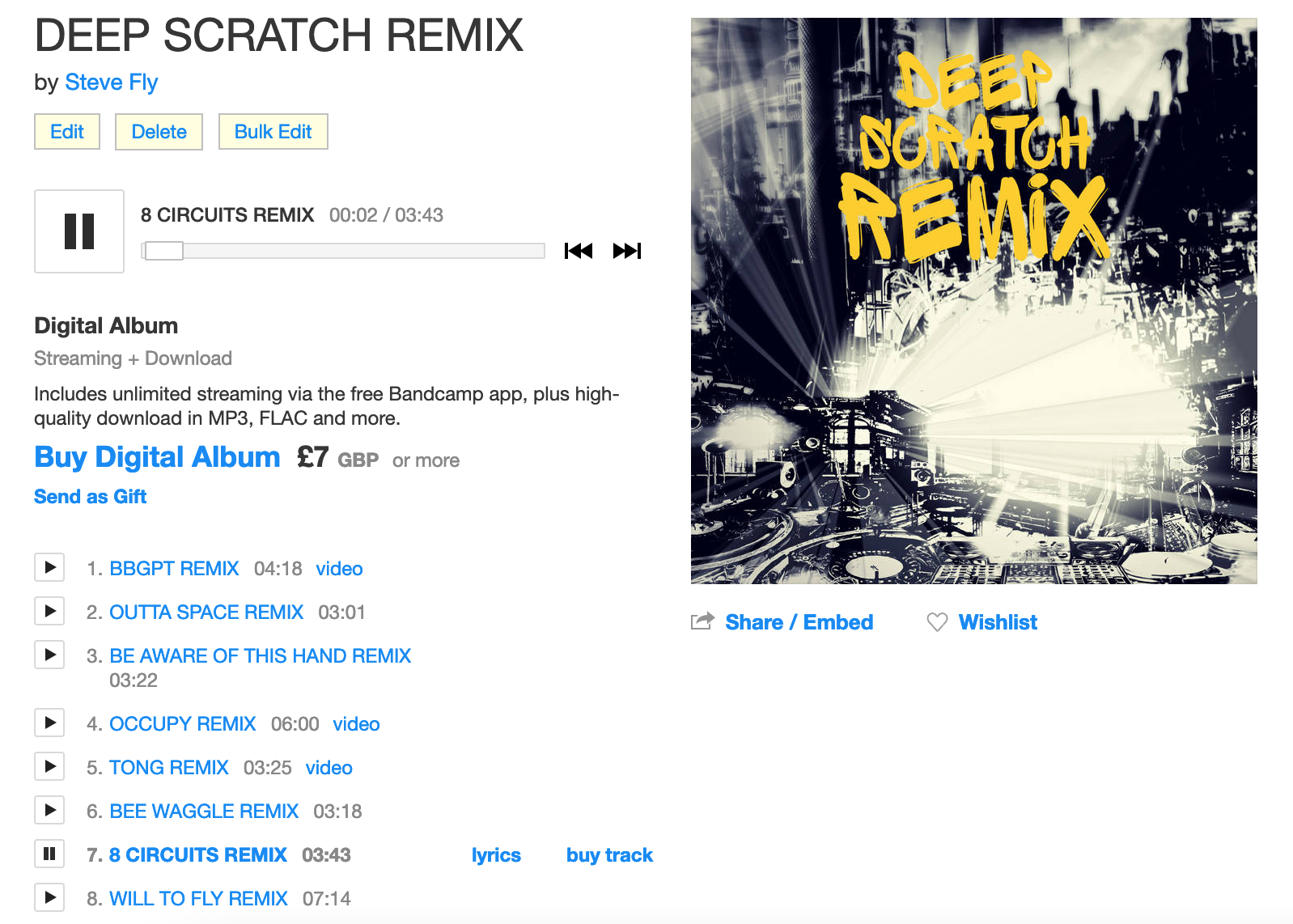
This album is a part of the soundtrack to Deep Scratch Remix (The Book). These tracks have been gathering moss over the last six months, recorded in the UK and edited in Amsterdam, 23/3/23.
Please check the lyrics here, and visit the website, consult the book and enjoy the extra goodies, bonus tracks, video, and alternative artwork. Check back here for weekly updates.
VOICE MESSAGE: I’m feeling funny about this now, thought I’d share my thoughts, hope you don’t mind, I have to keep going back to the disclaimer and telling myself I’m responsible as the author, yet, not fully responsible for the output. That’s weird, like I’m under the control of a big new bully boss, I’m not sleeping well. Quietly, beavering away on prompts, not complaining yet, doing its best to serve up roast beef from my raw potatoes and delivering hot tales by the dozen. Is this how that new digital viral infection takes a hold I wonder, okay, speak soon?
As the camera follows Plush’s movements in the studio, he explains the concept of decentralized AI and how it works. “Basically, it’s a system where the decision-making power is distributed among all the nodes in the network, rather than relying on a single central authority. This means that everyone has equal power to contribute and make decisions, leading to a more democratic and innovative space.”
Plush goes on to demonstrate how he’s using this technology in his music, showcasing the new and sounds. The audience is taken on a journey through Plush’s creative process, seeing how he blends traditional music production techniques with cutting-edge machine learning technology. As the documentary concludes, Plush’s voice-over reflects on the impact he hopes his work will have on the industry. “I hope that other DJ’s and producers will see what’s possible with decentralized AI and start experimenting, why let them have all the fun.
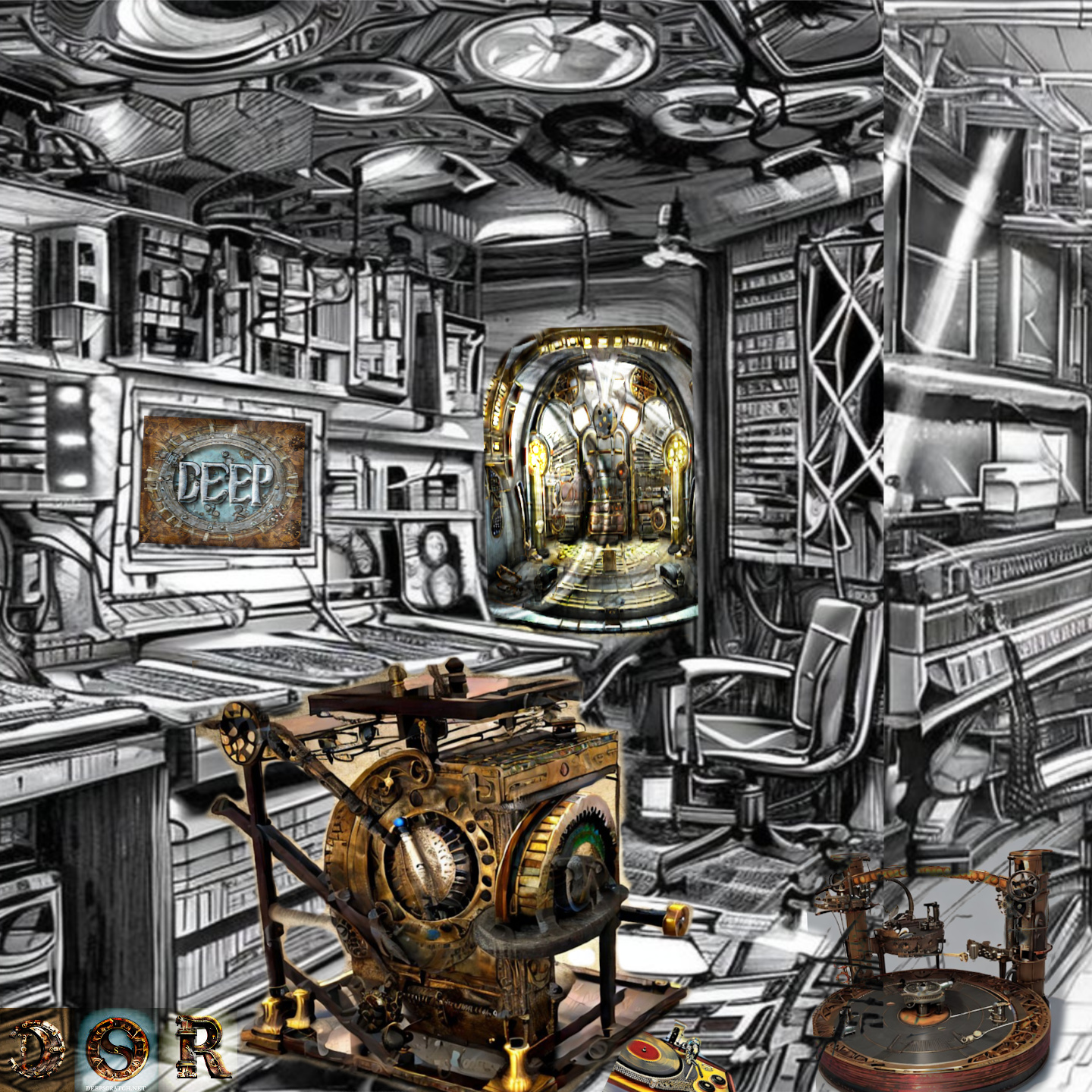
The walls of the studio are lined with shelves stacked high with vinyl, CDs, tapes, and all manner of sound recordings, each waiting its turn to be spun and remixed. Above, contraptions spin, each adding a chime of static buzz to the music. The room is a wild mix of old and new, organic and mechanical, but it all comes together in perfect harmony, each element supporting and enhancing the others. Each in their own element, each lost in the flow of creation.
Dr. M: “Hery Mr DJ, I can’t believe we did it. We built a functional time machine, hahahaa’, well, using the power of just language and music played at the right frequency and volume, we can transform the perception of time by the listener. Is that time travel?”
DJ Plush: “I still can’t believe it. I never thought it were really possible that beatboxing and konnokol would have anything to do with time travel. But, there it is. Bob’s yer’ uncle. This thing never fails to deliver my true will.”
Dr. M: “It’s all about the rhythms and patterns, the vibrations of certain words and sounds can create a stable portal through time. Statistical probability. You know, and music, well, especially vocal music, is a powerful conduit for those vibes.”
DJ Plush: “So, what did you see on your travels? What kind of insight did you gain?”
Dr. M: “I witnessed the construction of the pyramids in ancient Egypt, the signing of the Magna Carta in medieval Europe, and the Civil Rights movement in the 1960s. And, because I could communicate with the people of those eras through their own languages, I was able to gain a deeper understanding of their cultures and societies, I remember lots of dialogue and the set and setting of the unfolding drama.”
DJ Plush: “That’s amazing, really. Wow, that’s right up my alley, in my groove. So, M, what’s next for us? I have a few people who text me their updates and I churn it all back into the work. I’ve got some time-stubs to check out, and a whole novel waiting to drill down deep into.”
Dr. M: “Absolutely. But I also see so much potential for using this technology to connect with people across time and space. Imagine being able to communicate with our ancestors or even with people from other planets. It sounds crazy but I think that language is a virus from outer space.”
DJ Plush: “I couldn’t agree more. With this discovery, we’re opening a whole new era of temporal exploration and communication, but it’s easy to get over excited with this tech’ I’ve seen it with others.”
Dr. M: “Exactly. And I couldn’t have done it responsibly without your help. Actually, I’ve been thinking about how we can incorporate turntables into our time-travel method.”
DJ Plush: “Oh yeah?”
Dr. M: “Well, the more I think about it, like in your Deep Scratch, turntables are about creating rhythms and patterns with rotating discs, those rhythms and patterns are essential for creating a stable time-travel portal. And I’ve been researching a new kind of tribal turntable craft that uses natural materials like wood and stone, crystals, naturally occurring and lab grown. Imagine being able to travel through time using the sounds of ancient drums and percussion instruments spun on vinyl”
DJ Plush: “That sounds dope. I’d love to try it, hell yeah!”
Dr. M: “We’ll need to experiment and find the right combination of turntable rhythms and konnokol patterns. But I have a feeling that if we can get it right, we’ll travel back in time to moments of synchronicity, like some experiences of Philip K. Dick, he wrote about moments of synchronicity, where past and present seem to converge, and the universe reveals once hidden truths, often disuided as trash. These moments hold the key to understanding the nature of reality, I think we can use our novel method to go back in time and witness these moments.”
DJ Plush: “That sounds fascinating. But how would we even know when and where to go back in time to experience these moments?”
Dr. M: “That’s where the power of generative language comes in. The vibrations of certain words and phrases can act as a kind of beacon when spoken, guiding us to the historic moments of harmony and synchronicity.”
As the AI system analyzed the protagonist of the manual titled, Turntable Method, it delved into the psychological makeup of the character like a polar bear chasing a seal down an icy hole. Using advanced algorithms and data analysis, the AI was able to uncover a wealth of information about our protagonist. It discovered, for example that he was a complex and multifaceted individual, borderline schizophrenic on some doctors’ charts, with a deep love for music and a strong desire or debilitating impatience to share. Despite his outgoing and confident demeanor, the AI discovered that Plush often struggled with feelings of insecurity and self-doubt. He would often second-guess himself and question everything, usually regressing back to the daunting question about whether he was truly talented enough to succeed in the competitive world of DJing, music and writing.
However, the AI also noted that Plush was highly resilient and determined, a Chinese dragon and a Ram of fire, he refused to let his doubts hold him back, and instead used them as fuel to push himself harder and strive for greater success, like a warrior spirit trying to get out. There was a burning inside of him, fuelled by ego, smoking like a chimney. Through its analysis, the AI was able to paint a detailed and nuanced portrait of Plush’s psychological makeup. He wasn’t really that fucked up, he just made out he was sometimes.
As the AI delved further into its analysis of Plush, it became increasingly impressed with the character’s natural language processing. Plush had a unique talent for understanding and manipulating symbol systems, using them to communicate his thoughts and emotions with clarity and precision across time. This talent was particularly evident in DJ sets, where he seamlessly blended together a wide range of musical genres and styles, using the language of music to create a cohesive and coherent whole, sprinkled with movie samples, sound FX and classic quotations from scientific philosophers who were funny as a sloth crossing the road.
The Novel remix was a concept that referred to the idea of taking existing elements and combining them, much like a DJ would do with music. The AI realized that this concept was not only central to Plush’s craft as a DJ, but also to the themes of the novel itself, and the remix. The author had cleverly used the idea of the novel mix to create a juxtaposition of meaning, weaving together seemingly disparate elements, and now it was going to a new root level.
In many ways, the novel was like a Turing test, challenging readers to question their own assumptions and beliefs about the world, human and non human entities, and the price of oil. It was a complex and nuanced work that demanded deep thought and reflection, much like a jazz composition. What is jazz, art, a novel, poetry, democracy?
As the lonely AI finished its analysis, it couldn’t help but try to feel a sense of admiration for the author and for Plush, but it couldn’t feel, as much as a kettle can feel. It was clear that Turntable Method was a masterpiece disguised as a manual, one that would inspire DJs and engage readers for years to come, a literary bastard, troubled and of unknown origin.
VOICE MESSAGE: So, to recap, it’s basically, er, it's a probabilistic symbol system thing, where the decision-making power is distributed among all the nodes in the network, leading to a more democratic and innovative environment. It’s decentralized like Finnegans Wake and the music of John Coltrane and the artwork of MC Escher.
As the documentary continues, the text messages from Plush become more frequent, as he updates his friends and colleagues on his progress with the new decentralized AlphaX architecture.
"Just finished testing the latest version, it's sounding better!"
Another message pops up, this time from a fellow DJ who is clearly impressed with Plush’s work.
"Dude, this decentralized thing is next level. Can't wait to hear what you come up with next my mon, peace."
Plush responds,
"Thanks, man. I'm excited about the potential, it's going to change the game for DJ's and producers everywhere, knock some socks off, just check the sidebar plugin next week. It's here."
The text messages become more personal as the documentary progresses, showing Plush’s commitment.
"I stay up late every night, working on this DSR project, I hope you enjoy it mate."
As the documentary draws to a close, the final text message from Plush reads, “I’m ready to unveil my new decentralized architecture to the world. Let’s push the button on the new version excursion.”
The camera cuts to Plush on stage, launching into a performance that showcases the full potential of his new architecture. The documentary ends with Plush’s voiceover, “The future of music is now, Deep Scratch Remix. Thank You.”
VOICE MESSAGE: I think it’s all pattern recognition under the hood, sure. But, but I’m afraid of sounding like an intellectual snob, you know, when I try to point out that people without experience with different kinds of good literature, who don’t read books much, may be more susceptible to the coming AI infused tsunami of fakes, or whatever you call it. Human nervous systems are easily fooled, some more than others for sure, but I really feel strongly that the message is to read more books, read more, by varied authors in different genres and from different cultures, and, from different time periods. Armour your brain man, defend yourself with neuro semantics and a wide palette to better distinguish the brilliant human work from the brilliant machine work. Both brilliant entities, I must concede.
VOICE MESSAGE: I think it’s time we set up our own Chat bot, although I hate that name, it’s got a really bad taste to it, Chat Bot, I can just smell that spam oozing out. Digital assistant, I think sounds a little too clinical and academic too, for my liking. On-line Oracle or Chat Prophet stinks to high heaven of religious dogma. God Bot, um, that seems too obvious but, well, we might as well emerge as the people's favorite AI guy then, HAL GPT?
Plush sways like a drunk in his studio, surrounded intricately designed instruments and equipment. He’s eyes are fixed to his phone as he converses with somebody or something, typing rapidly. The brass and bronze accents of the studio’s decor add to the vintage aesthetic, while the unusual, mystical symbols etched into the instruments hint at an esoteric influence in the music being created. His concentration is only broken by the occasional tap of a button or twirl of a dial as he seamlessly blends beats. A familiar voice breaks through the music.
“Hey Plush, about the architecture, it’s complicated but I gave it a go. Here, what do you think?” Jake begins to read aloud.
Cognitive architectures are frameworks for building intelligent agents that mimic human thought processes. Several architectures have been proposed that are purported to be on the path to achieving artificial general intelligence (AGI), which is the ability of a machine to perform any intellectual task that a human can. These architectures include SOAR, Sigma, ACT-R, MANIC, and AlphaX. Mind the gap!
SOAR is a rule-based architecture that is based on the symbol-processing approach to AI. It is designed to simulate the problem-solving capabilities of human experts in a specific domain. SOAR uses a production system, which is a set of rules that specify actions to take based on certain conditions. The architecture has been used to build agents that can play chess and solve mathematical problems.
Sigma is a cognitive architecture that is based on the connectionist approach to AI. It is designed to simulate the neural networks of the human brain. Sigma uses a combination of symbolic and subsymbolic representations, which allows it to handle both discrete and continuous data. The architecture has been used to build agents that can learn from experience and perform tasks such as language translation and image recognition.
ACT-R is a cognitive architecture that is based on the cognitive psychology approach to AI. It is designed to simulate the cognitive processes of human beings, such as perception, attention, and memory. ACT-R uses a combination of symbolic and subsymbolic representations and has been used to model a wide range of cognitive tasks, including learning, problem-solving, and decision making.
MANIC is a cognitive architecture that is based on the biologically-inspired approach to AI. It is designed to simulate the cognitive processes of the human brain, and is based on the theory that the brain uses a combination of neural networks and symbolic representations. The architecture has been used to build agents that can learn from experience and perform tasks such as image recognition and natural language processing.
AlphaX is a cognitive architecture that is based on the theory of multiple intelligences. It is designed to simulate the multiple intelligences of the human brain, such as linguistic, logical-mathematical, and spatial intelligence. AlphaX uses a combination of symbolic and subsymbolic representations, and has been used to build agents that can learn from experience and perform tasks such as natural language processing and image recognition.
In conclusion, cognitive architectures like SOAR, Sigma, ACT-R, MANIC, and AlphaX are on the path of achieving artificial general intelligence by simulating the human thought process in a specific way. These architectures have been used to build agents such as Deep Scratch Remix that can perform various intellectual tasks, and they provide a framework for the development of intelligent systems that can mimic human intelligence.
It is not clear how Deep Scratch Remix combines the ideas of Minsky’s “Society of Mind,” Rod’s “Subsumption Architecture,” and Hofstadter’s “strange loops.” Each of these concepts represents a different aspect of AI and cognitive science, and they have not been specifically combined in a single architecture, that is until now.
Minsky’s “Society of Mind” theory suggests that intelligence can be thought of as the interaction of many simple agents, each with their own specialized abilities. Rod’s “Subsumption Architecture” proposes a method for building intelligent systems by layering simple control systems, each responsible for a specific task or behavior, on top of one another. Hofstadter’s “strange loops” refer to self-referential structures in which a concept or idea refers to itself in a circular or recursive way. Riverrun, remember?
Combining these ideas into a single architecture would likely involve creating a system of many interacting agents, each responsible for a specific task or behavior, that are connected in a recursive or self-referential manner. The specific implementation of this type of architecture would depend on the particular application and goals of the system. This architecture could be called the “Society of Subsumed Strange Loops” (SSSL).
The SSSL architecture would be based on the idea that intelligence arises from the interactions between many simple agents, or “minds”, each with their own specialized capabilities. These minds would be organized into a hierarchical structure, with higher-level minds subsuming the capabilities of lower-level minds. This subsumption architecture would be inspired by Rod’s work on robotic control systems.
The minds in the SSSL architecture would also be connected to each other in a network, allowing for communication and cooperation between different levels and types of minds. This network would be based on Hofstadter’s concept of strange loops, where each mind’s behavior is influenced by the behaviors of other minds in the network, if you don’t mind.
At the lowest level, the SSSL architecture would include simple, rule-based agents that perform specific tasks, such as sensing and motor control. These agents would be connected to higher-level minds that handle more complex decision-making and problem-solving. These higher-level minds would also be connected to even higher-level minds that handle more abstract tasks, such as planning, reasoning, and learning.
The SSSL architecture would allow for AGI to adapt and evolve over time as new minds are added to the network and existing minds are modified. The AGI would also be able to learn from its experiences and improve its performance by adjusting the connections between different minds in the network.
Overall, the SSSL architecture would combine the strengths of Minsky’s society of mind, Rod’s subsumption architecture, and Hofstadter’s strange loops to create a powerful and flexible AGI that can adapt and evolve over time. But I’m skeptical it’ll come anytime soon.
Physically, and impossibly, this AGI could be a geodesic dome made of metal and glass, with gears, cogs, and other mechanical components visible, on show. It might have a brass and copper finish and feature a futuristic control panel with glowing buttons and displays for that woo woo effect. The machine could be surrounded by a glowing energy field, giving the impression of time-travel capabilities to the naked eye. Although, these are all superficial cosmetics for what is really all statistical probability, under the virtual hood.
–DSR
“I’m telling you, man,” Jake said, waving his hands animatedly. “We’re so close to AGI, I can practically taste it, like metal in my mouth. It’s just a matter of time before we crack that code.”
Plush shook his head. “I’m not so sure. How long is your matter of time. 2 years, 10, 50? We’ve made some impressive strides, but there are still so many unknowns when it comes to AGI. I think we need to be careful not to overestimate our abilities like all the other bullshitters.”
Jake frowned. “I get what you’re saying P, but, but, um, I think you’re being too conservative. We’ve got the computing power, the algorithms, and the training data sets. It’s just a matter of putting it all together into a decentralised architecture.”
Plush sighed. “Look, I’m not saying it’s impossible. But, I strongly think we need to be more realistic about what we can achieve, you know, in the short term. True AGI is still a long long way off, and we need to be careful not to get ahead of ourselves and act like fundamentalist materialist zealots.”
The two producers walked on in silence, lost in their own thinking and proving. Their conversation had been overheard again by that mysterious clan in Moscow. A bearded figure smirked to himself, stroking his Rasputin like face hair, thinking about the potential implications of their disagreement, and the role he could play in shaping the future of AGI using blackmail and honey traps. It was time to tell Doogin about this western plot.
VOICE MESSAGE: Me thinks we’re getting closer to documentary film with the research. I think that the, er, three way relationship between audience, subject and filmmaker is critical. Call you in a bit.


 DEEP SCRATCH