Support me at:
https://www.patreon.com/stevefly
Let’s make more video like this, and better!
–Steve Fly

Support me at:
https://www.patreon.com/stevefly
Let’s make more video like this, and better!
–Steve Fly
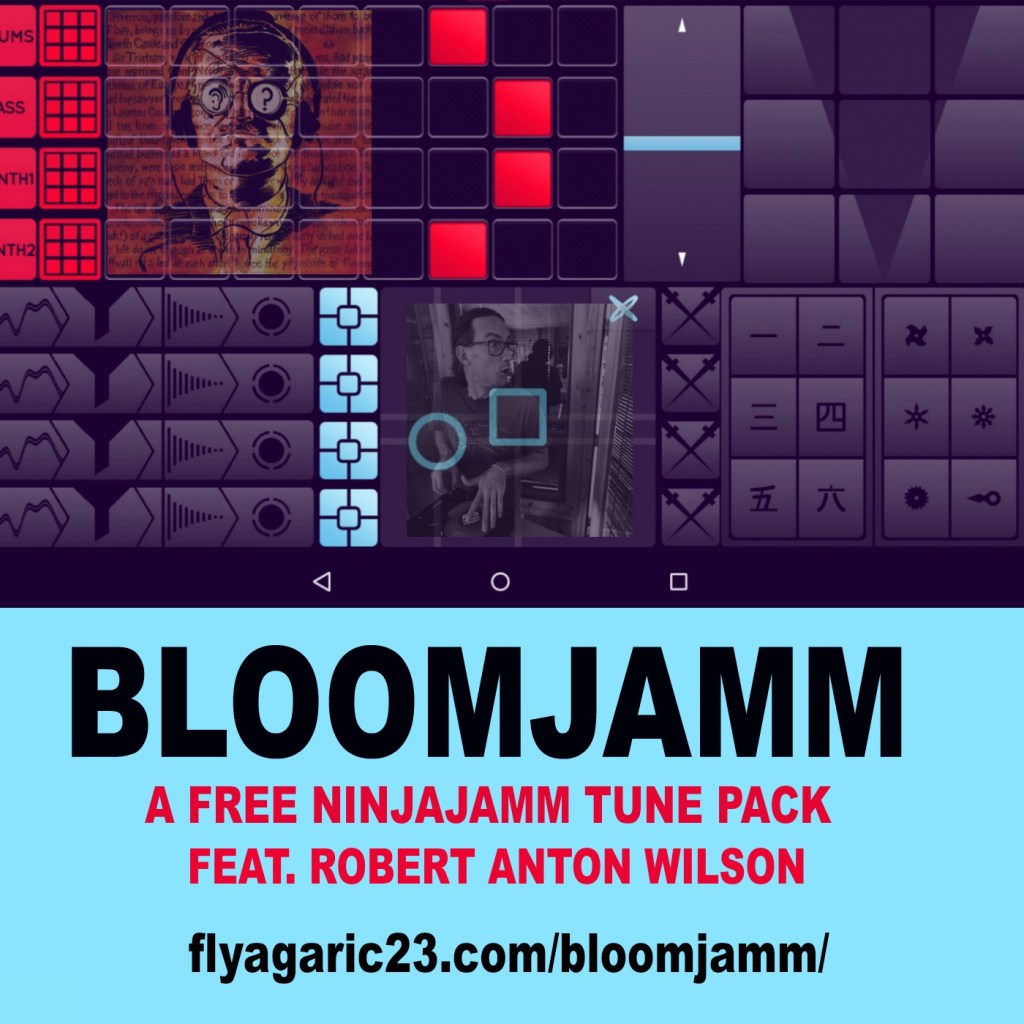

DOWNLOAD HERE: BloomPack
DOWNLOAD NINJAJAMM HERE: NINJAJAMM
For more info go here: https://flyagaric23.com/bloomjamm/
Steven Fly: Drums, Guitar, Turntable, Samples
Karl Frisby: Bass Guitar
Robert Anton Wilson: Vocals
Tom Grashion: Pack Programming
Tim Egmond: Sample Assistance
A sneaky funk expedition through jungles, over oceans and across savannahs, with daubs of electronica. A synchronistic Samba of Coincidance. A new tribal soundtrack with a global village stomp to boot. Bloomjamm sucks you into a wonkyworld of audio, like something David Attenborough might hallucinate. Raise the tempo, bring up the sub bass, get the party jumping and your trotters shaking.
Bloomjamm is an experimental musical investigation into Finnegans Wake. Crafted for a performance and give-away, at the 26th International James Joyce Symposium, Antwerp, on Bloomsday.
This pack features Robert Anton Wilson reading from Finnegans Wake, and singing the ballad. For more information about BloomJamm and more free download packs by Steve Fly, please visit:
Special thanks to all NinjaJamm heads, Matt, Tom, Aneek. Derek @ Waywords and Meansigns, Rasa @ Hilaritas Press, Karl, and all Joyce and RAW Ninjas worldwide. Jamm on.
By Steve Fly Agaric 23. (Dedicated to Sirius, the dog)
— Is that answers? — It am queery! — The house was Toot and Come-Inn by the bridge called Tiltass, but are you solarly salemly sure, beyond the shatter of the canicular year? Nascitur ordo seculi numfit. — Siriusly and selenely sure behind the shutter. Securius indicat umbris tellurem.
–James Joyce, Finnegans Wake, pages 512-513.
Cannabis Coffeeshop Journal 2017: Writings On Coffeeshop Culture (Volume 1)
by Steven James Pratt
Link: http://a.co/hMWdKax
Reading page 132, of ‘stranger than we can imagine’ by John Higgs, posted to me by Bogus Magus (Toby Philpott), only 10 minutes ago, i had a visitation experience. Probably the closest i have come yet. Let me try to explain.
Page 132, begins with‘…was more than just a story of nuts-and-bolts physical space travel. As the slogan of the 1990s television series ‘The X-Files’ put it, ‘i want to believe. Jung was not interested in the question of whether UFOs were ‘real’ or not. He wanted to know what their sudden appearance said about the late twentieth century…’ and he goes on ‘Whether a witness reported meeting fairies, angels, demons or gods depended on which of those labels their culture found most plausible.’—John Higgs, Pg. 132. Chapter 7: Science Fiction. Stranger Than We Can Imagine. 2015.
- They are symbols of courage, strength and happiness in Japan, but seen as sinister in European folklore.
- About 3012 species of dragonfly were known in 2010; these are classified into 348 genera in 11 families.
- An adult dragonfly eye has nearly 24,000 ommatidia.
- Fossils of very large dragonfly ancestors in the Protodonata are found from 325 million years ago
- Defending a breeding territory is fairly common among male dragonflies, especially among species that congregate around ponds in large numbers.
- Most of a dragonfly’s life is spent as a nymph, beneath the water’s surface. The nymph extends its labium (a toothed mouthpart) to catch animals such as mosquito larvae, tadpoles and small fish.[39] They breathe through gills in their rectum, and can rapidly propel themselves by suddenly expelling water through the anus.
- They have four different styles of flight:[46] A number of flying modes are used that include counter-stroking, with forewings beating 180 degrees out of phase with the hindwings, is used for hovering and slow flight.
- In high-speed territorial battles between male Australian emperors Hemianax papuensis, the fighting dragonflies adjust their flight paths to appear stationary to their rivals, minimizing the chance of being detected as they approach.
- Dragonflies can fly at 100 body-lengths per second, and 3 lengths per second backwards
- They are almost exclusively carnivorous, eating a wide variety of insects ranging from small midges and mosquitoes to butterflies, moths, damselflies and smaller dragonflies.
- With the destruction of rainforest habitats, many of these species are in danger of becoming extinct before they have even been named.
- For some Native American tribes, dragonflies represent swiftness and activity; for the Navajo they symbolize pure water. They are a common motif in Zuni pottery; stylized as a double-barred cross, they appear in Hopi rock art and on Pueblonecklaces.
- Douglas, a British motorcycle manufacturer based in Bristol, named its innovatively designed postwar 350cc flat twin model the Dragonfly.
- As a seasonal symbol in Japan, the dragonfly is associated with autumn.[79] More generally, dragonflies are symbols of courage, strength, and happiness, and they often appear in art and literature, especially haiku. Japanese children catch large dragonflies as a game, using a hair with a small pebble tied to each end, which they throw into the air.
- The poet Matsuo Bashō (1644-1694) wrote haiku such as “Crimson pepper pod / add two pairs of wings, and look / darting dragonfly”, relating the autumn season to the dragonfly.[88] Hori Bakusui (1718-1783) similarly wrote “Dyed he is with the / Colour of autumnal days, / O red dragonfly.”
- The poet Alfred, Lord Tennyson described a dragonfly splitting its old skin and emerging shining metallic blue like “sapphire mail” in his 1842 poem “The Two Voices”, with the lines “An inner impulse rent the veil / Of his old husk: from head to tail / Came out clear plates of sapphire mail.”
- ‘Dragonflies, or damselflies, were connected to Freya the Norse goddess of love, fertility and warfare. Freya was famous for her beauty and her knowledge as a magician. It was she who taught Odin the shamanic practices known as seidr which were still practiced during Christian times. The paired bodies of mating dragonflies form the shape of a heart, perhaps being the source for that modern symbol of love. In ancient lore, the dragonfly represents transformation, adaptation and insight.’–http://www.crystalinks.com/dragonfly.html

“Ezra Pound was no starnger to Oriental art when he met Mary McNeil Fenollosa, the widow of the American Orientalist Ernest Fenollosa (1853-1908), in London in late September 1913.”–Zhaoming Qian, Orientalism and Modernism (1994) pg. 9.
by Steve Fly
“Fenollosa [1853-1908], wrote an essay on
“The Chinese WrittenCharacter as a Medium for Poetry” which vastly influenced
Ezra Pound and, through Pound, modern poetry generally;
said essay also anticipates some formulations of General Semantics
and NeuroLinguistic Programming [NLP], and foreshadows
modern critiques of “linear” and “alphabetical” thinking. –Robert Anton Wilson, Recorsi 2005.
Ernest Fenollosa (1853-1908) found a place in the chain of human innovation, and the lineage of modernism as defined by Dr Robert Anton Wilson in his unfinished project called ‘the tale of the tribe’. Please read some of my others posts trying to get at TTOTT and what it all means to me.
Fly On The Tale Of The Tribe: A Rollercoaster Ride With Robert Anton Wilson
by Steven James Pratt
Link: http://a.co/gOGNKyV

Since the development of raw360 in the summer of 2010, i have mused on and on about a RAW A.I. Or… i used the idea of such a thing to augment my research into the tale of the tribe, and tease out parts of RAW through his encyclopedic works that resonate, with some current theories in Artificial Intelligence, e.g, AGI: Artificial General Intelligence.
Fly On The Tale Of The Tribe: A Rollercoaster Ride With Robert Anton Wilson
by Steven James Pratt
Link: http://a.co/gOGNKyV
listening to some of the ideas and descriptions of Artificial General Intellgence, I thought that the holistic approach of combining many differemt disciplines, reflects RAW’s comprehensive group of intelligence engineers in The tale of the tribe.
RAW asked what these characters and internet have in common? I am formulating a new set of answers based upon general purpose computing. And a new way of seeing the back of your head.

 DEEP SCRATCH