Author: flyagaric23

  • TTOTT WHEELS GO AROUNDAROTA

    TTOTT WHEELS GO AROUNDAROTA

    TTOTT WHEELS GO AROUNDAROTA

    BALANCING THE EQUATIONS WITH TRIADS.

    I view a part of my task in setting up a table of ttott correspondences as providing examples of how the tables can be used to create various effects. Both as study guides into historical, biographical work and as imagination guides into the tale of the tribe, and the new translations.

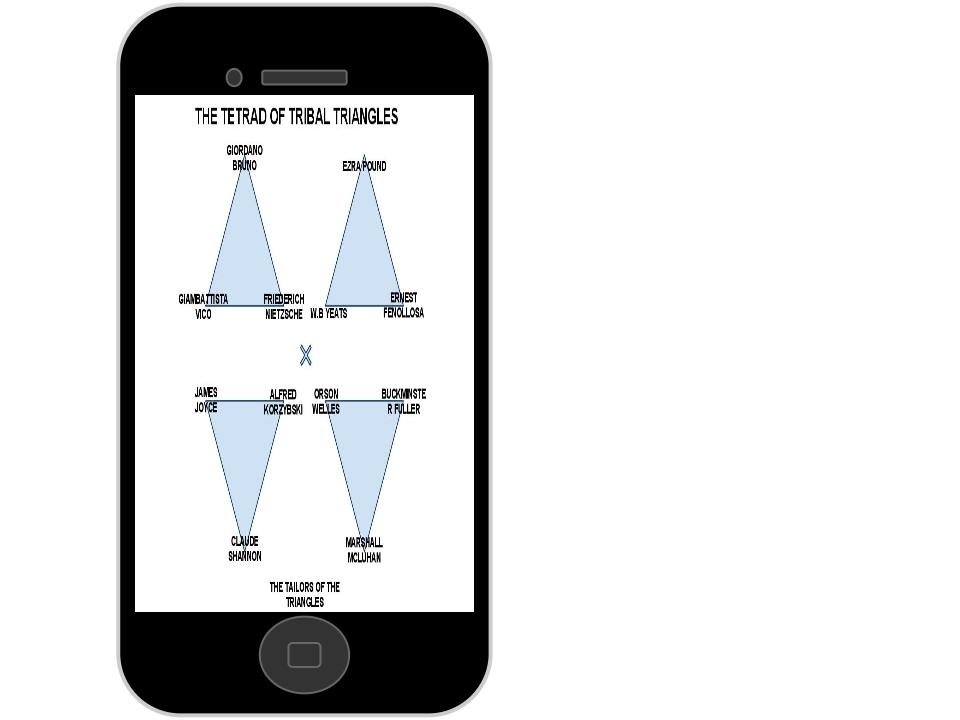
    The triangular structure enables opposing characteristics of mildness and severity a point of resolution and of synthesis, a middle path that may recycle the energies back and around and in so doing balance the opposing forces. The general idea of dividing 30 characters into 10 sets of triangulated groups of three characters, for example, may provide a working model for a rough structure, as would 15 sets of waltzing duo’s of opposing forces or a ‘coincidance of contraries’ as Joyce put it in Finnegans Wake.

    GEODESICS

    I have developed number systems for working out the new maps, due to the possibility of multi-dimensional models at a latter stage of the project, whereby objects containing various symbols and images can be folded and enfolded. I have already experimented with a TTOTT Dodecahedron of 20 sides and 12 vertices, and in principle, the numbers 30, 60, 90,120 and 150 all render symmetrical objects upon which information may be presented, here I pay tribute to Buckminster Fuller, and Giordano Bruno.

    THE TALLY OF THE TRIBE.

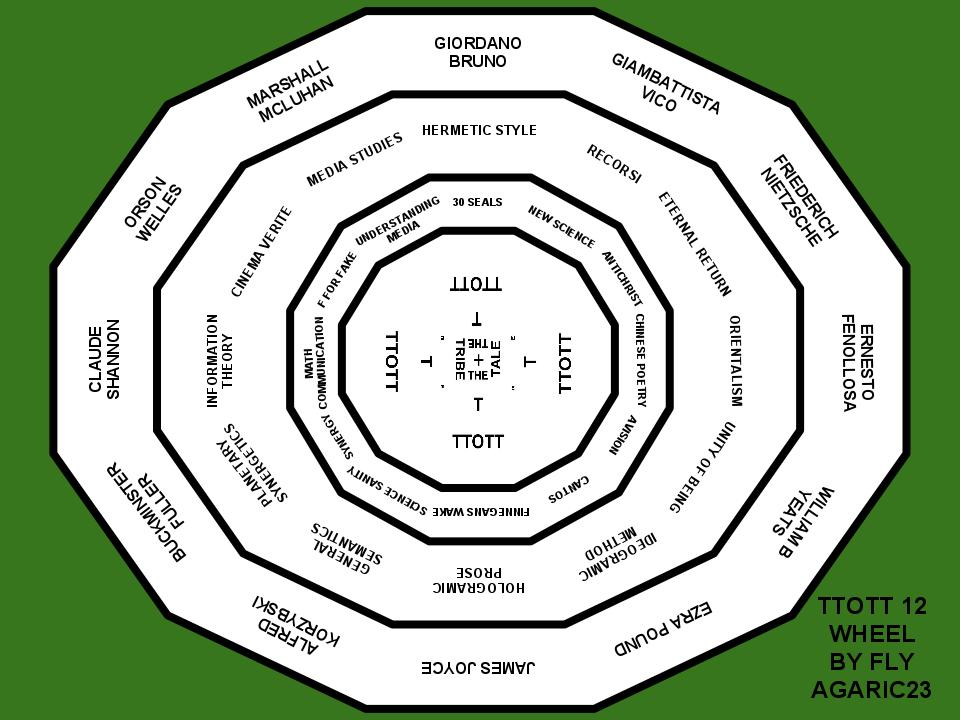
    The set of 5 wheels I have designed each have 30 ‘nodes’ on their belt of concentric rings. I made them by choosing 5 major categories: Tailors, Theolo, Texts, Teachings, Totems (Human Beings, Spirits, Texts, Principles, Objects).

    I have chose to recycle ‘T’ words and keep a running TTOTT structure to each heading and category I make. The TTOTT logo features four ‘T’s tilted to create a four way symmetry (+) with a circle placed central. If you pretend to say the word ‘T’ you’ll notice your tongue gets right up on your teeth, and if you make a repeated ‘T’ sound you may notice that you sound a little like a Hi-Hat cymbal, and, that you can repeat the letter ‘T’ faster and with more control than possibly any other letter in the English Alphabet? This will have some correspondence to the spoken word and spoken drum components to the class, but also keep the original TTOTT (the tale of the tribe) intact.

    Giordano Bruno used the number 30 often when constructing his wheels and wheels within wheels. Although unlike Bruno, my belts are so far only attenuated to the TTOTT matter, and simply borrow the use of the number 30 and the idea of putting lists of things on concentric rings, 5 in total, producing 150 nodes, or images in Bruno’s model, that I should add seems incredibly more complex and refined than my wheels. Reading Bruno recently led me to revisit the idea of having 30 things on revolving tables, something I used to anchor some themes in an early edition of my book: World Piss: 30 seals and the spore of the words.

    All the characters that follow Bruno chronologically can appear on the wheels that he inspired, together with Giambattista Vico, (another philosopher of the revolutionary hermetic renaissance tradition), the tribal characters can ride the wheel, the turning tables of correspondences, and so unify in that movement, that ever-changing sensibility and decentralized and rotational wisdom. A revolutionary force.

    CONNECTING CYCLES AND CIRCUITS

    The tale of the tribe must be a connected network, otherwise it is useless. A new team of nodal points, shared swarms that link together. The goal of a hologramic network, a poem, novel, screenplay, album, performing overlapping functions, working together.

    The triple spiral symbolizes the rotational and spiral nature of the connected works of Dr. Robert Anton Wilson, the triad or delta that symbolizes femininity and the triple goddess. Vico and Joyce and Nietzsche feed off the spiraling principles of recorsi. Giordano Bruno and his “Memory Wheels” plus Giambattista Vico and his “Cycles of Ages”, Frederich Nietzsche and the “Eternal Return”, Ernest Fenollosa and the omni-directional radiance of “Chinese Symbolism”, William Butler Yeats and his dynamic “Gyres” and “Unity of Being” and ‘Symbolism’, Ezra Pound and his “Revolutionary Calendar” and ‘Ideogramic method of juxtaposition’, James Joyce and his spiral powered “coincidance of contraries & resolution of opposites”, Buckminster Fuller and the moving “Synergistic” principles. Meanwhile Alfred Korzybski and his “General Semantics”, Marshall McLuhan and his “Global Village Tribes”, Orson Welles and his “Neurological Cinematic Relativity”, Claude Shannon and “Information Theory” and other recurring geniuses and their additional contributions to humanity intersect with connecting threads represented by Dr. Wilson. In my opionion at their most potent when writing on Joyce: the mother-load of compressed hermetic wisdom.

    THE TURNING OF THE TRIBE

    The new maps and seals I present are a work in progress and as far as I know a unique way of processing the information, and potentially a relatively simple and sharable method for others to conduct similar research.

    I would like to present a kind of Top Trumps challenge to create an equally revolutionary belt of innovative thinkers, or simply use any combination of belts on any grouping of things that you may wish, make it new! Bio-seasonal, calendrical, astrological and cosmological belts for example, may add many useful functions, the possibilities are literally endless with this, but I have chose to stack and pack a krewe that I believe represent the tale of the tribe as defined by Dr. Wilson, quite a bunch’, to perhaps provide a new platform for collaborative investigations, and new interpretations. Nodes or units of distilled cultural inheritance.

    Tailors, Theolo, Texts, Teachings, Totems (Human Beings, Spirits, Texts, Principles, Objects). v1.0

    1. “Alighieri, Dante” Agnosticism Arrow Atem-Re Avision
    2. “Bruno, Giordano” Buddhism Binocular Baal Book Of The Law
    3. “Crowley, Aleister” Cinema Verite’ Cup Circe Cantos
    4. “Dick, Philip K.” Deconstructionism Disk Dionysis Divine Comedy
    5. “Escher, M.C” Epistemology Earring Eris Everything is Under Control
    6. “Fuller, Buckminster” Fourth Way Flag Findabair Flying Saucers
    7. “Gurdjieff, G.I” General Semantics Glasses Ganesha Gulliver’s Travels
    8. “Hesse, Herman” Hologrammic Prose Headdress Horus Holographic Universe
    9. “Ibsen, Heinrik” Information Theory Ink Ishtar Illuminatus Trilogy
    10. “Joyce, James” Jungian Psychology Joystick Jove Jitterbug Perfume
    11. “Korzybski, Alfred” Kabbalah Kettle Kallisti Knox Om Pax
    12. “Leary, Timothy” Lullism Lamp Lugh Liber 777
    13. “McLuhan, Marshall” Magick Mitten Ma’at Mass Psychology Of Fascism
    14. “Nietzsche, Friederich” Neuro Linguistic Programming Nail Naga New Science
    15. “Olson, Charles” Ontology Oblisk Osiris Open Society And Its Enemies
    16. “Pound, Ezra” Pataphysics Pincer Prometheus Politics Of Ecstasy
    17. “Quiggly, Carroll” Quantum Psychology Quilt Quetzalcoatl Quantum Psychology
    18. “Reich, Wilhelm” Recorsi Rope Ra Recorsi
    19. “Shannon, Claude” Synergetics Scissor Sarasvati Science and Sanity
    20. “Tesla, Nikola” Tessellation Turntable Thoth Tale of The Tribe
    21. “Unrah, Wes” Unity of Being Umbrella Utu Understanding Media
    22. “Vico, Giambattista” Vorticism Viol Vishnu VALIS
    23. “Welles, Orson” Witchcraft Wand Woden White Goddess
    24. “X, Malcolm” Xenolinguistics Xylophone Xi Wang Mu Xo-psychology
    25. “Yeats, W. Butler” Yin Yang Yurt Yu Huang Yajur Veda
    26. “Zenji, Dogen” Zetetics Zip Zarathustra Zen
    27. “Neumann, John Von” Modernism Mirror Aphrodite Book of Shadows
    28. “Fenollosa, Ernesto” Ideogrammic Method Pipe Pan Ulysses
    29. “Bandler, Richard” Eternal Return Breastplate Luna Cosmic Trigger
    30. “Wiener, Norbert” Neuro-Logic Ring Aphrodite Critical Path

    Monday, September 13, 2010

    Fly Agaric 23 announces online RAW course

    Steve “Fly Agaric” 23 has announced a new online course, “email to the tribe,” which will run from Sept. 20 through Nov. 5 and will feature weekly doses of multimedia; participants are asked to donate what they can.

    Agaric explains, “Each week fly will provide a spread of multimedia for you to process, generally keeping in step with the program, encouraging a wide variety of conversation and focused feedback. Feel free to drop in and drop out, as you like.”

  • email to the tribe: a Maybe Logic Class by Fly Agaric 23

    email to the tribe: a Maybe Logic Class by Fly Agaric 23


    Fly Agaric 23

    September 20 – November 5
    email to the tribe
    Homogrammic Prose


    The tale of the tribe approximates a tale of humanity, or ‘tales’, a new global epic that must capture illuminating details from humanity and juxtapose them in a special way using special language (Hologrammic prose, the Hermetic style, Ideogrammic method, Joyce’s ‘epiphany’ etc.) Dr.Robert Anton Wilson crafted his tale of the tribe to suit, among other definitions; the architects of post-modem’ cyber-culture, reaching back to the renaissance and pulling up-tense to our decentralized–hyper connected–future present. 
     
    During a six week period, I-fly will share his open interpretations of the tale of the tribe, performing an on-line multimedia vortex of signals, dialed into James Joyce, Ezra Pound, Giordano Bruno, Marshall Mcluhan, ‘Bucky’Fuller, and RAW himself.
     
    email to the tribe will reprocess communications from across time, and produce new maps, new metaphors, and mold new memes that help forward the tale of the tribe and the RAW wisdom oozing out from all quarters.
     
    Each week fly will provide a spread of multimedia for you to process, generally keeping in step with the program, encouraging a wide variety of conversation and focused feedback. Feel free to drop in and drop out, as you like.
     
    EMAIL TO THE TRIBE: WEEKLY PRESCRIPTION.
    WEEK ONE – WHEELS AND CYCLES (Sep 20-26)
    The wheels of the tribe go around and around.
    WEEKLY DOSE: Decentralized and Rotational Map Warfare.
     
    WEEK TWO – GENERAL EPIPHANY (Sep 27-3rd October)
    Hologrammic Prose and meaningful common speech
    WEEKLY DOSE: RAW-FLY interviews. (Oct 4-10)
     
    WEEK THREE – IDEOGRAMMIC FULLERENE (Oct 11-17)
    The synergy of history
    WEEKLY DOSE: Vicosahedron and Canto LXVI. Open Source History.
     
    WEEK FOUR – GLOBAL FEEDBACK (Oct 18-24
    If its not connected its useless
    WEEKLY DOSE: Shannanigums Wave & Future Present.
     
    WEEK FIVE – CINEMA OF UNITY (Oct 25-31)
    Moving pictures to TV/Internet
    WEEKLY DOSE: Maybe Logic & RAW Multimedia.
     
    WEEK SIX – THE TALE OF THE CYBERNET (Nov 1-5)
    My-wiki-face-twitter
    WEEKLY DOSE: Work of the tribe. email to the tribe.
     
    COURSE TEXTS: Recorsi by Robert Anton Wilson.
     

    • $Pay-What-You-Can$ – Enroll Now •
    [$50 recommended minimum price] 

    http://www.maybelogic.org/courses.htm 

  • John Sinclair Radio Show #338

    Please visit my blog: FATTENING BLOGS FOR SNAKES. Dedicated to the music, writing and social activism of John Sinclair, love, steve.

    http://fatteningblogsforsnakes.blogspot.com/

    John Sinclair Radio Show #338

    http://www.radiofreeamsterdam.com/john-sinclair-radio-show-338/

    John Sinclair Radio Show #338

    The John Sinclair Foundation Presents
    Café The Zen
    Saturday, August 22, 2010 @ 2:00-3:00 am [20-1034]
    Amsterdam, NL.

    Our program this week emanates from Café The Zen in Amsterdam where we’ve been based all week with the New Orleans action painter called Frenchy and 101 Runners pianist Tom Worrell plus guitarist Vincent Pino (from Venezuela), drummer Steve Fly (UK) and bassist-engineer Leslie Lopez (Puerto Rico)—the International Blues Scholars. We’re listening to music we made here at Studio Zen on Monday night (16) and at the 420 Café on Wednesday (18), where we were joined by Chris Jones (New Orleans) on bongos during his brief visit to Amsterdam, and we’ve got a few records to add by Alberta Adams & the Planet D Nonet, Kermit Ruffins, Lenny Bruce on airplane glue, and Brother Jack McDuff. Rasdan makes a brief recorded announcement from Café The Zen while he presently languishes in a Dutch jail waiting to be deported back to Suriname for lack of proper paperwork. Free Rasdan!

    Playlist 338
    [01] Opening Music: Tom Worrell & the International Blues Scholars: Tipitina
    [02] John Sinclair Intro Comments with Larry Hayden & Steve Fly
    [03] Ras Dan: Pasa Ding De Café Zen
    [04] John Sinclair & His International Blues Scholars: Louisiana Blues
    [05] John Sinclair & His International Blues Scholars: The Delta Sound
    [06] John Sinclair Comments & Conversation with Larry Hayden & Steve Fly
    [07] Alberta Adams & Planet D Nonet: Say Baby Say
    [08] Kermit Ruffins: I Got a Treme Woman
    [09] Lenny Bruce: Airplane Glue
    [10] Brother Jack McDuff: Smut
    [11] John Sinclair Comments & Conversation with Larry Hayden & Steve Fly
    [12] Closing Music: John Sinclair & His International Blues Scholars: friday the 13th > monk in orbit > my buddy

    Hosted by John Sinclair for Radio Free Amsterdam
    Produced, recorded, edited & assembled by John Sinclair
    Posted by Larry Hayden
    Executive Producer: Larry Hayden
    Special thanks to Celia Sinclair, Frenchy, Tom Worrell, Vincent Pino, Steve Fly & Leslie Lopez—Leslie Lopez, The Man
    © 2010 John Sinclair. All Rights Reserved.

    http://www.radiofreeamsterdam.com/john-sinclair-radio-show-338/

  • ROBERT ANTON WILSON: UNIVERSE CONTAIN’S A MAYBE

    ROBERT ANTON WILSON:
    UNIVERSE CONTAIN’S A MAYBE

    December 16, 2000, Palm Springs, CA.
    Speaking at the Prophets Conference ~ Palm Springs (number 8) held at the Marquis Resort Conference Center.

    Recorded by Steven Pratt using a portable minidisc recorder. Special thanks to Robert Anton Wilson for encouraging me to record and inviting me to his room afterwards for an exclusive recording and some tasty clandestine reefers.

    NOTES:
    17th December 2000, Dr. Wilson gave a performance at the Marquee Hotel, Palm Springs, as a part of the Prophets Conference, now (Great Mystery) that marked the second leg of my five year travel excursion around the USA, studying his work and forwarding my own. I hope the sharing of this performance inspires like minded individuals.

    I was RAWs care-taker during the three days of the conference and helped him around in his wheelchair, opening doors and getting him to his performance on time.

    I recorded his presentation on my trusty old mini-disc recorder, that captured hundreds of hours of my American adventures. I only recently found the disc and transferred it to a ‘digital format’ so I can now share the entire show. Please accept my apologies for the sound quality and my sad state or organization that has led to this ten year gap from performance to distribution.

    “I had a manhattan with my lunch” –Bob

    Bobs performance was amplified for me by the fact that we were sitting together with Paul Krassner and his wife before the gig drinking Manhattan’s and having a jolly good old belly laugh, I think that Bob was a little tipsy going up onto the stage and really let his bullets fly, getting into cock sucking, the Bush Gore election, Bell’s theorem and more cock sucking to hilarious effect. I imagined Bob spiced up his act to impress Paul who was sitting at the front, I must admit that I had to hold back my laughter due to making the recording and not wanting to be chuckling throughout.

    In retrospect ‘The Universe Contains a Maybe’ gives an example of RAWs comeback after his first stroke that left him wheel-chair bound, and his first public speech after the now historic turning point in American history, the Florida election and recount, and recount, and recount.

    A line that stuck with me from early in his show was ‘…if the United States wasn’t trying to dominate the whole world, we wouldn’t be threatened by Terrorism’ and Bob goes on to reference the first World Trade Center bombing, just nine months before 911, and when I now hear Bobs typically brilliant, erudite and fact-filled spoken prose on ‘foreign policy’ ‘corporatism’ and the ‘Military industrial state’s’ I wish to accent his anarchist pacifism, considering earth 2010 culture, and his general good will to the disenfranchised, the down trodden and innocent victims of Imperialist, and in this case, American greed, ignorance and violence.

    “BULLLLSSSSHHHHITT”–Bob.

    Add to Bobs 36 books and thousands of unique and ground breaking articles, his spoken freestyle genius and ability to educate and entertain a crowd like no other sit-down comedian (scientific philosopher) who ever lived, and you start to see the distance from the rest Bob was in his prophesy, although, he would probably not use that term, but here, I think it perfectly describes the content of his presentation, only months before something, like something from out of one or two of his fictional epics; became a new reality. 911, the war on terror, more stolen election activity, foreign meddling, and the banking heists, and the continued war on some drugs.

    Even with Bob gone we can revisit his wisdom and wit and laugh along with him, at least temporarily, and each time I listen to one of his presentations I feel safer, I feel that the world is a safer place and feel more optimistic about our collective futures, the emergent technology for realizing the hermetic hologram of art, and collapsing the mechanism for centralized control, corporate monopoly and general brainwashing.

    Bob wrote on taboo and censored subjects, subjects that still today still only a handful of investigative journalists would touch, perhaps wikileaks? he has been writing about some of the most challenging things to humanity in a caring and yet viral style, for a long long time, ‘things’ that some suspect might get you killed, harassed and just generally fucked with.

    “Live with Integrity” –Bob

    Bob taught a resilience and intelligence and that its OK to write about anything, really, even the truth, and to always question authority, the scientific, religious and militaristic, the richest and the most-powerful, the ruthless and the criminal, question authority and think for your self, and to live your life as if this is your duty, as a writer, philosopher and scholar activist. Whoever you are, I hope you can pass it on.

    Please visit the following links that embody my thanks to those who have helped forward the life and works of Bob. May these recordings find bright future audiences and RAW scholars alike and tickle them.

    For more details on this recording please visit my extended linear notes in progress at http://ataleofatribe.blogspot.com/

    Love, steve fly

    http://paulkrassner.com/
    http://www.ep.tc/realist/
    http://www.maybelogic.org/
    http://maybelogic.blogspot.com/
    http://www.rawilson.com/home.html
    http://www.greatmystery.org/history.html
    http://www.maybelogic.com/
    http://ataleofatribe.blogspot.com/
    http://raw.maybeee.com/
    http://www.myspace.com/rawmemorial
    http://rawillumination.blogspot.com/
    http://tsogblogsphere.blogspot.com/
    http://photosynthesis.com/
    flyagaric23
    djflyagaric23

    Released by: fly agaric 23

    http://player.soundcloud.com/player.swf?url=http%3A%2F%2Fsoundcloud.com%2Frawmemorial%2Funiverse-contains-a-maybe&secret_url=false Universe Contains a maybe monday by rawmemorial

    http://player.soundcloud.com/player.swf?url=http%3A%2F%2Fsoundcloud.com%2Frawmemorial%2Funiverse-contains-a-maybe-1&secret_url=false Universe Contains a maybe tuesday by rawmemorial

    http://player.soundcloud.com/player.swf?url=http%3A%2F%2Fsoundcloud.com%2Frawmemorial%2Funiverse-contains-a-maybe-wednesday&secret_url=false Universe Contains a maybe wednesday by rawmemorial

    http://player.soundcloud.com/player.swf?url=http%3A%2F%2Fsoundcloud.com%2Frawmemorial%2Funiverse-contains-a-maybe-thursday&secret_url=false Universe Contains a maybe thursday by rawmemorial

    http://player.soundcloud.com/player.swf?url=http%3A%2F%2Fsoundcloud.com%2Frawmemorial%2Funiverse-contains-a-maybe-friday&secret_url=false Universe Contains a maybe friday by rawmemorial

    http://player.soundcloud.com/player.swf?url=http%3A%2F%2Fsoundcloud.com%2Frawmemorial%2Funiverse-contains-a-maybe-saturday&secret_url=false Universe Contains a maybe saturday by rawmemorial

    http://player.soundcloud.com/player.swf?url=http%3A%2F%2Fsoundcloud.com%2Frawmemorial%2Funiverse-contains-a-maybe-sunday&secret_url=false Universe Contains a maybe sunday by rawmemorial

  • What Ever Happened to the Book? (Future Present) Mark Pesce, Chu, Fly.

    Mark Pesce – Words.
    CHU – Images.
    Steve ‘Fly Agaric” – Mixing

    What Ever Happened to the Book?

    Line Steppers / Christy
    Line Steppers / Christy

    I: Centrifugal Force

    We live in the age of networks. Wherever we are, five billion of us are continuously and ubiquitously connected. That’s everyone over the age of twelve who earns more than about two dollars a day. The network has us all plugged into it. Yet this is only the more recent, and more explicit network. Networks are far older than this most modern incarnation; they are the foundation of how we think. That’s true at the most concrete level: our nervous system is a vast neural network. It’s also true at a more abstract level: our thinking is a network of connections and associations. This is necessarily reflected in the way we write.

    I became aware of this connectedness of our thoughts as I read Ted Nelson’s Literary Machines back in 1982. Perhaps the seminal introduction to hypertext, Literary Machines opens with the basic assertion that all texts are hypertexts. Like it or not, we implicitly reference other texts with every word we write. It’s been like this since we learned to write – earlier, really, because we all crib from one another’s spoken thoughts. It’s the secret to our success. Nelson wanted to build a system that would make these implicit relationships explicit, exposing all the hidden references, making text-as-hypertext a self-evident truth. He never got it. But Nelson did influence a generation of hackersSir Tim Berners-Lee among them – and pushed them toward the implementation of hypertext.

    As the universal hypertext system of HTTP and HTML conquered all, hypertext revealed qualities as a medium which had hitherto been unsuspected. While the great strength of hypertext is its capability for non-linearity – you can depart from the text at any point – no one had reckoned on the force (really, a type of seduction) of those points of departure. Each link presents an opportunity for exploration, and is, in a very palpable sense, similar to the ringing of a telephone. Do we answer? Do we click and follow? A link is pregnant with meaning, and passing a link by necessarily incurs an opportunity cost. The linear text is constantly weighed down with a secondary, ‘centrifugal’ force, trying to tear the reader away from the inertia of the text, and on into another space. The more heavily linked a particular hypertext document is, the greater this pressure.

    Consider two different documents that might be served up in a Web browser. One of them is an article from the New York Times Magazine. It is long – perhaps ten thousand words – and has, over all of its length, just a handful of links. Many of these links point back to other New York Times articles. This article stands alone. It is a hyperdocument, but it has not embraced the capabilities of the medium. It has not been seduced. It is a spinster, of sorts, confident in its purity and haughty in its isolation. This article is hardly alone. Nearly all articles I could point to from any professional news source portray the same characteristics of separateness and resistance to connect with the medium they employ. We all know why this is: there is a financial pressure to keep eyes within the website, because attention has been monetized. Every link presents an escape route, and a potential loss of income. Hence, links are kept to a minimum, the losses staunched. Disappointingly, this has become a model for many other hyperdocuments, even where financial considerations do not conflict with the essential nature of the medium. The tone has been set.

    On the other hand, consider an average article in Wikipedia. It could be short or long – though only a handful reach ten thousand words – but it will absolutely be sprinkled liberally with links. Many of these links will point back into Wikipedia, allowing someone to learn the meaning of a term they’re unfamiliar with, or explore some tangential bit of knowledge, but there also will be plenty of links that face out, into the rest of the Web. This is a hyperdocument which has embraced the nature of medium, which is not afraid of luring readers away under the pressure of linkage. Wikipedia is a non-profit organization which does not accept advertising and does not monetize attention. Without this competition of intentions, Wikipedia is itself an example of another variety of purity, the pure expression of the tension between the momentum of the text and centrifugal force of hypertext.

    Although commercial hyperdocuments try to fence themselves off from the rest of the Web and the lure of its links, they are never totally immune from its persistent tug. Just because you have landed somewhere that has a paucity of links doesn’t constrain your ability to move non-linearly. If nothing else, the browser’s ‘Back’ button continually offers that opportunity, as do all of your bookmarks, the links that lately arrived in email from friends or family or colleagues, even an advertisement proffered by the site. In its drive to monetize attention, the commercial site must contend with the centrifugal force of its own ads. In order to be situated within a hypertext environment, a hyperdocument must accept the reality of centrifugal force, even as it tries, ever more cleverly, to resist it. This is the fundamental tension of all hypertext, but here heightened and amplified because it is resisted and forbidden. It is a source of rising tension, as the Web-beyond-the-borders becomes ever more comprehensive, meaningful and alluring, while the hyperdocument multiplies its attempts to ensnare, seduce, and retain.

    This rising tension has had a consequential impact on the hyperdocument, and, more broadly, on an entire class of documents. It is most obvious in the way we now absorb news. Fifteen years ago, we spread out the newspaper for a leisurely read, moving from article to article, generally following the flow of the sections of the newspaper. Today, we click in, read a bit, go back, click in again, read some more, go back, go somewhere else, click in, read a bit, open an email, click in, read a bit, click forward, and so on. We allow ourselves to be picked up and carried along by the centrifugal force of the links; with no particular plan in mind – except perhaps to leave ourselves better informed – we flow with the current, floating down a channel which is shaped by the links we encounter along the way. The newspaper is no longer a coherent experience; it is an assemblage of discrete articles, each of which has no relation to the greater whole. Our behavior reflects this: most of us already gather our news from a selection of sources (NY Times, BBC, Sydney Morning Herald and Guardian UK in my case), or even from an aggregator such as Google News, which completely abstracts the article content from its newspaper ‘vehicle’.

    The newspaper as we have known it has been shredded. This is not the fault of Google or any other mechanical process, but rather is a natural if unforeseen consequence of the nature of hypertext. We are the ones who feel the lure of the link; no machine can do that. Newspapers made the brave decision to situate themselves as islands within a sea of hypertext. Though they might believe themselves singular, they are not the only islands in the sea. And we all have boats. That was bad enough, but the islands themselves are dissolving, leaving nothing behind but metaphorical clots of dirt in murky water.

    The lure of the link has a two-fold effect on our behavior. With its centrifugal force, it is constantly pulling us away from wherever we are. It also presents us with an opportunity cost. When we load that 10,000-word essay from the New York Times Magazine into our browser window, we’re making a conscious decision to dedicate time and effort to digesting that article. That’s a big commitment. If we’re lucky – if there are no emergencies or calls on the mobile or other interruptions – we’ll finish it. Otherwise, it might stay open in a browser tab for days, silently pleading for completion or closure. Every time we come across something substantial, something lengthy and dense, we run an internal calculation: Do I have time for this? Does my need and interest outweigh all of the other demands upon my attention? Can I focus?

    In most circumstances, we will decline the challenge. Whatever it is, it is not salient enough, not alluring enough. It is not so much that we fear commitment as we feel the pressing weight of our other commitments. We have other places to spend our limited attention. This calculation and decision has recently been codified into an acronym: “tl;dr”, for “too long; didn’t read”. It may be weighty and important and meaningful, but hey, I’ve got to get caught up on my Twitter feed and my blogs.

    The emergence of the ‘tl;dr’ phenomenon – which all of us practice without naming it – has led public intellectuals to decry the ever-shortening attention span. Attention spans are not shortening: ten year-olds will still drop everything to read a nine-hundred page fantasy novel for eight days. Instead, attention has entered an era of hypercompetitive development. Twenty years ago only a few media clamored for our attention. Now, everything from video games to chatroulette to real-time Twitter feeds to text messages demand our attention. Absence from any one of them comes with a cost, and that burden weighs upon us, subtly but continuously, all figuring into the calculation we make when we decide to go all in or hold back.

    The most obvious effect of this hypercompetitive development of attention is the shortening of the text. Under the tyranny of ‘tl;dr’ three hundred words seems just about the right length: long enough to make a point, but not so long as to invoke any fear of commitment. More and more, our diet of text comes in these ‘bite-sized’ chunks. Again, public intellectuals have predicted that this will lead to a dumbing-down of culture, as we lose the depth in everything. The truth is more complex. Our diet will continue to consist of a mixture of short and long-form texts. In truth, we do more reading today than ten years ago, precisely because so much information is being presented to us in short form. It is digestible. But it need not be vacuous. Countless specialty blogs deliver highly-concentrated texts to audiences who need no introduction to the subject material. They always reference their sources, so that if you want to dive in and read the lengthy source work, you are free to commit. Here, the phenomenon of ‘tl;dr’ reveals its Achilles’ Heel: shorter the text, the less invested you are. You give way more easily to centrifugal force. You are more likely to navigate away.

    There is a cost incurred both for substance and the lack thereof. Such are the dilemmas of hypertext.

    external image cube_halfdownanim.gif

    II: Schwarzschild Radius

    It appears inarguable that 2010 is the Year of the Electronic Book. The stars have finally aligned: there is a critical mass of usable, well-designed technology, broad acceptance (even anticipation) within the public, and an agreement among publishers that revenue models do exist. Amazon and its Kindle (and various software simulators for PCs and smartphones) have proven the existence of a market. Apple’s recently-released iPad is quintessentially a vehicle for iBooks, its own bookstore-and-book-reader package. Within a few years, tens of millions of both devices, their clones and close copies will be in the hands of readers throughout the world. The electronic book is an inevitability.

    At this point a question needs to be asked: what’s so electronic about an electronic book? If I open the Stanza application on my iPhone, and begin reading George Orwell’s Nineteen Eighty-Four, I am presented with something that looks utterly familiar. Too familiar. This is not an electronic book. This is ‘publishing in light’. I believe it essential that we discriminate between the two, because the same commercial forces which have driven links from online newspapers and magazines will strip the term ‘electronic book’ of all of its meaning. An electronic book is not simply a one-for-one translation of a typeset text into UTF-8 characters. It doesn’t even necessarily begin with that translation. Instead, first consider the text qua text. What is it? Who is it speaking to? What is it speaking about?

    These questions are important – essential – if we want to avoid turning living typeset texts into dead texts published in light. That act of murder would give us less than we had before, because the published in light texts essentially disavow the medium within which they are situated. They are less useful than typeset texts, purposely stripped of their utility to be shoehorned into a new medium. This serves the economic purposes of publishers – interested in maximizing revenue while minimizing costs – but does nothing for the reader. Nor does it make the electronic book an intrinsically alluring object. That’s an interesting point to consider, because hypertext is intrinsically alluring. The reason for the phenomenal, all-encompassing growth of the Web from 1994 through 2000 was because it seduced everyone who has any relationship to the text. If an electronic book does not offer a new relationship to the text, then what precisely is the point? Portability? Ubiquity? These are nice features, to be sure, but they are not, in themselves, overwhelmingly alluring. This is the visible difference between a book that has been printed in light and an electronic book: the electronic book offers a qualitatively different experience of the text, one which is impossibly alluring. At its most obvious level, it is the difference between Encyclopedia Britannica and Wikipedia.

    Publishers will resist the allure of the electronic book, seeing no reason to change what they do simply to satisfy the demands of a new medium. But then, we know that monks did not alter the practices within the scriptorium until printed texts had become ubiquitous throughout Europe. Today’s publishers face a similar obsolescence; unless they adapt their publishing techniques appropriately, they will rapidly be replaced by publishers who choose to embrace the electronic book as a medium,. For the next five years we will exist in an interregnum, as books published in light make way for true electronic books.

    What does the electronic book look like? Does it differ at all from the hyperdocuments we are familiar with today? In fifteen years of design experimentation, we’ve learned a lot of ways to present, abstract and play with text. All of these are immediately applicable to the electronic book. The electronic book should represent the best of 2010 has to offer and move forward from that point into regions unexplored. The printed volume took nearly fifty years to evolve into its familiar hand-sized editions. Before that, the form of the manuscript volume – chained to a desk or placed upon an altar – dictated the size of the book. We shouldn’t try to constrain our idea of what an electronic book can be based upon what the book has been. Over the next few years, our innovations will surprise us. We won’t really know what the electronic book looks like until we’ve had plenty of time to play with them.

    The electronic book will not be immune from the centrifugal force which is inherent to the medium. Every link, every opportunity to depart from the linear inertia of the text, presents the same tension as within any other hyperdocument. Yet we come to books with a sense of commitment. We want to finish them. But what, exactly do we want to finish? The electronic book must necessarily reveal the interconnectedness of all ideas, of all writings – just as the Web does. So does an electronic book have a beginning and an end? Or is it simply a densely clustered set of texts with a well-defined path traversing them? From the vantage point of 2010 this may seem like a faintly ridiculous question. I doubt that will be the case in 2020, when perhaps half of our new books are electronic books. The more that the electronic book yields itself to the medium which constitutes it, the more useful it becomes – and the less like a book. There is no way that the electronic book can remain apart, indifferent and pure. It will become a hybrid, fluid thing, without clear beginnings or endings, but rather with a concentration of significance and meaning that rises and falls depending on the needs and intent of the reader. More of a gradient than a boundary.

    It remains unclear how any such construction can constitute an economically successful entity. Ted Nelson’s “Project Xanadu” anticipated this chaos thirty-five years ago, and provided a solution: ‘transclusion’, which allows hyperdocuments to be referenced and enclosed within other hyperdocuments, ensuring the proper preservation of copyright throughout the hypertext universe. The Web provides no such mechanism, and although it is possible that one could be hacked into our current models, it seems very unlikely that this will happen. This is the intuitive fear of the commercial publishers: they see their market dissolving as the sharp edges disappear. Hence, they tightly grasp their publications and copyrights, publishing in light because it at least presents no slippery slope into financial catastrophe.

    We come now to a line which we need to cross very carefully and very consciously, the ‘Schwarzschild Radius’ of electronic books. (For those not familiar with astrophysics, the Schwarzschild Radius is the boundary to a black hole. Once you’re on the wrong side you’re doomed to fall all the way in.) On one side – our side – things look much as they do today. Books are published in light, the economic model is preserved, and readers enjoy a digital experience which is a facsimile of the physical. On the other side, electronic books rapidly become almost completely unrecognizable. It’s not just the financial model which disintegrates. As everything becomes more densely electrified, more subject to the centrifugal force of the medium, and as we become more familiar with the medium itself, everything begins to deform. The text, linear for tens or hundreds of thousands of words, fragments into convenient chunks, the shortest of which looks more like a tweet than a paragraph, the longest of which only occasionally runs for more than a thousand words. Each of these fragments points directly at its antecedent and descendant, or rather at its antecedents and descendants, because it is quite likely that there is more than one of each, simply because there can be more than one of each. The primacy of the single narrative can not withstand the centrifugal force of the medium, any more than the newspaper or the magazine could. Texts will present themselves as intense multiplicity, something that is neither a branching narrative nor a straight line, but which possesses elements of both. This will completely confound our expectations of linearity in the text.

    We are today quite used to discontinuous leaps in our texts, though we have not mastered how to maintain our place as we branch ever outward, a fault more of our nervous systems than our browsers. We have a finite ability to track and backtrack; even with the support of the infinitely patient and infinitely impressionable computer, we lose our way, become distracted, or simply move on. This is the greatest threat to the book, that it simply expands beyond our ability to focus upon it. Our consciousness can entertain a universe of thought, but it can not entertain the entire universe at once. Yet our electronic books, as they thread together and merge within the greater sea of hyperdocuments, will become one with the universe of human thought, eventually becoming inseparable from it. With no beginning and no ending, just a series of ‘and-and-and’, as the various nodes, strung together by need or desire, assemble upon demand, the entire notion of a book as something discrete, and for that reason, significant, is abandoned, replaced by a unity, a nirvana of the text, where nothing is really separate from anything else.

    What ever happened to the book? It exploded in a paroxysm of joy, dissolved into union with every other human thought, and disappeared forever. This is not an ending, any more than birth is an ending. But it is a transition, at least as profound and comprehensive as the invention of moveable type. It’s our great good luck to live in the midst of this transition, astride the dilemmas of hypertext and the contradictions of the electronic book. Transitions are chaotic, but they are also fecund. The seeds of the new grow in the humus of the old. (And if it all seems sudden and sinister, I’ll simply note that Nietzsche said that new era nearly always looks demonic to the age it obsolesces.)

    external image debutlondon_01-650x285.jpg

    III: Finnegans Wiki

    So what of Aristotle? What does this mean for the narrative? It is easy to conceive of a world where non-fiction texts simply dissolve into the universal sea of texts. But what about stories? From time out of mind we have listened to stories told by the campfire. The Iliad, The Mahabharata, and Beowolf held listeners spellbound as the storyteller wove the tale. For hours at a time we maintained our attention and focus as the stories that told us who we are and our place in the world traveled down the generations.

    Will we lose all of this? Can narratives stand up against the centrifugal forces of hypertext? Authors and publishers both seem assured that whatever happens to non-fiction texts, the literary text will remain pure and untouched, even as it becomes a wholly electronic form. The lure of the literary text is that it takes you on a singular journey, from beginning to end, within the universe of the author’s mind. There are no distractions, no interruptions, unless the author has expressly put them there in order to add tension to the plot. A well-written literary text – and even a poorly-written but well-plotted ‘page-turner’ – has the capacity to hold the reader tight within the momentum of linearity. Something is a ‘page-turner’ precisely because its forward momentum effectively blocks the centrifugal force. We occasionally stay up all night reading a book that we ‘couldn’t put down’, precisely because of this momentum. It is easy to imagine that every literary text which doesn’t meet this higher standard of seduction will simply fail as an electronic book, unable to counter the overwhelming lure of the medium.

    This is something we never encountered with printed books: until the mid-20th century, the only competition for printed books was other printed books. Now the entire Web – already quite alluring and only growing more so – offers itself up in competition for attention, along with television and films and podcasts and Facebook and Twitter and everything else that has so suddenly become a regular feature of our media diet. How can any text hope to stand against that?
    And yet, some do. Children unplugged to read each of the increasingly-lengthy Harry Potter novels, as teenagers did for the Twilight series. Adults regularly buy the latest novel by Dan Brown in numbers that boggle the imagination. None of this is high literature, but it is literature capable of resisting all our alluring distractions. This is one path that the book will follow, one way it will stay true to Aristotle and the requirements of the narrative arc. We will not lose our stories, but it may be that, like blockbuster films, they will become more self-consciously hollow, manipulative, and broad. That is one direction, a direction literary publishers will pursue, because that’s where the money lies.

    There are two other paths open for literature, nearly diametrically opposed. The first was taken by JRR Tolkien in The Lord of the Rings. Although hugely popular, the three-book series has never been described as a ‘page-turner’, being too digressive and leisurely, yet, for all that, entirely captivating. Tolkien imagined a new universe – or rather, retrieved one from the fragments of Northern European mythology – and placed his readers squarely within it. And although readers do finish the book, in a very real sense they do not leave that universe. The fantasy genre, which Tolkien single-handedly invented with The Lord of the Rings, sells tens of millions of books every year, and the universe of Middle-earth, the archetypal fantasy world, has become the playground for millions who want to explore their own imaginations. Tolkien’s magnum opus lends itself to hypertext; it is one of the few literary works to come complete with a set of appendices to deepen the experience of the universe of the books. Online, the fans of Middle-earth have created seemingly endless resources to explore, explain, and maintain the fantasy. Middle-earth launches off the page, driven by its own centrifugal force, its own drive to unpack itself into a much broader space, both within the reader’s mind and online, in the collective space of all of the work’s readers. This is another direction for the book. While every author will not be a Tolkien, a few authors will work hard to create a universe so potent and broad that readers will be tempted to inhabit it. (Some argue that this is the secret of JK Rowling’s success.)

    Finally, there is another path open for the literary text, one which refuses to ignore the medium that constitutes it, which embraces all of the ambiguity and multiplicity and liminality of hypertext. There have been numerous attempts at ‘hypertext fiction’; nearly all of them have been unreadable failures. But there is one text which stands apart, both because it anticipated our current predicament, and because it chose to embrace its contradictions and dilemmas. The book was written and published before the digital computer had been invented, yet even features an innovation which is reminiscent of hypertext. That work is James Joyce’s Finnegans Wake, and it was Joyce’s deliberate effort to make each word choice a layered exploration of meaning that gives the text such power. It should be gibberish, but anyone who has read Finnegans Wake knows it is precisely the opposite. The text is overloaded with meaning, so much so that the mind can’t take it all in. Hypertext has been a help; there are a few wikis which attempt to make linkages between the text and its various derived meanings (the maunderings of four generations of graduate students and Joycephiles), and it may even be that – in another twenty years or so – the wikis will begin to encompass much of what Joyce meant. But there is another possibility. In so fundamentally overloading the text, implicitly creating a link from every single word to something else, Joyce wanted to point to where we were headed. In this, Finnegans Wake could be seen as a type of science fiction, not a dystopian critique like Aldous Huxley’s Brave New World, nor the transhumanist apotheosis of Olaf Stapledon’s Star Maker (both near-contemporary works) but rather a text that pointed the way to what all texts would become, performance by example. As texts become electronic, as they melt and dissolve and link together densely, meaning multiplies exponentially. Every sentence, and every word in every sentence, can send you flying in almost any direction. The tension within this text (there will be only one text) will make reading an exciting, exhilarating, dizzying experience – as it is for those who dedicate themselves to Finnegans Wake.

    It has been said that all of human culture could be reconstituted from Finnegans Wake. As our texts become one, as they become one hyperconnected mass of human expression, that new thing will become synonymous with culture. Everything will be there, all strung together. And that’s what happened to the book.

    Schudio Photo by CHU
    Schudio Photo by CHU
  • Maybe Logic and the tale of the tribe: a no-place place.

    The following ‘testimonial’ is edited from a post I made at the Maybe Logic Academy some months ago when I was inspired by ‘evolver.net’ calling for members to make testimonials to their social network, I wanted to write a testimonial to the open learning network encircling the ‘Maybe Logic’ meme, and dashed something off that I felt on re-reading required some editing, and clarification. Thanks, steve fly.


    Maybe Logic and the tale of the tribe: a no-place place.

    Fly On The Tale Of The Tribe: A Rollercoaster Ride With Robert Anton Wilson

    by Steven James Pratt

    Link: http://a.co/gOGNKyV

    (more…)

  • The tale of the ‘high’ tribe

    The tale of the tribe

    High Time and the Counter-cultural hall of fame.

    “A ganachakra (Sanskrit: gaṇacakra, or ‘gathering circle’; Tibetan: tshogs kyi ‘khor lo) is also known as tsog, ganapuja, chakrapuja or ganachakrapuja. It is a generic term for various tantric assemblies or feasts, in which practitioners meet to chant mantra, enact mudra, make votive offerings and practice various tantric rituals as part of a sadhana, or spiritual practice. The ganachakra often comprises a sacramental meal and festivities such as dancing; the feast generally consisting of materials that were considered forbidden or taboo in medieval India, where the tantric movement arose. As a tantric practice, forms of ganachakra are practiced today in both Hinduism, Bön and Vajrayana Buddhism. —TSOG

    I like the idea of the Counter-cultural Hall of Fame, as developed by High Times and Steven Hager, and I’m happy that the legendary characters from America’s exulted tradition of counter-cultural revolutionaries, artists, poets, musicians and humanitarian activists in the fullest sense of that term: revolutionary. High Times magazine seem to have developed a good selection process for the Hall Of Fame and the Celebrity Cup judges, besides all the weed, the poetry and scholar activism blooms.

    In his essay – T.A.Z – from the book TSOG: The thing that ate the constitution. Robert Anton Wilson writes about being picked to be a celebrity judge for the High Times Cannabis Cup in 1999 and his experiences in Amsterdam. I read this essay again recently and found all sorts of cross links and descriptions of the Cannabis Cup and Amsterdam that I find irresistible to share.

    1. T.A.Z or Temporary Autonomous Zone invokes Peter Lamorn Wilson, another brilliant bearded anarchist ‘scholar activist philosopher’ of the American tradition, who RAW often criss-crosses paths with when musing upon cultural revolution. Peter Lamborn Wilson’s TAZ seems to be used here as the title of Bob’s essay [see excerpt below] to help describe the unique red-light and coffeeshop Zones of Dutch tolerance here in Amsterdam, and some other parts of the Netherlands, and a generally intelligent and exemplary model.

    2. William S. Burroughs was inducted into the High Times Hall of Fame in 1999, and RAW participated in the induction ceremony by reading parts from NOVA EXPRESS, a small clip of this event can be found on you tune in a video compiled based on the induction of the Beat generation into the High Times Countercultural Hall Of Fame. It was Burroughs who turned Wilson onto the 23 enigma’ and Wilson compared WSB with James Joyce as the two greatest literary entities of the 20th century.

    3. The name Simon Vinkenoog was familiar to me by way of Dr. Robert Anton Wilson, like so many things; who noted Simon’s work in his books, such as the tale of the Sage of Dalkey in his last published work – email to the Universe. When I arrived in Amsterdam Simon was active and a strong part of the Dutch resistance to Bullshit, mediocrity and Tsarist Occupation Government. Simon passed onwards into outer-hyperspace July 12th, 2009. Simon was recently featured upon John’s 10 show holiday extravaganza, and for me this fact makes yet another loop between American and European counter-cultural anthropology, bound together by John’s choice of musical artefacts, that continue to delight the air-waves.

    Big Chief: Getting High With John Sinclair And The Fly

    by Steven James Pratt et al.

    Link: http://a.co/czUbrSA

    (more…)

  • Alice In Amrita-Land Dodgson

    Alice in Amanita Land?

    Alice Pleasence Liddel or ALP, “Finnegan said simply, “is one aspect of Anna Livia Plurabelle or ALP, the superwomen who contains all women, in Joyce’s Finnegans Wake.”

    “Oh,” I said. It seemed the only adequate comment.

    “I have wondered, “de Selby went on, “if one can equate APL with ALP on cabalistic grounds, since both equal 111, what of PLA? But that is an irrelevance, i’ve decided. What is important is that in 1932 not only did Alice P. Liddell and John S. Joyce die, but the atom was split for the first time, and the 92nd chemical element was discovered–the last natural element, you see. For the first time in history, humanity had access to the energy of the stars and possessed a full catalog of the basic building blocks of the universe.Robert Anton Wilson, The Horror of Howth Hill, email to the universe.

    http://en.wikipedia.org/wiki/Alice_in_Wonderland

    “Be who,
    farther potential? and so wider but we grisly old Sykos who have
    done our unsmiling bit on ‘alices, when they were yung and
    easily freudened, in the penumbra of the procuring room and
    what oracular comepression we have had apply to them! —James Joyce, Finnegans Wake, Pg 115.

  • Wall Street Crash and Finnegans Wake: The fall of centralized media humpires

    In response to a recent Wall Street Article,
    I’ll remind the Wall Street Journal that WALL street features in the Wake.
    Page three opens with a WALLSTRAIT falling…

    You might want to take the trouble, at the Wall Street
    Journal, of reading and re-reading Finnegans
    Wake, and Proust,
    And Pound, Silvio Gessel, C.H Douglas and even McLuhan
    And listening to Sun Ra, Coltrane, Ornette Coleman and Don Cherry
    While loking at De Kooning and Pollock,
    Flying through oen space and new time
    As if ART were a hypertextually interactive show,
    Binding with your thoughts.
    As you thought, think and drank them.

    Thanks for reminding me of the Wall street crash
    Right smack bang there at the end of the beginning of
    The ‘Wake’…. maybe the first example
    Of ‘hypertext’ and a book jam packed full of ‘tweets’.

    Or listen to lady Gaga and read Dan Brown?
    huh…

    Steve fly

    “Reading demands a greater investment of time than looking at a complicated painting, and the average reader is not prepared to invest that much time in a book, no matter what critics say about it. I feel the same way. I suppose I could get to the bottom of “Finnegans Wake” if I worked at it—but would it be worth the trouble? Or would I be better served by spending the same amount of time rereading the seven volumes of Marcel Proust’s “Remembrance of Things Past,” a modern masterpiece that is not gratuitiously complicated but rewardingly complex?

    “You have turned your back on common men, on their elementary needs and their restricted time and intelligence,” H.G. Wells complained to Joyce after reading “Finnegans Wake.” That didn’t faze him. “The demand that I make of my reader,” Joyce said, “is that he should devote his whole life to reading my works.” To which the obvious retort is: Life’s too short. —http://online.wsj.com/article/SB10001424052748704911704575327163342009080.html?mod=googlenews_wsj

    The fall
    (bababadalgharaghtakamminarronnkonnbronntonnerronntuonnthunntrovarrhounawnskawntoohoohoordenenthurnuk!) of a once wallstrait oldparr is retaled early in bed and later
    on life down through all christian minstrelsy. The great fall of the
    offwall entailed at such short notice the pftjschute of Finnegan,
    erse solid man, that the humptyhillhead of humself prumptly sends
    an unquiring one well to the west in quest of his tumptytumtoes:
    and their upturnpikepointandplace is at the knock out in the park
    where oranges have been laid to rust upon the green since
    devlinsfirst loved livvy.–James Joyce, Finnegans Wake, g. 3