Category: Internet

  • We’re Fighting for Library Rights in Court This Friday – Join Us!

    “Friday is our day in court. After four long years of legal action, we will be in New York for the appellate oral argument in Hachette v. Internet Archive, the publishers’ lawsuit against our library.

    Support The Internet Archive. It’s cool as fuck. get with it.

  • Ezra Pound and the tale of the tribe in 2013.

    Ezra Pound and the tale of the tribe in 2013.

    Today, Easter Sunday 31st March 2013, I am here at home in Amsterdam, switching between facebook, blogger, youtube and Wikipedia, and my copy of Pound’s Cantos. And I cannot resist pulling out some examples of Pounds relevance, coloured by the texts analysis by Pound/Joyce scholar Dr Robert Anton Wilson.

    First off there is the poetry, the straight up imagist prose that is juxtaposing natures forms with man’s sensory experiences, bashing the mind with species and etymology through metaphor. Just on the surface, when revisiting Canto’s CXVII & CXVIII without pretending to be able to decode the strange new scripts intermingling on the page, there is an aesthetic appeal, an instant wonder and sense of the unique, nothing else in literature exits anything like this, to this day. And so I imagine the wonders and messages hidden away, what I don’t know is always in my face, highlighting what I can read and make inferences about, like little villages of recognizable action and meaning surrounded by a huge forest of mystery and unknown symbol systems.

    Due my acknowledgement of what I don’t know about the Cantos, it proves difficult to state a case about the text, and about what Pound means by any particular fragment or ideogram. However, there is a long line of scholarship and decoding of the texts, along with extensive biographical commentary on Ezra Pound to help the lone rambler stumbling into the forest. Like Joyce’s equally dense work Finnegans Wake, Pounds Cantos…works its hidden magic most effectively with an accompaniment of skeleton keys, supportive texts and internet search engines, or if you are fortunate a good teacher.

    Robert Anton Wilson regarded Ezra Pound very highly, although like many other Pound scholars made clear that he did not ascribe to Ezra’s opinions during the 30’s and 40’s which took on a fascist and racist tendency. RAW does not throw the baby out with the bathwater and almost begs us to reconsider Pound and all his contributions and his extensive wonderful works that aim to better humanity, our individual critical minds and refine a globalist taste for common horse-sense in general. RAW’s love and deep understanding of the Cantos is expressed in a series of Cantos commentaries published at rawfans.org, and which inspired this writing today. I recommend them highly, and especially with the Cantos in hand, reading in between the lines and discovering the labyrinth of rich languages running together with the English bits.

    Commentary on The Cantos of Ezra Pound, c. 2001-2002
    Canto III & XX, IIIIVVIII,  IXX,
    XI,  XIIXIIIXIV,  XVXVIIXVIII, XIX,
    XXIXXXIXXXIIXCVIII

    http://rawilsonfans.com/writings/

    “There are six rites for festival
           and 7 instructions
    that all converge as the root tun       pen
    the root veneration (from Mohamed no popery)
    To discriminate things
            shih  solid
    mu  a pattern
    fa  laws
    kung  public
    szu  private
    great and small
           (That Odysseus’ old ma missed his conversation)
    To see the light pour,
         that is, toward sinceritas”—Ez, Canto XCIX

  • RAW360.net (21st December Launch)

    www.raw360.net will go live December 21st, 2012.

    I made a short introduction to RAW360 by way of describing ‘the tale of the tribe’ and how, in my humble opinion, raw360.net presents a new medium by which to process the encyclopedic and the epic, in literature, poetry, and historicism.

    360 PANORAWMA AND THE TALE OF THE TRIBE.

    (An overview of TTOTT synthesis in the age of web 2.0)

    Over the last ten years, in the company of a sleepless band of independent researchers, I have been tuned onto special information processing of The Tale Of The Tribe (TTOTT) developed exclusively by Dr. Robert Anton Wilson (1932-2007).

    Today in July 2011 we embark on a whole new way of communicating some parts of RAWs ‘Tale of the tribe’ by introducing new ways of seeing and new ways of navigating ‘information processing spaces’ spaces that reflect the architects that RAW highlights in his TTOTT foundation.

     The multi-sensory experience of interacting with the new ‘info-process tools’ feature flash based 360 panoramas and embedded media in a way that ploughs the language for the appropriate inspiring flow.

    I walk in the footsteps of those writers whom wish to show delight in the limitations and boundaries of the art form. Visit any major writers website and be confronted with audio, video, texts and hyperlinks, the sum total of which, I feel, often overshadows the individual media by which they maybe regarded. (a moving picture with surround sound audio of Dali’ painting, for example, may exceed the attension span of most domesticated primates who ‘see’ his static paintings, although they move the mind more than most!

    A new synthesis has emerged amidst the convergence of information technology, social networking and the will to share, and what we are doing with the PANORAWMA is making a new synthesis explicit and demonstrable by example. Look and see, click and watch, read, listen process. I feel that in 2011/12 we can build special ‘information processing tools’ that are designed to interact with a special individuals ‘programming’ and ‘programmers’ and what better place to build a foundation other than that started by Dr. Robert Anton Wilson?

    Together the ‘programming’ (that maybe defined as the principles and methodologies distilled from the works of RAW) and the ‘programmers’ (in this special case scenario the dozen or so characters from RAWs TTOTT) produce a remarkable comprehensive super-computer: an operating system that includes the unique mixture of innovations that we get from study of the tale of the tribe, a new global epic including history and magic.

    Here I shd. offer a word on why you must read on and how RAWs TTOTT  harnesses a lifetimes study in what I, and many scholar activists alike; consider the most important and critical ‘information skills’ to help planetary humanity, make it together and explore mind, earth, space (inner/outer) and each other in harmony.
    Dr. Wilson read and processed each of the characters in his tale of the tribe over a period of approx’ sixty years. SIXTY YEARS, with a taoist modernist method of processing these characters, balanced progressive and featuring suspended judgement, multi-valued logic, poetic surprise principles and cybernetic mathematical balance.

    RAW exhibited a beautifully appropriate 21st century ‘programme’ of humanitarian information processing with a witty creative edge long long ago, and, I may add defined lawyer run capitalism, banking syndicates and secret societies, simultaneously with ‘quantum psychology’ and ‘the eight circuit model of consciousness’ with the likes of Dr. Timothy Leary. He helps place you, the reader, interactor in the driving seat enabled, better informed.

    RAW refused to step down or stop striking his hilariously precise blows at the greedy and corrupt  mummerjumpers who block and sabatage innovation, free-trade (in its proper sense), and art-run humanism from breaking out across planet earth tomorrow, and out into the greater solar system maybe in a matter of months.

    I think that the least we can do might consist of correlating some of his favorite innovators and humanitarian artists into a RAW universe, (PANORAWMA: a place that reflects RAW through the people he expressly named running together in a rogue gang, a sleepless krewe consisting of magicians, historians, writers, poets, film makers, linguists, media theorists, design scientists, comedians, heretics, all raving together in a big soup, engineered into cyberspace by the greatest living web 2.0 geniuses and visionary artists actively building the PANORAMA right here, everywhere and nowhere at once.

    The new 360 degree panorawma spaces are an opportunity for synthesis between the characters from RAWs TToTT, a synthesis between the innovations and principles they contributed to the collective human knowledge base (2011).

    The precise and equalibrius writing of RAW naturally provides such a synthesis, and his books and articles remain testament to this comprehensive wholism as deployed through the medium of literature. The PANORAWMA project reflects the process of making a movie in comparrison with writing a book. We are building an interactive Universe where activities and events take place through multi-media synthesis: video, image, text, audio, game play.

    In my opinion the key to building a harmonious Universe lies in the inter-connectivity between all of its parts, and the tale of the tribe by RAW seems to have been developed to exploit this inter-connectivity, where any of the charcters can be processed and permutated with any other to produce meaningful and complimentary mixtures. The art of mixing and of juxtaposition, however, often requires a very special touch, a rhythm and timing and sense for improvisation, to then travel the posible pathways, the choices, and analyse the path of least resistance, or that which resolves the immediate sense of opposing forces. Enter the poet, enter the painter, enter the photographer, enter the programmer, creating together to balance the equation: language vs. The equation.

    –Steven ‘fly agaric 23’ Pratt.
    www.raw360.net

    “Keep the lasagna flying”–Robert Anton Wilson.

  • Massive Online Open Courses: From McLuhan to MOOC.

    Note to Maybe Logic Academy!
    http://www.maybelogic.org/

    Massive Online Open Courses: From McLuhan to MOOC.

    “In this summer of 2012 the buzz in the world of higher education is about massive online open courses, or “MOOC.” It seems that cyber-prophet Marshall McLuhan saw this coming.

    As a classroom teacher for over 35 years who is about to set a virtual foot onto the campus of MOOC U (my neuroethics course will be offered by Coursera in January, the other major entrant into MOOC being EdX), I wonder what I’m getting into. I have a feeling I’m not alone among my dozens of colleagues in this regard. Surely they also wonder if the transmission of knowledge to which they’ve given much of their lives is about to undergo an unpredictable transformation in which they will play a part. University of Virginia professor Mark Edmundson is dubious that the classroom artistry of the truly fine teacher can be captured in the online experience.

    Edmundson has a point. I know exactly what he means when he compares those precious moments of didactic flow in a physical classroom to jazz improvisation.

    Yet the precise contours of the MOOC experience and its implications for higher education remain a mystery to everyone, including the investors, institutions and instructors. All we really know is that (1) the sheer number of potential online students is mind-boggling and hard to resist; and (2) the “production values” need to be far better than those for the university-produced online lectures I’ve watched in the past few years.

    The MOOCs need to hit that sweet spot between two hours of a static lecturer-focused camera and the flash-and-dash of TED Talks. But at this stage that still doesn’t tell us much about what to expect.

    In search of an oracle, I stumbled upon a piece co-authored by Marshall McLuhan in 1967 in, of all places, Look magazine (many teachers worry that online students will look but not think). The article forecast the learning experience of “The Class of 1989”; the same issue included a long essay by a Look senior editor on “The Generation Gap.” Just as young people were demanding more “relevance” in schools, McLuhan recites the longstanding progressive critique of standardized education as “bodies of knowledge” and lectures, the latter seen “one of the least effective [mode of education] ever devised by man,” soon to go the way of all other “mechanized production line[s].”

    Instead, McLuhan wrote, “the new modes of instantaneous, long-distance human communication — radio, telephone, television — are linking the world’s people in a vast net of electric circuitry that creates a new depth and breadth of personal involvement and events and breaks down the old, traditional boundaries that made specialization possible.” McLuhan thus foresaw the end of the mass-produced student. “When computers are properly used, in fact, they are almost certain to increase individual diversity. A worldwide network of computers will make all of mankind’s factual knowledge available to all students everywhere in a matter of minutes or seconds.”

    Not bad for 1967, just as the Pentagon’s packet switching technology was indeed laying the groundwork for “a worldwide network of computers.”

    http://www.huffingtonpost.com/jonathan-d-moreno/massive-online-open-cours_b_1695128.html

  • Some great nation of cannabis ceteceans

    Some great nation of cannabis cetaceans
    by Steven ‘fly agaric 23’ Pratt.

    In following the trajectory of the war on some people who use some drugs, over the last 20 years, I recently noticed a similar situation to that of the (WOSPWUSD) in the plight of those who wish to recognise a cetacean nation, or some rights and freedoms that humans enjoy.

    The strategy for aquiring  a kind of nationhood for Dolphins and Whales reflects, to my mind, the on-going battle between medical Marijuana activists and recognition, officially, of the benefits and culture surrounding Marijuana, effectively reversing the current laws and punishments for members of the cannabis community so that they become endowed with a kind of spirit-hood thing, and enjoy protected freedoms to live a proud and fearless life like other minorities or previously oppressed groups such as women, people of colour, homosexuals and a growing list of animals, vegetables and plants, cannabis people strive for at least equal rights and the pursuit of happiness as a Gorilla would!

    Jane Goddard seems to me to have kickstarted the quest for individual sovereignty through her work with the United Nations (dometicated primates) and her work with Apes (primates). And, as mentioned above, Dr John Lilly with a host of other scientists, thinkers and imaginative activists have outlined what a sovereign nation for cetaceans might look like, why we should have such a thing, and what we can do, collectively to work towards building and maintaining it.

    The cannabis nation also has such outlines and plans, research projects and evidence to put forward their case, but, (rising organ music please) with cannabis there are hundreds of thousands of such data sets pointing towards changes in the forever biased and bloody bigoted laws and punishments handed out to any member of the cannabis nation participating in their non-violent lifestyle e.g; ingesting cannabis in one form or another.

    In both cases, however, I come across a similar set of problems and in my humble opinion– misunderstandings–on behalf of those who fight for such equal rights and government recognition, in the same way other diverse groups are now protected, legalised and left up to their own devices, to the extent that humans are supposed to have irreducible rights based upon finding oneself in a lucky incarnation: that of a sentient human being.

    There are many different angles to the cannabis nation argument, and billions of Angels, based upon the wide strata of human culture, not least coming from the artistic and innovative music community world-wide. Whereas, the cetacean nation arguments usually come from a somewhat small and specialised area of scholarly research, although cargo cults often get on board the Dolphin and Whale boat to nationhood, adding a sometimes humorous, sometimes frustrating glossing to the concept of a cetacean nation. In my opinion, it is the definition and evidence amassed by Dr John Lilly in particular that best describes the case for cetacean rights and nationhood on par with that of human beings. Read him!

    As any reader of Dr John Lilly may know, he also wrote extensively on altered states of consciousness, cognitive liberty and the therapeutic, neuro-psychological uses of some drugs (in particular Ketamine and LSD). As a scientist, however, John did not follow the slightly more popular legalise cannabis, and other drugs battle in the streets, he rebelled through his research and feedback, both amplifying his brilliance and genius. John made tools and maps to help us navigate psychedelic space that maybe more important today than before based on the similarity between navigating psychedelic space (as defined by Lilly) and navigating cyberspace (as defined by Norbert Weiner and Tim Berners Lee). Cyber = to steer, remember?

    Techniques for navigating non-ordinary states of consciousness are very helpful in navigating through the Internet and our hyper-connected futures or science fiction futures as I like to call our multi-dimensional futures.

    I imagine a situation where inner space–the world behind our eyelids and the private space of one’s thoughts–spills out and over into outer-space or the human perceived space-time world, via Internet, social networks, web sites, games, movies, music and cyber-culture: the digital universe.

    Although this may seem a slight digression from the similarities in the process of recognition of both a cetacean nation and a cannabis people’s nation, the result of some carfeul investigation and a little research into non-ordinary states, reflects the descent or accent, depending how you view the idea of the world and reality made and manipulated primarily by language, to high weirdness!

    However, I must add that all this talk of nation-hoods and sovereignty runs contrary to my intuition about how to really solve the big problems of greed driven civilisation, the swelling global village,  and a peaceful cooperative future.

    I recognised that Buckminster Fuller nailed it when he implied that until the sovereign nations have been de-sovereignized (effectively decentralised) we cannot have open world around trade and balanced communication. I agree whole heatedly, although for the purposes of the arguments above I must drop such a notion, for some great nation of cannabis cetaceans.

    –Steve Fly

  • On the run up to the year 2012 (and The tale of the tribe)


    On the run up to the year 2012. by Steven ‘Fly Agaric 23’ Pratt.

    While the domesticated primates enter the Gregorian year 2012, I would like to share some of my thoughts on interpreting the ‘2012’ phenomena , and with a focus upon Bloomsday (16th June, the single day of James Joyce’s novel Ulysses) opposed to Doomsday (the end of humanity and planet earth as we know it). Most but not all of my observations today are highly influenced by the work of Mark Pesce and his conception of the next billion seconds (roughly a giga-second or 30 years) spanning from 1995-2025. Mark’s species of ‘2012’ phenomena, if you like, does not involve any galactic alignments or geological earth shifts, or the return of the space gods it simply involves the facts surrounding humanities collective decent into novelty (connectivity) and proposes answers to the question ‘what happens after we’re all connected?’ (please forgive any miss-interpretations and blunders I may have made in recycling some of Mark’s innovative study).

    Well I interpret what happens after we’re all connected based in part on Mark’s scholarly answers, to follow something along the lines of…your connectivity and your network defines you, and if you are not sharing or prepared to be shared then you may be made obsolete by some superior shared intelligence, wither, and die off quickly.

    With a ‘biological meaning’ concerning the human brain body nervous system: a human health-knowledge network of shared wisdom in real space-time, to the more abstract ‘software meaning’ concerning globalised light-speed computer networks and the resulting tendency for mash-upable, sharable, and free media to flourish, Mark approaches an almost Hermetic principle for the digital age echoing that which is as above, as that which is below. To remove the up/down two valued duality it might make sense to replace up and down with Software and Hardware, to produce that which is software, as that which is hardware, somewhat exstinguishing the distinction between the two by showing their unity and ‘mash-upable-ness’, I am here reminded of Terence Mckenna’s clever inverse of the old saying ‘The flesh made word’ into ‘The word made flesh’, in describing the technological singularity possibly taking place during 2012 and beyond.

    Today the idea of the ‘word made flesh’ could be ascribed to transhumanism and the impact that ‘information processing or information theory’ reflect on the human genome, neuro-psychology and thousands of other fields that are certainly radically and utterly transformed by the new ‘digital word’ or program made flesh. In this model the network provides the essential bridge between worlds, the vital connection between the two or more opposing forces, resolving them to the satisfaction of the individual, as defined by the group or connected network.

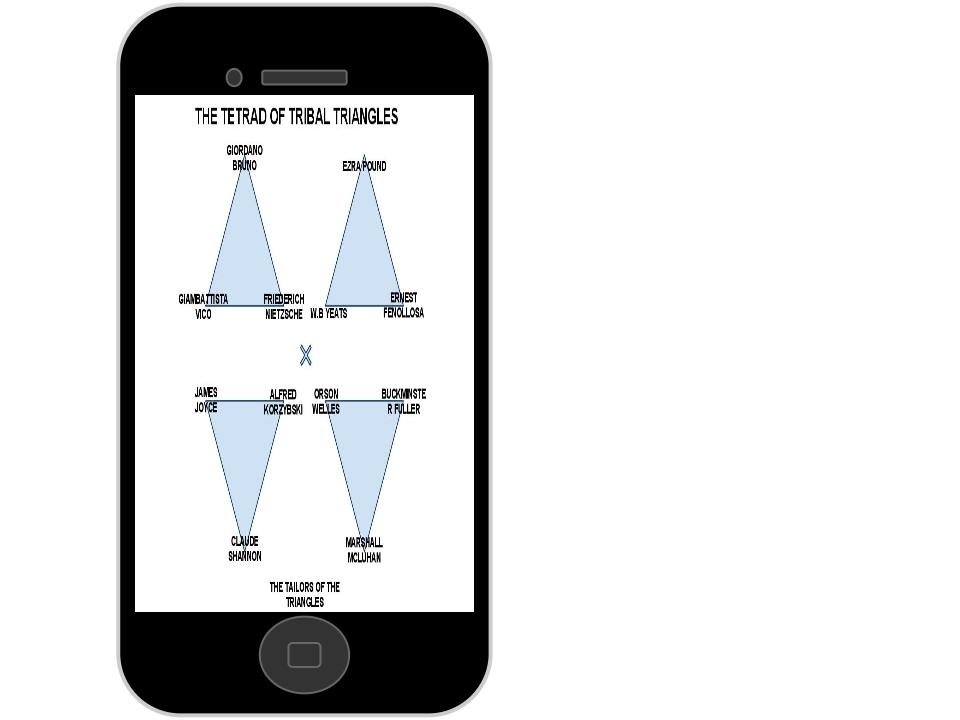
    I see a similar thread of openness and sharability and mash-up-able-ness in the methods and innovations developed by those critters whom Dr. Robert Anton Wilson listed as inspirations and those he recommended attentive study of, in particular the heretics listed in his ‘tale of the tribe’ which consists of approximately Twelve historical geniuses who have had a long lasting positive impact on humanity, and on Bob; and who may still yet emerge like Dracula from the grave to reposes culture in 2012? At least I get excited the more I look into these characters and into Bob’s writings upon them and why I think they are important for all around the world humanity in 2012.

    If this be a conspiracy theory so mote it be. Just consider the efforts to supress and keep out of print so many of the texts and source works cited before the age of bit torrent and pirate bay. The burning of Joyce’s books, and burning of Giordano’s body, the imprisonment of Ezra Pound, the ‘top secret privacy’ assigned to some of Shannon and Weiner’s early papers, the general harassment of Giambattista Vico, Freiderich Nietzche, and Orson Welles, and the ‘crazy stick’ poked at Marshal McLuahan, Joyce, Pound and even ‘Wilson’ himself, that damned old crank’ as he often referred to himself in that somewhat Irish humour of self-mockery. Praise Bob!

    So the conspiracy, if there must be ONE in this article takes into account that the most suppressive and violent censors throughout history, generally authoritarian systems of Church and State. (remember that the first paragraph of Joyce’s Ulysses starts with the word ‘Stately’ and ends with ‘crossed’ to symbolize State and Church crossed, as Bob liked to point out to his readers.) What we see in the current 2011, OCCUPY (world around peaceful revolution of economic intelligence and shared wisdom) echoes through Wilson’s works in the form of writings on Benjamin Tucker, Silvio Gessell, Lysander Spooner, Buckminster Fuller, Marx (and the brothers Marx) and Ezra Pound. Therefore the study of ‘the tale of the tribe’ can give great footholds and anchors for the Occupy movement to expand and feed on nutritious like-minded research into the ‘open source consciousness’ all-around-the-world movement.

    Perhaps if the ‘decentralized cosmology’ of Giordano Bruno were applied to the Mayan cosmology and 2012 calendar conundrum we might begin to see that we are each to our own calendar?, above as so below, and that ‘every man and every women is a star. Or, that in a decentralized cosmology with no absolute centre anywhere at all at all, it follows that the self-centred idea of a single paradigm shift on a single day, on a single typical G-star orbiting the sun in a galaxy among hundreds of Billions seems just slightly, to repeat the phrase, self-centred. So maybe the galactic alignment is up to where you place yourself and the geological shifts are within your body, the super cosmic overmind inside your head? Let’s no forget however that alongside his ‘decentralized Universe’ Giordano Bruno accomplished great innovations in Kabbalistic science experiments, magical programing languages and magical devices (memory wheels, alphabet wheels, symbol systems) all of which can greatly improve the art of protest and IMPACT at any Occupy events.

    McLuhan, like Fuller and like Pound might have us question ‘what is money and how is it?’ How did it get that way, and a deeper somewhat metaphysical look into the chain of values that lead to money, the relationship between credit and money etc., and right now…“No people ignorant of the nature of money can now maintain its rights, let alone attaining or holding to sovereignty. We have in our time two parties: the infamous, which tries to sabotage economic knowledge; the intelligent, which demands full light on the issue of coin, paper means of immediate exchange, and of credit. Credit, from this angle, becomes the privilege of delaying compensation.”—Ezra Pound, ARABIA DESERTA, Guide to Kulchur, pg. 271.

    I have found that like Wilson’s writing on so many varied subjects, McLuhan, Fuller and Pound can radically alter your perception of ‘what is money’ by raising varied and good questions seemingly ‘ignored by the mainstream economists and journalists’ up until only quite recently 2009. Wilson would home in on these grey areas of the counter culture, like alternative economics and alternative systems of distribution, chains of value, intelligence and transparency and weave them into both his fiction (maybe the most scientific of science fiction writers) and in particular into his non-fiction. Hunt em’ down and source out the sources, a treasure trove of workable methods and principles, not least, for example in Bucky’s ‘synergetics’ ‘dymaxion geometry’ and ‘Tesegrity geometry’ lie scattered among Lovecraft’s letters, Einstein’s dreams and Goofy’s nighmares to interpret how you will. READ HIM!

    “It is action at a distance, both in space and in time. In a highly literate fragmented society, “Time is money,” and money is the store of other people’s time and effort.”—Marshal McLuhan, Money: The poor man’s credit card, Understanding Media, pg. 147.

    To return to Mark Pesce and hypereconomics, we can now see the real impact of technology on peoples in real time, making Bucky’s ephemeralization and McLuhan’s Global Village apparent facts of the process of living on earth in 2011.

    Now we have the social networks to use as a parallel to the Global Village imagined out of thin air by McLuhan 50 years or so ago, and we have nano-technology and invisible light-speed information networks crossing the entire planet, imagined by Bucky to bring about an individual revolution of intelligence, as in the open source movement, sharing the tools and methods to then use them to build more tools and more sharable methods (maps, instructions, languages, blueprints).

    McLuahn and Bucky were right on many observations and predictions about the future of technology and how we be living today socially, psychologically, technologically, but Mark Pesce presents detailed new books and fresh video lectures taking these ideas, by way of working examples from the real world, into 2012 and beyond, combining the knowledge and confidence to make it real as Bob made it real in his own literary synthesis, and helped define WHY we should also go back and read the sources and roots of these innovations in sharing and ‘open source consciousness’.

    Bob specialized in this field and has a lifetime spent digging up and translating for those that follow the obscure bridges and links between multiple revolutionary innovations and their place in popular culture, Bob’s open source interests ranged from traditional computer software, political science and currency’s to open source Theology, Magick and Neuro-linguistic programing and open source psychology, and dipping beyond into open source nanotechnology and open source genetic engineering I imagine. Perhaps even contemplating open source atomic reactors for kicks?

    “Of course, my position is based on the denial that money does store wealth. I think it’s a semantic hallucination, the verbal equivalent of an optical illusion, to speak at all of money containing or storing wealth. Such thinking should have gone out with phlogiston theory. The symbol is not the referent; the map is not the territory. Money symbolizes wealth, as words symbolize things, and that’s all. The delusions that money contains wealth is the mechanism by which the credit monopoly hof study. as gained a stranglehold on the entire economy. As Colonel Greene pointed out in Mutual Banking, all the money could disappear tomorrow morning and the wealth of the planet would remain the same. However, if the wealth disappeared — if squinks from the Pink Dimension dragged it off to null-space or something — the money would be worth nothing. –Robert Anton Wilson, Illuminating Discord Interview, 1976. 

    And remember that if your research into the tale of the tribe starts to get a little stale and you feel lost in Korzybski’s giant tome or Joyce’s Wake, or staring at Shannon’s equations in a daze don’t be afraid to grab some stickers, a pen or some paint and go out into the wilderness and connect with your environment in a way that cannot be mistaken as vandalism but viewed as Art, funny, subtle, well placed and meaningful, and from the right place. Start a study group to begin looking into some of these characters and how they resonate with our current affairs on planet earth, make music, write, exorcise, smile, hug, love and live fully awake in 2011 and 2012. Get yourself connected. The writings on the wall, gotta’ get yourself connected, stumble you might fall.”

    –Steven ‘Fly Agaric 23’ Pratt.

  • ‘Marshall McLuhan strikes back’ and ‘the medium is the message’


    More Than Ever, the Medium Is the Message: How You Can Celebrate Marshall McLuhan’s 100th 

    “This is the 100th anniversary of McLuhan’s birth, and there’s been a year-long global celebration of the man — and his messages. All of this merry-making culminates in a conference and concert in Toronto November 7 – 10th.”

    http://www.huffingtonpost.com/julia-moulden/marshall-mcluhan_b_1065015.html

    Marshall McLuhan strikes back

    Published On Thu Oct 20 2011
    Philip Marchand, author of Marshall McLuhan: the medium and the messenger

    Image

    By Greg Quill Entertainment Reporter
    ENTERTAINMENT COLUMNIST
     

    Of the myriad arcane factoids, theories, impressions and interpretations likely to be disclosed during the course of the International Festival of Authors’ three major McLuhan 100 readings and dissertations over the next week, one is of exceptional interest: the Toronto-based communications guru, who was able to see a bigger picture than other contemporaries in his field, had a physiological advantage over most other mammals — a unique vascular pattern in his left cerebral cortex seen only in cats.

    “Actually, he used to say it was unique to tigers,” says McLuhan biographer and former Star books columnist, Philip Marchand, whose Marshall McLuhan: the medium and the messenger (1998), is considered one of the most compelling portraits of the complex and often incomprehensible academic and theorist, who is said to have pre-imagined the Internet, and laid out such forward thinking notions as “the medium is the message” and “the global village.”
    “It was the result of brain surgery in 1967 to remove a benign tumor,” says Marchand, who began his biography after being appointed to the task of cataloguing McLuhan’s papers for the national archive. McLuhan died in 1980 from the effects of a stroke.

    “He feared a blockage of blood vessels would necessitate another operation, but rather miraculously, new vascular systems developed that were apparently uncharacteristic in human anatomy.”

    What effect this anomaly had on McLuhan’s legacy is anyone’s guess, though some of his peers subsequently noted that the operation that saved his life cost him his genius, and that his work in later years never matched the promise in The Gutenberg Galaxy: The Making of Typographic Man and Understanding Media: The Extensions of Man, in the early 1960s.

    McLuhan might have fallen out of favour at the time of his death — “he was seen as a bit of a charlatan, because he preferred talking to writing and publishing, and used language and phrases that other academics considered dense and impenetrable,” Marchand says — but he’s back with a vengeance now, as one by one, his media prophesies become not just the new reality of communications-driven world, but a way of life.

    The International Festival of Author’s McLuhan 100 events, which gets underway Friday night at the Fleck Dance Theatre with an appearance by New York University professor and renowned social and technological networks consultant Clay Shirky, aren’t just manifestations of Toronto’s official year-long focus on the centenary of one of the city’s favourite sons, an international star, says festival director Geoffrey Taylor.

    “We were approached a year ago by the city to find a way of including McLuhan in the festival, which is, for the most part, a celebration of the written word and of new works of fiction.
    “But it’s also a festival about ideas and communication, so it was an easy fit, particularly since McLuhan is being embraced by a new generation of writers.”

    On Friday night Shirky will read from his latest book, Cognitive Surplus, and answer questions from Toronto broadcaster and graduate of the U of T’s McLuhan Program, Jesse Hirsh.
    Saturday afternoon, at Studio Theatre, Brooke Gladstone, co-host and managing editor of U.S. National Public Radio’s news magazine On the Media, will present The Influencing Machine, a graphic novel on the complexities of the modern media, with illustrations by Josh Neufeld.

    And Wednesday at Studio Theatre, Canadian novelist, essayist and filmmaker Douglas Coupland discusses his latest book, Marshall McLuhan, part of Penguin Group’s Extraordinary Canadians series.

    The Generation X author will be interviewed by Nora Young, host and creator of CBC Radio’s Spark, which examines technology and culture.

    McLuhan, says Taylor, is better appreciated in other parts of the world than in his homeland, “and generally underrated everywhere.

    “But writers are having to deal with communications in so many different ways now … and McLuhan seems more relevant than ever.”

    In a recent essay in the U.K. Guardian, Coupland, currently on tour in a remote region of China and outside the range of the Internet and email, outlined the origins of his fascination with McLuhan’s work, and the subject of his new book:

    “To be fair, McLuhan was about more than ‘the medium is the message’, but that remains a fabulous reduction. McLuhan was an information canary, warning us that there were new media coming down the line, and it was the effects of these new media on the mind that he wondered about so extravagantly — the message seemed to be very dark, indeed.

    “In his poetic and elliptical ways, McLuhan foresaw a fluid melting world of texting, email, YouTube, Google, smart phones and reality TV,” Coupland writes.

    “Most of the content of any of these media is pure crap. But what’s spooking us all is the inevitable message of these new media: what will be the psychic fallout of these technologies on our inner lives?

    “As with TV in the 1950s, don’t be fooled by the content of texts or blogging or online shopping. Look at what these media are doing to our souls. That’s what McLuhan did.”

    Marchand isn’t so sure either that McLuhan would have liked living in the wired world he foresaw as the inevitable confluence of broadcasting technology and the demands of the age of information.

    “For one thing, he loved books, and worked in a book-lined office. He devoured non-fiction by reading every second page, and never missed a thing. I don’t think he’d have enjoyed reading e-books.

    “He died before personal computers were a reality, but I think he’d have loved the Internet’s immediacy, and would have had no difficulty understanding its surrounding effect, or that it seems more real than the natural world,” Marchand adds.

    “But keyboards and texting, the reliance on literate skills in this new environment — I’m not sure what he’d have made of that.”

    BOOKS BY MARSHALL MCLUHAN:

    The Mechanical Bride: Folklore of Industrial Man 1951
    The Gutenberg Galaxy: The Making of Typographic Man 1962
    Understanding Media: The Extensions of Man 1964
    Verbi-Voco-Visual Explorations 1967
    Medium is the Massage: An Inventory of Effects 1967
    War and Peace in the Global Village with Quentin Fiore 1968
    Through the Vanishing Point: Space in Poetry and in Painting with Harley Parker 1968
    Counterblast with Harley Parker 1969
    From Cliche to Archetype with Wilfred Watson 1970
    Culture is Our Business 1970
    Take Today: The Executive as Drop-out 1972
    City as Classroom: Understanding Language and Media with Kathryn Hutchon and Eric McLuhan 1977
    Posthumous books:
    Laws of Media: The New Science with Eric McLuhan 1988
    The Global Village: Transformations in World Life and Media in the 21st Century with Bruce R. Powers 1989

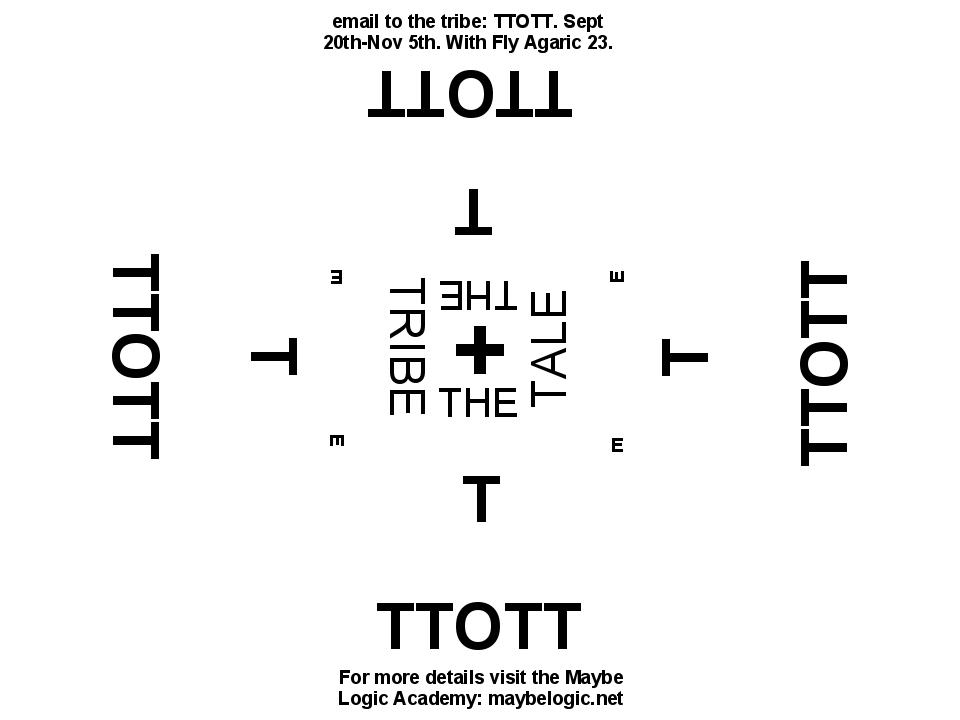
  • email to the tribe: a Maybe Logic Class by Fly Agaric 23

    email to the tribe: a Maybe Logic Class by Fly Agaric 23


    Fly Agaric 23

    September 20 – November 5
    email to the tribe
    Homogrammic Prose


    The tale of the tribe approximates a tale of humanity, or ‘tales’, a new global epic that must capture illuminating details from humanity and juxtapose them in a special way using special language (Hologrammic prose, the Hermetic style, Ideogrammic method, Joyce’s ‘epiphany’ etc.) Dr.Robert Anton Wilson crafted his tale of the tribe to suit, among other definitions; the architects of post-modem’ cyber-culture, reaching back to the renaissance and pulling up-tense to our decentralized–hyper connected–future present. 
     
    During a six week period, I-fly will share his open interpretations of the tale of the tribe, performing an on-line multimedia vortex of signals, dialed into James Joyce, Ezra Pound, Giordano Bruno, Marshall Mcluhan, ‘Bucky’Fuller, and RAW himself.
     
    email to the tribe will reprocess communications from across time, and produce new maps, new metaphors, and mold new memes that help forward the tale of the tribe and the RAW wisdom oozing out from all quarters.
     
    Each week fly will provide a spread of multimedia for you to process, generally keeping in step with the program, encouraging a wide variety of conversation and focused feedback. Feel free to drop in and drop out, as you like.
     
    EMAIL TO THE TRIBE: WEEKLY PRESCRIPTION.
    WEEK ONE – WHEELS AND CYCLES (Sep 20-26)
    The wheels of the tribe go around and around.
    WEEKLY DOSE: Decentralized and Rotational Map Warfare.
     
    WEEK TWO – GENERAL EPIPHANY (Sep 27-3rd October)
    Hologrammic Prose and meaningful common speech
    WEEKLY DOSE: RAW-FLY interviews. (Oct 4-10)
     
    WEEK THREE – IDEOGRAMMIC FULLERENE (Oct 11-17)
    The synergy of history
    WEEKLY DOSE: Vicosahedron and Canto LXVI. Open Source History.
     
    WEEK FOUR – GLOBAL FEEDBACK (Oct 18-24
    If its not connected its useless
    WEEKLY DOSE: Shannanigums Wave & Future Present.
     
    WEEK FIVE – CINEMA OF UNITY (Oct 25-31)
    Moving pictures to TV/Internet
    WEEKLY DOSE: Maybe Logic & RAW Multimedia.
     
    WEEK SIX – THE TALE OF THE CYBERNET (Nov 1-5)
    My-wiki-face-twitter
    WEEKLY DOSE: Work of the tribe. email to the tribe.
     
    COURSE TEXTS: Recorsi by Robert Anton Wilson.
     

    • $Pay-What-You-Can$ – Enroll Now •
    [$50 recommended minimum price] 

    http://www.maybelogic.org/courses.htm 

  • Maybe Logic and the tale of the tribe: a no-place place.

    The following ‘testimonial’ is edited from a post I made at the Maybe Logic Academy some months ago when I was inspired by ‘evolver.net’ calling for members to make testimonials to their social network, I wanted to write a testimonial to the open learning network encircling the ‘Maybe Logic’ meme, and dashed something off that I felt on re-reading required some editing, and clarification. Thanks, steve fly.


    Maybe Logic and the tale of the tribe: a no-place place.

    Fly On The Tale Of The Tribe: A Rollercoaster Ride With Robert Anton Wilson

    by Steven James Pratt

    Link: http://a.co/gOGNKyV

    (more…)