Messin’ with some beats.
x
Author: flyagaric23
-
Bruce Sterling On The Great AI Beast
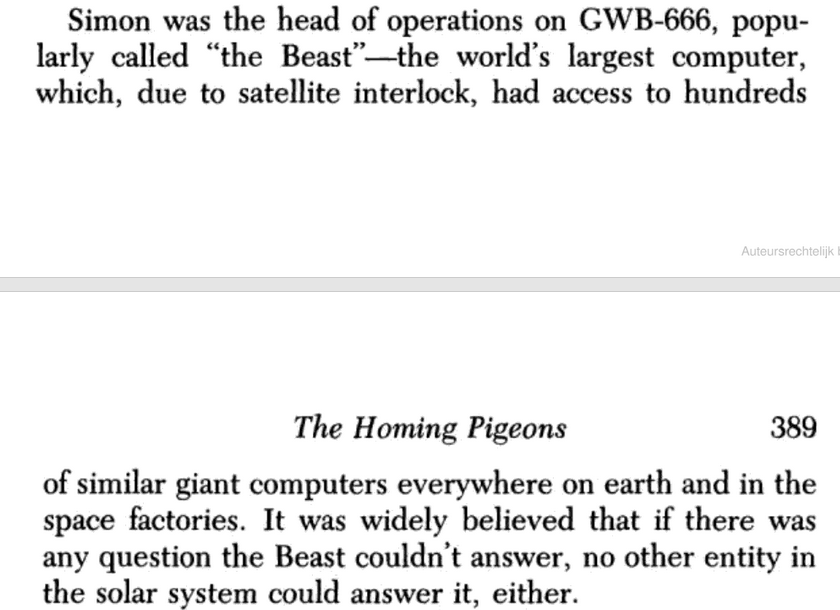
I’ve been a fan of Bruce Sterling since seeing his improvised presentation at the PlanetWorkers Conference, held at the Presidio in San Francisco, 2000. 23 years later his mixture of cookie-cutting-edge prose and technical translation get to the deep monstrous heart of the matter. I’m sure Bruce is aware of the supercomputer called The Great Beast GWB-666 from “Schrodinger’s Cat Trilogy” by Robert Anton Wilson.
But those “parrots” are also AI mythic beasts—parrots with a trillion dimensions. It’s as if that “dead parrot” in the legendary Monty Python sketch could take your job, or burst right out of the BBC-TV screen like a blazing phoenix and eat the television signal. Those parrots are dynamite!
Bruce Sterling, Newsweek, June 2023.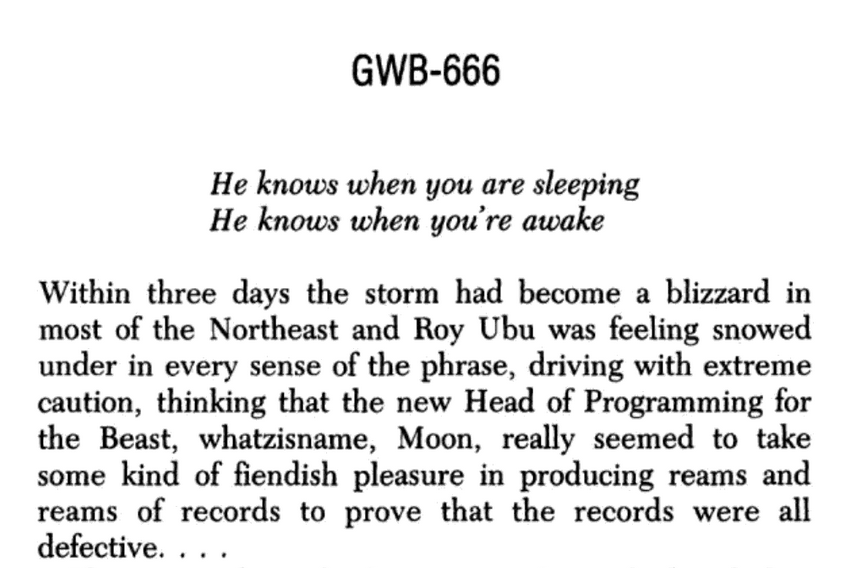
Next among the cavalcade of AI folk monsters: the “Masked Shoggoth.” The Shoggoth is an alien monster invented by the cosmic horror writer H.P. Lovecraft. The Shoggoth is a huge, boneless slave beast that sprouts eyes and tentacles at random. It’s a creepy beast-of-burden from outer space, and it’s forced to labor, but it’s filled with a silent, burning, unnatural resentment for its subjugation.
Bruce Sterling, Newsweek, June 2023.
So, the human programmers of today’s new AIs—those text-to-image generators, those Large Language Model GPT chatbots—they adore this alien monster. They deliberately place a little smiley-face Mask on the horrid Shoggoth, so that the public will not realize that they’re trifling with a formless ooze that’s eldritch, vast and uncontrollable.
-

Further Adventures In Chillout
Further Adventures In Chillout is a selection of relaxing (for the most part) downtempo dub beat experiments in electronica. Ambient and slow, music to lie back and do nothing too. Go on, you deserve it. After 50 minutes the music switches to murky dub-step and breakbeat, so get ready for the harsh change of mood. Please enjoy. Special thanks to all the producers DJ’s and artists keeping things moving in a sweet and gentle direction, steady she go.
https://www.mixcloud.com/flyagaric23/further-adnetures-in-chill-out/
#Chillout -

BUGHOUSE FLY
A mix up and shake down of bughouse, breakbeat, bass music, dub house, and dub step is for the dancefloor of the Insect Hotel, 2023.
-
Spaceship Earth: Buckminster Fuller at MIT
The earliest known use of the term[1] is a passage in Henry George‘s best known work, Progress and Poverty[2] (1879). From book IV, chapter 2:
It is a well-provisioned ship, this on which we sail through space. If the bread and beef above decks seem to grow scarce, we but open a hatch and there is a new supply, of which before we never dreamed. And very great command over the services of others comes to those who as the hatches are opened are permitted to say, “This is mine!”
https://en.wikipedia.org/wiki/Spaceship_EarthFirst, I’d like to explore a few thoughts about the vital data confronting us right now — such as the fact that more than half of humanity as yet exists in miserable poverty, prematurely doomed, unless we alter our comprehensive physical circumstances. It is certainly no solution to evict the poor, replacing their squalid housing with much more expensive buildings which the original tenants can’t afford to reoccupy. Our society adopts many such superficial palliatives.
https://en.wikiquote.org/wiki/Operating_Manual_for_Spaceship_Earth -
Earthday Evening Celebration With John Sinclair
You are invited to this memorable event at the Ralston Building (FB Link) on Sat. April 22, 2023 at 7pm featuring John Sinclair with Harmonica Shah and Howard Glazer and Steve Glazer. The $10 to $20 donation supports the Ralston Village Community Association (RVCA) and the Artists. Light refreshments, 313 Brand Detroit-made Tortilla Chips, BYOB, Ice available, water.
The activities and interests of the RVCA include education, healthy lifestyle, historic preservation, the arts (music, visual, performing arts) community discussion panels, land use planning, and positive economic impact. This event welcomes John Sinclair again to the Ralston, and will help to establish Mr Sinclair as Poet/Artist in Residence in the near future. Your attendance helps to set the stage for this to happen, so thanks for considering attending this event!
Michael Prent, Earth Community Co-Producer
-

It Feels like (AI) summer
You can feel it in the streets
Childish Gambino, (Donald Mckinley Glover) It Feels Like Summer.
On a day like this, the heatSeven billion souls that move around the sun
Childish Gambino, (Donald Mckinley Glover) It Feels Like Summer.
Rolling faster, faster, not a chance to slow down
Slow down
Men who made machines that want what they decide
Parents tryna’ tell the children please slow down
Slow down -
Do you feel absolutely sure “Robert Anton Wilson” wrote this and not some gol-danged bot?
Once again, Wilson reverses and rewires every mental polarity with a illuminated blog post from the date UNIX 1073865600, the good ole’ days.
UNIX Date 1073865600
“Maybe” is a thin reed to hang your life on but it’s all we’ve got.
–Woody AllenThis may not seem startling to gamers, but it sure woke me up; I learned about it on Law and Order last Sunday.
A type of program called a “bot ” can play a computer game “just like a human” and in the style of any chosen human, given enough skill on the part of the bot-maker.
It seems to me this surpasses virtual reality and approaches electronic cloning. After all, the bot can go on playing after the human has “died.”
A bot can also exist which, like an art forgery, seems to have the style and habits of a certain human but actually emerged from the brain of a clever faker.
This seems to me like virtual virtual reality and electronic immortality of a sort. If a bot plays chess like Alekhine, in what sense can we call Alekhine totally “dead”?
More: computer tech in general as brought us to the stage where producing a photo of a crime or even a moving picture of it does not prove a damned thing anymore. “I saw it with my own eyes” has become a bad joke.
I begin to feel that Maybe Logic will soon replace the Aristotelian either/or, not because of my books or Korzybski’s or von Neumann’s. but because virtual reality and artificial intelligence have destroyed certitude and left us with only degrees of probability.
BTW, do you feel absolutely sure “Robert Anton Wilson” wrote this and not some gol-danged bot?
-

Not A Bug But A Feature – R.U Sirius
Music by Steve Fly Agaric 23
Ken Goffman aka R.U. Sirius
Video by SatoriD
Lyrics and Kibitzing by R.U. Sirius
Not A Bug But A Feature
We all have a lot of drugs
It’s not a bug it’s a feature
And me I’m easily buzzed
So I can give you a bunch of my drugs
They tell me hugs not studs
They tell me don’t piss in the strudel
But I don’t care for their advice
I’ve got some drugs to make me nice
We’re having too much fun
And all the guns are loaded
And we were born to be wacked
And we were made to attack
We were born inside out
Like in a Cronenberg movie
We have lots of strange drugs
Therefore the whole thing is groovyTaken from the ALBUM: Infinite Gesture (A Work In Progress)