Tag: TTOTT

  • Chapel perilous review

    Chapel perilous review

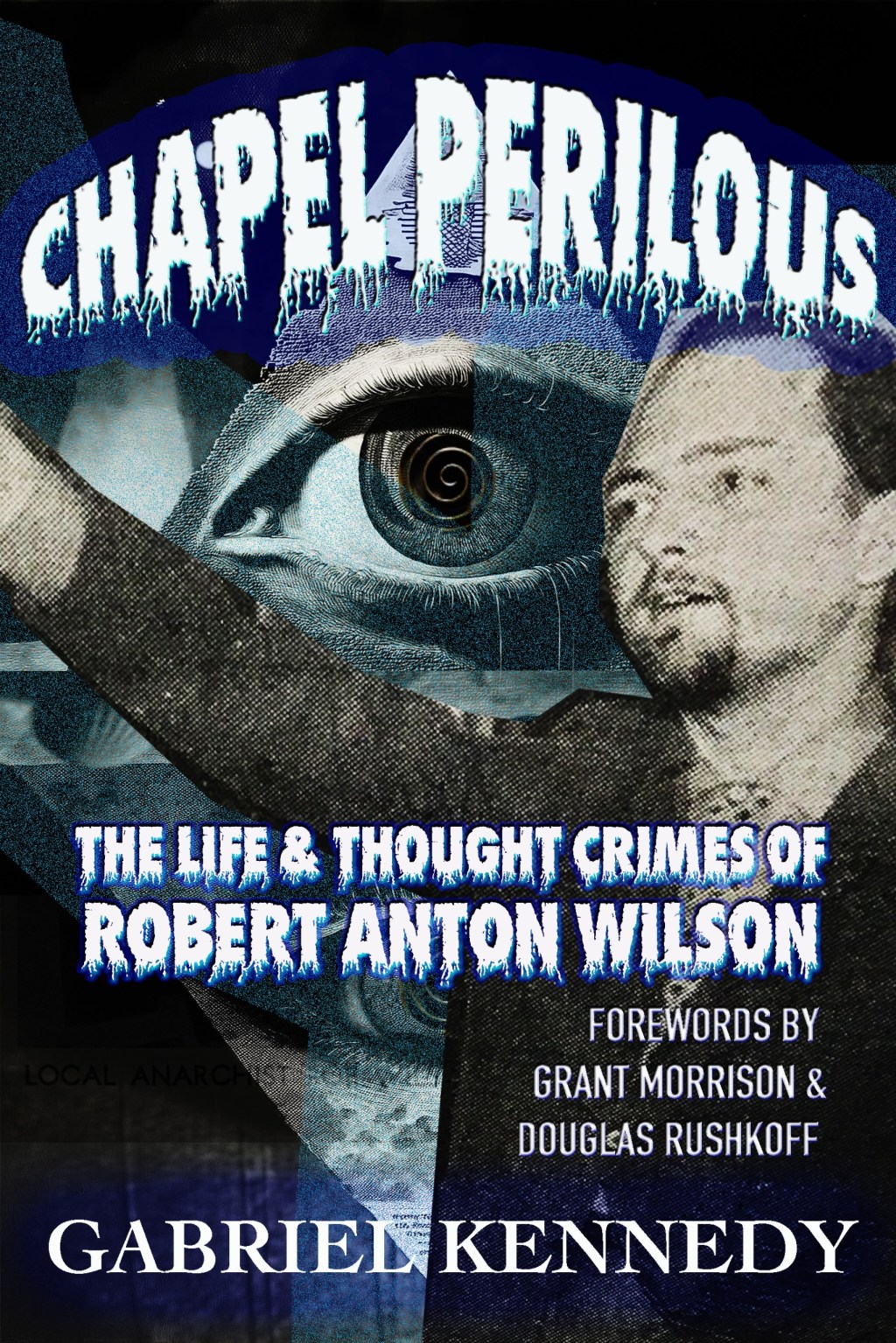
    Chapel Perilous: The Life and Thought Crimes of Robert Anton Wilson

    By Gabriel Kennedy a.k.a Prop Anon.

    Meticulous research, in depth interviews and his own blood sweat and tears make this book burst with primary sourced materials. Prop met and interviewed Wilson, and studied under his wings at the Maybe Logic Academy 2004-2007. Prop has read and processed everything Wilson published, and done a great service to humanity in discovering and compiling many unpublished materials and eclipsed details.

    This human story of integrity and the honest pursuit of the facts, no matter where they lead him is brave and honorable. Remaining forgiving and compassionate, RAW fans already feel this intuitively, now we have words and evidence to bolster those big feels. This book helps encapsulate and buffer that sense that now’s the time, the time to activate and put into practice what RAW communicated. Find and develope your own style. Nurture your own voice. Find the others. All that jazz.

    Both a clear introduction to his work, and a wellspring of fat facts for the RAW heads, this book can change your life, if you want it? 

    The work has helped cement my suspicion that RAW and his works present a road map, or a pathway or network of pathways, for all around the world humanity to thrive, relatively peacefully. A universal, fair and equal and sane vision for planetwide cooperation, physical and mental health and sufficient tolerance, that which is expressed by Charlie Chaplin (Perilous) in his famous speech from The Great Dictator (1940)

    Four quotations from the book, for a lil’ flava’

    “you are hereby invited to join the most powerful, unscrupulous, dangerous, and mind-blowing non-existent secret society in the world, the Bavarian Illuminati (a front for the even more powerful and non-existent, POEE.) –CP, pg. 86.

    Wilson was in D.C. that day with all the other hippies, Yippies, and freaks; walking past a chanting Ed Sanders who was standing on the back of a flatbed truck shouting, “Out demon, out!” towards the Pentagon.–CP, pg. 80.

    In a May Day letter, he told Leary, “I am developing a system of consciousness-expansion based on Lilly, yourself, Masters–Houston, Crowley, Gurdjieff, traditional Wiccadom…In my vain moments I think I have something quicker and easier than either traditional magick or modern psychology.”–CP, pg. 115.

    Cosmic Trigger Vol. 1 can now be named as the first popular non-fiction book to present the experiments that eventually earned John Clauser and Alain Aspect the 2022 Nobel Prize in Physics.118 It was also the first popular book, according to Alan Moore, the British comic book genius and magician, to properly contextualize Thelema in a language that was accessible and fun. As if that wasn’t enough, Wilson’s book was also the first to present his and Leary’s 8-Circuit model of intelligence, and, according to Richard Metzger, the first to popularize the McKenna brothers Terrence and Dennis’s Timewave Zero Theory after their own The Invisible Landscape (1974).–CP, pg. 131.

    I could go on quoting what I consider the evidence for both Wilson’s genius and the importance of this new biography in it’s carefully paced introduction to the facts.

    Self evidently, as the saying goes, if it does not make you laugh its probably not true, or, gods can be recognized by their cheerfulness. Through all the struggle, rejection and physical discomfort, Wilson kept his integrity and generally maintained his hilaritas, his cheerfulness, optimism and kindness (expressed by experiential and experimental understanding) toward all sentient beings. 

    As a super fan of Wilson and his works, I’m naturally biased in my urgent recommendation to read this book, and support the author for his heroic biography. A labour of love. I have followed the long road, and the authors own struggle to get this book completed and published. Writing a book such as this, who’s subject is widly regarded as one of the brightest minds of a generation, requires a laser like focus, and decades deep full immersion in the subjects work. As noted, Wilson gets the biographer he deserves in Prop Anon. Walking the walk and talking the talk, and writing the writ. Get it in your soul.


    Turn all that what might have been, what could have and should have been done, into action, into process. Do it. Make it knew. Walk tall.

    10/10

    https://a.co/d/7R4XByF (Amazon Link) PRE-ORDER.

    https://chapelperilous.us

  • INTRODUCTION THE TALE OF THE TRIBE – Michael André Bernstein

    INTRODUCTION THE TALE OF THE TRIBE – Michael André Bernstein

    In lieu of an abstract, here is a brief excerpt of the content:

    INTRODUCTION THE TALE OF THE TRIBE “I hold that a long poem does not exist. I maintain that the phrase ‘a long poem’ is simply a contradiction in terms. . . . If at any time, any very long poem were popular in reality—which I doubt—it is at least clear that no very long poem will ever be popular again.” —Edgar Allan Poe, “The Poetic Principle”

    1 “A heroic poem, truly such, is undoubtedly the greatest work which the soul of man is capable to perform.” —John Dryden, “Dedication Of The Aeneis”

     
    2 In 1920, Georg Lukacs published a critical study entitled The Theory of the Novel. The subtitle of this work, “A historicophilosophical essay on the forms of great epic literature,” announces Lukacs’ decision to treat the novel as the fundamental form of epic literature in modern writing. Subsequently, he justifies this decision, explaining: The epic and the novel, these two major forms of great epic literature differ from one another not by their author ‘s fundamental intentions but by the given historico -philosophical realities with which the authors were confronted. The novel is the epic of an age in which the extensive totality of life is no longer directly given, in which the immanence of meaning in life has become the problem, yet which still thinks in terms of totality.
     
    3 The conviction that verse could no longer deal adequately with “the extensive totality of life” (while the novel was now 
     
    4 · INTRODUCTION regarded as uniquely suited to attempt such a task) was by no means original with, or restricted to, Lukacs. Rather, he is representative of a widely shared attitude: a narrowing of the sphere regarded as “appropriate” for verse, which any poet seeking to equal the breadth of scope and subject matter of great novelists was compelled to confront. In 1917, when Ezra Pound began to publish his long modern verse epic, The Cantos, he was distinctly nervous about the problematic nature of his undertaking, and in the unrevised version of Canto I, he speculates whether it would not be wiser to “sulk and leave the word to novelists.”
     
    4 As late as 1922, after he had already completely revised the poem’s opening and published the first eight Cantos, Pound’s correspondence reveals a man still anxiously defending the ambitious intentions of his work-in-progress: “Perhaps as the poem goes on I shall be able to make various things clearer. Having the crust to attempt a poem in 100 or 120 cantos long after all mankind has been commanded never again to attempt a poem of any length, I have to stagger as I can.” (L:180) Underlying both Lukacs’ critical pronouncement and Pound’s initial self-doubt is a questioning of the essential nature of poetic discourse, of the formal limits within which the special language of verse must move if it is to remain faithful to its fundamental character as poetry. The question is really one of “decorum” in the full classical sense, an attempt to discover anew which modes of literary presentations are intrinsically most suitable to the different areas of human experience. By the end of the First World War, a verse epic was not so much a form as an oxymoron, an anachronism that seemed to violate what many poets as well as critics had come to regard as the characteristic structure and horizon of poetic discourse. Edgar Allan Poe’s strictures against the long poem in “The Poetic Principle” (1848) exercised a profound influence throughout the nineteenth century, especially upon the decisive figures in the development of modern French verse— Charles Baudelaire, Stephane Mallarme, and Arthur Rimbaud —but, in their own writings, Poe’s argument was taken up as only one aspect of a fundamental upheaval in the connection between language as a literary, poetic artifact and the INTRODUCTION · 
     
    5 world of quotidian reality. At bottom it was the representational nature of artistic language that was challenged, the traditional conception of verse as a mimesis of some external, and consequently independent, event. For Mallarme the poetic text was neither the discoverer nor even the celebrant of previously existent values: it was their sole originator, at once the source and only locus of meaning. The words of a poem, an incantation and hieroglyph, were absolutely divorced from their usage in the mundane world, and art, rather than offering an articulated duplication of reality, was seen as itself conferring the only reality, the only authentic and absolute form of being attainable.
    https://muse.jhu.edu/chapter/1258462
    .
  • Giordano Bruno "On Magic" year-1588- read by Joe Kiernan

    Published on Aug 25, 2014
    This is one of Bruno’s great book’s on magic, dealing with “bonding in general.” Couliano characterizes it as “one of those little-known works whose importance in the history of ideas far outstrips that of more famous ones.” It explains how the masses can be manipulated with psychological and magical bonds, and how one can escape these snares.

  • Email To The Tribe (A Youtube Playlist Refresher)

    Email To The Tribe (A Youtube Playlist Refresher)

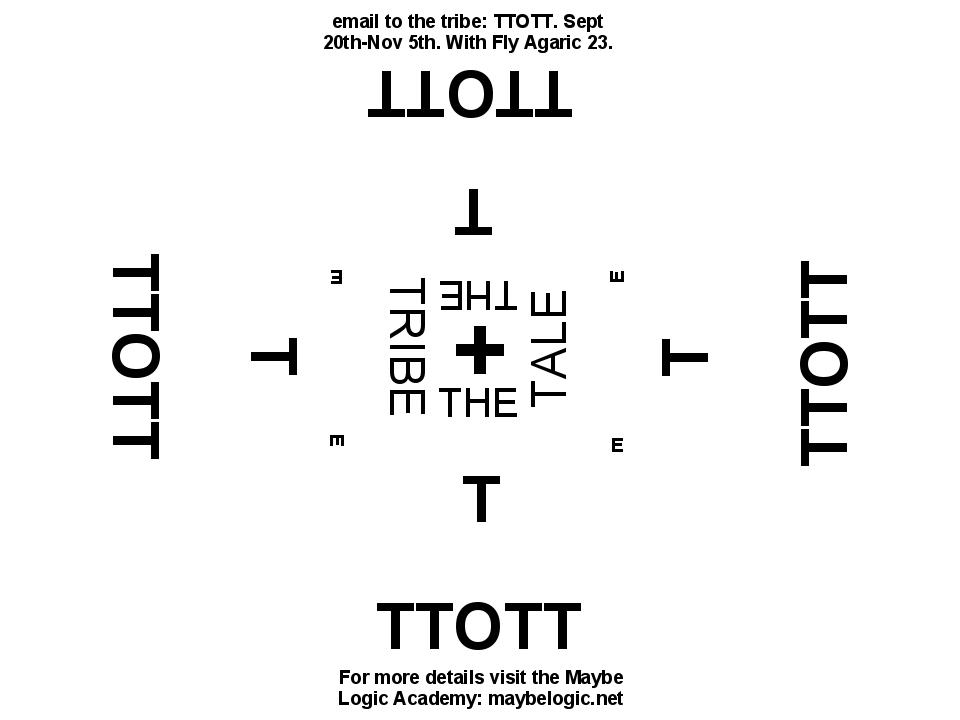
    Email to the tribe is my research class into the tale of the tribe, paying tribute to the last great work of Dr Robert Anton Wilson.…

    –Steve Fly

    Fly On The Tale Of The Tribe: A Rollercoaster Ride With Robert Anton Wilson

    by Steven James Pratt

    Link: http://a.co/gOGNKyV

  • Letter to Harold Innis from McLuhan, 14th March 1951.

    Letter to Harold Innis from McLuhan, 14th March 1951.

    Within the small and obscure field of those who follow the tale of the tribe, as defined by Robert Anton Wilson will probably already be familiar with this letter by Marshall McLuhan, to Harold Innis.

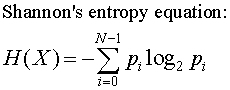
    In the letter McLuhan more or less drafts the trajectory RAW expands upon, with the addition of Giordano Bruno, Alfred Korzybski, Nietzsche, Claude Shannon and Orson Welles, RAW weaves a landscape of, dare i say, cybernetic post modernism?

    Internet…probably the greatest catalyst, tool, for the evolution of language and human-language interfacing. And so, 12/13 historical characters are selected by RAW to approximate the innovations that took place to bring us here, and the human biographical tales crisscrossing with the design science revolutions and new styles. RAWs tale of the tribe.

    Here is that letter that helped start it all, in some sense.

    –steve fly 

    Letter to Harold Adams Innis
    Toronto, 14th March 1951

    Dear Innis,
    Thanks for the lecture re-print. This makes an opportunity for me to mention my interest in the work you are doing in communication study in general. I think there are lines appearing in Empire and Communications, for example, which suggest the possibility of organizing an entire school of studies. Many of the ancient language theories of the Logos type which you cite for their bearings on government and society have recurred and amalgamated themselves today under the auspices of anthropology and social psychology. Working concepts of “collective consciousness” in advertising agencies have in turn given salience and practical effectiveness to these “magical” notions of language.
    But it was most of all the esthetic discoveries of the symbolists since Rimbaud and Mallarmé (developed in English by Joyce, Eliot, Pound, Lewis and Yeats) which have served to recreate in contemporary consciousness an awareness of the potencies of language such as the Western world has not experienced in 1800 years..

    Mallarmé saw the modern press as a magical institution born of technology. The discontinuous juxtaposition of unrelated items made necessary by the influx of news stories from every quarter of the world, created, he saw, a symbolic landscape of great power and importance. (He used the word “symbol” in the strict Greek sense sym-ballein, to pitch together, physically and musically). He saw at once that the modern press was not a rational form but a magical one so far as communication was concerned. Its very technological form was bound to be efficacious far beyond any informative purpose. Politics were becoming musical, jazzy, magical.

    The same symbolist perception applied to cinema showed that the montage of images was basically a return via technology to age-old picture language. S. Eisenstein’s Film Forum and Film Technique explore the relations between modern developments in the arts and Chinese ideogram, pointing to the common basis of ideogram in modern art, science and technology.

    One major discovery of the symbolists which had the greatest importance for subsequent investigation was their notion of the learning process as a labyrinth of the senses and faculties whose retracing provided the key to all arts and sciences (basis of myth of Daedalus, basic for the dreams and schemes of Francis Bacon, and, when transferred by Vico to philology and history of culture, it also forms the basis of modern historiography, archaeology, psychology and artistic procedures alike.)

    Retracing becomes in modern historical scholarship the technique of reconstruction. The technique which Edgar Poe first put to work in his detective stories. In the arts this discovery has had all those astonishing results which have seemed to separate the ordinary public from what it regards as esoteric magic. From the point of view of the artist however the business of art is no longer the communication of thoughts or feelings which are to be conceptually ordered, but a direct participation in an experience. The whole tendency of modern communication whether in the press, in advertizing, or in the high arts is toward participation in a process, rather than apprehension of concepts. And this major revolution, intimately linked to technology, is one whose consequences have not begun to be studied although they have begun to be felt.

    One immediate consequence, it seems to me, has been the decline of literature. The hyper-trophy of letter-press, at once the cause and effect of universal literacy, has produced a spectacular decline of attention to the printed or written word. As you have shown in Empire and Communications, ages of literature have been few and brief in human history. The present literary epoch has been of exceptional duration — 400 years. There are many symptoms that it is at an end. The comic book for example has been seen as a degenerate literary form instead of as a nascent pictorial and dramatic form which has sprung from the new stress on visual-auditory communication in the magazines, the radio and television. The young today cannot follow narrative but they are alert to drama. They cannot bear description but they love landscape and action.

    If literature is to survive as a scholastic discipline except for a very few people, it must be by a transfer of its techniques of perception and judgement to these new media. The new media, which are already much more constitutive educationally than those of the class-room, must be inspected and discussed in the class-room if the class-room is to continue at all except as a place of detention. As a teacher of literature it has long seemed to me that the functions of literature cannot be maintained in present circumstances without radical alteration of the procedures of teaching. Failure in this respect relegated Latin and Greek to the specialist; and English literature has already become a category rather than an interest in school and college.

    As mechanical media have popularized and enforced the presence of the arts on all people it becomes more and more necessary to make studies of the function and effect of communication on society. Present ideas of such effects are almost entirely in terms of mounting or sagging sales curves resulting from special campaigns of commercial education. Neither the agencies nor the consumers know anything about the social or cutural effects of this education.

    Deutsch’s interesting pamphlet on communication is thoroughly divorced from any sense of the social functions performed by communication. He is typical of a school likewise in his failure to study the matter in the particular. He is the technician interested in power but uncritical and unconcerned with social effect. The diagnosis of his type is best found, so far as I know, in Wyndham Lewis’s The Art of Being Ruled. That pamphlet is probably the most radical political document since Machiavelli’s Prince. But whereas Machiavelli was concerned with the use of society as raw material for the arts of power, Lewis reverses the perspective and tries to discern the human shape once more in a vast technological landscape which has been ordered on Machiavellian lines.

    The fallacy in the Deutsch-Wiener approach is its failure to understand the techniques and functions of the traditional arts as the essential type of all human communication. It is instead a dialectical approach born of technology and quite unable of itself to see beyond or around technology. The Medieval schoolmen ultimately ended up on the same dialectical reef.

    As Easterbrook may have told you I have been considering an experiment in communication which is to follow the lines of this letter in suggesting means of linking a variety of specialized fields by what may be called a method of esthetic analysis of their common features. This method has been used by my friend Siegfried Giedion in Space, Time and Architecture and in Mechanization Takes Command. What I have been considering is a single mimeographed sheet to be sent out weekly or fortnightly to a few dozen people in different fields, at first illustrating the underlying unities of form which exist where diversity is all that meets the eye. Then it is hoped there will be a feedback of related perception from various readers which will establish a continuous flow.

    It seems obvious to me that Bloor St. is the one point in this University where one might establish a focus of the arts and sciences. And the organizing concept would naturally be “Communication Theory and practice.” A simultaneous focus of current and historic forms. Relevance to be given to selection of areas of study by dominant artistic and scientific modes of the particular period. Arts here used as providing criteria, techniques of observation, and bodies of recorded, achieved, experience. Points of departure but also return.

    For example the actual techniques of common study today seem to me to be of genuine relevance to anybody who wishes to grasp the best in current poetry and music. And vice versa. There is a real, living unity in our time, as in any other, but it lies submerged under a superficial hubbub of sensation. Using Frequency Modulation techniques one can slice accurately through such interference, whereas Amplitude Modulation leaves you bouncing on all the currents.

    Marshall McLuhan

    from Marshall McLuhan — Complete Correspondence,
    edited by Matie Molinaro & Corinne McLuhan
  • RAW HYPERSHARING LANGUAGE VS. THE EQUATION

    RAW HYPERSHARING LANGUAGE VS. THE EQUATION


    RAW Sharing:

    Fly On The Tale Of The Tribe: A Rollercoaster Ride With Robert Anton Wilson

    by Steven James Pratt

    Link: http://a.co/gOGNKyV

    (more…)